华泰证券

Search documents
华泰证券研究张继强:明年大量中长期存款再配置或利好股市
Xin Lang Cai Jing· 2025-11-07 02:45
Core Insights - The stock market this year has been primarily driven by sentiment, capital, and valuation, with a shift in market perception and narrative influencing trends. There is an expectation for a transition to performance verification in the coming year [1] - The bond market has experienced a correction from excessive gains at the beginning of the year, and it is anticipated to return to a fundamental logic next year, focusing on nominal GDP, financing demand, and the stock-bond valuation ratio [1] - A significant point to note is that next year will see a large amount of medium- to long-term deposits maturing, which may lead to a reallocation of funds that could benefit the stock market [1] Market Trends - Short-term predictions suggest that the stock market may undergo a period of consolidation, while the bond market has a slightly higher probability of success but with average returns. However, in the first quarter of next year, the likelihood of stocks outperforming bonds remains high [1] - The bond market faces primary pressures from improved fundamental expectations, adjustments in institutional behavior, and the stock-bond valuation ratio. Despite this, the supportive stance of monetary policy and the need for recovery in financing demand limit the potential for interest rate increases, leading to an overall slightly weaker and more volatile market outlook [1]
华泰证券何康:岁末年初注意平衡价值与成长
Xin Lang Cai Jing· 2025-11-07 02:45
Core Viewpoint - The new economy represented by AI is supported by performance growth, interest rate cuts, and domestic and international industrial trends, but the technology sector appears crowded with high valuation premiums, leading to a more favorable outlook for the "old economy" sector going forward [1] Group 1: Reasons for Favoring Old Economy - There is a positive correlation between new and old economies; strong performance in the new economy typically boosts growth in the old economy [1] - The old economy sector currently has low valuations, low chip holdings, and low market expectations [1] - The bottom of the cycle has accumulated strong recovery potential [1] - From a funding perspective, new incremental funds such as insurance and foreign capital are expected to favor value styles next year [1] Group 2: Investment Strategy Recommendations - Investors are advised to balance value and growth in their allocations, utilizing methods such as dollar-cost averaging and phased entry [1] - Historically, funding allocations tend to focus on risk aversion towards the end of the year, with value styles being relatively dominant, making the period from year-end to the first quarter of the following year a favorable window for positioning [1]
华泰证券梁红:“老经济”优质龙头关注度有望提升
Zheng Quan Shi Bao Wang· 2025-11-07 02:33
Core Viewpoint - The "14th Five-Year Plan" emphasizes a shift towards a consumption-driven growth model, increasing the proportion of resident consumption in GDP, moving away from reliance on exports and investments [1] Group 1: Economic Outlook - The expectation for the next year is that the revaluation of Chinese assets will deepen, with equity investors shifting focus from the previous two years' strategies of "left-hand dividends, right-hand technology" to sectors more closely tied to economic fundamentals [1] Group 2: Sector Focus - There will be increased attention on cyclical sectors such as energy, consumption, and real estate, particularly on high-quality leading companies within these "old economy" sectors [1]
券商私募资管产品规模已达5.8万亿元
Zheng Quan Ri Bao· 2025-11-06 15:54
Core Viewpoint - The overall scale of private asset management by securities firms in China has shown a stable recovery trend in 2023, reaching a record high of 5.8 trillion yuan by the end of August, marking a 6.03% increase from the end of last year [1] Group 1: Asset Management Scale - As of the end of August, the scale of actively managed collective asset management plans reached 3.28 trillion yuan, a growth of 13.16% compared to the end of last year [1] - The scale of single asset management plans was 2.52 trillion yuan, reflecting a decrease of 2% from the end of last year [1] - The proportion of collective asset management plans in the total scale of private asset management increased from 52.97% at the end of last year to 56.53% by the end of August, indicating a shift towards active management [1] Group 2: Product Structure - Fixed income products dominate the private asset management offerings, with a scale of 4.78 trillion yuan, accounting for 82.41% of the total, and showing a steady increase of 5.6% from the end of last year [1] - Equity products and futures/derivatives products had scales of 370.81 billion yuan and 34.601 billion yuan, respectively, with equity products declining by 14.62% and futures/derivatives products increasing by 4.41% [1] Group 3: Mixed Products Growth - The scale of mixed products has significantly increased, reaching 613.813 billion yuan by the end of August, a growth of 29.08% from the end of last year [2] - The number of mixed products approved for registration from June to August showed a strong upward trend, with the proportion of mixed products in total approvals rising from 51.56% in June to 56.94% in August [2] - Mixed products are favored by investors due to their broad investment scope and ability to balance risk and return effectively [2] Group 4: Revenue Trends - In the first three quarters, 42 A-share listed securities firms achieved a total net income of 33.251 billion yuan from asset management fees, reflecting a year-on-year growth of 2.43% [2] - The net income from asset management fees for six firms exceeded 1 billion yuan, with CITIC Securities leading at 8.703 billion yuan [3] - Only 14 out of the 42 listed firms saw a year-on-year increase in asset management fee income, while 14 firms experienced a decline exceeding 20% [3]
华泰证券:坚定看好中国资产重估 明确看好“老经济”!
Zhong Guo Ji Jin Bao· 2025-11-06 13:43
Group 1 - The 2026 Investment Summit hosted by Huatai Securities focused on macroeconomic trends and market opportunities in the context of China's 14th Five-Year Plan and the upcoming 15th Five-Year Plan [1][3] - The summit highlighted a shift towards a consumption-driven growth model, emphasizing the importance of improving the proportion of household consumption in GDP [3] - Huatai Securities predicts a deepening revaluation of Chinese assets, with a focus on cyclical sectors such as energy, consumption, and real estate, particularly favoring high-quality leaders in the "old economy" [3][4] Group 2 - Huatai Securities' Chief Macro Economist provided forecasts indicating that China's nominal GDP growth in USD terms could rebound to 8.6% in 2026, marking the first visible acceleration since 2021 [4] - The expected appreciation of the RMB is projected to reach an exchange rate of 6.82 against the USD by the end of 2026 [4] - The stock market is anticipated to shift from being driven by sentiment and valuation to a focus on earnings verification in 2026 [5] Group 3 - The bond market is expected to return to a fundamental logic, with key factors such as nominal GDP, financing demand, and stock-bond valuation ratios becoming critical [5] - The overall market may experience a slightly weaker and more volatile pattern due to limited upward pressure on interest rates, despite supportive monetary policy [6] - A diversified asset allocation strategy is recommended, utilizing a "all-weather" approach to mitigate risks and achieve stable long-term returns [6] Group 4 - The "old economy" is viewed positively due to its low valuations, low market expectations, and strong recovery potential from cyclical lows [8] - Investment strategies should balance value and growth, with a recommendation for dollar-cost averaging and phased entry into positions, particularly during the end of the year and early next year [8] - The market is expected to gradually rebalance from growth to cyclical and value styles, with an emphasis on low-valuation, high-capitalization companies with strong profitability [9]


投顾晨报:新高在望,仍是震荡-20251106
Orient Securities· 2025-11-06 13:41
Market Strategy - The market is expected to reach new highs but will remain volatile due to a lack of strong catalysts in November, which is characterized as a policy and earnings window period [3][9] - The "dumbbell strategy" is recommended for operations, focusing on low-value sectors for medium-term recovery opportunities while short-term investments should target technology growth sectors [9] Sector Strategy - The brokerage sector has ample room for business expansion, particularly in margin financing, with opportunities for valuation recovery as leading brokerages increase their margin financing limits [5][9] - The average margin financing ratio for the top five brokerages is currently at 1.35 times net capital, indicating significant growth potential as the regulatory cap is four times net capital [9] Thematic Strategy - The traditional Chinese medicine sector is at a historic opportunity window, with the recent World Traditional Chinese Medicine Conference highlighting its global development potential [6][9] - The sector's high dividend yield and strong cash flow position it as a defensive investment in a complex macroeconomic environment, contrasting with low institutional allocation [9]
重磅发声!坚定看好中国资产重估,明确看好“老经济”!
中国基金报· 2025-11-06 13:01
Core Viewpoint - The 2026 Investment Summit hosted by Huatai Securities focuses on the macroeconomic landscape and market opportunities in the context of China's 14th and 15th Five-Year Plans, emphasizing a shift towards a consumption-driven growth model [2][5]. Group 1: Economic Outlook - The economic growth rate for China is expected to rebound to 8.6% in 2026, marking the first visible acceleration since 2021, driven by improved corporate profitability and a stable export outlook [7]. - The fiscal policy is anticipated to maintain a moderately expansionary stance, supporting the end of the deleveraging cycle [7]. - The real estate sector's deleveraging impact on credit cycles and corporate cash flows is expected to diminish [7]. Group 2: Market Trends - The focus for equity investors is shifting from technology and dividends to cyclical sectors such as energy, consumption, and real estate, particularly high-quality leaders in the "old economy" [6][11]. - The stock market is predicted to transition towards performance verification in 2026, moving away from sentiment-driven dynamics [9]. Group 3: Investment Strategies - Huatai Securities emphasizes the importance of balancing value and growth in investment strategies, particularly favoring the "old economy" due to its low valuations and market expectations [12]. - Investors are advised to adopt a dollar-cost averaging approach, particularly in the latter part of the year, as historical trends suggest a preference for value styles during this period [12]. - The recommendation includes focusing on "true value" sectors, particularly those with low valuations and strong profitability, primarily in domestic and Hong Kong financial and consumer sectors [13].

投行业务回暖下,头部券商IPO“存货”更多
Di Yi Cai Jing· 2025-11-06 12:21
Group 1 - The core viewpoint of the articles highlights a significant recovery in the IPO and M&A markets, leading to increased performance in investment banking for securities firms in 2023 [1][2] - In the first three quarters of 2023, 44 comparable listed securities firms achieved a total net income of 25.294 billion yuan from investment banking, representing a year-on-year growth of 22.94% [2][4] - The number of IPO applications received this year reached 197, significantly surpassing last year's total of 77, with over 60% of these applications intended for the Beijing Stock Exchange [1][5] Group 2 - Six leading securities firms reported net income from investment banking exceeding 1 billion yuan, with CITIC Securities leading at 3.689 billion yuan [3] - The number of IPOs underwritten by these top firms is substantial, with CITIC Securities independently sponsoring the most IPOs at 10, followed by Guotai Junan and Huatai United Securities with 8 each [3][6] - The overall performance of investment banking varies among smaller firms, with some experiencing significant growth while others face substantial declines in income [4][6] Group 3 - The majority of the 274 IPO projects currently under review are concentrated among a few major securities firms, with CITIC Securities having the highest number of projects at 24 [6][7] - The distribution of IPO applications shows that the Beijing Stock Exchange is a major contributor, with 170 out of 274 applications aimed at this exchange [6] - The trend of companies withdrawing or having their IPO applications terminated has decreased compared to previous years, indicating a more stable IPO environment [5][6]


利好突袭!黄金股,集体“嗨了”
中国基金报· 2025-11-06 10:16
Market Overview - The Hong Kong stock market experienced a strong rally, with all three major indices rising over 2%, effectively erasing the monthly losses [4][3] - The Hang Seng Technology Index increased by 2.74%, while the Hang Seng Index and the Hang Seng China Enterprises Index rose by 2.12% and 2.1%, respectively [4][5] - The total trading volume in the Hong Kong market reached HKD 234.7 billion, indicating a recovery in bullish sentiment [4] Technology Sector - The semiconductor sector showed robust performance, with Huahong Semiconductor rising over 9% and SMIC increasing by 7.32% [7][8] - Major tech companies like Alibaba, JD.com, and Tencent also saw significant gains, with increases of 4.10%, 3.34%, and 2.38%, respectively [7][8] - Analysts predict a new "super cycle" in the semiconductor industry driven by AI demand and domestic substitution [7] Financial Sector - The financial sector was active, with notable gains in Chinese brokerage stocks; Huatai Securities rose over 5% and GF Securities increased by 4.63% [10][12] - The insurance sector also performed well, with New China Life and China Life both rising nearly 5% [11][13] - China Life reported a substantial net profit increase of 92% year-on-year for Q3 2025, reaching CNY 126 billion [11] Gold Sector - Gold stocks surged as international gold prices rebounded above USD 4000 per ounce, with companies like Zijin Mining and Tongguan Gold rising by 8.67% and 7.14%, respectively [14][15] - The inclusion of Zijin Mining in the MSCI China Index is expected to attract passive fund inflows, providing further support to gold stocks [16] New Listings - Suzhou Wangshan Wangshui Biopharmaceutical Co., Ltd. debuted on the Hong Kong Stock Exchange, closing up 145.73% on its first day of trading [20][21] - The company focuses on developing small molecule drugs in key therapeutic areas, with plans to use the proceeds from its global offering for R&D and operational enhancements [21]

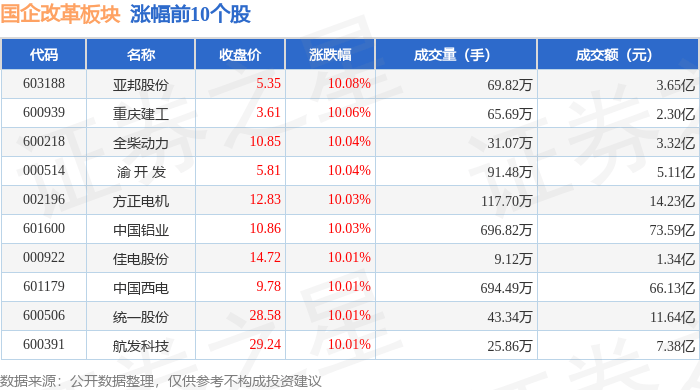
国企改革板块11月6日涨0.82%,亚邦股份领涨,主力资金净流出13.72亿元



Sou Hu Cai Jing· 2025-11-06 09:22
Market Performance - The state-owned enterprise reform sector rose by 0.82% compared to the previous trading day, with Yabong Co., Ltd. leading the gains [1] - The Shanghai Composite Index closed at 4007.76, up 0.97%, while the Shenzhen Component Index closed at 13452.42, up 1.73% [1] Top Gainers - Yabong Co., Ltd. (603188) closed at 5.35, with a gain of 10.08% and a trading volume of 698,200 shares, amounting to a transaction value of 365 million [1] - Other notable gainers include: - Cheqing Construction (600939) at 3.61, up 10.06% [1] - Quanchai Power (600218) at 10.85, up 10.04% [1] - Yudai Development (000514) at 5.81, up 10.04% [1] - Fangzheng Electric (002196) at 12.83, up 10.03% [1] Top Losers - Daya Energy (600403) saw a decline of 10.04%, closing at 8.15 with a trading volume of 1,588,600 shares, resulting in a transaction value of 1.317 billion [2] - Other significant losers include: - Standard Co. (600302) at 66.01, down 9.99% [2] - Guangdong Media (002181) at 11.84, down 9.96% [2] - Jishi Media (601929) at 4.44, down 9.94% [2] Capital Flow - The state-owned enterprise reform sector experienced a net outflow of 1.372 billion from institutional investors, while retail investors saw a net inflow of 4.833 billion [2][3] - The capital flow for key stocks in the sector indicates varying trends, with some stocks experiencing significant net inflows from retail investors despite overall outflows from institutional and speculative funds [3]