海康威视

Search documents
字节跳动发布通用机器人模型GR-3,AI人工智能(512930)回调蓄势
Xin Lang Cai Jing· 2025-07-23 02:46
Group 1: Company Developments - ByteDance's Seed team launched the general-purpose robot model GR-3, which can efficiently fine-tune with minimal human data, allowing for quick and low-cost adaptation to new tasks and object recognition [1] - Shanghai Artificial Intelligence Laboratory introduced the DeepLink technology solution for large-scale cross-domain mixed training, enabling interconnection and mixed training of large models across multiple intelligent computing centers over distances of up to 1500 kilometers [1] Group 2: Industry Performance - The AI theme index (930713) experienced a slight decline of 0.16% as of July 23, 2025, with mixed performance among constituent stocks [2] - The top-performing stocks included Qianqian Yuyou (002555) with a rise of 2.93%, Tongfang Co., Ltd. (600100) up by 2.74%, and Stone Technology (688169) increasing by 2.18% [2] - Conversely, Guangxun Technology (002281) led the decline with a drop of 2.18%, followed by Xinyi Sheng (300502) down 1.64%, and Deepin Technology (300454) down 1.46% [2] - The AI ETF (512930) also saw a decrease of 0.28%, with the latest price at 1.45 yuan [2] - The AI theme index comprises 50 listed companies involved in providing foundational resources, technology, and application support for artificial intelligence [2] Group 3: Index Composition - As of June 30, 2025, the top ten weighted stocks in the AI theme index (930713) accounted for 52.8% of the index, including companies like Zhongji Xuchuang (300308) and Hikvision (002415) [3] - The AI ETF (512930) has several off-market connections, including the Ping An CSI AI Theme ETF Initiated Connection A (023384) and others [3]

又一国家决定反华?美国享受零关税,中国却为何被无故加税
Sou Hu Cai Jing· 2025-07-22 23:18
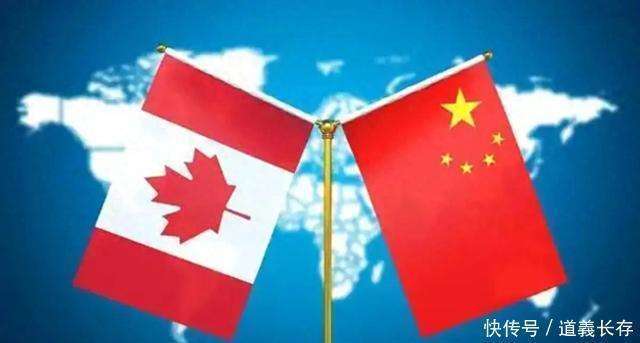
Group 1 - Canada imposed significant tariffs and quotas on Chinese steel imports, including a 25% tariff, a 50% quota reduction, and a 50% penalty tax [1][4][9] - The U.S. steel imports account for 50% of Canada's steel imports and enjoy zero tariffs, while Chinese steel, which only accounts for 10%, is targeted for harsh penalties [11][24] - The Canadian government, facing a trade deficit of CAD 7.1 billion and a 15.7% drop in steel exports, is under pressure to find a scapegoat for its economic troubles [6][4][24] Group 2 - The Canadian government's digital services tax has negatively impacted U.S. tech giants, leading to a backlash from the U.S. and forcing Canada to navigate a delicate trade relationship [4][20] - The steel industry in Canada is struggling, with over 40,000 jobs at risk, prompting the government to shift blame to China rather than addressing U.S. trade policies [7][24] - The Canadian steel producers' association supports the government's actions against China, believing it will help regain market share [9][24] Group 3 - China's response to Canada's tariffs included imposing a 100% tariff on Canadian canola and halting large-scale imports, significantly impacting Canadian farmers [33][31] - Canada is heavily reliant on China for its canola exports, with 70% of its canola being sold to China, making the agricultural sector vulnerable to trade disputes [29][31] - The crisis in the canola industry has led to financial distress for farmers, with unsold products and plummeting prices [35][33] Group 4 - The trade tensions have resulted in a mixed impact on Canadian stock markets, with steel stocks rising while agricultural sectors face declines [54][52] - The Canadian government's approach to trade, particularly its targeting of China, is seen as shortsighted and detrimental to its own economic interests [51][56] - The overall economic landscape in Canada is shifting, with potential long-term consequences for both the steel and agricultural industries due to the ongoing trade disputes [58][56]


A股总市值突破100万亿元—— 资本市场结构向好生态向优
Jing Ji Ri Bao· 2025-07-22 22:04
Group 1: Market Overview - The total market capitalization of A-shares reached 105.5 trillion yuan as of July 18, reflecting market expansion and high-quality development of the capital market, driven by macroeconomic recovery and effective policies [1] - The increase in market capitalization indicates global confidence in the Chinese market, with structural optimization and enhanced corporate value [1] Group 2: Company Quality and Performance - The overall quality of listed companies has improved, supporting the A-share market's growth, with technology companies now making up 27% of those with market caps over 100 billion yuan, up from 12% a decade ago [2] - In 2024, A-share companies are expected to invest 1.88 trillion yuan in R&D, accounting for over half of the national R&D expenditure, with a significant number of companies becoming industry leaders [2][3] - Nearly 60% of listed companies are projected to achieve revenue growth in 2024, with many companies reporting positive earnings forecasts for the first half of 2025 [3] Group 3: Investment Returns and Shareholder Engagement - A-share companies are increasingly focusing on shareholder returns, with 3,751 companies announcing cash dividend plans totaling nearly 2.4 trillion yuan, a record high [4] - The average dividend payout ratio is 37.78%, with 1,277 companies exceeding a 50% payout ratio, indicating a trend towards more frequent and substantial dividends [4][5] - Over 1,000 companies have conducted share buybacks this year, with total buyback amounts nearing 80 billion yuan, reflecting a strong commitment to enhancing shareholder value [5][6] Group 4: Policy Support and Market Stability - The Chinese government has emphasized the importance of stabilizing the stock market, implementing a series of policies to support market stability and attract long-term capital [7] - As of May, long-term funds, including social security and insurance, have net bought over 200 billion yuan in A-shares, contributing to a positive market cycle [7] - Regulatory measures have been strengthened to ensure a safe and compliant investment environment, further boosting investor confidence [7][8]
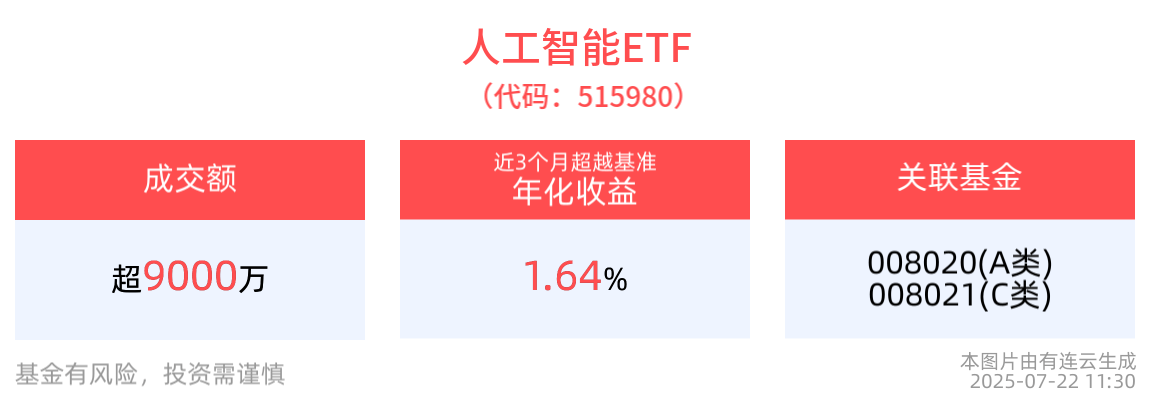
算力需求持续火热,人工智能ETF(515980)交投活跃,近1周累计上涨7.50%
Sou Hu Cai Jing· 2025-07-22 07:46
Core Viewpoint - The artificial intelligence (AI) sector is experiencing fluctuations in stock performance, with the China Securities Artificial Intelligence Industry Index showing a slight decline, while the AI ETF has demonstrated significant growth over the past week and year [1][3]. Group 1: Market Performance - As of July 22, 2025, the China Securities Artificial Intelligence Industry Index (931071) decreased by 0.82%, with mixed performance among constituent stocks [1]. - The AI ETF (515980) was priced at 1.11 yuan, reflecting a 7.50% increase over the past week as of July 21, 2025 [1][3]. - The AI ETF recorded a turnover rate of 5.45% and a total trading volume of 173 million yuan on the same day [3]. Group 2: Fund Performance Metrics - The AI ETF's latest scale reached 3.183 billion yuan, with a financing buy-in amount of 12.3129 million yuan and a financing balance of 89.6029 million yuan [3]. - Over the past year, the AI ETF's net value increased by 44.82%, ranking 425 out of 2929 index stock funds, placing it in the top 14.51% [3]. - The AI ETF achieved a maximum monthly return of 30.38% since its inception, with an average monthly return of 6.80% during rising months [3]. Group 3: Index Composition - The China Securities Artificial Intelligence Industry Index is constructed from 50 representative listed companies based on their AI business proportion, growth level, and market capitalization [4]. - As of June 30, 2025, the top ten weighted stocks in the index accounted for 52.07% of the total index weight, including companies like Zhongji Xuchuang and Keda Xunfei [4][6]. Group 4: Industry Insights - The demand for computing power in AI applications is increasing, with the return of H20 providing more options for AI application companies and alleviating the shortage of high-end chips [7]. - This shift is expected to encourage domestic manufacturers to accelerate product iterations and support the trend of domestic substitution in the industry [7].
问策|深圳如何持续擦亮“民营经济第一城”招牌?
Sou Hu Cai Jing· 2025-07-22 05:26
Core Viewpoint - The private economy in Shenzhen is a vital force in advancing China's modernization and has become a significant symbol of the city's economic development, contributing substantially to various economic metrics [3][7]. Economic Contribution - As of 2024, Shenzhen has a total of 4.404 million operating entities, with a growth rate of 4.2%, and over 2.6 million private enterprises, making it the leading city in private economic contributions [7]. - The private economy exhibits a "456799" phenomenon, contributing approximately 40% of fixed asset investment, over 50% of tax revenue, nearly 60% of added value, over 70% of import and export volume, and over 90% of employment and business entities [7]. Innovation and R&D - Innovation is the core strength of Shenzhen's private economy, with total R&D investment reaching 223.661 billion yuan in 2024, accounting for 6.46% of GDP, and 93.3% of this investment coming from enterprises [8]. - Shenzhen boasts over 25,000 national high-tech enterprises and 10,800 specialized and innovative enterprises, forming a vibrant innovation ecosystem alongside major companies like Ping An and Huawei [8]. Industrial Strength - Shenzhen's private enterprises dominate 37 out of 41 industrial categories, with over 14,000 large-scale industrial companies, maintaining its status as the "Industrial First City" in China for two consecutive years [9]. - The city has transformed from a follower to a leader in various niche markets, achieving significant growth in the electronic information industry and establishing a "one-hour industrial circle" in the Greater Bay Area for efficient supply chain management [9]. Business Longevity and Growth - The average lifespan of a private enterprise in Shenzhen is approximately 6 years, significantly higher than the national average of 3.7 years, with 17% of enterprises surviving over 10 years [11]. - The time taken for a private enterprise to grow into a listed company on the Sci-Tech Innovation Board is an average of 13.35 years, which is 1.05 years faster than the national average [11]. Challenges and Solutions - Despite the robust growth, Shenzhen's private economy faces challenges such as financing difficulties for small and medium-sized enterprises (SMEs), high operational costs, and talent competition due to high living costs [12][17]. - The government is actively optimizing the business environment, reducing burdens on enterprises by over 150 billion yuan in 2024, and implementing various reforms to enhance market conditions [15][16]. Policy Innovations - The introduction of the "Private Economy Promotion Law" aims to provide comprehensive legal support for private enterprises, addressing market access barriers and improving regulatory frameworks [16]. - Shenzhen is enhancing its financial services by optimizing bank assessment mechanisms and promoting innovative financing products to support SMEs [16][22]. Talent and Resource Management - The city is focusing on improving land allocation, talent policies, and easing residency restrictions to foster a competitive environment and facilitate talent mobility within the Greater Bay Area [17]. - Learning from other cities like Hangzhou, Shenzhen aims to enhance collaboration between large enterprises and SMEs, providing resources and support for startups [18][19].

不让中企活?对美妥协后,加拿大全面反华,25%关税制裁已就位!
Sou Hu Cai Jing· 2025-07-22 04:51
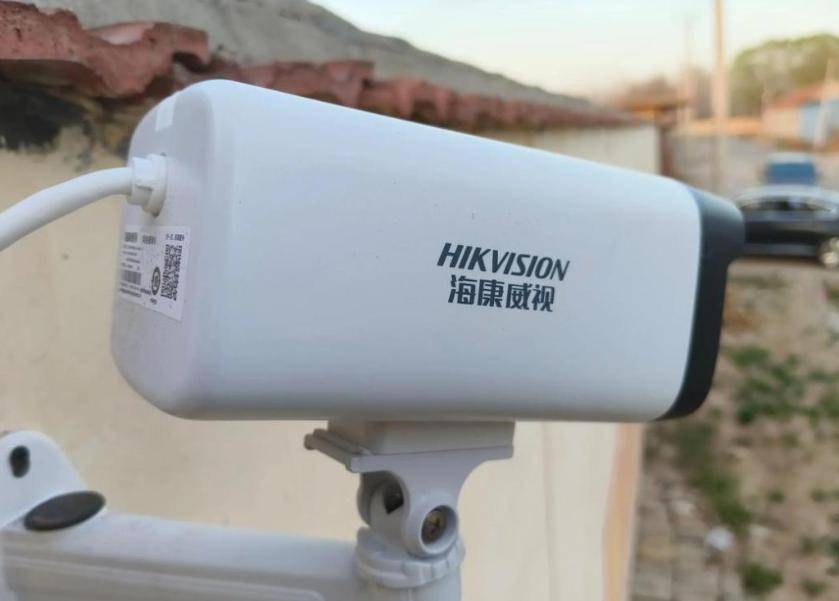
Group 1 - Canada is facing increasing pressure from the U.S. and has unexpectedly targeted China by imposing tariffs of up to 25% on certain industries, forcing many Chinese companies to withdraw from Canada [1][10] - Initially, Canadian Prime Minister Carney took a strong stance against U.S. tariffs, declaring the end of traditional relations with the U.S. and announcing countermeasures, including a CAD 2 billion fund to support affected Canadian auto industry workers and businesses [3][4] - Canada imposed a 25% retaliatory tariff on U.S. steel and aluminum exports, leveraging its position as the largest supplier of these materials to the U.S. as a key negotiating chip [5] Group 2 - Following U.S. tariff threats, Canada was shocked by Trump's new tax list, which included tariffs of up to 35% on various Canadian exports, severely impacting the Canadian economy, particularly in the steel and aluminum sectors [7][9] - Canada has implemented a complex quota control mechanism that halves the import quantity of Chinese products and imposes punitive tariffs for exceeding quotas, contrasting with the unrestricted export treatment from the U.S. [12] - The Canadian government's actions against China are perceived as an attempt to appease the U.S., but this strategy may backfire as China is not easily pressured [14][17] Group 3 - The Canadian government's measures have faced domestic criticism, especially from industries reliant on steel, which are experiencing budget reevaluations and project delays due to price fluctuations [14] - Hikvision, a Chinese company, holds about 30% of the market share in several provincial procurement contracts in Canada, and replacing its equipment would incur significant costs and negatively impact public service systems [15] - China has responded by imposing a 100% tariff on Canadian canola, which is a significant import for Canada, further demonstrating the intensity of the retaliatory measures [15]

跟美国谈不拢,对我们来硬的,加拿大要的,我们转手给了澳大利亚
Sou Hu Cai Jing· 2025-07-22 04:38
Group 1 - The trade negotiations between the US and Canada have reached a deadlock, with the US imposing a 35% tariff on all Canadian goods starting August 1, which has put pressure on the new Canadian Prime Minister Carney [1] - In response to US pressure, Canada has taken a hard stance against China, demanding the cessation of operations of Hikvision Canada under the pretext of "national security" [1] - Canada announced a limit on steel imports from countries without a free trade agreement with Canada, including China, capping imports at half of the 2024 volume, with tariffs up to 50% on excess amounts [1][2] Group 2 - Canada has decided to impose an additional 25% tariff on products from all non-US countries, particularly targeting steel products from China, to protect its domestic steel industry [2] - The Canadian government's actions appear to be aimed at appeasing the US while disappointing China, indicating a shift in Canada's trade policy [2] Group 3 - Despite efforts to improve relations, including increased imports of Canadian crude oil, Canada has continued its aggressive stance, leading to a deterioration in China-Canada relations [4] - China has significantly increased its imports of Canadian crude oil to 7.3 million barrels, a record high, in an attempt to foster cooperation [4] Group 4 - Australia is reportedly close to an agreement allowing its suppliers to export canola seeds to China, which could total between 150,000 to 250,000 tons, signaling a potential shift in trade dynamics [6] - This move by China to allow Australian canola imports is seen as a response to Canada's actions and a way to strengthen ties with Australia [6] Group 5 - Canada, previously a major supplier of canola seeds to China, has seen its market share threatened due to its previous tariffs on Chinese electric vehicles, which damaged trade relations [9] - China's shift in canola seed contracts from Canada to Australia serves as a warning to Canada about the consequences of its trade policies [9]
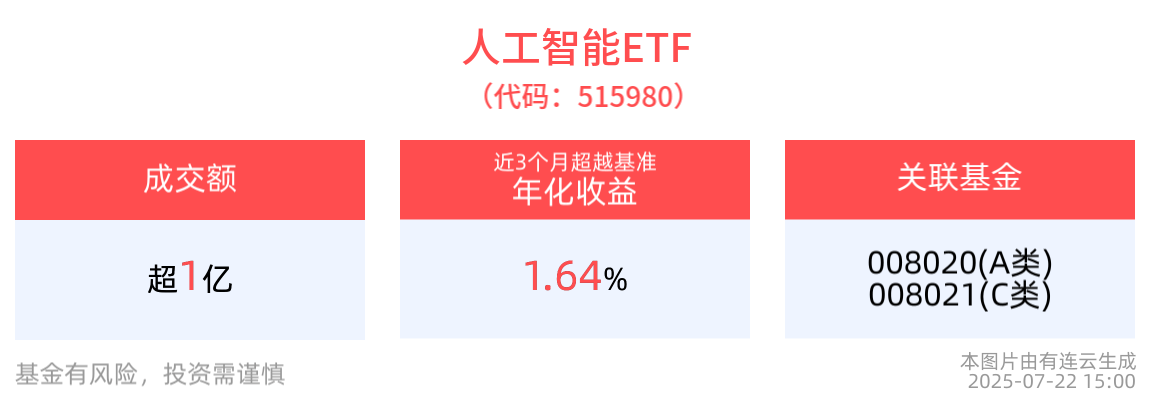
阿里更新旗舰版Qwen3模型,人工智能ETF(515980)整固蓄势,近1年净值上涨44.82%
Sou Hu Cai Jing· 2025-07-22 04:03
Core Viewpoint - The artificial intelligence (AI) sector is experiencing fluctuations in stock performance, with the China Securities Artificial Intelligence Industry Index showing a slight decline, while the AI ETF has demonstrated significant growth over the past week and year [1][3][7]. Group 1: Market Performance - As of July 22, 2025, the China Securities Artificial Intelligence Industry Index (931071) decreased by 0.51% [1]. - The AI ETF (515980) is currently priced at 1.11 yuan, with a weekly increase of 7.50% as of July 21, 2025 [1][3]. - The AI ETF has a total scale of 31.83 billion yuan, with a recent trading volume of 9321.86 million yuan and a turnover rate of 2.93% [3]. Group 2: Fund Performance - The AI ETF has achieved a net value increase of 44.82% over the past year, ranking 425 out of 2929 index stock funds, placing it in the top 14.51% [3]. - Since its inception, the AI ETF has recorded a maximum monthly return of 30.38% and an average monthly return of 6.80% during rising months [3]. Group 3: Key Holdings - As of June 30, 2025, the top ten weighted stocks in the China Securities Artificial Intelligence Industry Index account for 52.07% of the index, with 中际旭创 (300308) being the highest at 8.20% [4][6]. - Other notable stocks include 新易盛 (300502) at 7.36%, 科大讯飞 (002230) at 6.63%, and 豪威集团 (603501) at 6.28% [6]. Group 4: Industry Insights - East Wu Securities indicates that AI applications are on the verge of rapid growth, driven by advancements in information technology and significant reductions in the cost of large model deployment [7]. - The current landscape suggests that the AI sector is poised for substantial commercial potential, with a focus on industry leaders in AI applications [7].
GPT-5将发布?AI人工智能(512930)开盘拉升
Xin Lang Cai Jing· 2025-07-22 03:55
Group 1 - OpenAI is expected to release GPT-5, with indications from third-party open-source code suggesting a release date of July 13, 2025 [1] - OpenAI plans to add over 1 million GPUs by the end of this year, indicating strong growth in overseas computing power [1] - The AI-themed index (930713) has shown a 0.20% increase, with notable gains from companies like Zhongji Xuchuang (4.28%) and Xinyi Sheng (1.74%) [1] Group 2 - As of June 30, 2025, the top ten weighted stocks in the AI-themed index account for 52.8% of the index, including companies like Zhongji Xuchuang and Hikvision [2] - The AI artificial intelligence ETF (512930) closely tracks the AI-themed index and has seen a 6.64% increase over the past week [1][2]
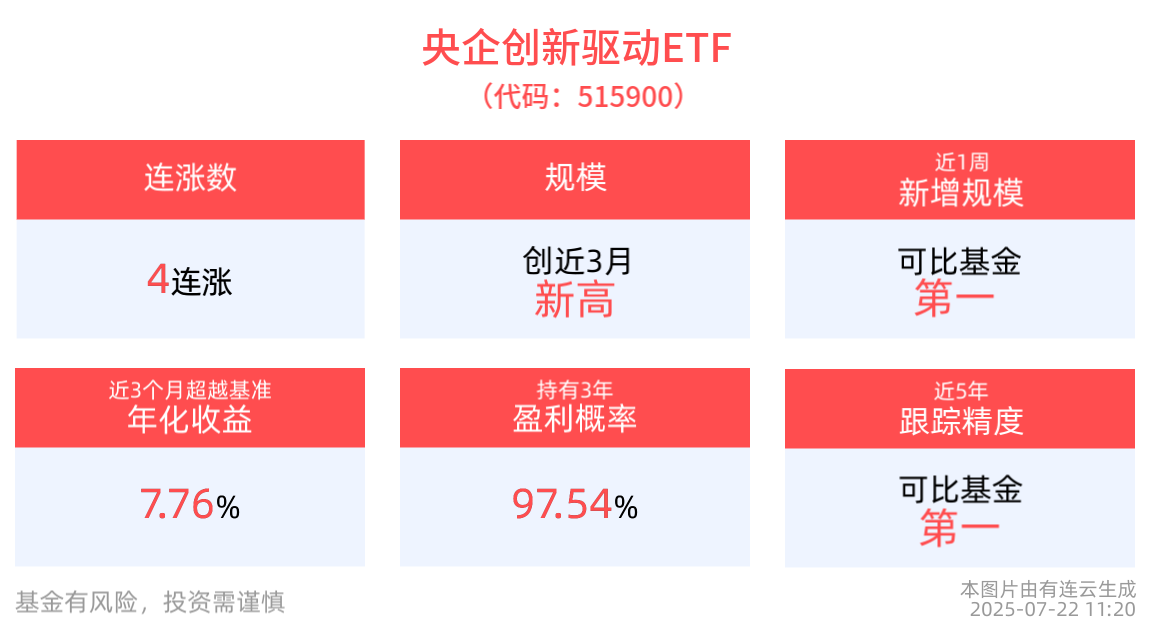
冲击4连涨!央企创新驱动ETF(515900)最新规模创近3月新高,雅江电站概念股继续大涨
Xin Lang Cai Jing· 2025-07-22 03:40
Core Viewpoint - The recent developments in the central state-owned enterprises (SOEs) innovation-driven index and related ETFs indicate a positive trend in the market, driven by significant infrastructure projects and favorable policies in the defense and low-altitude economy sectors [3][4][5]. Group 1: Market Performance - As of July 22, 2025, the Central SOE Innovation-Driven Index (000861) increased by 0.85%, with notable gains from companies such as China Railway Construction Heavy Industry (688425) up by 20.04% and China Energy Engineering (601868) up by 10.20% [3]. - The Central SOE Innovation-Driven ETF (515900) rose by 0.78%, marking its fourth consecutive increase, with a latest price of 1.55 yuan [3]. - Over the past week, the ETF has accumulated a rise of 3.77% [3]. Group 2: Infrastructure Projects - The commencement of the Yarlung Tsangpo River downstream hydropower project, with a total investment of approximately 1.2 trillion yuan, is expected to significantly boost infrastructure development in the western region and promote clean energy initiatives [4]. - This project represents six times the annual investment amount in Tibet and is projected to account for 88.7% of China's total water conservancy investment in 2024 [4]. Group 3: Fund Performance and Metrics - The Central SOE Innovation-Driven ETF has reached a new high in scale at 3.486 billion yuan, ranking in the top quarter among comparable funds [4]. - The ETF has shown a net value increase of 10.42% over the past two years, with a maximum monthly return of 15.05% since inception [4][5]. - The ETF's management fee is 0.15% and the custody fee is 0.05%, both of which are the lowest among comparable funds [5]. Group 4: Industry Outlook - The defense and military industry is experiencing a dual boost from policy and market conditions, with the low-altitude economy meeting injecting new momentum into the sector [4]. - The hydropower project is expected to benefit various sectors, including civil explosives, tunneling, and power equipment, enhancing the overall industry outlook [4].