东风汽车

Search documents
从极寒测试到万套装车!半固态电池今年有望搭载多款新车:各大厂商摩拳擦掌,动力电池技术迎来迭代年
Mei Ri Jing Ji Xin Wen· 2026-01-27 13:44
每经记者|黄辛旭 刘曦 李星 每经编辑|范文清 裴健如 零下20摄氏度的极寒测试场,寒风裹挟着冰粒抽打在测试车辆上。上汽通用五菱的工程师们紧盯着数据终端,屏幕上跳动的参数关乎着一项关键技术的落 地——搭载半固态电池的测试车,正接受低温续航与充放电稳定性的终极考验。 当车辆顺利完成全流程测试,现场响起短暂的欢呼,这份成绩单不仅为该企业三个月后的半固态电池战略发布会提供了数据基础,更印证着一个行业趋 势:曾被视作"过渡路线"的半固态电池,已进入量产前夜。 截至目前,多家企业已披露半固态电池上车和交付进展,2026年成关键节点。半固态电池凭借高安全性、强环境适应性、产线兼容性及成本控制能力率先 落地,但也面临技术争议。半固态电池的加速落地正引发供应链的深度变革,电池行业将迈入全方位、深层次的变革周期。 竞速量产:从极寒测试到万套装车的突破 "极寒环境中,我们最担心的就是电池在低温下掉链子。"上汽通用五菱副总经理赵奕凡谈到冬标测试时仍心有余悸。这场测试的核心目标,是验证半固态 电池对"新能源车冬季续航焦虑"的破解能力。最终,测试车展现出的稳定充放电性能与超出预期的续航表现,让研发团队吃下了定心丸。 这场极寒中的突破, ...

3000亿蒸发,重庆新首富崛起、“旧王”借款续命
阿尔法工场研究院· 2026-01-27 00:06
Core Viewpoint - Companies that rely on a single dividend and lack core technology will ultimately struggle to sustain themselves in the long run [4][30]. Group 1: Company Overview - Zhifei Biological, once a leading vaccine company in China, is facing a significant downturn, with projected net losses of 10.698 billion to 13.726 billion yuan for 2025, marking a year-on-year decline of 630% to 780% [5][6]. - The company’s revenue skyrocketed from 4 billion yuan in 2016 to 52.92 billion yuan in 2023, with net profits reaching 7.915 billion yuan, showcasing a rapid growth trajectory [12]. - However, the company’s reliance on agency business has proven to be a fragile foundation, leading to a severe profit crisis as market dynamics shifted [13][15]. Group 2: Financial Crisis - By 2025, Zhifei Biological's revenue is expected to plummet to 26.07 billion yuan, with a net profit of only 1.991 billion yuan, reflecting a nearly 75% year-on-year decline [14]. - The company is experiencing a liquidity crisis, with total liabilities of 16.786 billion yuan and a significant short-term debt of 10.318 billion yuan, while cash reserves are only 2.498 billion yuan, resulting in a funding gap exceeding 7.8 billion yuan [18][20]. - To alleviate inventory pressure, Zhifei Biological has initiated promotional activities and is attempting to optimize its debt structure through bond issuance, but the process has faced obstacles due to unexpected losses [19][20]. Group 3: Wealth and Market Dynamics - The wealth of the Jiang Rensheng family has drastically decreased from 140 billion yuan in 2021 to 42 billion yuan in 2025, a loss equivalent to the combined market value of two leading listed companies in Chongqing [17]. - The stock price of Zhifei Biological has also dropped from 360 billion yuan to 41 billion yuan, reflecting the company's declining market position [18]. - The rise of Zhang Xinghai and Yan Min, who have transitioned to become the new wealth leaders in Chongqing through advancements in the smart automotive sector, highlights a shift in the local business landscape [24][28]. Group 4: Industry Trends - The challenges faced by Zhifei Biological are indicative of a broader trend in the vaccine industry, where domestic companies are increasingly breaking the monopoly of foreign firms, leading to intensified competition [30]. - The shift from reliance on agency business to a focus on independent innovation is becoming essential for survival in the evolving market [31][32].
智能驾驶再添“新军”!埃泰克主板上市申请过会
Shang Hai Zheng Quan Bao· 2026-01-21 13:46
Core Viewpoint - The Shanghai Stock Exchange has approved the IPO application of Wuhu Aiteke Automotive Electronics Co., Ltd., marking a new entrant in the automotive electronics sector [1] Company Overview - Aiteke has been focused on the research, production, and sales of automotive electronic intelligent solutions since its establishment in 2002, developing a product matrix covering four functional domains: body domain, intelligent cockpit domain, power domain, and intelligent driving domain [3] - The company has achieved a market share of 25.5% in the body control unit sector for domestic brand passenger cars in 2024, ranking first for three consecutive years, and has also secured the top position in the market for remote physical keys with a share of 13.83% [3] Financial Performance - Aiteke's revenue has shown steady growth, with reported revenues of 2.174 billion yuan, 3.003 billion yuan, and 3.467 billion yuan for the years 2022, 2023, and 2024 respectively, and net profits of 77.44 million yuan, 171 million yuan, and 202 million yuan [4] - For the first half of 2025, the company achieved a revenue of 1.522 billion yuan and a net profit of 85.61 million yuan, indicating strong operational and profitability capabilities [4] IPO Details - Aiteke plans to issue up to 44.7727 million shares in its IPO, raising 1.5 billion yuan for projects including the annual production of 5 million automotive electronic units and the expansion of its production base [4] - The company's largest customer, Chery Automobile, has increased its revenue contribution from 27.6% in 2022 to 50.26% in the first half of 2025, raising concerns during the IPO review regarding customer dependency and revenue stability [5] Industry Trends - The automotive industry in China is increasingly focusing on intelligent driving, with multiple companies accelerating their capital market activities since 2026 [6] - Companies like Daoyuan Technology and Zhenju Technology are also entering the market, focusing on high-precision positioning and electric control solutions for new energy vehicles [6][7]

刚因“电芯”遭23亿天价索赔,欣旺达又卷入沃尔沃全球召回风波
Guo Ji Jin Rong Bao· 2026-01-19 13:00
Core Viewpoint - The recent recall of Volvo's electric vehicle EX30 due to battery safety issues has raised concerns about the responsibility of the battery supplier, A123, and has compounded existing sales pressures on Volvo [2][3][5]. Group 1: Volvo's Recall and Sales Performance - Volvo has initiated a global recall of its EX30 electric model due to high-voltage battery overheating risks, affecting markets including the US, Canada, South Africa, and Australia [2]. - In the UK, 10,440 units of the EX30 are confirmed to be affected, covering models from 2024 to 2026 [2]. - Volvo's global sales in 2024 are projected at 763,400 units, an 8% increase year-on-year, but sales in China, its largest market, have dropped to 156,400 units, the lowest in five years [4]. Group 2: Financial Impact and Battery Supplier Issues - In Q3 2023, Volvo's global sales fell to 160,500 units, a 7% year-on-year decline, with revenues of 86.4 billion Swedish Krona, down 6% [5]. - The recall has sparked controversy over battery supply responsibilities, with reports indicating that the problematic battery cells were produced by a joint venture involving A123 [5][6]. - A123's chairman stated that the battery packs were supplied through a different factory, distancing the company from direct responsibility for the issues [5]. Group 3: A123's Challenges and Market Position - A123 is facing significant challenges, including a recent lawsuit from Zeekr over battery quality issues, which has intensified scrutiny on the company's reliability [6][9]. - The company has seen a reduction in orders from key clients like Li Auto and Xiaomi, with the number of models supported by A123 for Li Auto dropping from 10 to 3 [9]. - A123's aggressive pricing strategy has led to declining profit margins, with a gross margin of only 9.77% in H1 2025, significantly lower than competitors [10]. Group 4: Financial Health and Future Outlook - A123 reported a loss of 1.87 billion Yuan in 2024, with cumulative losses exceeding 4.5 billion Yuan from 2023 to H1 2025 [10]. - The company's debt levels have risen sharply, with a debt-to-asset ratio of 67.62% and total liabilities reaching 67.9 billion Yuan [10]. - Concerns about ongoing litigation and financial losses may hinder A123's plans for an IPO in Hong Kong, which was anticipated for 2026 [10].

岚图汽车赴港上市获批 东风集团股份将私有化退市
Zhong Guo Jing Ying Bao· 2026-01-15 01:00
Group 1 - Lantu Automotive's plan to list in Hong Kong has been approved, marking its entry into the capital market after a short preparation period of less than five months [1] - Dongfeng Motor Group announced the privatization of Dongfeng Group through a merger, which includes the distribution of Lantu Automotive shares and the cancellation of the group's listing status [1][3] - The listing plan for Lantu Automotive began on August 22, 2025, with a two-step process involving a share distribution and a merger [3] Group 2 - Dongfeng Group will distribute 79.67% of its shares in Lantu Automotive to all shareholders before Lantu's introduction to the Hong Kong Stock Exchange [3] - Following the share distribution, Dongfeng Motor's wholly-owned subsidiary will pay equity compensation to the controlling shareholder and cash compensation to minority shareholders to achieve 100% control of Dongfeng Group [3] - Lantu Automotive changed its name and corporate structure in September 2025, transitioning to a joint-stock company [3]

成都打响“下半场”逆袭战
Si Chuan Ri Bao· 2026-01-14 19:17
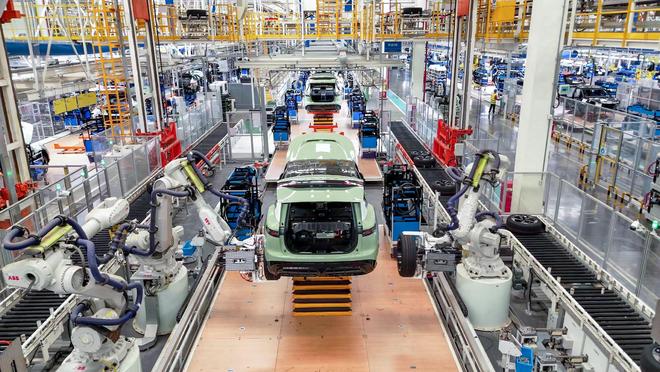
Core Insights - The establishment of Jetta Sichuan marks a significant milestone for Chengdu's automotive industry, allowing for local market-oriented research and rapid decision-making, which is crucial for adapting to the electric vehicle (EV) market [2][3] - Chengdu aims to transform its automotive industry from assembly-based operations to a more integrated model that includes R&D, manufacturing, and sales, thereby enhancing its competitiveness in the EV sector [2][3] Industry Overview - Chengdu has over 10 automotive manufacturers, primarily functioning as assembly plants, lacking headquarters and R&D capabilities, which hindered its response to the EV wave [2] - In 2025, Chengdu's automotive production reached 821,000 units, a year-on-year increase of 26.6%, with EV production at 205,000 units, reflecting a remarkable growth of 198.3% [2] Strategic Developments - Jetta Sichuan, with a registered capital of 3 billion yuan, is positioned to lead the development of smart electric vehicles tailored to local needs, supported by local government and strategic partnerships with major automotive players [3] - The collaboration between local governments and automakers like FAW and Dongfeng aims to create "city partners" and "industry partners," fostering a supportive ecosystem for the automotive sector [3] Future Goals - Jetta Sichuan plans to produce 400,000 to 500,000 vehicles annually, with five new models, four of which will be EVs, expected by 2028 [3] - Chengdu targets to exceed 1.5 million vehicles in production and 300 billion yuan in output by 2030, aiming to reclaim its position among the top automotive cities in China [3]
汽车生产,谁在领跑?(锐财经)
Ren Min Ri Bao· 2026-01-12 20:23
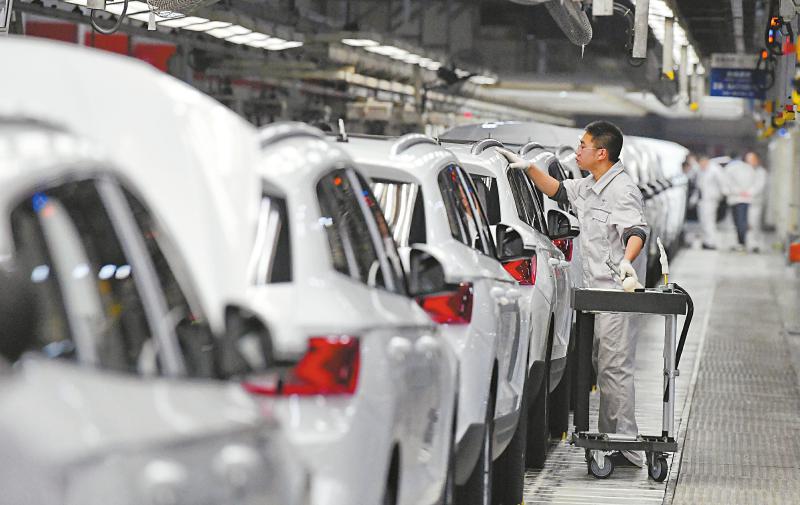
Core Insights - The automotive production landscape in China is evolving, with cities like Chongqing, Beijing, and Shanghai showing significant output figures, particularly in the electric vehicle (EV) sector [2][3][4] - Technological innovation and resilient supply chains are key competitive factors driving the growth of automotive production in various cities [3][5] Production Highlights - Chongqing produced approximately 2.5 million vehicles in the first 11 months of 2025, marking a 12.1% year-on-year increase, with a notable rise in EV production reaching 950,000 units, over six times that of 2021 [3] - Shanghai's vehicle production reached 1.6 million units, with 1.04 million being EVs, while Beijing's output was 1.34 million units, reflecting a 27.6% increase year-on-year [3] - Other cities like Zhengzhou and Qingdao are approaching the million-unit mark, with Zhengzhou's production at 956,300 units, a 16.52% increase [3] Electric Vehicle Leadership - Hefei leads the nation in EV production with 1.25 million units produced in the first 11 months of 2025, supported by a strong industrial base including major brands like NIO and BYD [4] - Hefei's rapid growth in the EV sector is attributed to strategic industry planning and the establishment of production bases for various automotive brands [4] Industry Support and Innovation - The automotive industry in cities like Liuzhou and Qingdao benefits from comprehensive supply chains, with Liuzhou being home to five major vehicle manufacturers [5] - Innovations in autonomous driving and vehicle networking are being spearheaded in Chongqing, with the first L3-level autonomous driving license plate expected by the end of 2025 [5] Policy and Strategic Initiatives - Local governments are implementing supportive policies, such as Chongqing's strategy to develop a world-class smart connected EV industry cluster [6] - Anhui province is also backing Hefei's ambition to become a globally influential EV hub [6] Statistical Changes Impacting Rankings - Changes in statistical methods for vehicle production reporting are reshaping the rankings of leading automotive cities, with a shift from "enterprise location" to "production location" affecting how output is measured [7] - In 2023, Guangzhou maintained the highest production at 3.18 million units, but projections for 2025 indicate shifts in rankings due to these new reporting standards [7] Overall Industry Performance - The Chinese automotive industry demonstrates strong resilience and vitality, with total production and sales reaching 31.23 million and 31.13 million units respectively in the first 11 months of 2025, both showing over 11% year-on-year growth [8] - Factors such as over 50% penetration of new energy passenger vehicles and advancements in L3 autonomous driving are propelling the industry into a new phase of high-quality development [8]
抢滩万亿具身智能蓝海 泛汽车企业“卡位”人形机器人赛道
Zhong Guo Jing Ying Bao· 2026-01-09 19:58
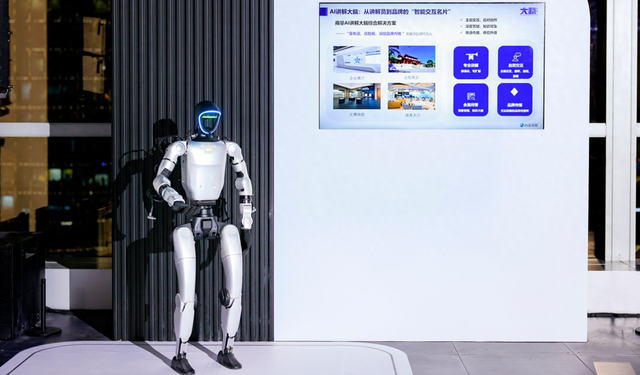
Core Viewpoint - The automotive industry is increasingly entering the humanoid robot sector, viewing it as a "third growth curve" alongside traditional automotive business lines, with significant investments and product developments underway [3][4][5]. Group 1: Investment and Development - Chery Group announced it is accelerating the incubation of its humanoid robot, Moja, with a recent investment of 35 million yuan from Wuhu Bertli Automotive Safety Systems [3]. - The humanoid robot market is projected to reach a size of $5 trillion by 2050, with an estimated deployment of 1 billion units, indicating a vast market opportunity for automotive companies [7]. - Dongfeng Group is also developing humanoid robots for tasks such as customer reception and material handling in factories, showcasing the diverse applications of these robots [5]. Group 2: Technological Synergy - Automotive companies possess inherent advantages in technology and manufacturing processes, which can be leveraged in the development of humanoid robots [7][10]. - The overlap in supply chains between smart vehicles and humanoid robots is as high as 60%, providing a natural pathway for cost reduction [10]. - Chery's approach to humanoid robots is seen as a natural extension of its existing automotive technology and manufacturing capabilities [8]. Group 3: Market Entry and Competition - New players, including companies like SenseTime and Black Sesame Intelligence, are entering the humanoid robot market, indicating a competitive landscape [4][6]. - SenseTime's recent product launches and partnerships in the humanoid robot space highlight the industry's focus on collaboration and ecosystem development [4]. - The entry of automotive companies into the humanoid robot sector is seen as a strategic move to capture future technological opportunities and enhance their market positions [7][11]. Group 4: Challenges and Future Outlook - The humanoid robot industry is still in its early stages, facing challenges such as the lack of industry standards and safety regulations [9]. - Key technological breakthroughs are needed in areas like AI chips, battery technology, and sensor systems to enable large-scale deployment of humanoid robots [10]. - The development of commercial models, such as robot leasing platforms, is emerging as a potential avenue for revenue generation in the humanoid robot sector [11].

骏成科技:公司产品通过一级供应商交付应用于上汽吉利长安等主机厂
Zheng Quan Ri Bao Wang· 2026-01-08 10:43
Core Viewpoint - Jun Cheng Technology (301106) engages with major domestic automotive manufacturers through first-tier suppliers, indicating a strong position in the automotive supply chain [1] Group 1: Company Overview - Jun Cheng Technology's products are delivered through first-tier suppliers such as Weichai, Visteon (Tianbao Automotive), Tianyouwei (603202), and Xintongda [1] - The company collaborates with leading automotive manufacturers including SAIC Group (600104), Geely Automobile, Changan Automobile, Beijing Automotive, Chery Automobile, and Dongfeng Motor [1]

马年第一只新股叫啥“马”?
Yang Zi Wan Bao Wang· 2026-01-04 09:07
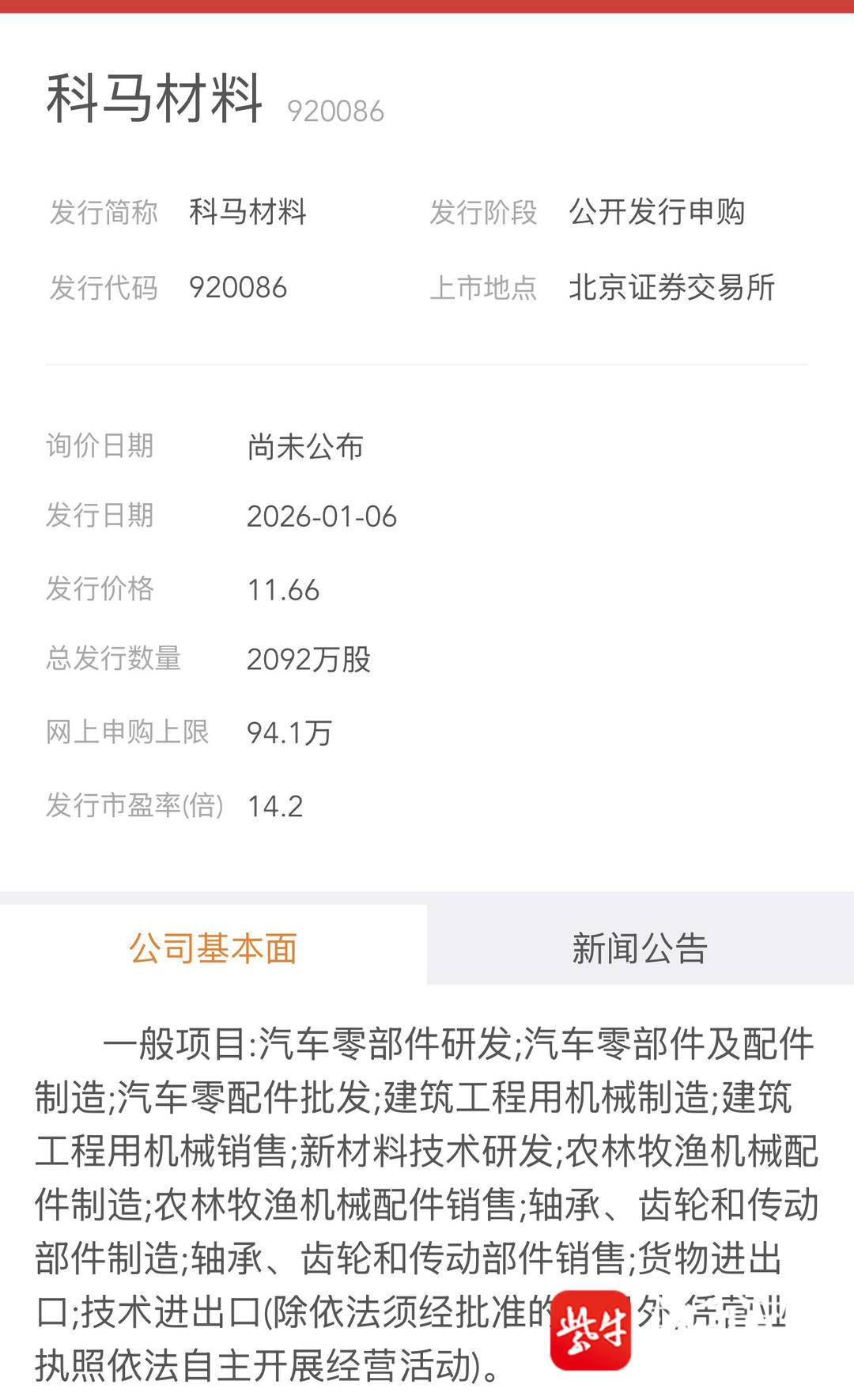
Company Overview - Koma Materials is recognized as a "little giant" enterprise in the domestic automotive friction materials sector, focusing on the research, production, and sales of dry and wet paper-based friction plates [4] - The company has over 20 years of experience in the transmission friction materials industry, serving major domestic clutch manufacturers such as ZF (Jiaxing), Fast Eaton, and Fuda [4] Financial Performance - Koma Materials achieved revenues of 202 million yuan, 199 million yuan, and 249 million yuan for the years 2022, 2023, and 2024, respectively, with net profits of 42 million yuan, 50 million yuan, and 72 million yuan for the same years [4] - The management forecasts a revenue growth of 0.39% to 12.44 billion yuan and a net profit growth of 14.63% to 34.21% for 2025 [4] Issuance Details - The issuance price for Koma Materials is set at 11.66 yuan per share, with a price-to-earnings ratio of 14.2 [2][4] - The total number of shares to be issued is 20.92 million, with a maximum online subscription limit of 941,000 shares [2] Industry Position - Koma Materials is classified as a "specialized and innovative" small giant by the Ministry of Industry and Information Technology and as an "invisible champion" in Zhejiang Province [4] - The company's products are utilized by well-known brands such as China National Heavy Duty Truck, FAW Liberation, and Dongfeng Motor [4]