有友食品

Search documents
4652只个股收绿,原因找到了!
Guo Ji Jin Rong Bao· 2026-02-02 13:26
Market Overview - A-shares experienced a significant decline on February 2, with the Shanghai Composite Index and ChiNext Index both dropping over 2% [2][4] - The market showed a broad-based decline, with 4,652 stocks closing lower, particularly in resource sectors such as metals, coal, oil, and chemicals [4][9] - The trading volume decreased significantly, with daily turnover dropping by 255.8 billion to 2.61 trillion [5] Sector Performance - Resource stocks were heavily impacted, with declines exceeding 5% in sectors like non-ferrous metals, steel, basic chemicals, coal, and oil [8][9] - The food and beverage sector, particularly liquor stocks, showed resilience, with several companies like Jinhuijiu and Youyou Food hitting the daily limit [6][7] - Banking stocks also performed relatively well, with several banks showing slight gains despite the overall market downturn [8] Market Sentiment and Factors - The decline was attributed to a combination of external market disturbances, profit-taking, and heightened risk aversion ahead of the holiday [3][11] - Analysts suggest that the market may need 3 to 5 trading days to stabilize, with a focus on whether the Shanghai Composite can hold above the 4,000-point mark [3][15] - The current market environment is characterized as a healthy technical correction rather than a trend reversal, with no signs of panic selling or liquidity crisis [12][14] Investment Strategy - Investors are advised to avoid high-volatility sectors in the short term and to wait for clear signs of market stabilization before gradually increasing positions in quality sectors [3][16] - There is a recommendation to focus on defensive sectors such as electric grid equipment and high-dividend blue chips, while avoiding emotional selling [15][17] - The market is expected to recover quickly post-holiday, supported by liquidity replenishment and policy expectations from the upcoming Two Sessions [15][17]





亚太股市集体下跌,发生了什么
Zhong Guo Zheng Quan Bao· 2026-02-02 11:05
Market Overview - The Asia-Pacific stock markets experienced widespread declines, with the South Korean Composite Index dropping over 5%, triggering a trading halt for 5 minutes [1][5] - The A-share market saw all three major indices fall by more than 2%, with the Shanghai Composite Index down 2.48%, the Shenzhen Component down 2.69%, and the ChiNext Index down 2.46% [1][6] - The Hang Seng Index and the Hang Seng China Enterprises Index also fell by over 2%, while the Hang Seng Technology Index dropped by 3.36% [1][6] Sector Performance - The A-share non-ferrous metals sector underwent significant corrections, with precious metals and industrial metals leading the declines; stocks like Sichuan Gold and Chifeng Jilong Gold hit the daily limit down [2] - The storage chip concept saw expanded declines in the afternoon, with stocks such as Kaipu Cloud and Wanrun Technology also hitting the daily limit down [2] - Other sectors like oil and gas, chemicals, coal, and semiconductors also faced notable declines [2] Key Factors Influencing Market Movement - A sudden shift in expectations regarding the Federal Reserve's policy, particularly with the nomination of Kevin Walsh as the next Fed Chair, raised concerns about potential delays in interest rate cuts, impacting global risk asset valuations [7] - Profit concerns in the AI industry led to a sell-off in technology stocks, with major players like Samsung Electronics and SK Hynix experiencing declines of over 6% and 8%, respectively [7] - Pre-holiday risk aversion and reduced market liquidity contributed to a lack of buying support, as investors opted to secure profits ahead of the upcoming Spring Festival [7] - Technical adjustments were also noted, as some sectors had reached high valuation levels after significant prior gains [7] Food Sector Insights - The food sector saw some stocks, such as Youyou Food, experience sharp increases, with several others following suit [8] - Analysts suggest that the rise of healthy snacks and the penetration of online channels are key growth drivers in the market [11] - The food and beverage industry is currently at a historical low in valuation, presenting potential investment opportunities as market dynamics shift [11]
亚太股市,集体下跌!发生了什么
Zhong Guo Zheng Quan Bao· 2026-02-02 09:17
Market Overview - The Asia-Pacific stock markets experienced a widespread decline, with the South Korean Composite Index dropping over 5%, triggering a trading halt for 5 minutes [1][4] - The A-share market saw all three major indices fall by more than 2%, with the Shanghai Composite Index down 2.48%, the Shenzhen Component down 2.69%, and the ChiNext Index down 2.46% [1][4] - The Hang Seng Index and the Hang Seng China Enterprises Index both fell by over 2%, while the Hang Seng Technology Index dropped by 3.36% [1] Sector Performance - The A-share non-ferrous metals sector experienced a significant pullback, with precious and industrial metals leading the declines; stocks like Sichuan Gold and Chifeng Jilong Gold hit the daily limit down [4] - The storage chip sector also saw expanded losses, with stocks such as Capcloud and Wanrun Technology hitting the daily limit down [4] - Other sectors like oil and gas, chemicals, coal, and semiconductors also faced notable declines [4] Commodity Market - Domestic commodity futures closed lower across the board, with major contracts for silver, palladium, platinum, nickel, tin, copper, aluminum, international copper, crude oil, fuel oil, aluminum alloy, and lithium carbonate all hitting the daily limit down [4] Factors Influencing Market Movement - A sudden shift in expectations regarding the Federal Reserve's policy, particularly with the potential nomination of Kevin Walsh as the next Fed Chair, has raised concerns about delayed interest rate cuts and tightening liquidity, impacting global risk asset valuations [6] - Profit concerns in the AI sector have led to a sell-off in technology stocks, with major players like Samsung Electronics and SK Hynix experiencing significant declines of over 6% and 8%, respectively [6] - Pre-holiday risk aversion and reduced trading volume have contributed to market weakness, as investors are inclined to secure profits ahead of the upcoming Spring Festival [6] - Technical adjustments are also at play, as some sectors in the Asia-Pacific region have reached high valuation levels after substantial prior gains [6] Consumer Sector Insights - The rise of healthy snacks and the penetration of online channels are identified as key growth drivers in the market, with projections indicating that the Chinese leisure food industry will reach 1.18 trillion yuan by 2025 and 1.24 trillion yuan by 2027 [10] - Current valuations in the food and beverage sector are at historical lows, suggesting potential investment opportunities as market dynamics shift [10] - Three main investment themes are suggested: focusing on industry leaders with stable demand and strong risk resilience, companies innovating in new products and channels, and segments within the mass consumer goods industry that have reasonable valuations post-adjustment [10]
休闲食品板块2月2日跌0.52%,立高食品领跌,主力资金净流出6688.73万元
Zheng Xing Xing Ye Ri Bao· 2026-02-02 09:15
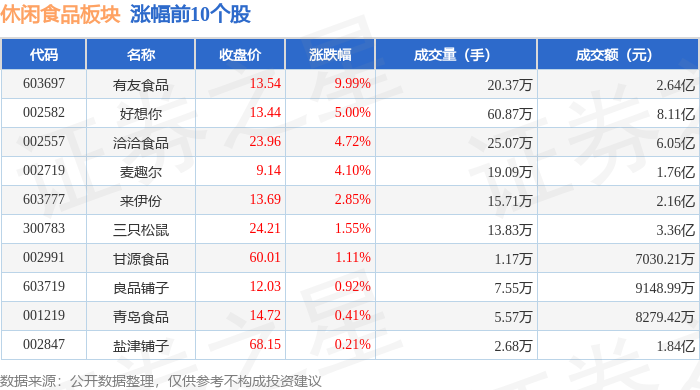
Market Overview - The leisure food sector experienced a decline of 0.52% on February 2, with Li Gao Food leading the drop [1] - The Shanghai Composite Index closed at 4015.75, down 2.48%, while the Shenzhen Component Index closed at 13824.35, down 2.69% [1] Stock Performance - Youyou Food (603697) saw a significant increase of 9.99% in its closing price at 13.54, with a trading volume of 203,700 shares and a transaction value of 264 million [1] - Other notable gainers included: - Hao Xiang Ni (002582) up 5.00% at 13.44 with a transaction value of 811 million [1] - Zhi Zhi Food (002557) up 4.72% at 23.96 with a transaction value of 605 million [1] - Li Gao Food (300973) reported a decline of 6.36% in its closing price at 42.14, with a trading volume of 54,400 shares and a transaction value of 236 million [2] Capital Flow - The leisure food sector saw a net outflow of 66.88 million from main funds, while retail investors contributed a net inflow of 98.06 million [2] - The capital flow for key stocks included: - Youyou Food with a net outflow of 50.25 million from main funds [3] - Three Squirrels (300783) had a net inflow of 25.34 million from main funds [3] - Salted Fish (002847) reported a net inflow of 13.69 million from main funds [3]




【焦点复盘】沪指逼近4000点,全市场超800股跌逾5%,白酒、电网设备股逆势活跃
Xin Lang Cai Jing· 2026-02-02 09:09
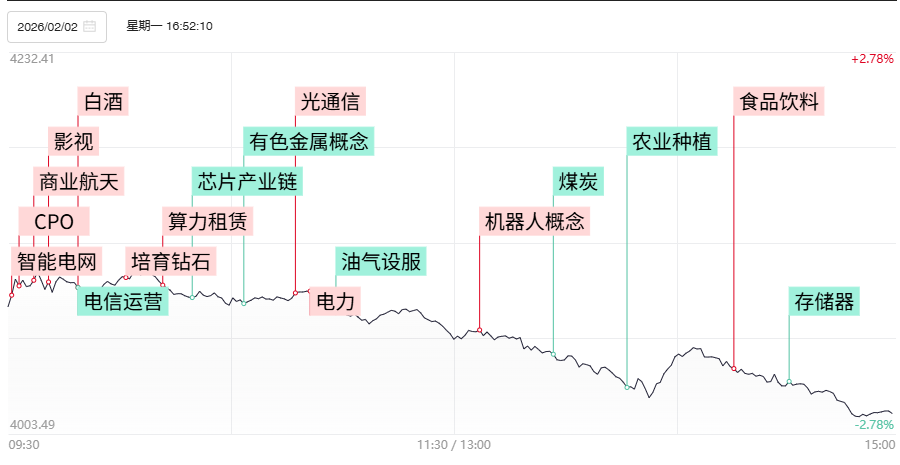
Market Overview - The market experienced a significant decline with all three major indices dropping over 2%, and the Shanghai Composite Index falling by 2.48% [1] - A total of 36 stocks hit the daily limit up, while 18 stocks faced limit down, resulting in a sealing rate of 67% [1] - The total trading volume in the Shanghai and Shenzhen markets was 2.58 trillion yuan, a decrease of 250.8 billion yuan compared to the previous trading day [1] Sector Performance - The electric grid equipment, liquor, and food and beverage sectors led the market gains, while non-ferrous metals, oil and gas, and semiconductors faced significant declines [1] - The electric grid equipment sector saw a strong performance with multiple stocks hitting the limit up, driven by high demand for transformers and related products [5] - The liquor sector, particularly stocks like Huangtai Liquor and Jin Hui Liquor, showed resilience with multiple consecutive limit up days, attributed to the upcoming Spring Festival demand [8][19] Stock Analysis - The consecutive limit up rate for stocks reached 42.85%, with three stocks achieving three consecutive limit ups [3] - Stocks such as Wanfeng Co., Huangtai Liquor, and Hong Kong Film Industry achieved three consecutive limit ups, indicating strong market interest [11][20] - The AI application and computing rental sectors showed mixed performance, with some stocks like Litong Electronics and Qunxing Toys hitting limit up, while others faced pullbacks [6][22] Future Outlook - The market is expected to face continued volatility, with significant pressure from the decline in cyclical sectors affecting overall market sentiment [9] - The electric grid equipment sector may continue to perform well in the short term, despite potential cost pressures from rising metal prices [5] - The liquor sector is anticipated to benefit from seasonal demand, but overall market sentiment remains cautious due to broader economic conditions [8][19]
盘中必读|今日共44股涨停,三大指数均跌超2%,电网设备板块逆势走高
Xin Lang Cai Jing· 2026-02-02 07:33
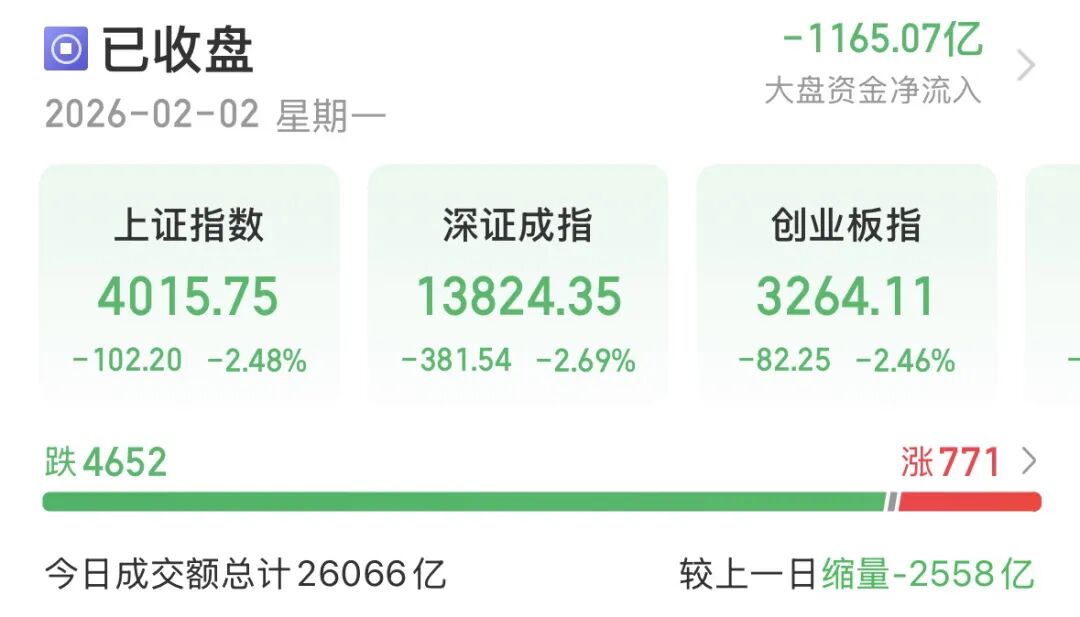
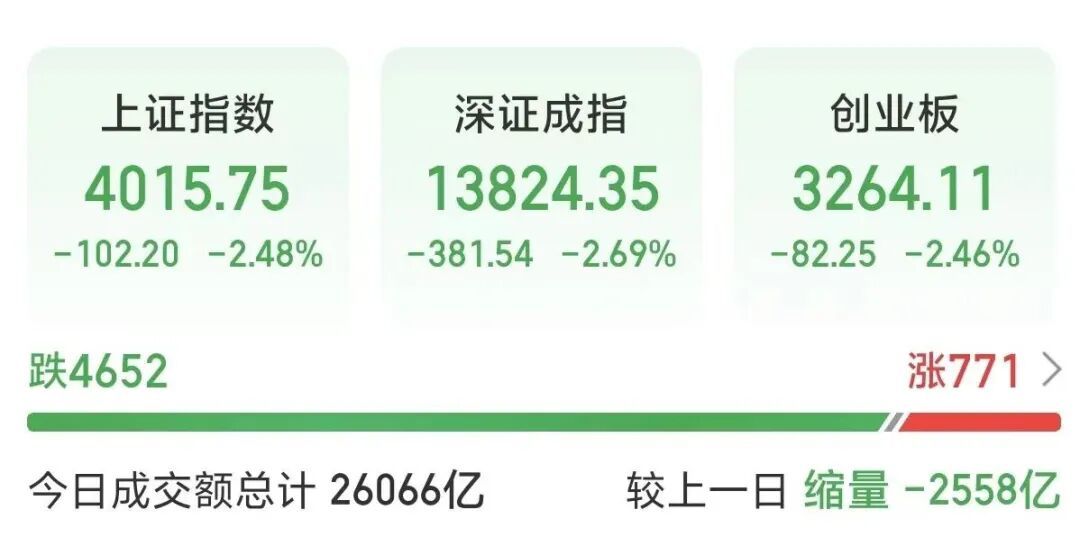
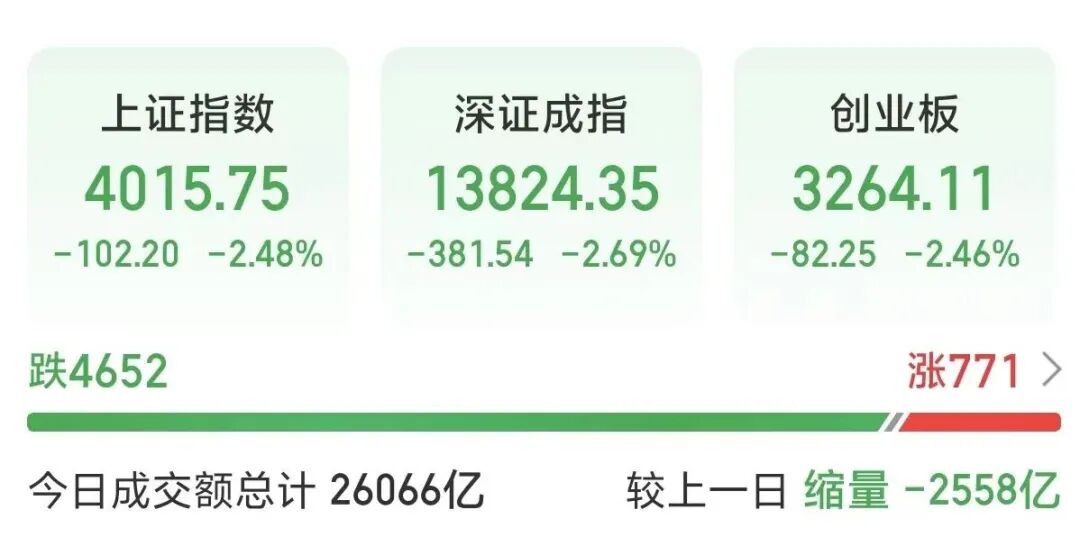
Market Overview - The A-share market experienced a collective decline in the three major indices, with the Shanghai Composite Index closing at 4015.75 points, down 2.48% [1] - The Shenzhen Component Index closed at 13824.35 points, down 2.69% [1] - The ChiNext Index closed at 3264.11 points, down 2.46% [1] - Overall, more than 4600 stocks declined, indicating a broad market downturn [1] - The total trading volume in the Shanghai and Shenzhen markets was 2.58 trillion yuan, a decrease of 250 billion yuan compared to the previous trading day [1] Sector Performance - The electric grid equipment sector rose against the trend, with stocks such as Hangdian Co., Sanbian Technology, and Baiyun Electric hitting the daily limit [1] - Consumer stocks showed active performance, with companies like Xinhua Department Store and Maoye Commercial also reaching the daily limit [1] - The liquor sector saw a partial rebound, with stocks like Huangtai Liquor and Jinhui Liquor hitting the daily limit [1] - The computing power concept saw some gains, with stocks such as Qunxing Toys and Litong Electronics also reaching the daily limit [1] - In contrast, the precious metals and semiconductor sectors experienced significant declines [1]
有友食品(603697) - 关于使用闲置募集资金进行现金管理的公告
2026-01-28 10:15
特别风险提示:公司本次现金管理购买的理财产品为有保本约定的浮 动收益型理财产品,但金融市场受宏观经济的影响较大,不排除该项投资受 到市场波动、宏观经济形势及货币政策、财政政策等宏观政策发生变化带来 的系统性风险影响,投资的实际收益不可预期。 证券代码:603697 证券简称:有友食品 公告编号:2026-007 投资种类:券商收益凭证 投资金额:人民币 2,000 万元 一、投资情况概述 有友食品股份有限公司 关于使用闲置募集资金进行现金管理的公告 本公司董事会及全体董事保证本公告内容不存在任何虚假记载、误导性陈述 或者重大遗漏,并对其内容的真实性、准确性和完整性承担法律责任。 重要内容提示: 已履行的审议程序:有友食品股份有限公司(以下简称"公司")于 2025 年 3 月 19 日召开第四届董事会第十一次会议及第四届监事会第十一次会 议,并于 2025 年 4 月 9 日召开 2024 年年度股东会,审议通过《关于使用暂 时闲置募集资金进行现金管理的议案》,同意公司(含子公司)在不影响募投 项目建设和正常经营业务的前提下,使用总额不超过人民币 10,000 万元的募 集资金进行现金管理,使用期限自 202 ...
东吴证券晨会纪要2026-01-28-20260128
Soochow Securities· 2026-01-28 04:51
Macro Strategy - The IPCA model shows better application effects in the domestic credit bond market compared to the US market, with a Sharpe ratio consistently above 1.45 and above 2.2 from May to December 2025 [1][13] - The strategy exhibits asymmetric risk/reward characteristics, with 75% of sample dates showing positive excess credit returns, and a maximum excess return of 0.13% from January 2024 to December 2025 [1][13] - The practical operability of the strategy is strong, allowing for investment in bonds with similar risk characteristics even when specific bonds are not available in the secondary market [1][13] Fixed Income Opportunities - The "14th Five-Year Plan" emphasizes the development of key industries, including new pillar industries, future industries, traditional industry upgrades, infrastructure construction, green transformation, and consumer upgrades, which are expected to receive policy support and financing breakthroughs [2][14] - A total of 1,098 bond-issuing entities align with the "14th Five-Year Plan," with a total bond scale of approximately 10.8 trillion yuan, primarily rated AAA and concentrated in East and North China [2][14] - The participation of bond-issuing entities in the six key industries shows significant differentiation, with infrastructure and new pillar industries leading in both the number of issuers and bond scale [2][14] Industry Insights - The public utility sector is expected to benefit from deepened electricity reforms, with recommendations to focus on green electricity, thermal power, hydropower, nuclear power, and the valuation of photovoltaic and charging pile assets [7] - The food and beverage sector is anticipated to experience a spring consumption surge, particularly in snacks, dining, and seasonal beverages, with a positive outlook for Q1 2026 due to favorable market conditions [7] - Companies like KaiGe Precision Machinery and HeMai Co. are positioned to benefit from the growing demand in AI computing and energy storage, with projected profit growth in the coming years [9][10]
省级高新区“扩容”,下一个“千亿区”这样建
Mei Ri Jing Ji Xin Wen· 2026-01-28 01:24
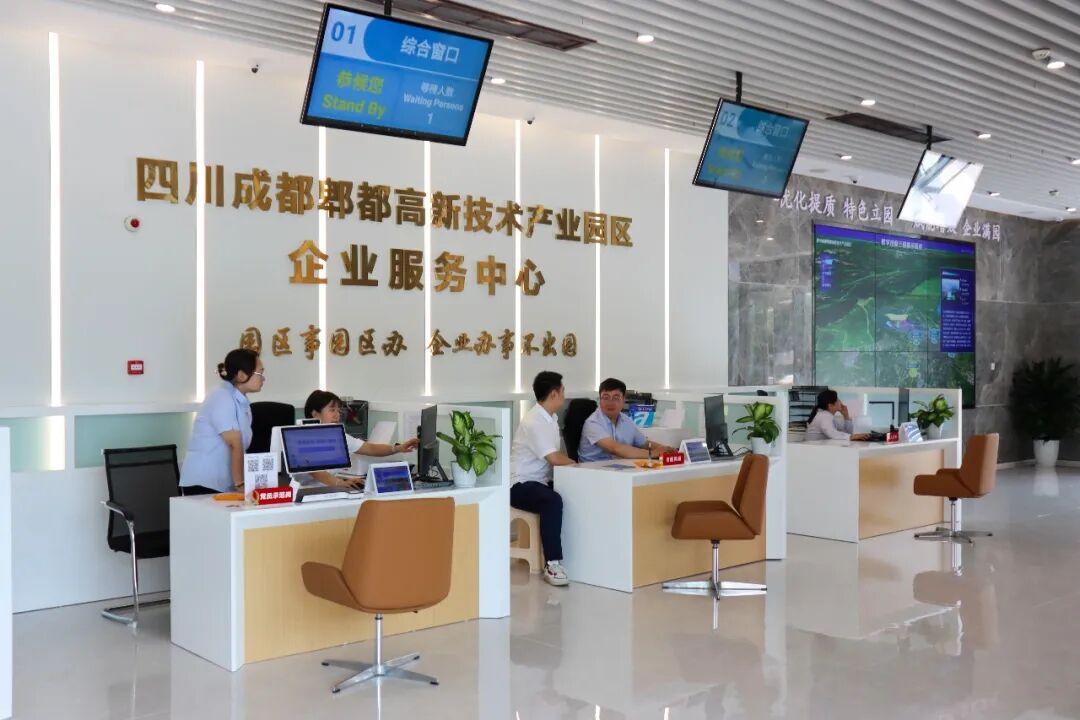
Core Viewpoint - Chengdu's Pidu District has successfully transitioned to a new phase of high-quality development, achieving significant economic milestones and aiming for a total economic output of 120 billion yuan during the "14th Five-Year Plan" period, with a focus on becoming a modern city in western Chengdu during the "15th Five-Year Plan" [1][3]. Economic Development - The Pidu District's economy has crossed two hundred billion thresholds, marking a robust development trajectory as it embarks on the "15th Five-Year Plan" [1]. - The Chengdu Modern Industrial Port has been recognized as a provincial-level high-tech industrial park, reflecting the district's commitment to transforming plans into reality through the "Full Park Development" initiative [3][4]. Industrial Growth - The Chengdu Modern Industrial Port's elevation to a provincial high-tech zone is a testament to Pidu's efforts in optimizing industrial structure and fostering innovation [4]. - The district has established a diverse industrial ecosystem, with 417 electronic information companies, including 75 large-scale enterprises, contributing significantly to the local economy [5]. Strategic Focus - Pidu District is focusing on four main industries: electronic information, equipment manufacturing, new materials, and green food, while also targeting 12 vertical segments for future growth [12]. - The district aims to enhance its competitive edge by integrating traditional industries with branding and high-value chains, exemplified by the launch of the "Taste of Pidu" condiment gift box [7]. Future Planning - Pidu is positioning itself for future industrial opportunities by emphasizing differentiated development and precision targeting in niche markets [10]. - The district plans to attract major industrial projects and enhance its industrial chain, aiming for a total output of 900 billion yuan by 2026 [20]. Cultural and Creative Industries - The Chengdu Film and Television City has become a hub for over 600 cultural and creative enterprises, contributing to a cultural industry value added of over 10 billion yuan [9]. - Pidu is enhancing its cultural soft power by developing the film and television industry, aiming to transition from a production center to an industry center [12]. Government Support - The local government is providing strong support for businesses, facilitating rapid establishment processes and fostering a collaborative industrial ecosystem [17]. - Companies in Pidu, such as Chengdu Tianqin Zhihui Technology Co., are benefiting from favorable policies and resources, enabling them to set ambitious growth targets [17][20].
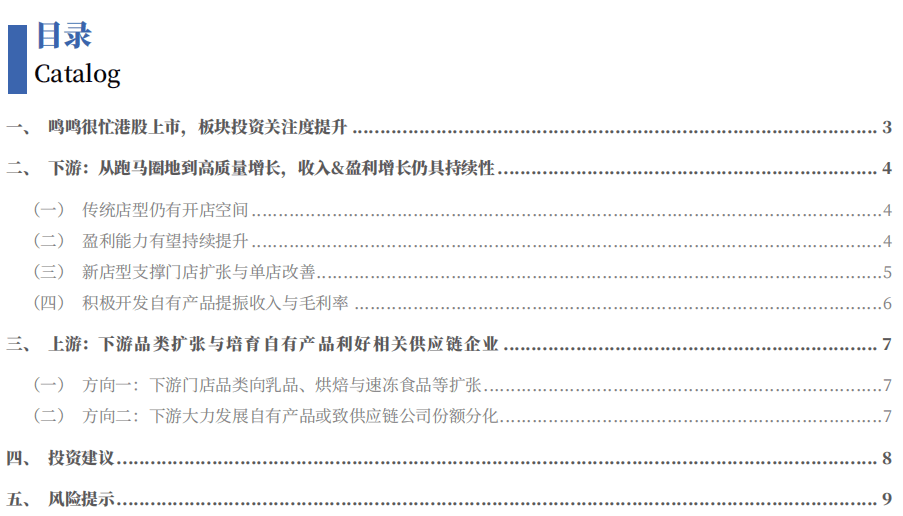
【银河食饮刘光意】专题研究丨鸣鸣很忙港股上市,关注产业链投资新趋势
Sou Hu Cai Jing· 2026-01-28 00:30
Group 1 - The core viewpoint is that Ming Ming Hen Mang plans to list on the Hong Kong Stock Exchange on January 28, becoming the first stock in the "bulk snack" sector, with a global offering of 14.1 million shares, expected to raise over HKD 3 billion, and a market capitalization of approximately HKD 50 billion [1][7] - The market response has been positive, with eight cornerstone investors subscribing a total of HKD 1.5 billion, including Tencent, Temasek, and BlackRock, and the latest subscription multiple exceeding 1500 times [1][8] Group 2 - Downstream growth is shifting from rapid expansion to high-quality growth, with traditional store types still having significant opening space, projected to reach nearly 50,000 stores by 2025, with a total potential of about 74,000 stores [2][9] - Profitability is expected to continue improving, with adjusted net margins for Ming Ming Hen Mang increasing from 2.3% to 3.9% from 2023 to the first three quarters of 2025, driven by reduced opening subsidies and category structure adjustments [2][13] - New store formats are supporting store expansion and single-store improvement, with both Ming Ming Hen Mang and Wan Chen planning to open discount supermarket formats by 2025, currently accounting for less than 20% of new store types [2][17] - The development of private label products is boosting revenue and gross margins, with both companies planning to increase their private label revenue share, currently in the single digits, compared to 20-30% for similar brands [2][19] Group 3 - Upstream opportunities are emerging as downstream stores expand into categories like dairy, baking, and frozen foods, benefiting related upstream supply chain companies, particularly mid-tier brands with significant revenue elasticity [3][24] - The focus on developing private label products is leading to market share differentiation among supply chain companies, with manufacturers that have strong product development and customization capabilities likely to gain market share [3][26] Group 4 - Investment recommendations highlight the positive outlook for the bulk snack industry, emphasizing the transition to high-quality growth and the potential for upstream supply chain companies to benefit from downstream category expansions and increased private label product shares [4][28]