阿里妈妈

Search documents
从“具体情绪”到“空间环绕”,2025下半年六大营销趋势洞察
3 6 Ke· 2025-07-23 04:02
Group 1 - The core viewpoint emphasizes the importance of analyzing marketing trends and case studies to identify potential growth opportunities for brands in the second half of 2025 [1] - Six forward-looking marketing trends have been identified through the analysis of over a hundred cases, providing actionable insights for brands [1] - Emotional marketing has become a key driver of consumer behavior, with brands needing to integrate emotional elements into their strategies [2][4] Group 2 - LABUBU serves as a prime example of emotional marketing, resonating with young consumers by embracing a rebellious and non-conformist identity [4][7] - Emotional marketing is evolving towards more specific and precise expressions, with different emotions being assigned distinct meanings [4][7] - Brands are encouraged to adopt a long-term approach to emotional marketing, ensuring that emotional connections are deeply embedded in their brand identity [7] Group 3 - Brands are increasingly recognizing the need to return to the essence of marketing by focusing on quality content rather than short-term traffic [8] - Leveraging trending content can help brands establish emotional connections with consumers, transforming them from mere observers to active participants in cultural conversations [10] - Successful collaborations, such as the partnership between Mengniu and the animated film "Nezha," demonstrate the effectiveness of aligning brand values with popular cultural narratives [10][12] Group 4 - Long-form video content is gaining traction as a means to create deeper emotional connections with consumers, moving beyond traditional advertising methods [15] - Brands are utilizing long-form content to build a narrative that resonates with audiences, enhancing brand perception and loyalty [15] Group 5 - The concept of female empowerment in marketing is shifting from superficial representations to a deeper understanding of women's real needs and experiences [19][26] - Successful female-focused marketing campaigns are characterized by genuine empathy and respect for women's diverse roles and challenges in society [19][22] - Brands must elevate their narratives around women from mere commercial strategies to social responsibility practices to foster authentic emotional connections [23] Group 6 - The emergence of experiential marketing, exemplified by LV's "Louis Ship," highlights the importance of creating immersive brand experiences that resonate with consumers [27][29] - This trend reflects a broader consumer desire for emotional connections and meaningful interactions in physical spaces [31] - Brands are encouraged to craft their stories through experiential marketing, integrating their history and values into the consumer experience [31] Group 7 - Scene-based marketing is becoming a vital strategy for brands to connect with consumers by tapping into specific emotional needs and contexts [32][35] - Brands are increasingly recognizing the importance of predicting consumer scenarios and tailoring marketing activities to meet those needs [35] Group 8 - AI marketing is transforming the landscape by enhancing content production and user experience, with a significant penetration rate of 72% for AIGC in content creation [36] - Brands are exploring AI's potential to streamline marketing processes, from ideation to execution, creating a more efficient and engaging consumer experience [36][39] - The integration of AI in marketing is not just about technology but also about fostering long-term emotional trust with consumers [39]


氪星晚报|阿里妈妈AIGC创意与敦煌文化展开跨界合作;中国联通与中兴通讯签署战略合作协议;《海南自由贸易港跨境资产管理试点业务实施细则》发布
3 6 Ke· 2025-07-21 10:51
Group 1: Customer Data Breach - Louis Vuitton reported a data breach affecting nearly 420,000 customers in Hong Kong, with leaked information including names, passport numbers, birth dates, addresses, email addresses, phone numbers, shopping records, and product preferences, but no payment information was compromised [1] - The Hong Kong Privacy Commissioner has initiated an investigation into the incident, focusing on whether there was a delay in reporting the breach [1] Group 2: Retail and Market Trends - The first "Community Retail 4.0" store by Laiyifen and Yangchuanji opened in Shanghai, marking a significant step in their strategic partnership aimed at tapping into the growing community retail market, projected to exceed 1 trillion yuan in 2024 with an annual growth rate of 18% [1] Group 3: Technology and AI Developments - Baidu announced the 2025 Baidu Cloud Intelligence Conference scheduled for August 28-30 in Beijing, focusing on new cloud infrastructure, enterprise-level intelligent services, model capability enhancement, and upgrades to intelligent tool platforms [2] - Alibaba's AIGC creativity team collaborated with Dunhuang culture to launch a series of AI promotional videos, leveraging deep learning models to digitally recreate ancient Dunhuang civilization for summer marketing campaigns [3] - ZTE and China Unicom signed a strategic cooperation agreement to enhance innovation and competitiveness in network communication and digital infrastructure [4] Group 4: New Product Launches - Volcano Engine is set to launch a new digital human platform named "Chimera," currently in closed testing, with public testing expected by the end of the month [5] - iPowerAI introduced the self-driven GEO large model product "iGeo," which utilizes a cluster of AI agents to optimize brand visibility and recommendation rates in AI search engines [6] Group 5: Investment and Financing - "Jiliu Technology" completed nearly 100 million yuan in A+ round financing, with funds aimed at core technology development, market expansion, and team building [7] - JD.com made significant investments in three robotics companies, emphasizing its focus on technology innovation in supply chain scenarios [8] - "Box Box Sharing" secured over 100 million yuan in F round financing to enhance its capabilities across the entire industry chain and accelerate its global localization strategy [8] Group 6: Market Insights - Hong Kong's IPO market has seen a surge, with 52 IPOs raising 124 billion HKD by mid-July, marking increases of 30% and 590% year-on-year, respectively, positioning Hong Kong as a leading global IPO destination [9] - The market for online literature going overseas is expected to exceed 5 billion yuan in 2024, with 460,000 overseas writers cultivated and over 350 million users globally, particularly in Japan, which has seen a 180% increase in user growth [9] Group 7: Regulatory Developments - The People's Bank of China and other regulatory bodies released implementation guidelines for cross-border asset management pilot programs in Hainan Free Trade Port, allowing foreign investors to invest in various financial products [10][11]

6月5日上线!小红书种草笔记可一键购买京东商品
Nan Fang Du Shi Bao· 2025-05-30 12:27
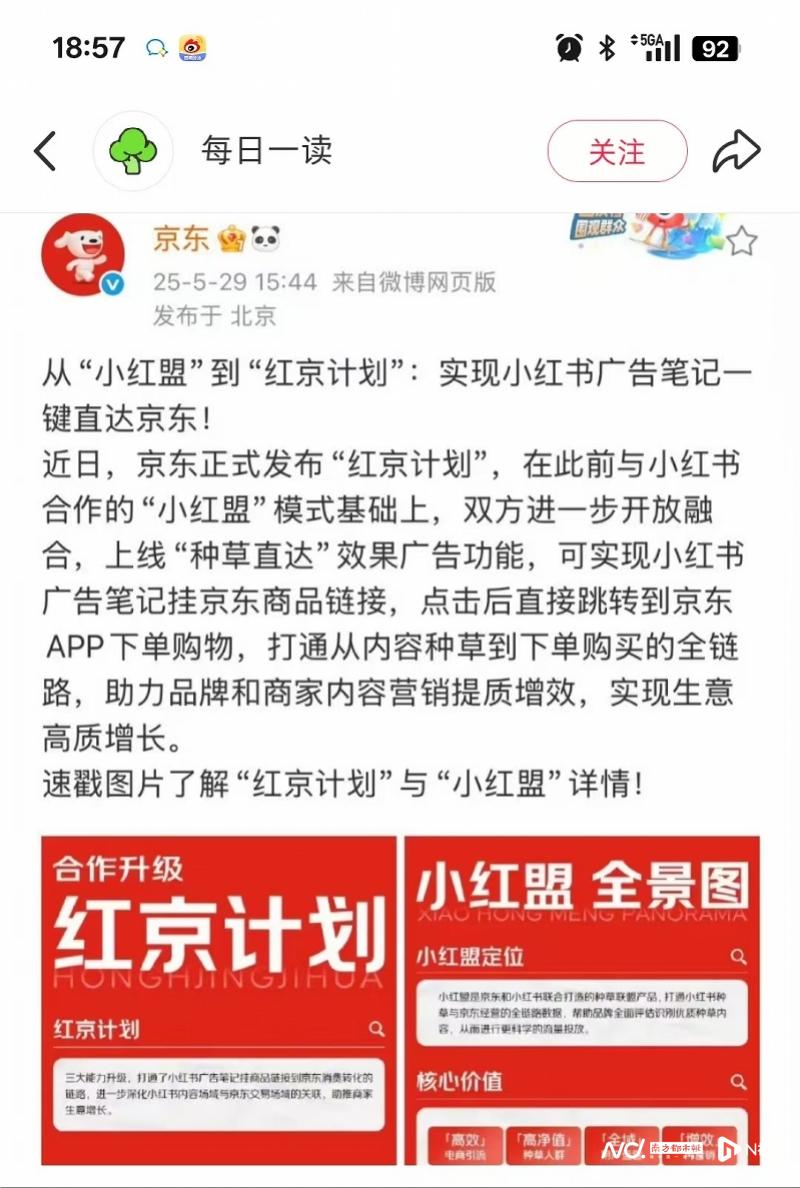
Core Viewpoint - JD.com and Xiaohongshu have upgraded their strategic partnership by launching the "Hongjing Plan," allowing brands on JD.com to use Xiaohongshu's "grass planting direct" feature for advertising, enabling direct links to JD.com for seamless shopping experiences [1][2][6]. Group 1: Partnership Details - The "Hongjing Plan" builds on the previous "Xiaohongmeng" model, enhancing integration between Xiaohongshu and JD.com, allowing for direct links from Xiaohongshu ads to JD.com for immediate purchases [2][6]. - This collaboration aims to create a closed-loop from content marketing to transaction, improving the efficiency of brand and merchant marketing efforts [6]. Group 2: Performance Metrics - Data indicates that the conversion rate for products viewed on Xiaohongshu can increase by an average of 45% through the "Xiaohongmeng" model, with add-to-cart conversion rates improving by an average of 28% [6]. Group 3: Future Collaborations - Xiaohongshu is exploring further collaborations with other e-commerce platforms, raising questions about potential partnerships with platforms like Pinduoduo [7].

消费参考丨餐饮业洗牌加剧:2024年闭店数升至409万家
2 1 Shi Ji Jing Ji Bao Dao· 2025-05-20 01:29
Restaurant Industry Overview - The total revenue of the national catering industry in April increased by 5.2% year-on-year to 416.7 billion yuan, slightly higher than the retail sales growth of 5.1% [1] - However, revenue from catering enterprises above designated size grew by only 3.7% to 123 billion yuan, indicating greater external pressure on larger businesses [1] - The number of restaurant closures has significantly increased, with 4.09 million closures in 2024, resulting in a closure rate of 61.2%, surpassing 2023 levels [1] - Most restaurant categories, except for Western cuisine (up 6%), bakery and desserts (up 5%), and Korean cuisine (up 1%), experienced a decline in store efficiency [1] Pricing and Profitability - Major restaurant brands, including Xiaocaiyuan, Jiumaojiu, and Haidilao, reported a noticeable decline in average customer spending [1] - In Q1 2025, brands like KFC and Pizza Hut also saw further decreases in customer spending [1] - The trend of lowering customer prices is seen as a necessary step for survival in the restaurant business [2] - Profit margins are declining, with Jiumaojiu's revenue at 6.074 billion yuan (up 1.47%) but net profit down 87.69% to 55.81 million yuan, and Xiaobuhua's revenue at 4.755 billion yuan (down 19.65%) with a net loss of 401 million yuan, a 100.88% increase in losses [3] Industry Transformation - The restaurant market is at a critical transformation stage, with companies focusing on cost reduction across the entire supply chain, including store renovations and labor costs [1][4]
AI创变正在发生,一切品类都值得重做一遍
36氪· 2025-03-20 10:50
Core Viewpoint - The article discusses the transformation in e-commerce driven by AI, emphasizing that brands must leverage AI for strategic decision-making to achieve growth and adapt to changing consumer behaviors [1][10]. Group 1: AI's Impact on E-commerce - AI is reshaping the competition logic in e-commerce, moving from budget-based strategies to intelligent decision-making processes [2][6]. - The shift from "experience + tools" to "AI + decision-making" signifies a fundamental change in how brands operate and strategize [4][6]. - AI enables brands to predict market trends and optimize marketing strategies, enhancing operational efficiency and decision-making accuracy [6][10]. Group 2: Case Studies of Successful Brands - Skechers utilized AI to identify a significant demand for "slip-on" shoes among young consumers, allowing them to adjust their marketing strategies and product offerings swiftly [12][14]. - Fenjiu, a traditional liquor brand, successfully engaged younger consumers by creating a new drinking culture and leveraging AI to optimize their marketing strategies, resulting in a 200% increase in GMV [16][18]. - Cotton Era enhanced its brand recognition and consumer engagement through AI-driven strategies, achieving significant growth in new customer conversion rates [20][21]. Group 3: Future Directions and Strategies - The article highlights that AI will continue to play a crucial role in helping brands achieve predictable and efficient growth, with a focus on creating a healthy operating environment for merchants [29][30]. - The integration of AI into brand strategies is seen as essential for navigating the complexities of consumer engagement and market dynamics [30][31].

这51个品牌,凭什么能出爆款?
虎嗅APP· 2025-03-20 10:45
Core Viewpoint - The article discusses how Skechers successfully leveraged AI tools from Alibaba Mama to identify and expand its consumer base for the "Flash Shoes," demonstrating the importance of understanding diverse consumer needs in a rapidly changing market [1][9]. Group 1: AI and Consumer Insights - AI is becoming a crucial tool for brands to predict trends and enhance operational efficiency, allowing them to capture emerging consumer demands effectively [2][3]. - The integration of AI in business operations enables brands to transition from traditional marketing methods to data-driven strategies, enhancing their ability to identify and act on consumer trends [12][20]. Group 2: Changing Consumer Behavior - The emergence of a "new value consumption era" is characterized by consumers increasingly seeking comfort and relaxation, with younger demographics showing a growing interest in these attributes [1][5]. - The 00s generation is redefining consumption patterns, actively engaging with AI technologies to enhance their shopping experiences and making informed decisions based on personalized recommendations [7][18]. Group 3: Case Studies and Success Stories - Skechers' "Flash Shoes" have seen significant success in markets like Europe and Japan, and the brand's collaboration with Alibaba Mama has allowed it to tap into younger consumers who value comfort and versatility [8][9]. - The health brand Zhenyan successfully transitioned from niche products to broader markets by utilizing AI to understand consumer preferences and identify new growth opportunities [12][13]. Group 4: Future Trends and Strategies - Brands must adapt to the fast-paced changes in consumer behavior and preferences, utilizing AI to stay ahead of trends and effectively engage with their target audiences [10][20]. - The article emphasizes the importance of building strong brands that can quickly respond to market changes, with AI serving as a critical component in achieving sustainable growth [19][23].
AI时代,阿里妈妈带领消费品牌“赢新”
36氪未来消费· 2025-03-04 11:36
Core Insights - The consumer market is undergoing a "track change," with consumers increasingly valuing lifestyle, values, and sustainability over mere product functionality [1][2] - Female consumers are emerging as a significant force in the market, demonstrating a clear understanding of their desired lifestyles [2][5] - Brands must adapt to these changing consumer preferences by leveraging AI technology to enhance engagement and understanding [2][6] Consumer Behavior Trends - Z Generation consumers prioritize emotional symbols, health labels, and instant delivery in their purchasing decisions, indicating a shift towards a more diversified definition of value [4] - Factors such as emotional value, health concepts, and situational adaptability are becoming crucial in consumer decision-making [4] Brand Opportunities and Challenges - The 38 promotion event serves as a critical starting point for brands to experiment with new growth strategies, particularly in the context of female consumer engagement [5][6] - Brands that can effectively utilize new technologies to capture consumer needs will gain a competitive edge during market reshuffling [5][6] AI's Role in Consumer Engagement - AI technology is redefining growth logic by enabling brands to identify consumer pain points and accelerate the introduction of new products [6][9] - Successful case studies, such as the home brand Zhi Huashi, demonstrate how AI can enhance marketing strategies and significantly boost sales [9] Case Studies of Successful AI Implementation - Zhi Huashi utilized AI to identify key consumer segments, resulting in a 600% increase in GMV during the pre-sale period [9] - Kailas leveraged AI to expand its target audience and enhance brand storytelling, achieving over 100% GMV growth during the same period [10] - OPPO and Proya effectively used AI to convert transient traffic into loyal customers, with OPPO's new product achieving over 100 million in GMV in its first week [11][12] Future of Brand-Consumer Relationships - AI is transforming the relationship between brands and consumers, allowing for more personalized and meaningful interactions [14][15] - The evolution from resource competition to intelligence competition signifies a shift in market dynamics, emphasizing the importance of understanding consumer needs through AI [15]