
青岛啤酒

Search documents
【干货】啤酒产业链全景梳理及区域热力地图
Qian Zhan Wang· 2026-02-21 06:08
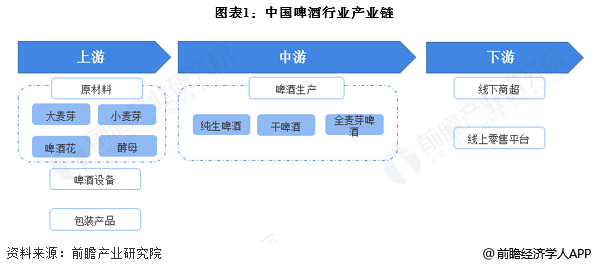
Core Insights - The article discusses the current state of the beer industry in China, highlighting the dominance of major players in the market and the structure of the industry chain [1][5]. Industry Overview - The beer industry in China has a mature supply chain, with upstream suppliers providing raw materials, brewing equipment, and packaging [1]. - Major players in the midstream beer production segment include China Resources Beer, Tsingtao Brewery, Budweiser APAC, Chongqing Beer, and Yanjing Beer, which collectively hold approximately 80% of the market share [1][5]. Supply Chain Structure - Upstream suppliers consist of companies like Angel Yeast and Yongshuntai for raw materials, and CIMC Anrui and Lehui International for brewing equipment [5]. - The downstream market includes physical supermarkets such as Yonghui Supermarket and online retail platforms like Alibaba, JD.com, and Suning [5]. Regional Distribution - The beer industry chain is primarily concentrated in the Guangdong-Hong Kong-Macau Greater Bay Area, followed by Zhejiang, Beijing, and Fujian [7]. - Midstream beer manufacturers are mainly located in the Guangdong-Hong Kong-Macau Greater Bay Area, Shandong, and Chongqing [8]. Investment Trends - A summary of investment activities from 2020 to 2026 in the beer industry indicates various funding rounds and investments in emerging companies [12]. - Notable investment events include multiple funding rounds for companies like Xuanbo Beer and Aigulu, with amounts ranging from millions to tens of millions of RMB [14].





白酒企业仍然青睐春晚舞台,但玩法变了
Xin Lang Cai Jing· 2026-02-18 09:20
Core Viewpoint - The competition for sponsorship of the 2026 CCTV Spring Festival Gala is intensifying among liquor companies, particularly in the white liquor sector, which has a long-standing partnership with the event due to its alignment with the festive atmosphere and consumer behavior during the Spring Festival [1][5]. Group 1: Sponsorship and Marketing Strategies - CCTV has officially announced four white liquor sponsors for the 2026 Spring Festival Gala, with Wuliangye being the most talked-about due to its prominent presence in the magic performance segment [2][4]. - Wuliangye has been the exclusive interactive partner for the "Heavenly Gifts" segment of the Spring Festival Gala for four consecutive years, distributing 136,000 gifts valued at 100 million yuan during the event [4]. - Yanghe has been the exclusive timekeeping partner for the seventh consecutive year, while Gujinggongjiu and Langjiu also maintain significant sponsorship roles [4][5]. Group 2: Industry Trends and Consumer Behavior - The number of white liquor sponsors for the 2026 Spring Festival Gala has increased by one compared to the previous year, indicating sustained enthusiasm for sponsorship despite economic pressures [5]. - White liquor companies are increasingly focusing on creative and engaging marketing strategies, moving beyond traditional advertising to more integrated product placements in various segments of the gala [5][6]. - Local television stations are also seeing increased collaboration with liquor companies, showcasing a broader marketing strategy that emphasizes regional brand recognition and consumer engagement [5][6]. Group 3: Financial Performance and Market Challenges - The financial outlook for white liquor companies is challenging, with significant profit declines reported by major players such as Yanghe and Kweichow Moutai, indicating a tough market environment [6][8]. - Despite the high costs associated with sponsoring the Spring Festival Gala, companies view it as a strategic investment to maintain brand visibility and consumer engagement during a period of economic downturn [6][10]. - The industry is shifting towards more cost-effective marketing strategies, focusing on key moments and channels that can directly influence sales, rather than relying solely on broad advertising campaigns [10].





果然视频|青岛啤酒连世界,举杯共庆中国年
Qi Lu Wan Bao· 2026-02-15 07:00
Group 1 - The core message emphasizes Qingdao Beer as a symbol of Chinese culture, connecting people globally during the Chinese New Year celebration [1] - Qingdao Beer aims to evoke feelings of nostalgia and connection among Chinese people worldwide, highlighting its role in festive gatherings [1]

青岛啤酒:公司已于2024年成立了财务共享中心
Zheng Quan Ri Bao· 2026-02-13 09:39
Group 1 - The company has established a financial shared service center in 2024, focusing on centralized accounting and fund settlement processing [1] - Some units have already gone live on the shared platform, with the remaining units being implemented in an orderly manner [1]
食品饮料行业双周报(2026、01、30-2026、02、12):预制菜国标公开征求意见,关注春节需求表现-20260213
Dongguan Securities· 2026-02-13 07:33
食品饮料行业 超配(维持) 食品饮料行业双周报(2026/01/30-2026/02/12) 预制菜国标公开征求意见,关注春节需求表现 2026 年 02 月 13 日 投资要点: ◼ 风险提示:原材料价格波动、产品提价不及预期、渠道开展不及预期、 行业竞争加剧、食品安全风险、宏观经济波动风险等。 本报告的风险等级为中风险。 本报告的信息均来自已公开信息,关于信息的准确性与完整性,建议投资者谨慎判断,据此入市,风险自担。 请务必阅读末页声明。 行 业 周 报 分析师:黄冬祎 SAC 执业证书编号: S0340523020001 电话:0769-22119410 邮箱: huangdongyi@dgzq.com.cn ◼ 行情回顾:1月30日-2月12日,SW食品饮料行业指数整体下跌0.95%,板 块涨幅位居申万一级行业第二十四位,跑输同期沪深300指数约0.23个 百分点。细分板块中,多数细分板块跑输沪深300指数。其中,调味品板 块上涨0.64%,板块涨幅最大;其他酒类板块跌幅最大,为6.40%。 ◼ 行业周观点:预制菜国标公开征求意见,关注春节需求表现。白酒板块: 受房地产政策、飞天动销、市场风格切换等因 ...
中泰国际每日晨讯-20260213
ZHONGTAI INTERNATIONAL SECURITIES· 2026-02-13 02:22
Market Overview - On February 12, Hong Kong stocks opened lower and closed down, with the Hang Seng Index falling 233 points (0.8%) to close at 27,032 points[1] - The Hang Seng Tech Index dropped 91 points (1.6%) to close at 5,408 points, with total market turnover increasing to HKD 238.7 billion[1] - Southbound capital saw a net inflow of HKD 4.57 billion, down from the previous day's net inflow of HKD 4.82 billion[1] Company Performance - Tencent (700 HK) fell 2.3% to a six-month low, with a year-to-date decline of over 8% due to perceived lag in AI development compared to competitors like ByteDance and Alibaba[1] - SenseTime (20 HK) surged 6.7%, while Zhizhu (2513 HK) rose 28.7% after releasing a new flagship model[1] - Lenovo Group (992 HK) reported a 36% year-on-year increase in adjusted net profit for Q3, yet its stock price fell 4.6%[1] U.S. Market Insights - Initial jobless claims in the U.S. decreased from 232,000 to 227,000, slightly above expectations, while continuing claims rose to 1.862 million, exceeding the expected 1.85 million[2] - The Dow Jones Index fell 669 points (1.3%) to 49,451 points, the Nasdaq dropped 469 points (2.0%) to 22,597 points, and the S&P 500 declined by 108 points to 6,832 points[2] - Gold and silver prices fell by 3% and 8%, respectively, as investors awaited inflation data[2] Macro Dynamics - The China Passenger Car Association reported a 13.9% year-on-year decline in retail sales of passenger cars in January, with new energy vehicle sales down 20.0%[3] - The decline was attributed to market factors and adjustments in the new energy vehicle purchase tax policy[3] Industry Trends - In the consumer sector, Budweiser APAC (1876 HK) reported a 4.2% year-on-year decline in revenue for Q4, with an adjusted EBITDA drop of 24.7%, leading to a 5.2% stock price decrease[4] - The healthcare sector saw the Hang Seng Healthcare Index drop 1.4%, with WuXi Biologics (2269 HK) down 0.1% despite strong project acquisition capabilities[4] - The renewable energy and utilities sector experienced gains, with notable increases in stock prices for Dongfang Electric (1072 HK) by 12.4% and Harbin Electric (1133 HK) by 13.7%[5]
未知机构:交易台高盛香港市场综述恒指09国企指数09-20260213
未知机构· 2026-02-13 02:05
Summary of Key Points from the Conference Call Industry Overview - The focus is on the Hong Kong stock market, specifically the Hang Seng Index, which decreased by 0.9%, along with the Hang Seng Tech Index, which fell by 1.7% [1][2] - The market experienced a pullback after three consecutive days of gains, with concerns about the impact of AI and competition within the industry [1] Core Insights and Arguments - The Hang Seng Tech Index faced significant pressure from two main catalysts, leading to a decline in performance [2] - Southbound capital saw a slight increase in buying activity, but its trading volume remained around 20% of total transactions [2] - Short positions underperformed compared to the Hang Seng Index, indicating pressure on some short sellers [3] - The A-share market exhibited indecisiveness ahead of the holiday, reflecting cautious market sentiment [3] Company-Specific Highlights - Lenovo's stock dropped by 4.6% after reporting a revenue increase to $22.2 billion, which was better than expected, but net profit for the December quarter fell by 21% [4] - Meituan's performance declined by 4.5%, influenced by Alibaba's increased investment in instant shopping and heightened industry competition [4] - NetEase's stock fell due to underwhelming game sales [5] - The consumer staples sector weakened, particularly beverage stocks like Budweiser APAC (-5.2%) and Tsingtao Brewery (-3.1%), primarily due to technical corrections [5] Other Important Insights - The materials sector showed strong performance driven by rising gold and lithium prices [5] - The industrial sector saw gains in logistics and equipment stocks [6] - The trading desk recorded significant buying activity in the mining and materials sectors, particularly in Zijin Mining [3]
青岛啤酒借助人工智能技术,实现全流程数据畅通 搭建与时间赛跑的极速保鲜链
Ren Min Ri Bao· 2026-02-12 22:24
Core Insights - Qingdao Beer, with over 100 years of history, is leveraging artificial intelligence technology to enhance its production and distribution processes, creating a more efficient supply chain [1] Group 1: Production Innovations - The brewery has established seven intelligent management systems utilizing IoT, AI, and big data, which differ from traditional brewing methods, allowing for rapid response in production [2] - An intelligent scheduling system automates production planning and interacts with material delivery systems to specify the types, quantities, and timing of required raw materials [2] - The production line can quickly switch between over 500 different product varieties, reducing the time for product changeovers by 70% and shortening order delivery times by 50% [2] - Production efficiency has increased by 60%, and carbon emissions density in the factory has decreased by 40% over three years [2] Group 2: Logistics and Warehousing - The brewery's intelligent vertical warehouse, standing 34 meters tall, utilizes robots and automated systems for efficient inventory management, handling over 200,000 boxes daily [3] - The system allows for automatic binding of products to orders and delivery vehicles, facilitating rapid dispatch to consumers [3]
青岛啤酒:青岛啤酒产品长期出口欧洲市场,在当地主要通过合资公司面向当地经销商开展产品销售业务
Zheng Quan Ri Bao Zhi Sheng· 2026-02-12 13:40
Core Viewpoint - Qingdao Beer is recognized as the most well-known Chinese brand in the international market, focusing on high quality, high price, and high visibility in its branding strategy [1] Group 1: Brand Strategy - The company emphasizes internationalization and interactive brand promotion to enhance its global market presence [1] - Qingdao Beer continues to innovate in distribution channels to expand its overseas market coverage [1] Group 2: Sales and Market Presence - The proportion of overseas export products in total sales remains relatively small for the company [1] - Qingdao Beer has a long-standing presence in the European market, primarily selling products through joint ventures with local distributors [1]
低度酒掀起风潮,“渠道保真”成关键
Xin Jing Bao· 2026-02-11 08:48
Core Insights - The Spring Festival is a traditional peak season for alcohol consumption, serving as a trend indicator for the industry [1] - Consumers are increasingly favoring high-quality, well-known brands, with a shift towards lower-alcohol beverages among younger generations [4][5] - The market for zodiac-themed alcohol is also thriving, with brands integrating cultural and artistic elements into their products [7][8] Group 1: Consumer Trends - Consumers are opting for "drink less, drink better," leading to a rise in sales of core products from top brands [1] - The demand for low-alcohol beverages is increasing, with sales of low-alcohol wines and beers seeing significant growth, such as a 714% increase in sales of bulk and mixed-pack wines [4][6] - The trend of "self-indulgence" among younger consumers is driving the popularity of health-oriented and low-alcohol drinks [4][5] Group 2: Pricing and Sales Dynamics - The white liquor industry is undergoing a deep adjustment, with significant price reductions observed; for instance, the price of 53-degree 500ml Moutai has dropped to between 1600 and 1800 yuan, down from over 2000 yuan last year [2] - Consumers are increasingly choosing core products priced around 600 to 700 yuan, benefiting from the wider selection due to price reductions [2] - Online channels are becoming crucial for alcohol sales, with brands enhancing partnerships with e-commerce platforms to ensure product authenticity [3] Group 3: Zodiac Alcohol and Cultural Elements - Zodiac-themed alcohol is experiencing a sales boom, with brands releasing limited-edition products that emphasize cultural significance and artistic value [7][9] - Moutai's zodiac series has seen prices fluctuate, with the retail price of the Moutai zodiac wine being significantly lower than previous years, yet still commanding a premium in the market [7][8] - The design of zodiac alcohol incorporates traditional Chinese cultural elements, appealing to consumers' desire for unique and meaningful gifts [8][9]