国电南瑞

Search documents
每日快报!中国充电联盟:2025年全国充电基础设施增量为727.4万个 同比上升72.3%
Zhi Tong Cai Jing· 2026-01-21 13:05
Core Insights - The charging infrastructure in China is projected to see significant growth in 2025, with an increase of 7.274 million units, representing a year-on-year rise of 72.3% [2] - Public charging facilities are expected to grow by 1.138 million units, a 33.4% increase, while private charging facilities will see a rise of 6.136 million units, up 82.2% [2] Charging Infrastructure Overview - By the end of December 2025, the total number of electric vehicle charging infrastructure (guns) in China is expected to reach 20.092 million, a 49.7% increase year-on-year, surpassing the 20 million mark [2] - Public charging facilities (guns) will total 4.717 million, a 31.9% increase, with a total rated power of 220 million kilowatts, averaging about 46.53 kilowatts per unit [2] - Private charging facilities (guns) will reach 15.375 million, a 56.2% increase, with a total installed capacity of 134 million kilovolt-amperes [2] Regional Distribution - The top 10 regions (Guangdong, Zhejiang, Jiangsu, Shandong, Shanghai, Henan, Anhui, Sichuan, Hubei, Fujian) account for 65.7% of the public charging facilities [3] - The majority of charging electricity is concentrated in Guangdong, Jiangsu, Hebei, Sichuan, Zhejiang, Shanghai, Shandong, Fujian, Henan, and Shaanxi, primarily serving buses and passenger vehicles [3] Charging Volume and Growth - The total charging electricity in China is projected to reach approximately 9.07 billion kilowatt-hours by December 2025, reflecting a year-on-year increase of 53.4% and a month-on-month increase of 7.4% [3] Operator Landscape - The top 15 charging operators account for 82.2% of the total charging piles, with notable operators including Telai Electric (899,000), Star Charging (732,000), and Yun Kuai Charge (700,000) [3] - The remaining operators make up 17.8% of the total [3] Comparison with Electric Vehicle Sales - In 2025, the increase in charging infrastructure is expected to be 7.274 million units, while domestic sales of new energy vehicles are projected at 13.875 million units, indicating a charging pile to vehicle ratio of 1:1.9, which suggests that charging infrastructure development is keeping pace with the rapid growth of new energy vehicles [4]


中国充电联盟:2025年全国充电基础设施增量为727.4万个 同比上升72.3%
智通财经网· 2026-01-21 12:37
Core Insights - The charging infrastructure in China is experiencing significant growth, with a total increase of 7.274 million charging points in 2025, representing a year-on-year increase of 72.3% [1] - Public charging facilities have also seen substantial growth, with an increase of 1.138 million units, a 33.4% year-on-year rise, while private charging facilities increased by 6.136 million units, up 82.2% year-on-year [1] Charging Infrastructure Overview - By the end of December 2025, the total number of electric vehicle charging points in China reached 20.092 million, a 49.7% increase year-on-year, surpassing the 20 million mark [1] - Public charging points accounted for 4.717 million, a 31.9% increase, with a total rated power of 220 million kilowatts, averaging approximately 46.53 kilowatts per point [1] - Private charging points reached 15.375 million, reflecting a 56.2% year-on-year growth, with a total installed capacity of 134 million kilovolt-amperes [1] Regional Distribution - The top 10 regions for public charging facility construction, including Guangdong, Zhejiang, and Jiangsu, account for 65.7% of the total [2] - The majority of charging electricity is concentrated in provinces such as Guangdong, Jiangsu, and Hebei, primarily serving buses and passenger vehicles, with a smaller share for other vehicle types [2] Operational Insights - As of December 2025, the top 15 charging operators in China manage a total of 82.2% of the charging points, with the leading operators being Telecharge (899,000), Star Charge (732,000), and Yun Kuai Charge (700,000) [2] - The total charging electricity in December 2025 was approximately 9.07 billion kilowatt-hours, marking a year-on-year increase of 53.4% and a month-on-month increase of 7.4% [2] Comparison with Electric Vehicle Sales - In 2025, the increase in charging infrastructure was 7.274 million, while domestic sales of new energy vehicles reached 13.875 million, indicating a charging point to vehicle ratio of 1:1.9, which suggests that the growth in charging infrastructure is keeping pace with the rapid development of new energy vehicles [3]
柔性直流输电概念下跌0.94%,9股主力资金净流出超亿元
Zheng Quan Shi Bao Wang· 2026-01-21 09:18
Group 1 - The flexible DC transmission concept declined by 0.94%, ranking among the top declines in the concept sector, with companies like Electric Power Research Institute, Shuangjie Electric, and Baobian Electric experiencing significant drops [1] - Among the 18 stocks that rose, Hanlan Co., Highlan Co., and Farah Electronics saw increases of 7.77%, 3.86%, and 3.38% respectively [1] - The flexible DC transmission sector experienced a net outflow of 3.41 billion yuan, with 43 stocks seeing net outflows, and 9 stocks exceeding 100 million yuan in net outflows [2] Group 2 - The top net outflow stock was Tebian Electric, with a net outflow of 1.27 billion yuan, followed by China West Electric, Guodian Nari, and Baobian Electric with net outflows of 409 million yuan, 261 million yuan, and 224 million yuan respectively [2] - The stocks with the highest net inflow included Hengtong Optic-Electric, Farah Electronics, and Far East Co., with net inflows of 137 million yuan, 76.84 million yuan, and 61.17 million yuan respectively [2][4] - The flexible DC transmission concept saw significant declines in individual stocks, with notable drops including Shuangjie Electric at -7.10%, Baobian Electric at -5.17%, and Electric Power Research Institute at -8.43% [3][4]


国内外电网投资景气共振,推动电网设备需求快速增长
AVIC Securities· 2026-01-21 05:23
Investment Rating - The investment rating for the industry is "Overweight" [1][28]. Core Insights - Domestic and international grid investment trends are resonating, leading to rapid growth in demand for grid equipment during the 14th Five-Year Plan period [2]. - The aging of power grids in developed countries is driving a strong demand for global grid upgrades and renovations [3]. - The ongoing AI infrastructure development is expected to generate a demand for electrical equipment worth hundreds of billions [4]. - The domestic grid is accelerating its transformation to support the construction of a new power system, which is likely to boost demand for domestic electrical equipment [6]. Summary by Sections Section: Investment Trends - The mismatch between renewable energy investments and grid investments during the 14th Five-Year Plan is setting the stage for unprecedented levels of domestic grid investment and upgrades [2]. - From 2019 to 2023, domestic grid investment growth rates lagged behind power generation projects, but a reversal is expected starting in 2024 [12]. Section: Global Market Dynamics - The International Energy Agency (IEA) forecasts significant global grid investment needs, with a projected investment of 5,840 billion by 2030 [3]. - The global data center electricity consumption is expected to grow significantly, with a compound annual growth rate (CAGR) of 14.7% from 2024 to 2030 [26]. Section: Future Projections - The demand for AIDC (Artificial Intelligence Data Center) distribution systems is projected to range from 863 to 2,878 billion from 2025 to 2030 [27]. - The UPS (Uninterruptible Power Supply) market is expected to see a market space of 385 to 1,284 billion during the same period [27].
9亿资金盘中继续抢筹!百亿规模电网设备ETF(159326)单日“吸金”27亿,居全ETF市场第一,近9日净流入94亿
Ge Long Hui A P P· 2026-01-21 03:11
Group 1 - The core viewpoint of the news highlights the significant inflow of funds into the electric grid equipment ETF, which has seen a net subscription of 5.15 billion shares and an estimated net subscription of 918 million yuan, marking a continuous trend of investment in this sector [1] - The electric grid equipment ETF has experienced a total net inflow of over 9.4 billion yuan over the past nine days, reaching a new high in total scale of 14.506 billion yuan, making it the largest ETF in the electric grid industry [1] - The State Grid has announced a fixed asset investment of 4 trillion yuan during the 14th Five-Year Plan, while the Southern Power Grid is expected to invest around 1 trillion yuan, leading to a total investment of nearly 5 trillion yuan in the industry over the next five years, significantly exceeding previous plans [2] Group 2 - The North American market is witnessing a surge in demand for electrical equipment driven by aging infrastructure and the electricity needs of AI data centers, with exports of transformers, high-voltage switches, and wires from China expected to see double-digit growth by 2025 [2] - Leading companies in the electrical equipment export sector, such as Siyi Electric, are projected to exceed market expectations for their 2025 performance, with a forecasted year-on-year increase of 79% in net profit for Q4 2025 [2] - The electric grid equipment ETF tracks the CSI Electric Grid Equipment Theme Index, with key weighted stocks including State Grid NARI (a leader in smart grid technology), TBEA (a core supplier of ultra-high voltage equipment), and Siyi Electric (focused on R&D and manufacturing of electrical equipment) [2]

电力设备-重申重视国网两会行情-关注主配网投资机会
2026-01-21 02:57
Summary of Conference Call on Power Equipment Industry Industry Overview - The National Grid's overall investment during the 14th Five-Year Plan (2021-2025) is expected to have a compound annual growth rate (CAGR) of 5.5% to 6% during the 15th Five-Year Plan (2026-2030), with potential dynamic adjustments [1][4] - Total investment is projected to be at least 450 billion to 500 billion yuan, including at least 16 DC and approximately 20 AC lines [1][4] - The investment growth rate for the main grid is expected to outpace that of the distribution network, with a significant acceleration in ultra-high voltage (UHV) construction [1][4] Key Investment Areas - **Main Grid Investment**: - Expected to increase from 45% in 2025 to 47%-48% in 2026, with UHV investment growth exceeding 10% [2] - Non-UHV main grid investment is also anticipated to grow rapidly [2] - **Distribution Network Investment**: - Focused on three main areas: 1. Upgrading old equipment, including transformers and switches 2. Enhancing reliability, particularly in rural and urban areas 3. Increasing capacity for distributed photovoltaic systems through transformer upgrades [5][6] Specific Projects and Developments - In 2026, several new UHV projects are set to begin construction, including those in Sichuan and other regions [4] - The investment in secondary equipment for the distribution network is critical, with less than 15% coverage of smart terminals in rural areas, necessitating significant investment in metering, communication, and monitoring equipment [3][8] Notable Companies and Growth Potential - **Main Grid Companies**: - Key players include Pinggao Electric, XJ Electric, China XD Electric, Guodian NARI, TBEA, and Sifang Electric, all of which have significant advantages in UHV technology [3][9] - Expected profit growth rates for 2026: - Pinggao Electric: 20% due to strong orders for 1,000 kV equipment [9][10] - XJ Electric: 15% with a doubling of revenue from UHV projects [9][10] - China XD Electric: 15% with successful bids for major projects [9][10] - Guodian NARI: 10% with new core components contributing to performance [9][10] - TBEA: Close to 20% growth due to breakthroughs in the National Grid sector [9][10] - Sifang Electric: 45% growth expected due to increased market share [9][10] - **Distribution Network Companies**: - Recommended companies include Samsung Medical and Oriental Electronics, with Samsung being a leader in distribution and Oriental focusing on digitalization [3][9] Investment Opportunities and Risks - The distribution network presents substantial investment opportunities, particularly in the latter half of the 15th Five-Year Plan, with a need for structural improvements in weak supply networks [8] - Companies with technological advantages and comprehensive solutions are expected to benefit from the increasing investment in the grid [7] Conclusion - The power equipment industry is poised for significant growth driven by government investment in both the main and distribution networks, with specific companies positioned to capitalize on these trends through their technological capabilities and market strategies [4][9]
十五五电网投资观点梳理
2026-01-21 02:57
Summary of Key Points from Conference Call Records Industry Overview - The focus is on the electric power industry, specifically the initiatives and investments by the State Grid Corporation of China (SGCC) to enhance the electric grid infrastructure and support renewable energy projects [1][2]. Core Insights and Arguments - **Investment Plans**: In 2026, SGCC plans to invest 4 trillion yuan in fixed assets, a significant increase from 2.85 trillion yuan during the previous five-year period, marking a new phase of high-intensity construction aimed at building a new power system to adapt to renewable energy and carbon neutrality goals [2]. - **Strengthening the Grid Platform**: SGCC aims to enhance the grid platform by focusing on UHV (Ultra High Voltage) construction to support the development of wind and solar resources in the western regions and hydropower projects in the southwest. Key equipment such as transformers, GIS (Gas Insulated Switchgear), and converters will see increased demand, benefiting companies like Pinggao Electric, China XD Electric, and XJ Electric [1][4]. - **Improving Regulation Capabilities**: SGCC is investing in virtual power plants, energy storage technologies, and digital upgrades of distribution networks, with a focus on smart terminals and automated distribution systems. Companies like Dongfang Electronics and Sifang Co. are expected to benefit from these investments [1][5]. - **Technological Empowerment**: The company is actively investing in technologies such as drone inspections and AI applications to enhance operational capabilities. Companies like Dongfang Electronics and Sifang Co. are positioned to benefit from these technological advancements [1][6][7]. - **Electric IT and Software Development**: A robust software platform is essential for digital transformation in areas like scheduling, marketing, and asset management. Companies like State Grid Information and Yuanguang Software are expected to benefit from these developments [1][8]. Additional Important Insights - **Global Market Opportunities**: There is a strong demand for electric equipment globally, particularly in North America and Southeast Asia, which presents significant growth opportunities for Chinese companies. The focus should be on capturing new cyclical development opportunities in these markets [3][9]. - **Space Photovoltaics Investment Logic**: The investment logic in space photovoltaics includes reduced launch costs due to commercial space advancements, increased power output per satellite, and the application of new technologies. Companies like Junda and Dongfang Risheng are leading in this field [3][10][11]. - **AIDC Power Trends**: The tightening of power supply in North America has led to increased electricity prices, driven by the demand from data centers. This trend is expected to continue, providing growth opportunities for Chinese power supply companies entering the North American market [3][12]. - **Investment Themes**: Current market themes include space photovoltaics, AIDC power, and solid-state batteries, which have clear long-term demand and investment value. The recent electric grid investment plans are likely to boost related equipment markets in the short term [3][13].
风-光-储-电网年度投资策略
2026-01-21 02:57
Summary of Key Points from Conference Call Records Industry Overview - The global energy storage market is experiencing rapid growth, with an expected new installed capacity of 233 GWh by 2026 and a compound annual growth rate (CAGR) exceeding 37% over the next three years. Independent storage accounts for approximately 78% of this capacity, primarily located in Ningxia and Shanxi [1][8][9]. - North America’s AIDC (Artificial Intelligence Data Center) storage demand is projected to surge from 8.9 GWh in 2025 to 190 GWh by 2030, with a remarkable CAGR of 84%. The green electricity direct connection model is favored for its quick delivery and economic benefits [1][12]. - The European energy storage market is driven by both large-scale and commercial storage, with an anticipated overall installed capacity of 29.7 GWh by 2025, representing a 30% year-on-year increase, and expected to reach 118 GWh by 2029 [1][13]. - Domestic grid investment is expected to exceed 1 trillion yuan annually, while international investment is projected to reach 4 trillion yuan. The acceleration of ultra-high voltage projects in 2026 will enhance the main distribution network's performance [1][3]. Investment Recommendations - The preferred investment order in the wind, solar, storage, and grid sectors is: storage, grid, wind, and solar. Storage is primarily driven by strong domestic and international policies and market demand [2]. - Large-scale storage is identified as a core growth area, with significant projects expected to materialize in North America and Europe within the next 3-5 years [2]. Key Developments in Specific Sectors Energy Storage - The internal rate of return (IRR) for independent storage remains attractive, with a projected IRR of 18% under standard assumptions [1][9]. - The demand for commercial and industrial storage is shifting from traditional pricing arbitrage to a multi-revenue model, including spot market trading and capacity compensation [10]. Wind Power - The wind power industry is expected to maintain a favorable competitive landscape, with a continued trend of rising volume and price in 2026. Both offshore and overseas wind power markets present significant opportunities [1][6]. - The global wind power sector is projected to grow at a CAGR of 27% from 2025 to 2030, with China and Europe leading the way [18]. Solar Power - The solar industry is focusing on countering internal competition and the impact of rising component prices, with some prices reaching 0.8 yuan per watt. Technological breakthroughs such as perovskite and reduced silver usage are expected to accelerate cost reductions [4][7]. - The cancellation of export tax rebates in April 2026 is anticipated to increase export costs for companies, potentially reducing internal competition among Chinese firms [22]. Emerging Markets and Global Trends - Emerging markets, particularly in Australia, are receiving policy support for renewable energy and storage, with a target of 82% renewable energy by 2030 [15]. - Chinese companies are accelerating their international expansion, with expected shipments of energy storage systems reaching 400 GWh by 2025, a 60% increase year-on-year [16]. Conclusion - The energy sector is poised for significant growth driven by technological advancements, favorable policies, and increasing demand across various markets. Key players in storage, wind, and solar sectors are recommended for investment consideration, particularly those with strong international expansion strategies.
铜:市场避险,价格承压
Guo Tai Jun An Qi Huo· 2026-01-21 02:30
商 品 研 究 2026 年 01 月 21 日 铜:市场避险,价格承压 季先飞 投资咨询从业资格号:Z0012691 jixianfei@gtht.com 【基本面跟踪】 铜基本面数据 | | | 昨日收盘价 | 日涨幅 | 昨日夜盘收盘价 | 夜盘涨幅 | | --- | --- | --- | --- | --- | --- | | | 沪铜主力合约 | 101,230 | 0.05% | 99930 | -1.28% | | | 伦铜3M电子盘 | 12,797 | -1.47% | - | - | | | | 昨日成交 | 较前日变动 | 昨日持仓 | 较前日变动 | | 期 货 | 沪铜指数 | 335,565 | -128,098 | 634,562 | 7,401 | | | 伦铜3M电子盘 | 27,891 | 7,244 | 326,000 | -589 | | | | 昨日期货库存 | 较前日变动 | 注销仓单比 | 较前日变动 | | | 沪铜 | 148,193 | -4,462 | - | - | | | 伦铜 | 156,300 | 8,875 | 30.58% | -2.35% ...
寒潮天气能源保障“不打烊” 多举措“组合拳”攒足保暖保供“底气”
Yang Shi Wang· 2026-01-21 02:21
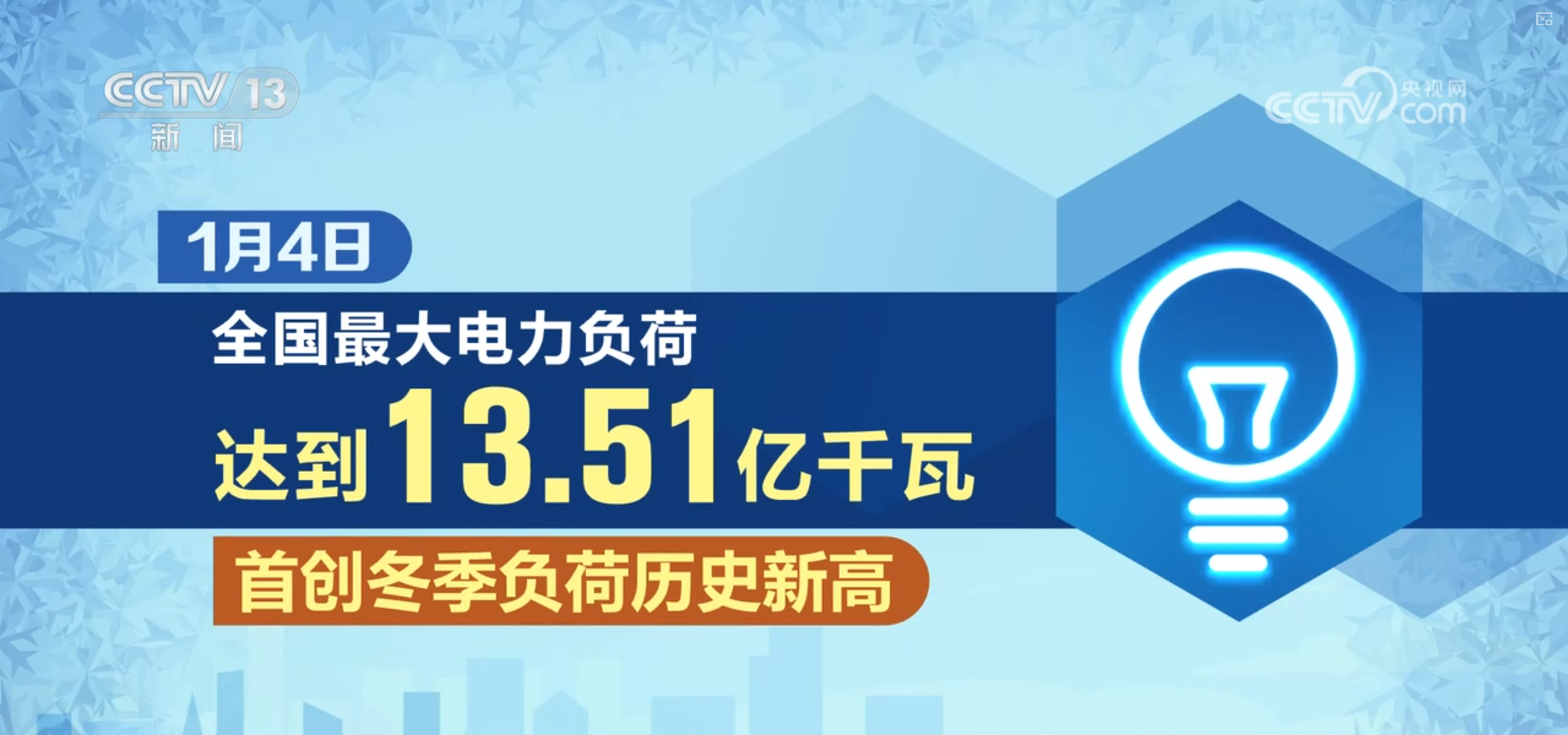
Group 1: Electricity Demand - The national electricity load has reached historical highs this winter, with the maximum load hitting 1.417 billion kilowatts on January 20, 2026 [3] - The electricity load has increased rapidly due to a cold wave, with significant milestones including 1.379 billion kilowatts on January 19 and 1.351 billion kilowatts on January 4 [3] - Since the beginning of January, daily electricity consumption has remained high, surpassing 30 billion kilowatt-hours for the first time on January 5 [5] Group 2: Natural Gas Supply - The main natural gas pipeline network has also seen record supply levels, with a daily supply reaching 1.067 billion cubic meters on January 20 [8] - In Shandong, the daily natural gas download volume surged to over 79 million cubic meters, marking a 39% increase and setting a new daily record [10] - The national gas network is under pressure to ensure supply amid the cold wave, with operational measures being taken to maintain system stability and prevent equipment freezing [11][13]