易方达基金

Search documents
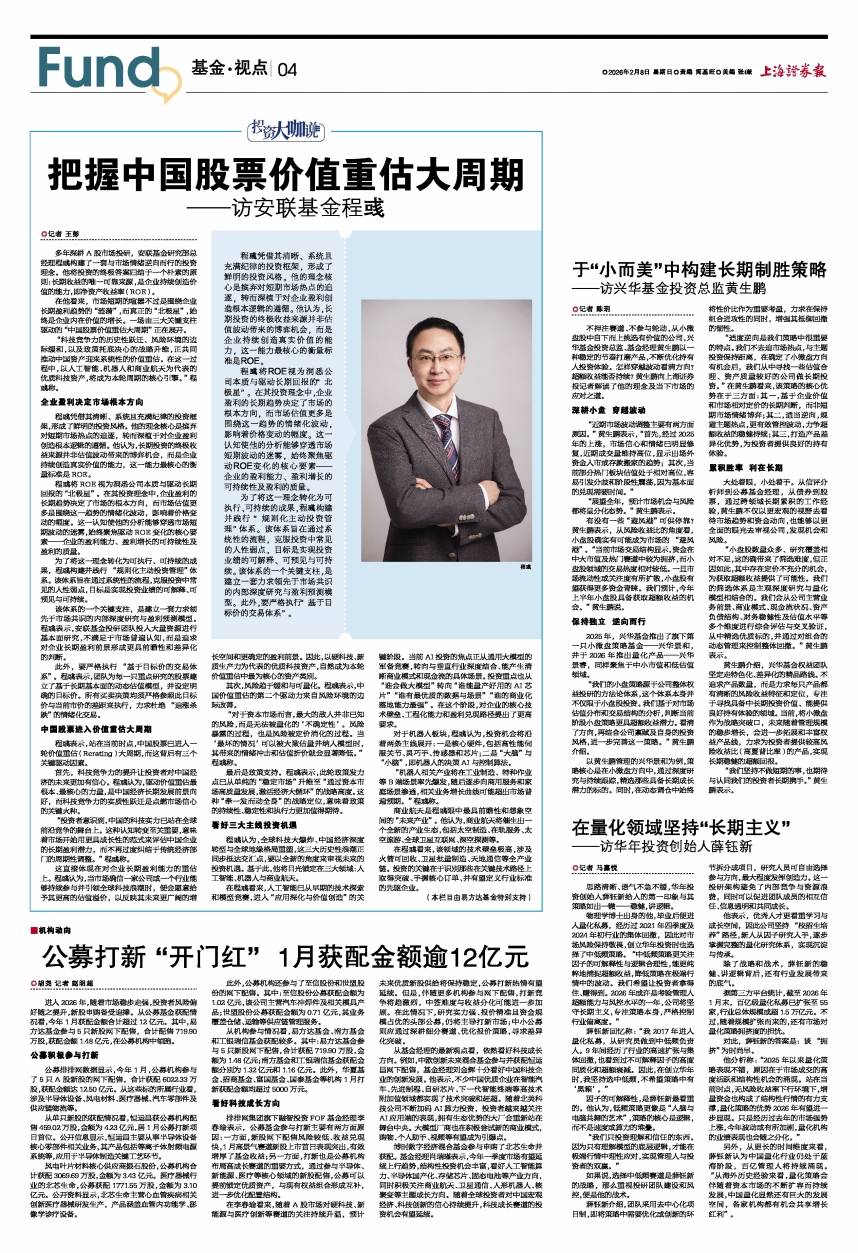
投资大咖说 | 把握中国股票价值重估大周期——访安联基金程彧
Sou Hu Cai Jing· 2026-02-09 02:06
Core Viewpoint - The investment philosophy emphasizes long-term value creation over short-term market trends, with a focus on Return on Equity (ROE) as the key metric for assessing a company's intrinsic value and long-term returns [1][15][16] Investment Philosophy - The investment framework is characterized by a disciplined approach that avoids chasing short-term market fads and instead focuses on the fundamental logic of corporate profit generation [1][15] - ROE is viewed as the "North Star" for understanding a company's essence and driving long-term returns, with a focus on the sustainability and quality of profit growth [1][16] - The investment strategy aims to overcome common behavioral biases in investing through a systematic process, ensuring that investment performance is explainable, predictable, and sustainable [14][17] Market Dynamics - A significant "re-rating" cycle for Chinese stocks is underway, driven by three key factors: the enhancement of technological competitiveness, the improvement of the risk environment, and supportive government policies [18][19] - The rise in technological competitiveness has instilled greater confidence in the future of the Chinese economy, leading to a reassessment of corporate long-term profit potential [18][19] - The improvement in the risk environment allows for better quantification of risks, reducing emotional shocks and valuation discounts in the market [19] Investment Opportunities - The focus is on three main investment themes: artificial intelligence, robotics, and commercial aerospace, which are seen as pivotal in the current economic landscape [20] - In artificial intelligence, the investment focus has shifted from general model competition to specific applications that generate clear business models and cash flows [21] - The robotics sector presents opportunities in core hardware and decision-making AI, with expectations of rapid growth in industrial and commercial applications [21][22] - Commercial aerospace is viewed as a future industry with high barriers to entry, requiring identification of companies that achieve breakthroughs in key technologies and hold significant orders [22]

恒生科技指数“越跌越买”,近5日净流入超69亿元
Jing Ji Wang· 2026-02-09 02:06
Market Overview - The A-share market saw a rebound with the Shanghai Composite Index returning to 4100 points, while the ChiNext Index experienced a recovery after hitting a low [1] - The coal sector showed significant gains, and the space photovoltaic concept stocks continued their upward trend, whereas AI application stocks declined [1] ETF Market Dynamics - The stock ETF market experienced a net outflow of approximately 1.6 billion yuan, with notable outflows from products like the Huatai-PB CSI 300 ETF and the CSI 500 ETF [1] - The total scale of the stock ETF market reached 4.15 trillion yuan, with the Hang Seng Technology Index seeing a net inflow of 2.884 billion yuan, marking it as the top sector for fund inflows [3][5] Fund Inflows and Outflows - The top three ETFs by net inflow included the Hang Seng Technology Index ETF (1.021 billion yuan), the Hang Seng Internet ETF (957 million yuan), and the Sci-Tech 50 ETF (910 million yuan) [4] - The Huatai-PB CSI 300 ETF experienced the largest net outflow at 2.597 billion yuan, followed by the CSI 500 ETF with 1.662 billion yuan [8] Fund Management Insights - Leading fund companies like E Fund and Huaxia Fund reported significant net inflows across their ETFs, with E Fund's total ETF scale reaching 655.65 billion yuan, reflecting a net inflow of 2.33 billion yuan [5] - The market remains active with a high trading volume, particularly in the context of approaching the Chinese New Year holiday, indicating sustained liquidity support [9]

【读财报】公募基金发行透视:1月新发基金约1202亿元 广发基金、华宝基金等旗下产品发行规模居前
Sou Hu Cai Jing· 2026-02-09 01:30
Group 1 - The total issuance scale of public funds in January 2026 reached approximately 120.21 billion yuan, representing a year-on-year increase of 39.28% and a month-on-month increase of 5.06% [2][4] - A total of 123 fund products were issued in January, excluding transformed and subdivided funds [2] - The largest issuance scale was for mixed funds, exceeding 50 billion yuan, with specific products like GF Research Smart Selection and Hua Bao Advantage Industry leading the issuance [4][5] Group 2 - The top three funds by issuance scale in January were GF Research Smart Selection at 7.22 billion yuan, Hua Bao Advantage Industry at 5.78 billion yuan, and ICBC Ying Tai Stable 6-Month Holding [5][6] - The issuance structure included mixed funds at 54.77 billion yuan, followed by stock funds at 26.47 billion yuan and FOF funds at 19.94 billion yuan [4] - Three funds announced extensions for their fundraising periods, including products from GF Fund and Hai Fu Tong Fund [7]

布局港股!南向资金,连续7日净流入
券商中国· 2026-02-08 23:34
Core Viewpoint - Southbound capital has been continuously increasing its investment in the Hong Kong stock market since the beginning of 2026, indicating strong investor interest and potential opportunities in the market [1][2]. Group 1: Southbound Capital Trends - As of February 8, 2026, southbound capital has recorded a net inflow for seven consecutive trading days, totaling 56.6 billion yuan [1]. - Notably, on February 5, 2026, the net buying amount reached a recent high of 22.206 billion yuan [1]. - In 2025, the net inflow of southbound capital reached a historical high of 1,408.7 billion HKD, significantly surpassing the 807.9 billion HKD recorded in 2024 [2]. Group 2: ETF Market Dynamics - There is a notable trend of funds shifting from traditional high-dividend sectors to technology growth sectors, with Hong Kong tech leaders attracting increased investment due to their low valuations and high growth potential [2]. - Six out of the top ten cross-border ETFs with the highest growth in scale this year are technology-related, indicating a strong preference for tech investments [2]. - The newly launched Ping An Fund's Hong Kong Stock Connect Technology ETF has seen a scale increase of 0.862 billion yuan since its listing on February 3, 2026, reflecting investor enthusiasm for Hong Kong stocks [1]. Group 3: Valuation Insights - The Hang Seng Technology Index's price-to-earnings ratio was reported at 22.38 times as of February 4, 2026, which is lower than major global market indices, suggesting that Hong Kong stocks are undervalued [3]. - The investment logic for Hong Kong stocks has shifted from traditional valuation recovery to a revaluation based on new productivity and high-quality development, with expectations for moderate expansion in valuation and earnings in 2026 [4]. - There is a growing consensus among foreign investors regarding the investability of Chinese assets, with emerging market funds showing a significant preference for the Chinese market [4].

加仓!资金大幅涌入这些方向
Zhong Guo Zheng Quan Bao· 2026-02-08 23:07
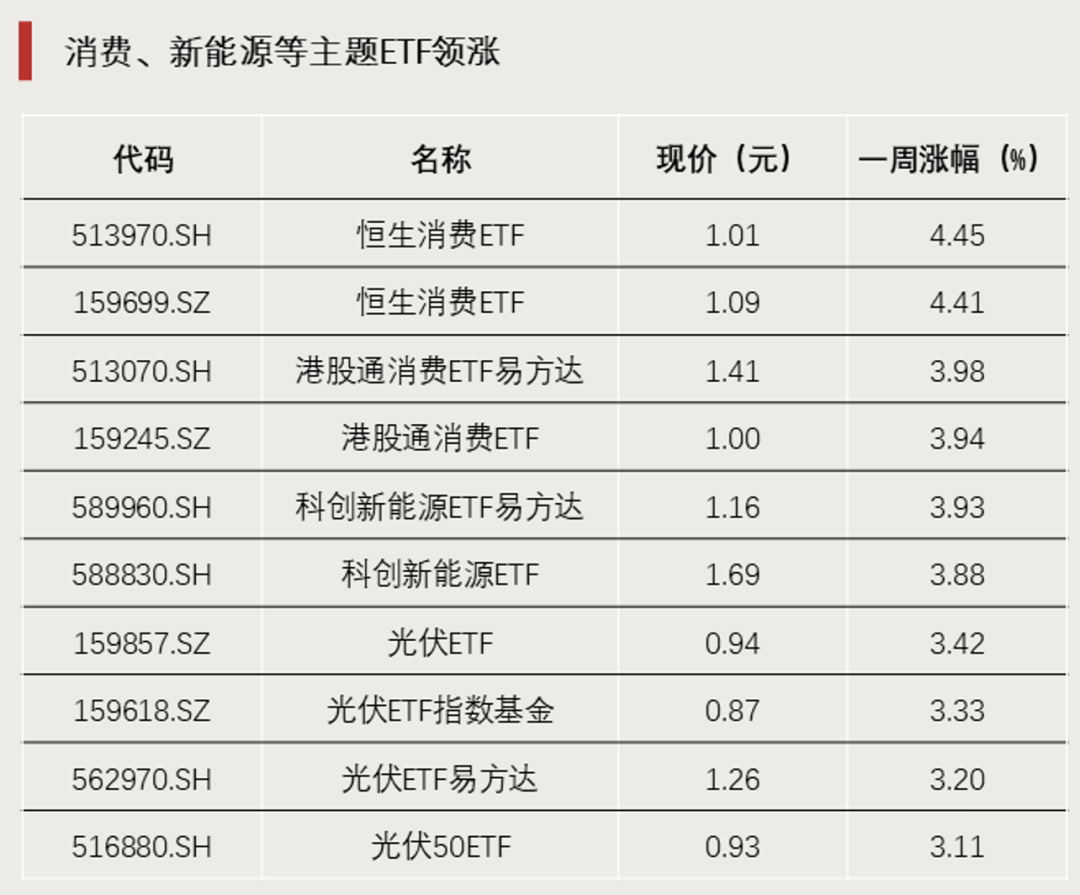
Group 1: Market Performance - The consumption and photovoltaic sectors saw significant gains last week, with several related ETFs, such as the E Fund Consumption ETF (513070) and E Fund New Energy ETF (589960), recording over 3% weekly increases [1][4] - Conversely, gold and artificial intelligence sectors experienced notable adjustments, with multiple related ETFs declining over 9% [1][6] Group 2: Trading Activity - The A-share market saw active trading in broad-based products, with the A500 ETF (159361) and others tracking the CSI A500 index achieving a total trading volume exceeding 254.8 billion yuan [2][8] - The Hang Seng Technology sector attracted significant capital inflow, with ETFs like the E Fund Hang Seng Technology ETF (513010) seeing substantial net inflows [3][10] Group 3: Sector Highlights - The Hang Seng Consumption ETF (513070) tracked the CSI Hong Kong Consumption Index, which rose over 4%, while the E Fund New Energy ETF (589960) and E Fund Photovoltaic ETF (562970) tracked indices that increased over 3% [4][5] - The gold sector showed weakness, with all 14 commodity gold ETFs declining over 5%, and some gold stock ETFs dropping more than 13% [6][7] Group 4: Future Outlook - Industry experts express optimism for the Hong Kong consumption sector in 2026, focusing on high-dividend consumer stocks, resilient domestic demand sectors like education, and timing strategies for new consumption sectors [5] - The market is expected to shift focus towards macroeconomic and industrial cues post-holiday, with a clearer framework for high-quality development and new-old kinetic energy conversion [12]
资金加仓恒生科技等赛道 宽基核心资产受关注
Zhong Guo Zheng Quan Bao· 2026-02-08 21:55
Group 1 - The consumer and photovoltaic sectors saw significant gains last week, with several related ETFs rising over 3% [1][2] - The A-share market's broad-based products experienced active trading, with ETFs tracking the CSI A500 index exceeding a total transaction volume of 250 billion yuan [1][2] - The market outlook for February suggests a continuation of the upward trend, driven by concentrated earnings forecasts and the recovery of leading companies' performance [1][4] Group 2 - The Hong Kong consumer sector performed strongly, with ETFs such as the Hang Seng Consumer ETF leading the gains [2] - Gold-related ETFs faced a downturn, with an average decline of over 5% across 14 commodity gold ETFs, and some gold stock ETFs dropping more than 13% [2] - The technology sector attracted significant capital inflow, with the Huatai-PineBridge Hang Seng Technology ETF seeing a net inflow of over 3.8 billion yuan last week [3] Group 3 - Several asset management institutions have released macro outlooks for China's equity market in 2026, highlighting diverse growth paths driven by the 14th Five-Year Plan [4][5] - Key investment areas identified include technology, manufacturing, renewable energy, healthcare, and emerging consumer sectors [4][5] - The market is expected to maintain a structural trend in February, with a focus on core growth assets that are currently at historical median valuation levels [5]
掘金科技浪潮 紧跟产业最新变化
Zhong Guo Zheng Quan Bao· 2026-02-08 20:22
Core Insights - The rapid development of artificial intelligence (AI) is creating both excitement and apprehension in the investment community, indicating a potential long-term industrial cycle lasting several decades [1] - The focus on technology investments is driven by the need to adapt to market changes and maintain a balance between returns and volatility [1][2] Technology Investment Focus - The technology sector has experienced significant price volatility, particularly due to external disturbances affecting performance expectations [2] - The manager's background in engineering and personal interest in electronics contribute to a deeper understanding of technology companies [2] - AI is seen as a transformative force, representing a shift from the internet era's focus on information dissemination to a new era of productivity leaps and technological equity [2][3] Investment Philosophy - The investment strategy emphasizes identifying companies with substantial growth potential and the ability to capitalize on technological changes for sustainable returns [3][4] - Companies are categorized based on linear growth paths and nonlinear growth opportunities, with a focus on those that can rapidly adapt to industry changes [4][5] Strategy and Analysis - A successful investment strategy in technology requires understanding the underlying changes in industries and companies, focusing on those with strong management and organizational capabilities [5][6] - The selection process prioritizes companies that have made significant investments in R&D and organizational optimization during industry downturns [6] Risk and Reward Considerations - The concept of investment odds (potential returns versus risks) is crucial for maintaining objectivity and avoiding over-optimism in market expectations [7] - The current market presents structural opportunities despite increasing difficulty in finding high-odds investments, as ongoing technological changes continue to expand the market [7][8] Portfolio Management - The portfolio is managed with a degree of diversification to mitigate volatility, adapting to market conditions and the certainty of industry trends [8]
资金加仓恒生科技等赛道宽基核心资产受关注
Zhong Guo Zheng Quan Bao· 2026-02-08 20:22
Group 1 - The consumer and photovoltaic sectors saw significant gains, with several related ETFs rising over 3% last week, while gold and artificial intelligence sectors experienced declines, with some ETFs dropping over 9% [1][2] - A-shares market showed active trading in broad-based products, with ETFs tracking the CSI 500 index exceeding a total trading volume of 250 billion yuan, and those tracking the Sci-Tech 50 index surpassing 30 billion yuan [1][2] - The market outlook for February suggests a continuation of the upward trend, driven by concentrated earnings forecasts and the recovery of leading companies' performance, benefiting core assets [1][4] Group 2 - The Hong Kong consumer sector performed strongly, with ETFs such as the Hang Seng Consumer ETF leading the gains, while the photovoltaic sector also showed positive performance [1] - The gold sector underperformed, with commodity gold ETFs declining over 5%, and gold stock ETFs experiencing even greater declines, with some dropping over 13% [2] - The technology sector attracted significant capital inflow, with the Hang Seng Technology ETFs seeing substantial net inflows, particularly the Huatai-PineBridge Hang Seng Technology ETF, which had a net inflow of over 3.8 billion yuan last week [2] Group 3 - The satellite communication sector also experienced notable capital inflow, with the Yongying National Commercial Satellite Communication Industry ETF seeing a net inflow of over 1.8 billion yuan [3] - Several ETFs, including the Huazhong Gold ETF and the Southern CSI Nonferrous Metals ETF, reported net inflows exceeding 10 billion yuan this year [3] - Investment firms are focusing on five key areas for the Chinese equity market by 2026: technology, manufacturing, renewable energy, healthcare, and emerging experiential consumption [3] Group 4 - The market is expected to stabilize in February, with a shift in focus from January's credit and liquidity performance to macro and industry clues [4] - The "14th Five-Year Plan" is anticipated to provide a clearer framework for high-quality development and new growth drivers, stabilizing market perceptions of future growth [4] - Core assets are recommended for continued attention, as their valuations are at historical median levels, with stable profit expectations and increasing foreign capital inflow [4]
易方达基金蔡荣成:掘金科技浪潮 紧跟产业最新变化
Zhong Guo Zheng Quan Bao· 2026-02-08 20:22
Group 1 - The article discusses the recent trends in the investment banking sector, highlighting a significant increase in M&A activities, with a year-on-year growth of 25% in deal volume [1] - It notes that the technology sector has been a major driver of this growth, accounting for 40% of total M&A transactions in the last quarter [1] - The report emphasizes the importance of regulatory changes that have facilitated cross-border transactions, leading to a 15% increase in international deals [1] Group 2 - The article mentions that the overall revenue for investment banks has risen by 10% compared to the previous year, reaching a total of $50 billion [1] - It highlights the competitive landscape, with top firms gaining market share, while smaller players struggle to keep up [1] - The analysis points out that firms are increasingly investing in technology to enhance their service offerings and improve operational efficiency [1]
锚定“硬科技”赛道 公募踊跃参与上市公司定增项目
Shang Hai Zheng Quan Bao· 2026-02-08 17:33
Core Viewpoint - The number of listed companies conducting private placements has significantly increased in 2023, with a total financing scale reaching 84.939 billion yuan, a 359% increase compared to the same period last year, indicating a robust recovery in the A-share market and a growing interest from public funds in high-quality projects [1][3]. Group 1: Market Activity - As of February 5, 2023, 12 listed companies have completed private placements, doubling the number from the same period last year [1]. - The total amount raised through these placements has reached 84.939 billion yuan, reflecting a substantial increase in market activity [1]. - Public funds such as E Fund, Caitong Fund, and Nord Fund have actively participated in these private placements, indicating a competitive environment for high-quality projects [1][2]. Group 2: Fund Participation - E Fund has emerged as a major player in the private placement of companies like Beiqi Blue Valley and Megmeet, with significant allocations across multiple funds [2]. - Other public fund companies, including Guotou Ruijin Fund and Huatai Asset Management, have also participated in various private placements, showcasing a broad interest in the market [2]. - The participation of multiple funds in projects like Megmeet and Beiqi Blue Valley highlights the trend of increasing collaboration among public funds in private placements [2]. Group 3: Industry Focus - The companies involved in these private placements predominantly exhibit "hard technology" characteristics, focusing on sectors such as electric vehicles, smart appliances, and electronic information technology [3]. - Approximately 70% of the financing from private placements is directed towards new productive forces, aligning with national strategic directions for industrial upgrades [3]. - The current trend indicates a healthy market environment characterized by stable volume and improved quality of projects, with a focus on high-quality companies leveraging capital markets to strengthen their core businesses [3][4]. Group 4: Investment Challenges - The increasing competition for high-quality private placement projects has raised the bar for fund managers' research and pricing capabilities [4]. - The disparity between a restrained supply of projects and a surging demand from various capital sources, including banks and insurance funds, has intensified the competition [4]. - The average issuance discount for private placements has risen, necessitating a greater emphasis on pricing strategies and research capabilities for successful investment [4].