
老百姓

Search documents
金价降了没人买,金店人潮不见了,老百姓为啥不喜欢黄金了?
Sou Hu Cai Jing· 2025-11-17 18:09
Core Viewpoint - The continuous interest rate hikes by the Federal Reserve and the strong rise of the US dollar index have put significant pressure on international gold prices, which have fallen from a peak of $2078.8 per ounce in March to a low of $1618.3 per ounce last month. However, contrary to previous trends, domestic gold stores in China are experiencing poor sales despite the drop in gold prices [1][3]. Group 1: Reasons for Poor Domestic Gold Sales - The decline in international gold prices has not translated into significant price drops in domestic gold stores due to the limited decrease in domestic gold prices, which are affected by the depreciation of the Chinese yuan against the US dollar [3][5]. - The majority of gold sold in domestic stores consists of jewelry, which includes high processing and design fees that do not adjust with international gold price fluctuations, resulting in minimal price reductions for consumers [3][5]. - Domestic demand for gold has decreased significantly due to the ongoing economic downturn and the impact of repeated COVID-19 outbreaks, leading consumers to cut back on non-essential spending, including gold jewelry [5][7]. Group 2: Changing Consumer Preferences - The younger generation shows a declining interest in gold jewelry, viewing it as outdated and preferring luxury items like designer bags and high-performance cars to express their personal style and economic status [7][9]. - Consumers are becoming increasingly savvy regarding the resale of gold, often facing unfavorable buyback prices compared to their purchase prices, which diminishes their willingness to invest in gold [9].


七大上市连锁药店三季报出炉 技源集团:HMB增长潜力可观|康·财
Sou Hu Cai Jing· 2025-11-17 11:59
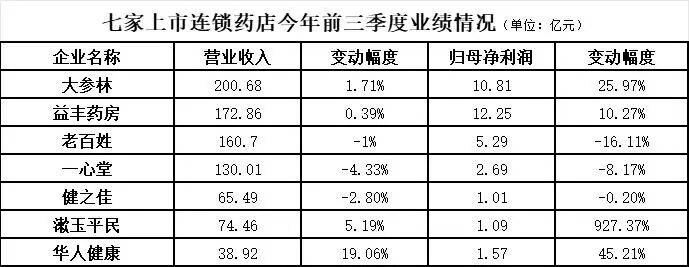
Group 1 - The number of listed companies disclosing data is steadily increasing, indicating the maturation of China's nutrition and health industry [1] - Jiyuan Group shows considerable growth potential for HMB [1] - Minsheng Health is promoting stable growth in its mineral business through the synergy of online and offline channels [1] Group 2 - The third-quarter reports of seven major listed chain pharmacies have been released, revealing that Dazhenlin, Yifeng Pharmacy, Shuyapingmin, and Huaren Health achieved both revenue and net profit growth, while Laobaixing, Yixintang, and Jianzhijia experienced declines in both metrics [1] - The overall expansion speed of chain pharmacies has noticeably slowed, with a shift in focus from scale expansion to quality improvement and efficiency [1] - Specific performance data for the seven listed chain pharmacies for the first three quarters of the year includes: - Dazhenlin: Revenue of 20.068 billion, up 1.71%; Net profit of 1.081 billion, up 25.97% - Yifeng Pharmacy: Revenue of 17.286 billion, up 0.39%; Net profit of 1.225 billion, up 10.27% - Laobaixing: Revenue of 16.07 billion, down 1%; Net profit of 529 million, down 16.11% - Yixintang: Revenue of 13.001 billion, down 4.33%; Net profit of 269 million, down 8.17% - Jianzhijia: Revenue of 6.549 billion, down 2.80%; Net profit of 101 million, down 0.20% - Shuyapingmin: Revenue of 7.446 billion, up 5.19%; Net profit of 1.09 billion, up 927.37% - Huaren Health: Revenue of 3.892 billion, up 19.06%; Net profit of 157 million, up 45.21% [1] Group 3 - The trademark dispute involving Tongrentang is expected to come to an end as the acquisition of Tianjin Tongrentang Group's shares by Beijing Tongrentang Group has entered the acceptance stage, allowing Beijing Tongrentang to hold 60% of Tianjin Tongrentang [2] Group 4 - Six stores of Laobaixing in Loudi, Hunan Province were penalized for insurance fraud, where they switched health products for insurance-covered medications, leading to a fine and the revocation of their insurance service agreements [3]


医药生物行业报告(2025.11.10-2025.11.14):流感样病例占比快速爬坡,建议关注呼吸道检测、中药等相关个股
China Post Securities· 2025-11-17 09:43
Investment Rating - The industry investment rating is "Outperform the Market" and is maintained [2] Core Views - The report highlights a rapid increase in influenza-like illness (ILI) cases, suggesting that related detection and treatment products are expected to see significant growth. Recent data from the National Influenza Center indicates that the ILI percentage in southern provinces is 5.5%, up from 4.6% the previous week, and higher than the same period in 2022 and 2024 [5][14]. - The report emphasizes the long-term positive trend in the innovative drug sector, supported by China's growing capabilities in global competition and ongoing collaborations with multinational corporations [8][25][26]. - The medical device sector is showing signs of recovery, with leading companies reporting improved performance in Q3, indicating a potential influx of investment into this area [9][32]. Summary by Sections Industry Investment Rating - The industry is rated as "Outperform the Market" [2]. Recent Trends - The A-share pharmaceutical sector rose by 3.29% from November 10 to November 14, 2025, outperforming the CSI 300 index by 4.37 percentage points [7][23]. - The report notes that the medical device sector is expected to benefit from a reduction in the pressure from centralized procurement, which has been ongoing for six years [9][32]. Influenza and Related Products - The report indicates a rising trend in flu positivity rates in both southern and northern hospitals, with the southern region currently higher than the previous two years but lower than 2023 [6][16]. - Beneficiary stocks in the detection sector include companies like Innotec and Saint Shine, while traditional Chinese medicine companies such as Yiling Pharmaceutical are also highlighted [21]. Innovative Drugs - The report expresses optimism about the innovative drug sector, noting that domestic companies are expected to accelerate their growth and profitability, supported by favorable policies [25][26]. - Recommended stocks in this sector include Innovent Biologics and Kintor Pharmaceutical [27]. Medical Devices - The report suggests that the medical device sector is becoming attractive for investment, with leading companies like Mindray showing improved performance [9][32]. - Beneficiary stocks include Huadong Medicine and Aohua Endoscopy [33]. Traditional Chinese Medicine - The report indicates that traditional Chinese medicine is under pressure but may benefit from centralized procurement policies and innovation [36][38]. - Recommended stocks include Zhaoke Pharmaceutical and Kangyuan Pharmaceutical [36]. Retail Pharmacy - The report anticipates that the retail pharmacy sector will see increased concentration, with leading companies like Yifeng Pharmacy expected to benefit from market consolidation [39]. Overall Market Valuation - As of November 14, 2025, the overall valuation of the pharmaceutical sector is 30.83, with a premium of 129.30% over the CSI 300 index, indicating a positive market outlook [47].
14天12涨停,名字“讨彩”的合富中国、人民同泰被游资爆炒
Jing Ji Guan Cha Wang· 2025-11-16 09:09
Group 1 - The stock prices of HeFu China and RenMin TongTai have surged recently due to speculative trading, despite their poor performance and fundamentals [1][2][3] - HeFu China experienced a stock price increase of 256.29% from October 28 to November 14, with a peak price of 23.80 yuan on November 14, leading to a trading suspension [1][4] - RenMin TongTai's stock rose by 61.13% from November 10 to November 14, while the Shanghai Composite Index fell by 0.18% during the same period [2][5] Group 2 - HeFu China's net profit for Q3 2025 was -5,047,969.82 yuan, a decrease of 225.26% year-on-year, with a static P/E ratio of 343.67, significantly higher than the industry average of 30.94 [4] - RenMin TongTai reported a revenue of 784,592.89 thousand yuan for the first three quarters of 2025, a year-on-year increase of 2.19%, but its net profit fell by 45.69% [4] - The rolling P/E ratio for RenMin TongTai is 66.92, compared to the industry average of 18.77, indicating a significant overvaluation [5]


GDP全球第二,为何老百姓还是不敢花钱?刘元春揭秘消费低迷真相
Sou Hu Cai Jing· 2025-11-16 02:15
Core Insights - The essence of the issue is a strong government, wealthy enterprises, and impoverished residents, leading to high mandatory savings and low income distribution for residents, which directly results in low consumption rates [2][5]. Consumption Data Comparison - China's final consumption rate is approximately 55%, while developed countries average around 80%. Government consumption accounts for 30%, but private consumption is below 70%. The share of household consumption in GDP is less than 40%, lower than the global average of 55% [3]. Consumption Growth Performance - Despite a low consumption rate, consumption growth has been significant, with an average increase of 8.24% over the past 20 years, more than three times that of the U.S. In 2024, consumption is expected to contribute 44.5% to economic growth, remaining the primary driver of China's economy [5]. Distribution Imbalance - The core issue of low consumption is linked to a decline in consumption growth, which is becoming disconnected from GDP growth. The initial distribution of national income shows that the household sector accounts for only 60.6%, which is 5.5 percentage points lower than the global average, while the corporate sector is 5.6 percentage points higher [5][7]. Social Security and Wealth Gap - The inadequacy of the social security system contributes to a persistent wealth gap, with China's Gini coefficient reflecting a modest reduction of 12%, compared to a 40% reduction in Europe. High housing prices and insufficient affordable housing force low- and middle-income individuals to allocate savings to real estate, limiting funds available for daily consumption [5][7]. Short-term Consumption Weakness - Recent years have seen a worsening of consumption shortfalls, with household income growth lagging behind nominal GDP. Despite a GDP growth of 5.2% in the first three quarters, retail sales only grew by 4.5%, indicating a weak recovery in consumption [7]. Structural Reform Recommendations - To address the consumption gap, estimated at 6% of GDP (approximately 2.9 trillion yuan annually), structural reforms are necessary rather than temporary measures like vouchers or discounts [7][8]. Six Structural Reform Directions 1. Transition the government from an investment-focused model to a service-oriented one, enhancing social security, healthcare, education, and elderly care [8]. 2. Increase the return of state-owned enterprise profits to society, preventing excessive reinvestment of profits [8]. 3. Reform income distribution to raise the share of household income in national income [8]. 4. Strengthen social security systems to alleviate the pressure of precautionary savings on residents [8]. 5. Adjust housing policies to provide more affordable housing for low- and middle-income groups [8]. 6. Restore confidence in income and asset expectations, as all three elements are essential [8]. Historical Opportunity and Fundamental Path - The current period is seen as a critical window for China to transition from a wealthy nation to one that enriches its citizens. Improving household income and restoring consumption capacity are vital for making consumption the engine of China's economic internal circulation [10].

盘点上市连锁药店三季报:门店扩张速度放缓 四家业绩增长
Xin Jing Bao· 2025-11-15 05:30
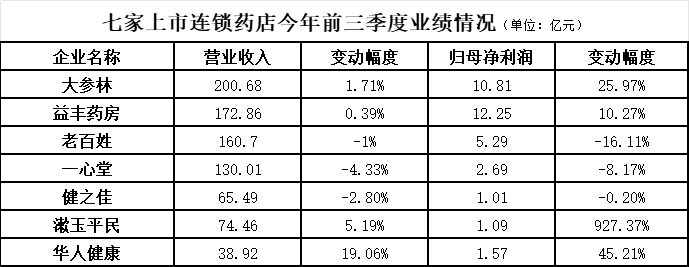
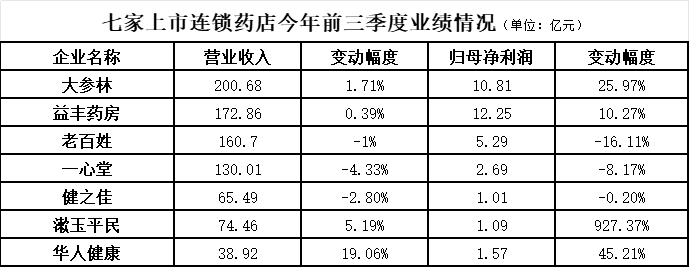
Core Viewpoint - The performance of seven listed chain pharmacies in the third quarter of this year shows a mixed picture, with some achieving growth in both revenue and net profit, while others experienced declines. The overall trend indicates a slowdown in store expansion and a focus on improving quality and efficiency in the industry [1][12]. Revenue and Profit Summary - Dazhenglin reported revenue of 20.068 billion yuan, a year-on-year increase of 1.71%, and a net profit of 1.081 billion yuan, up 25.97% [2][3]. - Yifeng Pharmacy achieved revenue of 17.286 billion yuan, a slight increase of 0.39%, with a net profit of 1.225 billion yuan, growing by 10.27% [2][3]. - Laobaixing's revenue decreased by 1% to 16.07 billion yuan, with a net profit of 529 million yuan, down 16.11%, the largest decline among the seven pharmacies [2][4]. - Yixin Tang's revenue was 13.001 billion yuan, down 4.33%, and net profit was 269 million yuan, down 8.17% [2][4]. - Jianzhijia reported revenue of 6.549 billion yuan, a decrease of 2.8%, and net profit of 101 million yuan, down 0.2% [2][5]. - Shuyupingmin achieved revenue of 7.446 billion yuan, up 5.19%, and net profit of 109 million yuan, a significant increase of 927.37% [2][6]. - Huaren Health, listed in March 2023, reported revenue of 3.892 billion yuan, a growth of 19.06%, and net profit of 157 million yuan, up 45.21% [2][6]. Store Expansion and Market Trends - The rapid expansion of chain pharmacies has slowed, with many companies pausing new store openings. The total number of pharmacies in the country decreased by 0.5% in the third quarter of 2024, marking the first quarterly decline in recent years [7][8]. - Dazhenglin had 16,833 stores by the end of the reporting period, with a significant number of closures [8][10]. - Laobaixing had 15,492 stores, closing 304 and opening 756, while Yifeng Pharmacy had 14,666 stores, closing 440 [9][10]. - Yixin Tang closed more stores than it opened, with 430 closures and only 288 new stores [9][10]. - Shuyupingmin made strategic acquisitions, adding 754 stores in its core market of Shandong, while Huaren Health also expanded its store count through new openings and acquisitions [11][12]. Industry Challenges and Adjustments - The industry is facing multiple pressures, including regulatory changes and increased competition, leading to a decline in profitability for many chain pharmacies. Companies are focusing on closing underperforming stores and improving operational efficiency [12]. - The shift towards online and offline integration is expected to accelerate, with larger listed chains likely to benefit from increased market concentration [12].

盘点上市连锁药店三季报:门店扩张速度放缓,四家业绩增长
Bei Ke Cai Jing· 2025-11-15 05:08
Core Insights - The performance of seven listed chain pharmacies in the third quarter of this year shows a mixed picture, with some achieving growth in both revenue and net profit, while others experienced declines [1][3][4]. Revenue and Profit Performance - Dazhenlin reported a revenue of 20.068 billion yuan, a year-on-year increase of 1.71%, and a net profit of 1.081 billion yuan, up 25.97% [2][3]. - Yifeng Pharmacy achieved a revenue of 17.286 billion yuan, a slight increase of 0.39%, and a net profit of 1.225 billion yuan, growing by 10.27% [2][3]. - Laobaixing's revenue decreased by 1% to 16.07 billion yuan, with a net profit of 529 million yuan, down 16.11%, the largest decline among the seven pharmacies [2][4]. - Yixin Tang's revenue was 13.001 billion yuan, down 4.33%, and net profit was 269 million yuan, down 8.17% [2][4]. - Jianzhijia reported a revenue of 6.549 billion yuan, a decrease of 2.8%, and a net profit of 101 million yuan, down 0.2% [2][5]. - Shuyupingmin achieved a revenue of 7.446 billion yuan, up 5.19%, and a net profit of 109 million yuan, a significant increase of 927.37% [2][6]. - Huaren Health, listed in March 2023, reported a revenue of 3.892 billion yuan, a growth of 19.06%, and a net profit of 157 million yuan, up 45.21% [2][6]. Store Expansion Trends - The rapid expansion of chain pharmacies has slowed down, with many companies pausing new store openings and focusing on improving efficiency [1][7]. - The total number of pharmacies in the country decreased by 0.5% in the third quarter of 2024, marking the first quarterly decline in recent years [7]. - Dazhenlin had 16,833 stores by the end of the reporting period, with a net increase of only 152 self-built stores and no new acquisitions [8][12]. - Laobaixing had 15,492 stores, closing 304 and opening 756, with a significant portion being franchise stores [9][12]. - Yifeng Pharmacy had 14,666 stores, closing 440 and opening 422, including franchises [10][12]. - Yixin Tang closed 430 stores while opening only 288, indicating a contraction in its store network [11][12]. - Shuyupingmin, however, expanded through acquisitions, adding 754 stores in the Shandong region [13][14]. Industry Challenges and Adjustments - The industry is facing multiple pressures, including regulatory changes and increased competition, leading to a decline in profitability for many pharmacies [15]. - Companies are focusing on closing underperforming stores and improving operational efficiency as part of their strategic adjustments [15].
都在指望内循环救经济,但现实却打了脸,老百姓可能已经拉不动内需了
Sou Hu Cai Jing· 2025-11-14 07:07
Core Insights - The article highlights a significant decline in consumer spending in China, driven by stagnant income growth, high debt levels, and increasing living costs, leading to a cautious consumer sentiment [1][3][7] Economic Indicators - In the first half of 2025, the total retail sales of consumer goods grew by only 3.2% year-on-year, a decrease of 1.5 percentage points compared to the same period in 2024 [1] - Major consumer sectors such as automobiles and home appliances experienced a slowdown, with automobile sales growing by just 1.8%, down 3.7 percentage points from the previous year, and home appliance sales declining by 2.5%, widening by 1.3 percentage points [1] - The consumer confidence index for Q2 2025 was reported at 95.3, below the neutral line of 100, marking a five-year low [5] Consumer Behavior - A survey indicated that 65% of respondents plan to reduce non-essential spending in the next six months, and 83% intend to postpone large purchases [1] - The actual growth rate of per capita disposable income for urban residents was only 2.8% in the first half of 2025, down from 5.7% in 2019, while the unemployment rate remained around 5.3% [3] Debt and Financial Pressure - The household leverage ratio reached 63.4% in Q1 2025, with some cities reporting debt-to-income ratios exceeding 3:1, indicating significant financial strain on families [3][4] - Rising costs in healthcare and education are further squeezing household budgets, with healthcare spending increasing by 8.6% year-on-year [4] Impact on Industries - The sluggish consumer spending is adversely affecting sectors such as retail, dining, and tourism, with restaurant revenues growing by only 2.5% year-on-year, significantly lower than pre-pandemic levels [7] - The vacancy rate for retail spaces in some second and third-tier cities has reached as high as 30%, indicating a challenging environment for brick-and-mortar businesses [7] Future Outlook - The article suggests that merely calling for increased domestic demand will not suffice; substantial improvements in income levels and distribution are necessary to stimulate consumer spending [8] - Long-term economic adjustments and reforms are essential to enhance consumer confidence and spending capacity, with the potential for improvement as urbanization and income distribution reforms take effect [12]
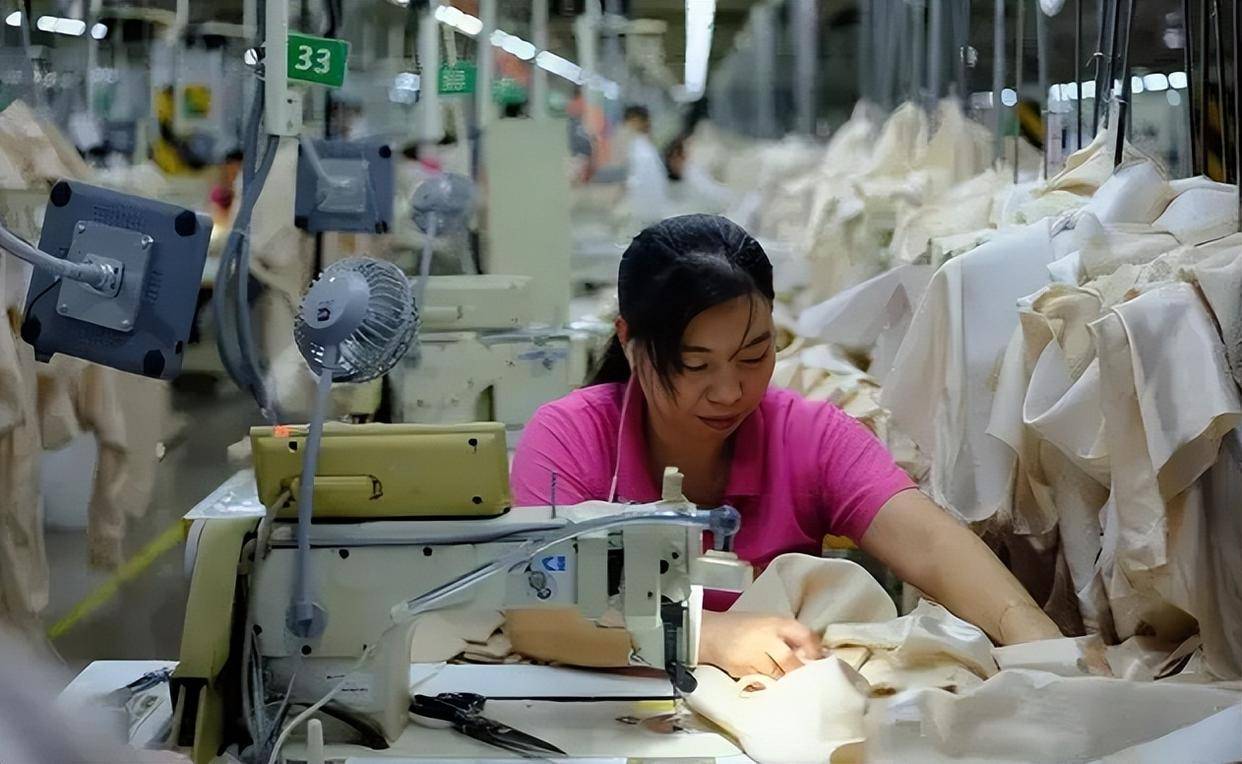
杨伟民:满足老百姓急难愁盼就是在扩消费 “十五五”时期应提高农业转移人口市民化率
Zheng Quan Shi Bao Wang· 2025-11-14 05:31
Core Insights - The "15th Five-Year Plan" emphasizes the need for an economic development model driven by domestic demand and consumption, especially in light of increasing uncertainties in the international environment [1][2] - The target for GDP growth during the "15th Five-Year Plan" period is set at an average of 4.17%, with a projected GDP total of 175 trillion yuan by 2030, requiring an increase in total supply and demand by approximately 35 trillion yuan over the next five years [1][2] Group 1: Economic Growth Drivers - The reliance on external demand for economic growth is expected to decline, making it essential to focus on expanding resident consumption to maintain reasonable economic growth [1][2] - Capital formation is anticipated to contribute more to economic growth, but it is unlikely to return to peak levels seen in the past [2] Group 2: Strategies for Expanding Consumption - A shift in development perspective is necessary, where local governments should prioritize understanding and meeting consumer demand rather than solely focusing on investment projects [2][3] - Specific targets should be set in the "15th Five-Year Plan" to improve indicators such as the resident consumption rate and the proportion of disposable income in national income [2] Group 3: Income Distribution and Urbanization - Improving the income distribution system is crucial for balancing supply and demand, with a focus on increasing the income of all citizens through actionable policies [3] - Supporting the urbanization of the nearly 300 million agricultural migrant workers is vital for creating a consumption-driven development model, with recommendations for cities to adopt metrics for integrating these populations into urban life [3]
2026年医保这样交最划算,湖南医保开启惠民新模式
Chang Sha Wan Bao· 2025-11-12 12:12
Core Viewpoint - The Hunan Provincial Medical Insurance Bureau, in collaboration with various stakeholders, has launched a new model to reduce the economic burden on insured residents and enhance health insurance coverage, benefiting nearly 50,000 residents so far [1] Group 1: Policy Initiatives - The Hunan Provincial Medical Insurance Bureau and the Provincial Federation of Trade Unions have introduced maternity-friendly measures, encouraging grassroots unions to pay basic medical insurance for the minor children of members who legally give birth, effective from September 2025 [2] Group 2: Financial Incentives - Multiple banks are offering payment discounts for medical insurance contributions, including: - Agricultural Bank: Users can receive up to 50 yuan discount when paying through specific apps [3] - Bank of Communications: Users can enjoy a 20 yuan discount on a 400 yuan payment when using digital RMB [3] - Bank of China: New account holders can receive various discounts, including a 30 yuan discount for specific purchases and additional benefits for using their banking apps [3] - China Construction Bank: Offers random discounts between 2 to 66 yuan for payments made through their app during a specified period [4] - UnionPay: Users can receive random discounts for insurance payments made through their app, with a limit on the number of discounts per user [4] Group 3: Health Initiatives - The Hunan Provincial Medical Insurance Bureau has partnered with major telecom operators to launch a "Recharge for Health" initiative, allowing users to prepay phone bills to receive health insurance vouchers and health management benefits, including reimbursement for cancer screenings and other health checks [6] - Over 4,000 pharmacies in Hunan are offering discounts on medications, with an additional promotion for first-time customers [7]