零跑汽车

Search documents
法国打响第一枪,27国考虑对我们加税30%,美财长3字定义中美关系
Sou Hu Cai Jing· 2026-02-12 18:53
法国政府一份最新报告公然呼吁欧盟对中国复制1985年针对日本的《广场协议》,提出要么全面加征30%关税,要么逼迫人民币对欧元大幅升值 30%。 这份由法国高等战略与规划委员会在2026年2月9日发布的文件,直接将中国制造业描述为欧洲工业的"生存危机",甚至白纸黑字引用四十多年 前的货币围猎案例,试图用同样手段削弱中国竞争力。 欧洲内部因为这剂"猛药"炸开了锅。 法国BFM电视台直接用"令人震惊"来形容这份报告,而《回声报》则批评其激进程度超乎寻常。 更讽刺的是, 就在同一天,法国经济财政部长莱斯屈尔急忙出面降调,声称"一刀切不太行",强调需要更有针对性的措施。 这种政府内部自相矛盾的表态,暴露 了欧洲在应对中国崛起时的焦虑和分裂。 至于汇率操纵方案,报告明确提及1985年美日《广场协议》,建议欧盟联合施压让人民币升值。 但这一设想被欧洲学者直接戳破"漏洞":欧元作为 全球主要储备货币,其汇率受多方制约,绝非法国能单独操控。 更重要的是,中国不是当年的日本,拥有完整工业体系、庞大国内市场和独立货币 政策,根本不可能接受外部胁迫。 就在法国推出这份激进报告的同时,美国财政部长贝森特在巴西圣保罗发表讲话,用"舒适区 ...

禁止亏本卖车,车圈反内卷新规出炉,价格战乱象大整治
3 6 Ke· 2026-02-12 11:25
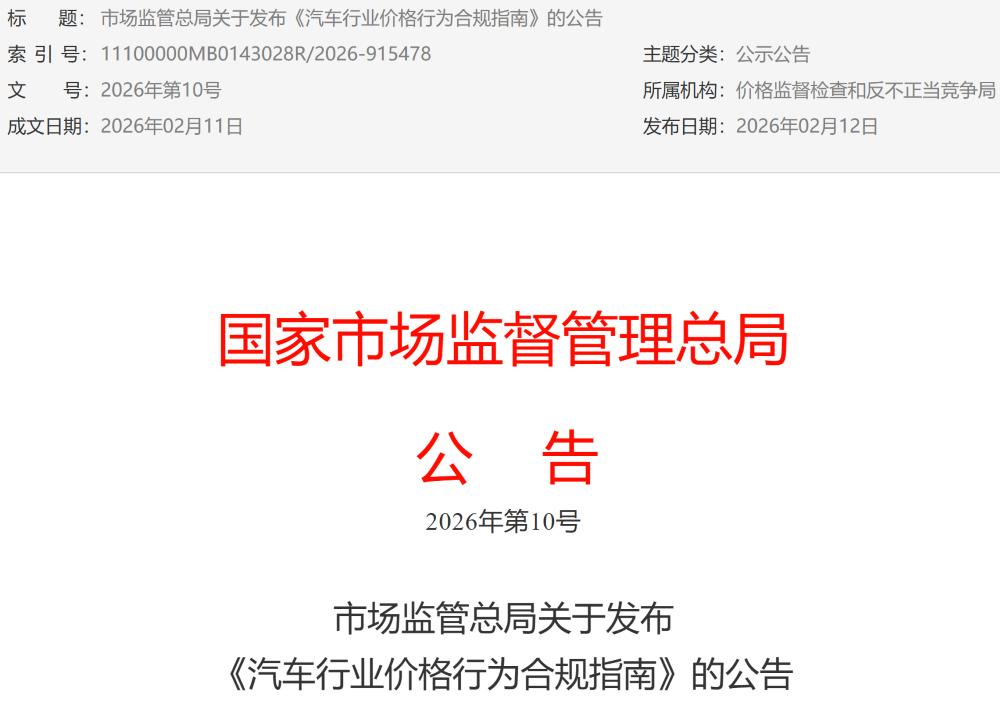
Core Viewpoint - The release of the "Guidelines for Compliance with Pricing Behavior in the Automotive Industry" by the State Administration for Market Regulation aims to standardize pricing behavior in the automotive sector, ensuring fair competition and protecting consumer rights while promoting high-quality industry development [3][24]. Group 1: Pricing Guidelines for Automotive Manufacturers - Automotive manufacturers must base pricing on production costs and market demand, prohibiting loss-leading sales aimed at eliminating competitors or monopolizing the market [5][6]. - Manufacturers are not allowed to significantly raise prices without justifiable reasons, even when there is a severe supply-demand imbalance in the automotive supply chain [6]. - The guidelines require manufacturers to clearly inform consumers about the terms and costs associated with "pay-to-unlock" features, including any free trial periods [6][13]. Group 2: Pricing Guidelines for Automotive Dealers - Automotive dealers are required to display clear pricing, including vehicle name, price, unit of measurement, model, manufacturer, and key specifications [13][18]. - Dealers must publicly disclose promotional rules, activity duration, and applicable scope, ensuring transparency in discounts and promotional offers [13][18]. - Similar to manufacturers, dealers are prohibited from loss-leading sales except during inventory clearance [14][18]. Group 3: Supplier Payment Terms and Industry Practices - A survey by the China Automotive Industry Association indicates that most of the 17 key automotive companies have reduced payment terms to within 60 days, with an average of 54 days, which is a reduction of about 10 days compared to the previous year [20][21]. - 15 companies have adopted cash or bank acceptance bills for payments, with some companies allowing early payment requests for cash-strapped small and medium enterprises [20][21]. - The guidelines are part of a broader effort to ensure compliance with the revised "Regulations on Payment of Funds to Small and Medium Enterprises" by the State Council, promoting timely payments to suppliers [21][24].
雷军晒新一代SU7,称参加过多次测试,还开过一趟北京到上海高速;此前宣布初代SU7停产,卖了超36万辆!小米汽车:新SU7明起到店
Mei Ri Jing Ji Xin Wen· 2026-02-12 10:06
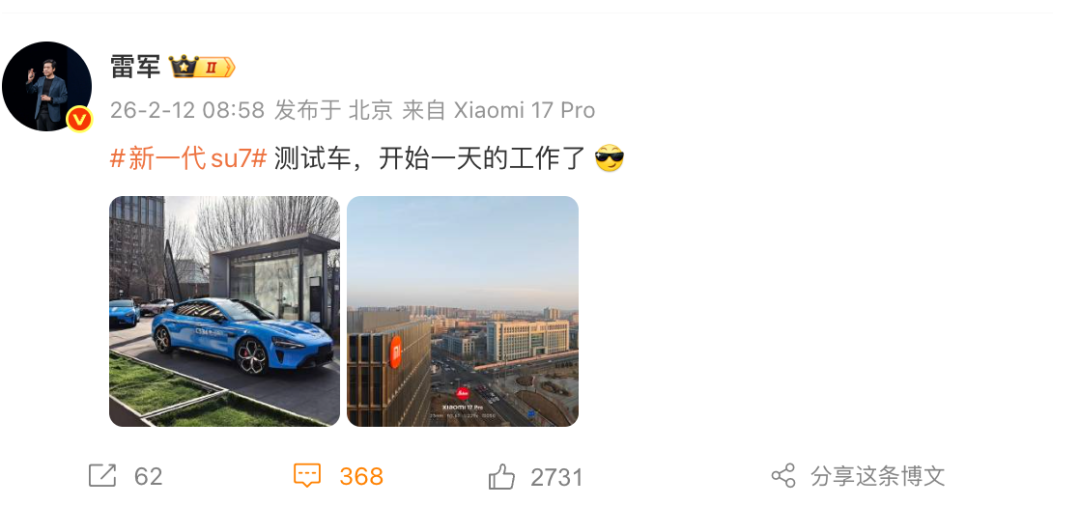
每经编辑|程鹏 12日,@雷军晒新一代SU7测试车并配文:新一代SU7测试车开始一天的工作了。 随后,有网友在评论区表示:雷总还是亲自开车测试吗?雷军回应称:新一代SU7,我参加过多次测试,还开过一趟北京到上海的高速测试。 小米汽车2月12日发文称,新一代SU7卡布里蓝将于2月13日起开始到店。首批覆盖7城30店:北京、上海、广州、深圳、杭州、成都、武汉。春节期间, 全国小米汽车门店正常营业。 对于即将于4月上市的全新一代小米SU7,雷军介绍称,新车上的电机、电池、电子电气架构、高压架构、底盘等都进行了升级,门把手也是提前符合新 国标的安全标准。"新一代SU7的变化是从里到外的,是一次换代级别的升级。"雷军强调。 对于小米汽车的电子电气架构,雷军介绍称,小米YU7采用的是四合一域控制模块,这套系统全部是小米自研的。"因为小米的本行是做手机,所以电子 电气架构是小米的强项。"雷军表示。 针对外界关心的小米汽车电池是否满足新国标的问题,小米汽车副总裁李肖爽回复称:"(电池)不仅满足,而且我们远高于新国标。" 雷军多次强调,电池包安全对纯电动车来说很重要,需要大家下很大工夫研发。"我们整个电池包在研发过程中,有10 ...
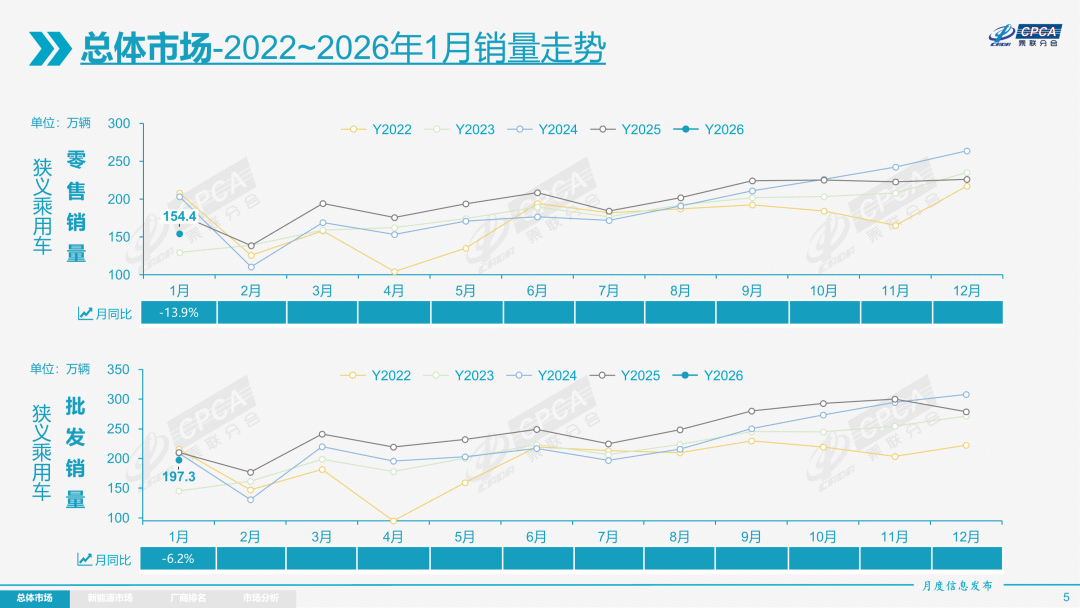
乘联分会:1 月全国乘用车市场零售 154.4 万辆,同比下降 13.9%
Xin Lang Cai Jing· 2026-02-12 07:27
Core Viewpoint - In January, the retail sales of passenger cars in China reached 1.544 million units, representing a year-on-year decline of 13.9% [1][7]. Group 1: Market Performance - The January retail sales decline is part of a historical trend where January sales have shown significant fluctuations, with previous years experiencing similar declines [3][9]. - The penetration rate of new energy vehicles (NEVs) in the overall passenger car market was 38.6%, down 3 percentage points from the previous year [3][9]. - Among domestic retail sales, the penetration rate of NEVs for independent brands was 61.7%, while luxury brands had a penetration rate of 16.1%, and mainstream joint venture brands only reached 4.3% [3][9]. Group 2: New Energy Vehicle Sales - In January, the retail share of NEVs for independent brands was 60.1%, a decrease of 12 percentage points year-on-year, while the share for mainstream joint venture brands increased to 3.9%, up 2 percentage points [3][9]. - The new forces in the market, including brands like Xpeng, Leap Motor, and Xiaomi, saw their share increase by 10 percentage points year-on-year, reaching 31.2% [3][9]. - Tesla's market share fell to 3.1%, a decrease of 1.5 percentage points compared to the previous year [3][9]. Group 3: Export Performance - In January, NEV exports reached 286,000 units, marking a year-on-year increase of 103.6%, accounting for 49.6% of total passenger car exports, up 12.5 percentage points from the previous year [4][10]. - Pure electric vehicles constituted 65% of NEV exports, while A00 and A0 class pure electric vehicles made up 50% of pure electric exports [4][10]. - The growth of NEV exports is attributed to the increasing recognition of Chinese brands in international markets, despite some external challenges [4][10]. Group 4: Manufacturer Performance - Leading manufacturers in NEV exports for January included BYD (96,859 units), Tesla China (50,644 units), and Geely (32,117 units) [5][11]. - The overall performance of NEV manufacturers remained strong, with 16 companies achieving monthly wholesale sales exceeding 10,000 units, accounting for 90.3% of total NEV sales [6][12]. - BYD led the market with 205,518 units sold, followed by Geely (124,252 units) and Tesla China (69,129 units) [6][12]. Group 5: Market Outlook - The outlook for February indicates a potential decline in sales due to the shorter effective production and sales time caused by the extended Spring Festival holiday [7][13]. - The rising costs of raw materials, driven by increased demand for electric power storage, are putting pressure on manufacturers [7][13]. - The anticipated decrease in promotional capabilities for NEV manufacturers may lead to a cautious consumer sentiment, potentially suppressing normal car purchase demand in the short term [7][13].




乘联分会:1月全国乘用车市场零售154.4万辆 新能源车渗透率为38.6%
智通财经网· 2026-02-12 06:41
Core Insights - The overall retail sales of passenger cars in January decreased by 13.9% year-on-year, with a total of 1.544 million units sold. The retail sales of new energy vehicles (NEVs) reached 596,000 units, representing a penetration rate of 38.6%, down 3 percentage points from the previous year [1][11]. Retail Market Overview - In January, the retail sales of self-owned fuel passenger cars were 250,000 units, up 17% year-on-year, while self-owned NEVs sold 226,000 units, marking a significant increase of 115%. NEVs accounted for 47.5% of self-owned exports, indicating growing international influence [2]. - The retail sales of self-owned brands totaled 890,000 units, down 18% year-on-year, with a domestic market share of 57.5%, a decrease of 3.5 percentage points [2]. - Mainstream joint venture brands sold 470,000 units, down 4% year-on-year, with German brands increasing their market share to 19.8%, up 1.4 percentage points [2]. Production and Wholesale Analysis - In January, the production of passenger cars was 2.003 million units, down 4.4% year-on-year. The wholesale volume was 1.973 million units, a decrease of 6.2% year-on-year [4]. - The wholesale of self-owned brands was 1.326 million units, down 8%, while luxury car wholesale increased by 4% to 228,000 units [4]. - The overall wholesale landscape is changing, with some mid-tier companies showing strong performance, such as SAIC-GM-Wuling and NIO [4]. New Energy Vehicle Insights - The production of NEVs reached 938,000 units, a slight decrease of 0.6% year-on-year, while wholesale sales were 864,000 units, down 3.3% [5][6]. - NEV retail sales were 596,000 units, down 20% year-on-year, with conventional fuel vehicles selling 948,000 units, down 10% [7]. - NEV exports reached 286,000 units, a remarkable increase of 103.6%, accounting for 49.6% of total passenger car exports [11][12]. Market Trends and Future Outlook - The new energy vehicle market is expected to face challenges in February due to the impact of the Spring Festival, which may lead to lower sales volumes [16]. - The transition from merely selling cars to exporting entire industrial chains is anticipated, indicating a shift towards quality growth in the automotive export sector [17].



乘联分会:1月新能源乘用车出口28.6万辆,同比增长103.6%
Xin Lang Cai Jing· 2026-02-12 06:19
2月12日,乘联分会数据显示,1月新能源乘用车出口28.6万辆,同比增长103.6%。占乘用车出口 49.6%,较去年同期增长12.5个百分点;其中纯电动占新能源出口的65%(去年同期67%),作为核心焦 点的A00+A0级纯电动车占纯电动出口的50%(去年同期41%)。伴随着中国新能源车的规模优势显现 和市场扩张需求,中国制造的新能源品牌产品越来越多地走出国门,在海外的认可度持续提升。其中插 混占新能源出口的33%(去年同期32%),虽然近期受到外部国家的一些干扰,但自主插混出口发展中 国家增长迅猛,前景光明。 1月厂商新能源出口方面优秀的企业是:比亚迪汽车(96,859辆)、特斯拉中国(50,644辆)、吉利汽车 (32,117辆)、奇瑞汽车(27,033辆)、零跑汽车(14,523辆)、上汽乘用车(13,071辆)、上汽通用五 菱(11,097辆)、东风汽车(6,745辆)、长城汽车(6,102辆)、长安汽车(4,952辆)、光束汽车 (3,713辆)、长安马自达(3,391辆)、沃尔沃亚太(3,316辆)、小鹏汽车(3,204辆)、极星汽车 (2,758辆)、赛力斯汽车(湖北)(2,108辆)、智马达 ...
多家主流车企公布2026年销量目标,最高增速达67.5% 中安在线-新能源汽车
Mei Ri Jing Ji Xin Wen· 2026-02-12 02:56
2026年车市大幕拉开,多家主流车企陆续公布年度销量目标。 据《每日经济新闻》记者观察,2026年,传统汽车集团普遍坚持稳健增长策略,将新能源业务的深化转 型与海外市场的版图扩张列为核心发力点;而造车新势力及跨界入局的科技企业,则凭借2025年的高速 交付势头与产品口碑积累,纷纷设定大幅超越行业平均增速的激进目标,力求在智能电动赛道抢占更多 市场份额。 传统车企稳增长,目标增速10%至15% 综合来看,多家传统汽车集团基于2025年市场表现,普遍设定了10%至15%的同比增长目标,同时将新 能源业务作为销量提升的关键引擎,通过产品矩阵扩容与品牌细分巩固市场地位。 东风集团与奇瑞集团目标相近,均瞄准320万辆级别市场。东风集团将2026年整体销量目标定为325万 辆,其中新能源汽车170万辆、出口60万辆。这一目标建立在2025年新能源汽车和自主乘用车"双百 万"销量目标达成的基础上,旗下岚图品牌2025年87%的同比增速也为其注入信心。2026年,东风集团 将深化与华为的合作,并在技术上持续加码,包括发力混动技术和自主车规级芯片等。 长城汽车则采取相对审慎的策略,将2026年销量目标定为不低于180万辆。相较 ...
汽车数据出境有章可循更便利
Jing Ji Ri Bao· 2026-02-11 21:56
Core Viewpoint - The article discusses the release of the "Automotive Data Export Security Guidelines (2026 Edition)" by multiple Chinese government departments, aiming to establish a safe and efficient mechanism for the cross-border flow of automotive data, enhancing the convenience of data export and promoting high-quality development in the automotive industry [1]. Group 1: Data Export Challenges - The automotive industry generates significant data throughout its lifecycle, with a high-level autonomous driving test vehicle producing up to 10TB of data daily [2]. - Companies face common challenges in data export, including selecting appropriate export methods, defining data for security assessments, and building a protective system tailored to the automotive sector [2]. - The guidelines systematically define important data categories and clarify data export paths for six major scenarios, addressing long-standing operational pain points for enterprises [2]. Group 2: Regulatory Framework - The guidelines require all organizations and individuals within China, including domestic and foreign enterprises, to conduct data export activities in a regulated manner [3]. - The guidelines respond to urgent concerns in the automotive industry, facilitating global collaboration and service provision through clear data identification rules and exemptions [3]. - A transparent and efficient management framework for automotive data export is expected to align with international governance trends and enhance global cooperation in automotive data management [3]. Group 3: Promoting Data Utilization - The guidelines encourage the integration of security technologies such as data desensitization and encryption into the automotive production process, enhancing the industry's technological framework [4]. - Data is viewed as a critical resource for innovation in areas like autonomous driving and service upgrades, driving the digital transformation of the automotive sector [5]. - Companies are advised to embrace the guidelines to optimize their global operations and enhance their market competitiveness by effectively utilizing data [5]. Group 4: Industry Development Benefits - The guidelines are seen as a "stabilizing pill" for the automotive industry, providing clear rules that enhance confidence in global market expansion [6]. - They act as an "accelerator" for industry upgrades, prompting companies to better understand their data assets and improve their data governance systems [6]. - The guidelines serve as a "new benchmark" for safety management, offering a practical manual for the industry to navigate data export regulations [7]. Group 5: Implementation Support - The Ministry of Industry and Information Technology plans to assist companies in identifying important data and establishing safety protection goals [7]. - Companies are encouraged to develop comprehensive management systems covering the entire data lifecycle, employing technologies to ensure data security [7]. - The industry is urged to foster cross-sector data security sharing mechanisms to promote safe and efficient data flow, unlocking data value for innovation [7].
“驰骋万里、通达世界”:高水平开放看金华金东
Xin Lang Cai Jing· 2026-02-11 16:40
(来源:中国经济导报) 转自:中国经济导报 相距不远的金义综合保税区与华东国际联运港"区港联动",货物在铁路口岸完成通关后,30分钟内即可 短驳至综保区进行集散、分拨。凭借这一优势,金义综保区大平台上聚集200多家企业,年进出口额稳 定在200亿元以上。 向海看,海铁联运势头喜人。金华南—北仑的海铁联运班列率先实现了每天一列"天天班"、每天双向对 开,甬金铁路货运试点线路拓展"第六港区"运输通道。宁波舟山港海港功能向内陆港延伸,全面实现宁 波舟山港与义乌国际陆港港务、关务、船务、信息及管理一体化,实现"一次申报、一次查验、一次放 行"。 金义中央大道、建金高速建成投用,金义东市域轨道交通开通运行,路网密度走在浙江省前列;自贸 区、综保区优势叠加,中欧班列驰骋万里、通达全球,成功获评国家级服务业标准化试点、省进口贸易 促进创新示范区、义甬舟开放大通道综合性战略平台等荣誉称号。营商环境持续优化,"四个变""三个 办"理念深入人心,转化为行动自觉。既不靠海也不临边的金东,在深化改革扩大开放的篇章里书写辉 煌。 华东国际联运港作为国际陆港枢纽建设的"两核"之一,塔吊林立,中欧班列集结中心、金华铁路枢纽扩 容改造工程、 ...
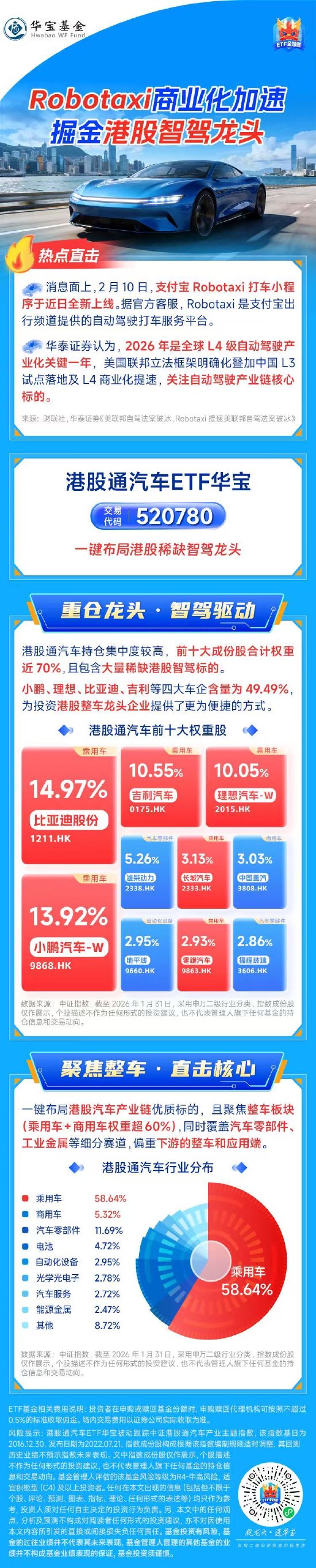
港股通汽车ETF华宝(520780):Robotaxi商业化加速,掘金港股智驾龙头
Xin Lang Cai Jing· 2026-02-11 11:40
Group 1 - The core viewpoint of the news is the launch of the Robotaxi service by Alipay, which is an autonomous driving ride-hailing platform [1][8] - Huatai Securities believes that 2026 will be a critical year for the global L4 autonomous driving industry, with the clarification of the U.S. federal legislative framework and the acceleration of L4 commercialization in China [1][2] - The report emphasizes the importance of focusing on key players in the autonomous driving industry chain [1][2] Group 2 - The Hong Kong Stock Connect automotive ETF has a high concentration of holdings, with the top ten constituent stocks accounting for nearly 70% of the total weight [3][4] - Major companies such as XPeng, Li Auto, BYD, and Geely make up 49.49% of the ETF's holdings, providing a convenient way to invest in leading automotive companies in Hong Kong [4][8] - The ETF focuses on high-quality targets in the automotive industry chain, with over 60% weight in the complete vehicle sector, covering both passenger and commercial vehicles [4][9]