
Lumentum

Search documents
2025 年台湾国际半导体展_3.5D 先进封装、共封装光学及更多测试_ SEMICON Taiwan 2025_ 3.5D advanced packaging, co-packaged optics and more testing
2025-09-15 13:17
Summary of Key Points from the Conference Call Industry Overview - The conference focused on the semiconductor industry, particularly advancements in AI chips, heterogeneous integration, advanced packaging, and optical interconnect technologies, reflecting the growing importance of these areas in the market [2][3][20]. Core Findings 1. **TSMC's Capacity Expansion**: TSMC is expected to expand its CoWoS capacity to 100kwpm by the end of 2026, up from 70kwpm at the end of 2025, driven by robust demand for Cloud AI GPUs and ASICs [3]. 2. **AI Computing Demand**: AI computing requirements have surged by 10x in the past year, necessitating advancements in chip scaling, memory, and interconnect technologies [3]. 3. **3.5D Advanced Packaging**: The event highlighted significant discussions around 3.5D advanced packaging, which is anticipated to become mainstream for high-performance computing, improving cost structures and product design speeds [3]. 4. **Heterogeneous Integration**: The trend towards co-packaged optics (CPO) is gaining traction, with expectations for power consumption to be optimized by 2028, allowing for the replacement of copper in AI server integrations [3]. 5. **Testing Innovations**: The complexity of die and package designs is increasing the need for more rigorous testing at the wafer/die level to identify yield issues early [3]. Stock Recommendations - Top stock picks in the Greater China semiconductor sector include TSMC, ASE, MediaTek, Alchip, and Aspeed, all rated as "Buy" due to their structural AI opportunities [4]. Additional Insights - **Optical Interconnects**: Nvidia's advancements in networking infrastructure, particularly with its Spectrum-X CPO solution, promise significant power savings and improved signal integrity [12]. - **AI Data Center Power Consumption**: The power consumption of AI data centers is projected to rise dramatically, with examples like Meta's Hyperion data center expected to consume 2GW by 2030 [16]. - **Challenges in Advanced Packaging**: The industry faces challenges in transitioning to panel-level packaging and CoWoP technologies, which require overcoming technical hurdles related to system design and materials [30][39]. Emerging Technologies - **Silicon Photonics**: TSMC's COUPE platform aims to enhance integration of optics and electrical signaling, addressing bandwidth bottlenecks in computing performance [12]. - **GaN Technology**: GaN is highlighted for its efficiency and potential in powering AI applications, with Texas Instruments and Infineon leading developments in this area [36][38]. Conclusion - The semiconductor industry is at a pivotal point, driven by AI advancements and the need for innovative packaging and integration solutions. Companies like TSMC, Nvidia, and MediaTek are positioned to capitalize on these trends, while challenges in testing and power consumption remain critical areas for development [3][4][16][20].
邹支农“追光”持股市值暴涨432亿 天孚通信绑定英伟达业绩股价齐飞
Chang Jiang Shang Bao· 2025-09-07 23:19
Core Viewpoint - The recent surge in A-share market, particularly in CPO concept stocks, has significantly benefited Tianfu Communication, controlled by the Zou family, with its stock price reaching a historical high and a substantial increase in market capitalization [1][8]. Company Overview - Tianfu Communication specializes in optical communication components and has evolved into a well-known global player in the industry, focusing on high-speed optical devices and advanced packaging services [6]. - The company was founded in 2005 by Zou Zhinong and partners, aiming to break the monopoly of Japanese companies in the zirconia ceramic sleeve market [2][3]. Financial Performance - In 2024, Tianfu Communication achieved a revenue of 32.52 billion yuan, marking a year-on-year increase of 67.74%, with a net profit of 13.44 billion yuan, up 84.07% [6]. - For the first half of 2025, the company reported revenues of 24.56 billion yuan, a 57.84% increase year-on-year, and a net profit of 8.99 billion yuan, growing by 37.46% [6]. - The production of optical communication components reached 210 million units in the first half of 2025, an increase of 38.38% compared to the previous year [6]. Stock Performance - Tianfu Communication's stock price saw a dramatic rise from 40.44 yuan per share in April 2025 to a peak of 225.05 yuan on September 1, 2025, representing a 362% increase [8]. - As of September 5, 2025, the stock closed at 186.8 yuan per share, reflecting a significant market capitalization of 145.2 billion yuan [1][8]. Ownership and Control - The Zou family indirectly holds 37.95% of Tianfu Communication's shares, with a market value increase of approximately 43.18 billion yuan over three months [1][8]. - Co-founder Zhu Guodong has reduced his stake in the company, selling 9.9 million shares, which decreased his ownership from 8.26% to 6.99% [8]. Market Position and Strategy - Tianfu Communication aims to be a leader in the optical communication sector, emphasizing research and development, with R&D expenses increasing significantly from 77.3 million yuan in 2020 to 126 million yuan in the first half of 2025 [6]. - The company has established strong ties with industry leaders like Nvidia, which has contributed to its stock price surge and market presence [7][8].

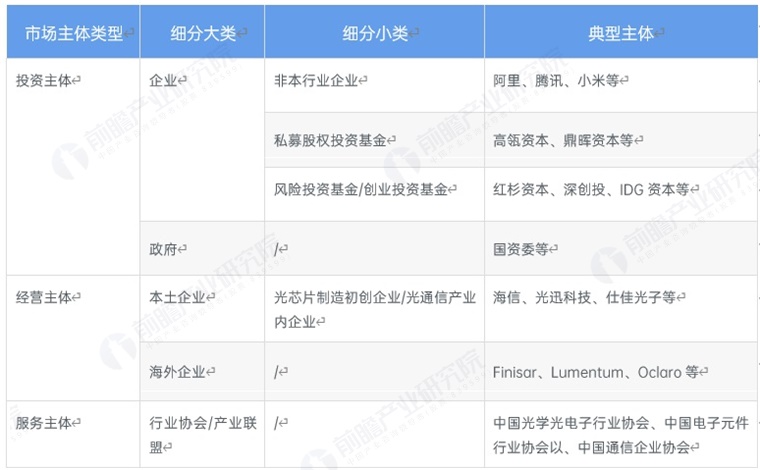
2025年中国光电芯片经营主体分析 企业注册数量较少【组图】
Qian Zhan Wang· 2025-09-04 04:28
Market Structure - The Chinese optical chip industry consists of three main types of market entities: investment entities, operating entities, and service entities [1] - Investment entities include non-industry companies like Alibaba, Tencent, and Xiaomi, private equity funds such as Hillhouse Capital and IDG Capital, and government bodies like the State-owned Assets Supervision and Administration Commission [1] - Operating entities are categorized into domestic companies (e.g., Hisense, Lightwave Technology) and foreign companies (e.g., Finisar, Lumentum) [1] - Service entities include industry associations and organizations like the China Optical Optoelectronic Industry Association [1] Entry Methods - Companies in the Chinese optical chip industry adopt various entry methods, including independent R&D, collaboration with research institutions, acquisitions, and participation in industry standards [2][4] - Vertical integration (IDM model) allows companies to cover the entire supply chain from chip design to packaging, exemplified by Source Technology focusing on InP optical chips [4] - The "Fab-lite" model combines self-built facilities with outsourcing to balance flexibility and cost, as seen with Zonghui Chip Light [4] - Mergers and acquisitions are used to quickly gain core patents and resources, demonstrated by Shijia Photon acquiring Dongguan Fuke Xima [4] Industry Statistics - As of August 2025, there are approximately 56 registered optical chip companies in China, with a low annual increase of 1-2 companies from 2016 to 2024 [5] - Nearly 45% of these companies have registered capital exceeding 10 million yuan, while around 40% have capital between 1-5 million yuan [6] - Guangdong province leads in the number of registered optical chip companies, followed by Hubei and Jiangsu [7]



400G Per Lane Optical Links, And Economies Of Scale Make Lumentum Undervalued
Seeking Alpha· 2025-08-26 06:46
Core Viewpoint - Lumentum Holdings Inc. is expected to benefit from advancements in photonics intensity and the adoption of 200G/lane and 400G/lane optical links [1] Company Summary - Lumentum Holdings Inc. operates in the photonics industry, focusing on optical networking solutions [1] - The company is positioned to leverage new technologies that enhance data transmission capabilities [1] Industry Summary - The photonics industry is experiencing growth driven by the demand for higher bandwidth solutions, particularly in optical links [1] - The transition to 200G and 400G optical links indicates a trend towards increased data capacity and efficiency in telecommunications [1]


钉钉十周年发布首款AI硬件DingTalk A1!科创人工智能ETF华夏(589010)成分股航天宏图收获20%涨停!
Mei Ri Jing Ji Xin Wen· 2025-08-25 07:17
Group 1 - The core viewpoint of the news highlights the performance of the Huaxia Sci-Tech AI ETF (589010), which has risen by 1.38%, reflecting a market style switch and maintaining a strong upward trend with resilience [1] - The ETF's holdings include significant gains from stocks such as Aerospace Hongtu, which hit a 20% limit up, Yuntian Lifei up 10.57%, Optics Valley up 7.14%, and Aobo Zhongguang up 6.36% [1] - The trading volume during the session exceeded 75 million yuan, indicating a vibrant market with trading activity far surpassing the usual levels [1] Group 2 - Guojin Securities notes that the domestic computing power chain is experiencing multiple favorable conditions, with accelerated iterations in overseas optical communication solutions [2] - The introduction of DeepSeek V3.1 utilizing UE8M0 FP8 compatible with domestic chips and the halt of H20 by Nvidia suggests a significant expansion in the domestic computing power chain [2] - The Huaxia Sci-Tech AI ETF closely tracks the Shanghai Stock Exchange Sci-Tech Innovation Board AI Index, covering high-quality enterprises across the entire industry chain, benefiting from high R&D investment and policy support [2]





Lumentum(LITE) - 2025 Q4 - Annual Report
2025-08-19 21:09
Revenue Impact and Economic Conditions - The company has ceased all product shipments to Huawei, historically its largest networking customer in China, due to export control restrictions, negatively impacting revenue and financial condition [100]. - Economic challenges, including inflation and geopolitical instability, have led to decreased demand for products, revenue fluctuations, and increased price competition [92]. - The company has faced challenges in maintaining customer demand due to economic conditions, leading to order cancellations and delayed purchasing decisions [98]. - The inability to sell products to significant customers like Huawei has restricted revenue opportunities and may lead to increased competition from other suppliers [99]. - The current geopolitical environment and trade policies have created uncertainty in market conditions, impacting the company's growth prospects [91]. - Inflation and increased borrowing costs are expected to impact the company's cash flows and profitability, with rising costs of labor and materials potentially affecting overall cost structure [104]. - The company’s backlog may not accurately predict future revenues due to changing customer behaviors influenced by macroeconomic factors and trade policy changes, which could lead to reduced demand for certain products [106]. - The company's revenues and cash flows may fluctuate unpredictably due to cyclical demand for optical communication and laser products, making financial predictions difficult [167]. Supply Chain and Operational Risks - The company relies on a limited number of suppliers for raw materials, which poses risks of supply disruptions and increased costs due to market fluctuations [96]. - Supply chain disruptions have resulted in increased costs and challenges in meeting customer demand, adversely affecting revenue and profitability [97]. - Supply chain constraints, particularly in semiconductor components, have adversely affected the company’s operations, leading to extended lead times and potential revenue impacts [109]. - Disruptions in the production and delivery of raw materials and components could inhibit the company’s ability to produce finished goods, resulting in increased costs and delays in new product introductions [110]. - The company relies heavily on a limited number of customers for a significant portion of its sales, which poses risks if these customers alter their purchasing behavior [116]. - The company is highly dependent on shipping infrastructure; disruptions could lead to increased shipping costs and delays in product delivery [123]. Regulatory and Compliance Challenges - Adverse regulatory activities, such as export controls and economic sanctions, could limit sales to certain regions, particularly China, and increase operational costs [95]. - The company faces potential adverse effects on its business due to ongoing U.S. government restrictions on exports, particularly concerning entities like Huawei and FiberHome Technologies Group, which have been under export control since May 2019 and May 2020 respectively [103]. - Changes in U.S. and Chinese trade policies, including tariffs and sanctions, could materially impact the company's ability to source products and meet customer expectations [135]. - Compliance with new laws and regulations, such as GDPR and CCPA, increases complexity and costs, with potential penalties for non-compliance [165]. - The company is subject to the reporting requirements of the Sarbanes-Oxley Act and must maintain effective internal controls, which may require significant operational resources [177]. - Non-compliance with environmental regulations could result in substantial costs and fines, adversely impacting financial condition and operating results [190]. Financial Position and Capital Management - The company has issued a total of $2.514 billion in convertible senior notes across various maturities, including $1.05 billion due in 2026, $861 million due in 2028, and $603.7 million due in 2029 [157]. - The company may require additional capital for growth initiatives, and future financing may not be available on favorable terms, potentially impairing business growth [157]. - The company’s ability to service its convertible notes depends on future performance, which is subject to various uncontrollable factors [200]. - As of June 28, 2025, the company had cash, cash equivalents, and short-term investments totaling $877.1 million, focusing on capital preservation and liquidity [330]. - A hypothetical 1% increase or decrease in interest rates would affect the fair value of the company's investment portfolio by approximately $3.4 million [331]. Competition and Market Dynamics - Intense competition in the optical products market is leading to pricing pressures, with the company needing to innovate continuously to maintain market share and profitability [118]. - The company derives a majority of its revenue from international operations and plans to continue expanding in international markets, which may expose it to additional risks [119]. - The company faces significant risks from international operations, including adverse economic conditions, currency fluctuations, and regulatory changes that could impact financial results [120]. - Global economic volatility has led to significant fluctuations in foreign exchange markets, which may increase costs for non-U.S. operations when reported in U.S. dollars [121]. Legal and Intellectual Property Risks - The company faces litigation risks associated with acquisitions, which could divert management attention and incur additional costs [140]. - The company seeks to protect its intellectual property through patents and trademarks, but challenges in enforcement and potential infringement claims could adversely affect operations [168]. - The company may face significant expenses and resource diversion from litigation related to patent infringement claims, which could impact revenues and operating results [173]. - Trademark infringement claims could result in monetary liability or restrictions on product sales, adversely affecting revenues [174]. Workforce and Human Resource Challenges - The company’s ability to hire and retain key personnel is challenged by intense competition and high turnover rates, particularly in specialized technical areas [179]. - Changes in immigration laws could impact the company’s ability to hire foreign nationals, affecting workforce stability and operational capacity [180]. Environmental and Social Governance (ESG) Considerations - Compliance with environmental, social, and governance (ESG) regulations may complicate the supply chain and impact relationships with customers and investors [186]. - The company may incur increased costs and operational disruptions due to compliance with climate change regulations and environmental laws [188]. - The evolving legal landscape regarding AI may increase operational costs and compliance risks, adversely affecting financial results [196].
通信行业周观点:算力高增应用井喷,光通信景气延续-20250819
Changjiang Securities· 2025-08-19 13:13
Investment Rating - The report maintains a "Positive" investment rating for the communication industry [10]. Core Insights - The communication sector has seen a 6.96% increase in the 33rd week of 2025, ranking second among major industries in the Yangtze River region. Year-to-date, the sector has risen by 30.93%, also ranking second [2][4]. - China's total computing power is rapidly expanding, with a projected year-on-year growth of 20% for general computing power and 43% for intelligent computing power in 2025. The daily token consumption in China has surged from approximately 1 trillion at the beginning of 2024 to over 30 trillion by mid-2025, indicating a dramatic increase in computing demand [5]. - Lumentum and Coherent have both reported significant revenue growth in optical communication, with Lumentum achieving $480 million in revenue for FY25Q4, a 56% year-on-year increase, and Coherent reporting $1.53 billion, a 16.4% increase [6][7]. Summary by Sections Market Performance - The communication sector's performance in the 33rd week of 2025 shows a 6.96% increase, with notable individual stock performances including Hengbao Co. (+49.2%), Guangku Technology (+48.9%), and Shengke Communication (+38.9%) [4]. Computing Power Expansion - China's computing power is expected to reach a total scale that ranks second globally, with a consistent annual growth rate of about 30% over the past five years. The demand for AI applications has skyrocketed, with token consumption increasing over 300 times in just a year and a half [5]. Optical Communication Revenue - Lumentum's optical module revenue exceeded expectations, with a significant contribution from cloud computing and networking, while Coherent's communication business also saw substantial growth, despite challenges in its industrial segment [6][7]. Investment Recommendations - The report recommends several companies across various segments, including operators like China Mobile, China Telecom, and China Unicom, as well as optical module manufacturers such as Zhongji Xuchuang and Xinyi Sheng [8].



通信行业周报:AI在业务间协同加速,低轨卫星加速组网-20250819
Guoyuan Securities· 2025-08-19 05:45
Investment Rating - The report maintains a "Recommended" rating for the telecommunications industry, considering the sustained high prosperity of the sector driven by AI, 5.5G, and satellite communications [2][5]. Core Insights - The overall market performance for the week of August 11-17, 2025, saw the Shanghai Composite Index rise by 1.70%, the Shenzhen Component Index by 4.55%, and the ChiNext Index by 8.58%. The telecommunications sector, represented by the Shenwan Communications Index, increased by 7.66% during the same period [2][11]. - Within the telecommunications sector, the highest increase was observed in the communication network equipment and devices sub-sector, which rose by 12.40%. In contrast, the communication engineering and services sub-sector had the lowest increase at 1.22% [2][14]. - Notable individual stock performances included Hengbao Co., which surged by 49.23%, followed by Guangku Technology at 48.90% and Beiwai Technology at 41.12% [2][16]. Summary by Sections Market Overview - The telecommunications sector experienced a significant increase in stock prices, with the Shenwan Communications Index rising by 7.66% during the week [11]. - The sub-sector of communication network equipment and devices led the gains with a 12.40% increase, while communication engineering and services saw a modest rise of 1.22% [14]. Notable Developments - The successful launch of the GW 08 satellite constellation on August 9, 2025, marked a significant advancement in satellite internet capabilities, focusing on applications such as intelligent connected vehicles and marine fisheries [18]. - ZTE Corporation and China Mobile achieved a global first by completing a real-world verification of a single-core hollow fiber with a transmission capacity of 114.9Tb/s, showcasing advancements in optical communication technology [20][21]. - Lumentum reported a substantial increase in revenue driven by AI-related services, with a 55.9% year-over-year growth in the fourth fiscal quarter [22][23]. Future Focus Areas - The report suggests focusing on the computing power industry chain and satellite internet as key areas for investment [3].


通信ETF(515880)昨日净流入超2.4亿元,低轨卫星与算力需求驱动行业关注
Mei Ri Jing Ji Xin Wen· 2025-08-19 04:46
Group 1 - The core viewpoint is that China's low Earth orbit satellite launches have entered a multi-site collaborative phase, with 8 successful launches completed by August 13, indicating a maturing commercial space industry in satellite manufacturing and launch capabilities [1] - The low Earth orbit satellite constellation network is set to start in December 2024, with a total of 65 official satellites expected to be launched, reflecting a high-density launch trend in the second half of the year [1] - The global demand for optical communication and AI computing power is strong, as evidenced by significant year-on-year revenue growth in data center businesses reported by Lumentum and Coherent [1] Group 2 - The communication industry has seen a year-to-date increase of 30.73%, driven by AI and computing power as core growth factors, indicating sustained upward momentum in the industry chain [1] - The communication ETF (515880) tracks the communication equipment index (931160), which includes listed companies involved in the research, production, and sales of communication network infrastructure and terminal devices [1] - The index constituents possess high technical content and innovation capabilities, effectively reflecting the overall development trend of the communication equipment industry [1]
航空航天ETF天弘(159241)小幅回调,年内份额增超127%暂居同标的第一,我国空间站首次应用专业领域AI大模型
2 1 Shi Ji Jing Ji Bao Dao· 2025-08-19 02:12
Group 1: Market Performance - The three major indices opened mixed but collectively turned positive by the time of reporting, with the defense and military industry sector experiencing fluctuations and corrections [1] - The Aerospace ETF Tianhong (159241) fell by 1.54%, with a trading volume exceeding 14 million yuan and an intraday premium/discount rate of 0.03% [1] - Year-to-date, the Aerospace ETF Tianhong (159241) has seen a share increase of over 127%, ranking first among similar products [1] Group 2: Industry Insights - The Aerospace ETF Tianhong (159241) closely tracks the National Aerospace Index, which has over 98% weight in the defense and military industry, making it the index with the highest military content in the market [1] - The core sectors of aerospace equipment and space equipment account for 66% of the index's weight, focusing on key areas such as large aircraft development, low-altitude economy, and commercial aerospace [1] Group 3: Technological Developments - The Shenzhou 20 mission successfully completed an extravehicular activity with the assistance of the "Wukong AI" model, which provided intelligent and specialized support for astronauts during their tasks [2] - The "Wukong AI" model was developed based on domestic open-source models and tailored to meet the needs of manned spaceflight missions, utilizing pre-training and instruction fine-tuning techniques [2] Group 4: Industry Outlook - The domestic commercial aerospace industry is entering a phase of high-density satellite launches, with satellite manufacturing and launch capabilities maturing [3] - The demand for global optical communication and AI computing power remains strong, as evidenced by significant revenue growth in the data center and communication markets reported by Lumentum and Coherent [3] - The military industry is expected to see an upward trend in various fields, with a focus on "new quality combat capabilities" and key observation windows in Q3 [3]