
科伦药业

Search documents
药企都在建“数字员工”,医疗器械管理者该如何应对?
Xin Lang Cai Jing· 2025-12-03 13:21
Core Insights - The "Artificial Intelligence +" action plan aims to accelerate the deployment of specialized AI agents in the healthcare sector by November 2025, prompting leading pharmaceutical companies to implement digital employees such as "bidding assistants" and "patient follow-up AI agents," achieving over a 40% reduction in labor costs for certain processes [1][12] - The real challenge for managers in the medical device industry lies not in the adoption of AI but in leading the transformation rather than passively adapting to it [1][12] - The necessity for AI agents is emphasized due to the accelerated operational pace in the medical device sector, driven by normalized centralized procurement and reforms in payment systems [1][12] Industry Trends - The introduction of AI agents is seen as a significant organizational capability restructuring rather than just a technological upgrade [1][12] - Managers face daily challenges such as immediate retrieval of clinical value and economic evidence during insurance negotiations, rapid interpretation of changing bidding policies, and compliance-related tasks that require high accuracy [1][12] - The shift in mindset is crucial, as low-code platforms and specialized large models enable more non-technical managers to engage in the configuration and iteration of AI agents [1][12] Managerial Implications - Simply introducing digital employees does not equate to achieving intelligence; the key differentiator is the organization's ability to convert business logic into AI-executable processes, which becomes a new competitive advantage for professional managers [2][13] - In the next three years, managers who can transform frontline business pain points into automated solutions will gain greater influence in resource-constrained environments, while teams that remain in manual process modes may become marginalized [2][13] - AI is not expected to replace managers but will reshape their roles, emphasizing the importance of proactively mastering the ability to direct AI agents [2][13] Training and Development - Training programs are designed to equip participants with the skills to build and deploy AI systems tailored to pharmaceutical scenarios, focusing on compliance and practical applications [15][18] - The training targets various roles within pharmaceutical companies, including medical managers, compliance reviewers, market managers, and digital teams [15][16] - The curriculum includes hands-on experience with AI tools, case studies, and practical applications to ensure participants can effectively implement AI agents in real-world scenarios [19][20]


12月3日医疗健康R(480016)指数跌0.42%,成份股人福医药(600079)领跌
Sou Hu Cai Jing· 2025-12-03 10:05
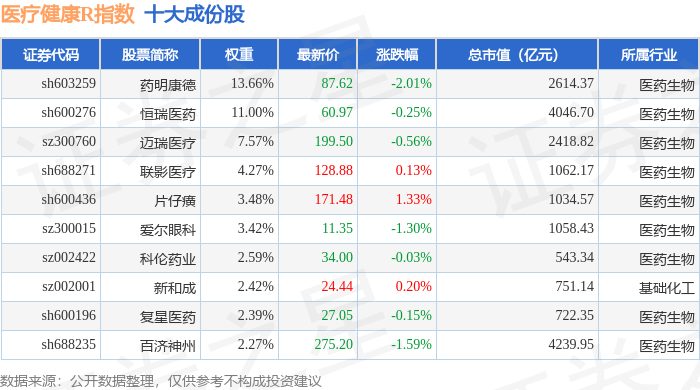
Core Points - The Medical Health R Index (480016) closed at 7284.72 points, down 0.42%, with a trading volume of 17.046 billion yuan and a turnover rate of 0.61% [1] - Among the index constituents, 23 stocks rose while 26 fell, with TeBao Bio leading the gainers at 2.85% and Renfu Pharmaceutical leading the decliners at 3.33% [1] Index Constituents Summary - The top ten constituents of the Medical Health R Index include: - WuXi AppTec (sh603259) with a weight of 13.66%, latest price at 87.62, down 2.01%, and a market cap of 261.437 billion yuan [1] - Hengrui Medicine (sh600276) with a weight of 11.00%, latest price at 60.97, down 0.25%, and a market cap of 404.670 billion yuan [1] - Mindray Medical (sz300760) with a weight of 7.57%, latest price at 199.50, down 0.56%, and a market cap of 241.882 billion yuan [1] - United Imaging Healthcare (sh688271) with a weight of 4.27%, latest price at 128.88, up 0.13%, and a market cap of 106.217 billion yuan [1] - Pianzai Shou (sh600436) with a weight of 3.48%, latest price at 171.48, up 1.33%, and a market cap of 103.457 billion yuan [1] - Aier Eye Hospital (sz300015) with a weight of 3.42%, latest price at 11.35, down 1.30%, and a market cap of 105.843 billion yuan [1] - Kelun Pharmaceutical (sz002422) with a weight of 2.59%, latest price at 34.00, down 0.03%, and a market cap of 54.334 billion yuan [1] - Xinhecheng (sz002001) with a weight of 2.42%, latest price at 24.44, up 0.20%, and a market cap of 75.114 billion yuan [1] - Fosun Pharma (sh600196) with a weight of 2.39%, latest price at 27.05, down 0.15%, and a market cap of 72.235 billion yuan [1] - Ziji Shenzhou (sh688235) with a weight of 2.27%, latest price at 275.20, down 1.59%, and a market cap of 423.995 billion yuan [1] Capital Flow Analysis - The Medical Health R Index constituents experienced a net outflow of 1.159 billion yuan from institutional investors, while retail investors saw a net inflow of 999 million yuan [1] - Detailed capital flow for specific stocks shows: - Health元 (600380) had a net inflow of 34.2431 million yuan from institutional investors [2] - Hengrui Medicine (600276) had a net inflow of 29.9909 million yuan from institutional investors [2] - Long Spring High-tech (000661) had a net inflow of 19.8154 million yuan from institutional investors [2] - The index constituents underwent adjustments, adding four new stocks and removing one [2]





持续重点推荐创新药械产业链
2025-12-03 02:12
Summary of Conference Call Records Industry Overview - The pharmaceutical sector underperformed the broader market in November, with pharmaceutical commerce, traditional Chinese medicine, and raw materials performing relatively well [1][5] - The S&P Healthcare Select Sector Index in the US rose by 9.1%, outperforming the S&P 500 Index by 0.1% [5] Key Companies and Recommendations New Additions to Investment Portfolio - **Jin Xin Pharmaceutical**: Added due to its low valuation and stable core business; its LPA project ranks among the top two in China, expected to act as a catalyst [1][6] - **Yi Fang Bio**: Stock price has reached a low point; TIKTOO product is expected to have potential authorization in the next six months, with similar product data from Takeda acting as a catalyst [1][7] - **Te Bao Bio**: Main product Pegasys for hepatitis B has received approval, with new patient numbers increasing; expected to continue high growth next year [1][8][9] Continued Recommendations - **Hengrui Medicine**: Strong R&D pipeline and favorable procurement situation; R&D Day on December 5 is a key event to watch [1][10] - **Medical Device Leaders**: Long-term investment value due to stable competitive landscape and recovery in terminal bidding; many companies reported revenue turning points in Q3 [1][11] Market Trends and Projections - The medical device industry is expected to see a recovery trend in Q4 2025 and 2026, with strong performance in neuro-intervention and neurosurgery sectors [1][12] - The IVD industry may face volume and price pressures in 2025 but is expected to see a turning point in 2026 [1][12][13] Competitive Landscape - China's medical device market is gaining global competitiveness due to advantages in engineering, industrial clusters, supply chains, and clinical resources [1][14] - Despite complexities, Chinese medical devices are competitive globally due to cost-effectiveness; leading companies are increasing overseas revenue [1][14] Individual Company Insights - **Kelong Pharmaceutical**: Faced challenges due to procurement price reductions but is expected to stabilize with rising demand for large-volume infusions [1][16] - **BeiGene**: Anticipated to achieve profitability for the first time, with strong sales performance from its drug Zebrutinib [1][16] Investment Recommendations - Recommended stocks include **United Imaging**, **Lepu Medical**, **Hui Tai**, **Chun Li**, and **New Industry** in the IVD sector [1][15] - **United Imaging**: Expected to continue high growth with new product contributions [1][15] - **Lepu Medical**: Stable core business with growth potential in new sectors [1][15] Future Catalysts - TIK2 inhibitors are expected to show potential in various indications, with significant data releases anticipated [1][18] - Jin Xin Pharmaceutical has completed Phase I clinical trials with satisfactory results, indicating strong potential in the cardiovascular field [1][20][21] Conclusion - The pharmaceutical and medical device sectors are poised for recovery, with specific companies showing strong potential for growth and investment opportunities in the coming years.
基金经理研究系列报告之八十七:广发基金杨冬:团队赋能,“主观+量化”打造多策略产品矩阵
Shenwan Hongyuan Securities· 2025-12-02 09:43
Group 1: Report Industry Investment Rating - No relevant content provided Group 2: Core Views of the Report - Yang Dong's fundamental quantitative team provides a product matrix with diverse strategies and low correlations, and the excess returns come from the comprehensive support of the team and the platform [115][116][117] - Yang Dong's team's products mainly fall into two categories: bottom - position funds aiming to beat mainstream indices and style - enhancing funds for enhanced performance [115] Group 3: Summary According to the Table of Contents 1. Guangfa Fund Yang Dong: Combining Subjective Research and Quantitative Investment to Build a Product Matrix with High Strategy Uniqueness and Wide Coverage - **Fund Manager Introduction**: Yang Dong, with a master's degree in finance, has 19 years of securities experience and 16 years of investment management experience. He has worked at Guangfa Fund since 2006 and currently holds multiple positions. His team uses a framework combining "subjective long - only + quantitative investment" to pursue excess returns [11] - **Managed Product Situation**: Yang Dong manages 8 public funds with a total scale of 25.065 billion yuan. The products can be divided into subjective long - only products and "subjective + quantitative" products, each with different investment scopes, strategies, and characteristics [13] - **Product Line with Different Positions and Unique Strategies**: From the perspective of user needs, the products are divided into bottom - position funds and style - enhancing funds. Most products have "subjective + quantitative" features, with differences in position ratios. The products pursue strategy differentiation, and most have low correlations [17][19][24] 2. Subjective Long - Only Products: The Choice for Bottom - Position, Balancing Equilibrium, Value, and Growth Styles - **Guangfa Multi - Factor**: An equilibrium - style fund that has outperformed three major indices for 8 consecutive years. It has a "close - to - benchmark + outstanding - excess - return" bottom - position fund attribute, with balanced industry style and moderate rotation, and strong stock - selection ability [26][34][45] - **Guangfa Value Pilot**: A product with value - growth attributes and outstanding performance elasticity. It focuses on PB and ROE, has a unique industry structure, and its performance comes from stock - selection and industry contributions, with an emphasis on Hong Kong stocks [53][57][60] - **Guangfa Balanced Growth**: An actively - selected product with high rolling win - rates and many days of reaching new highs within the year. It has low - valuation characteristics among growth funds, with balanced industry allocation and a focus on growth, and the ability to select stocks to contribute excess returns [64][68][79] 3. "Subjective + Quantitative" Products: Style Enhancement, Differentiated Smart Beta + Focus on Sectors - **Guangfa Steady Strategy**: A dividend - style enhanced product that has achieved outstanding absolute and excess returns since Yang Dong took office. It balances income elasticity and drawdown control, combines high dividends and growth, and actively allocates Hong Kong stocks [86][89][96] - **Guangfa Growth Smart Selection**: Positioned as a growth - style enhanced product, it shows relatively stable excess returns compared to the benchmark. It emphasizes high - growth sectors, has the ability to rotate industries, and focuses on A - share growth opportunities [99][102] - **Guangfa Smart Selection Series**: The three "Smart Selection" products use a composite strategy of "subjective long - only + active quantification + AI enhancement". Taking Guangfa Manufacturing Smart Selection and Guangfa Technology Smart Selection as examples, they have high industry concentration, a "quantitative - led + active - enhanced" stock - selection feature, and have achieved excess returns compared to the relevant index [105][109][112] 4. Summary - Yang Dong's team's products meet the two solutions provided by public funds: bottom - position funds and style - enhancing funds. The team provides a diverse product matrix with low correlations, and the excess returns come from the comprehensive support of the team and the platform, which is in line with the requirements of the "Action Plan for Promoting the High - Quality Development of Public Funds" [115][116][118]
国泰海通医药2025年12月月报:持续重点推荐创新药械产业链-20251201
Haitong Securities International· 2025-12-01 11:21
Investment Rating - The report maintains an "Outperform" rating for A-Shares including Jiangsu Heng Rui Medicine, Sichuan Kelun Pharmaceutical, Huadong Medicine, Jiangsu Nhwa Pharmaceutical, Xiamen Amoytop Biotech, Zhejiang Jingxin Pharmaceutical, Innovent Biologics, WuXi AppTec, Hangzhou Tigermed Consulting, Lepu Medical, and APT Medical [2][4][29] - The report also maintains an "Outperform" rating for H-Shares including Hansoh Pharmaceutical Group, 3SBio, PATEO, Akeso, and related targets such as Innovent Biologics and WuXi AppTec (H-Shares) [2][7][29] Core Insights - The report continues to recommend the innovative drug and device industry chain [1][2] - In November 2025, the pharmaceutical sector underperformed the broader market, with the SW Pharma Bio index falling by 3.6% compared to a 1.7% drop in the SHCOMP [2][10] - The premium of the pharmaceutical sector to all A-Shares is currently at a normal level of 72.6% as of the end of November 2025 [17][22] Summary by Sections A-Shares Performance - The report highlights the A-Shares that are recommended for investment, maintaining an "Outperform" rating for several companies, including Jiangsu Heng Rui Medicine and Sichuan Kelun Pharmaceutical, among others [4][5] - The report notes that the pharmaceutical sector's performance was ranked 23rd among Shenwan's first-level industries in November 2025 [10][12] H-Shares Performance - The report indicates that the H-Shares pharmaceutical sector performed in line with the market, with the Hang Seng Healthcare index down by 0.1% and the biotech sector up by 0.4% in November 2025 [2][23] - Top gainers in the H-Shares market included Laekna, Inc. (+40%) and Clover Biopharmaceuticals, Ltd. (+22%) [23] U.S. Market Performance - The U.S. pharmaceutical sector outperformed the broader market in November 2025, with the S&P Healthcare Select Sector rising by 9.1% compared to a 0.1% increase in the S&P 500 [23]



2025年1-9月中国化学药品原药产量为272.1万吨 累计增长1.2%
Chan Ye Xin Xi Wang· 2025-11-30 02:09
Core Viewpoint - The report highlights the trends and statistics in the Chinese chemical pharmaceutical industry, indicating a slight decline in production while maintaining overall growth in the first nine months of 2025 [1]. Industry Summary - In September 2025, the production of chemical pharmaceutical raw materials in China was 295,000 tons, representing a year-on-year decrease of 3.6% [1]. - Cumulatively, from January to September 2025, the total production of chemical pharmaceutical raw materials reached 2.721 million tons, showing a cumulative growth of 1.2% [1]. - The report is based on data from the National Bureau of Statistics and is compiled by Zhiyan Consulting, a leading industry consulting firm in China [1]. Company Summary - Listed companies in the chemical pharmaceutical sector include Heng Rui Medicine (600276), East China Pharmaceutical (000963), Lizhu Group (000513), Baiyunshan (600332), North China Pharmaceutical (600812), Haizheng Pharmaceutical (600267), Fosun Pharmaceutical (600196), Kelun Pharmaceutical (002422), Enhua Pharmaceutical (002262), and Xianju Pharmaceutical (002332) [1].



印度仿制药杀到家门口,国产仿制药如何打破增长天花板
3 6 Ke· 2025-11-28 06:19
Core Insights - Indian pharmaceutical companies have made significant inroads into the Chinese market, winning multiple bids in the latest national drug procurement round, with prices drastically lower than original branded drugs, indicating a new competitive phase in the market [1][2] - The entry of Indian generics is seen as a major challenge for domestic Chinese generic drug manufacturers, who face both internal and external pressures [1][2] Group 1: Indian Pharmaceutical Companies' Market Entry - Indian companies like Hetero Labs, Cipla, Annora Pharma, and Natco Pharma have collectively won bids for seven drug varieties, marking a record for Indian firms in China's national procurement [1] - Hetero Labs' bid price of 0.215 yuan per tablet is significantly lower than AstraZeneca's original drug price of 4.36 yuan, showcasing the competitive pricing strategy of Indian generics [1] - Indian pharmaceutical firms have prepared extensively for the Chinese market, with many holding multiple registration certificates and having passed consistency evaluations for generics [2] Group 2: Competitive Advantages of Indian Generics - Indian companies benefit from lower production costs, with labor costs being 1/2 to 1/3 of those in China, and significantly lower costs for bioequivalence testing [2] - The production capacity utilization of Indian firms is around 50%, allowing them to offer competitive pricing due to excess capacity [2] - India has become the largest exporter of generics globally, supplying 20% of the world's generics and meeting 40% of the U.S. demand for generics [3] Group 3: Challenges for Chinese Generic Drug Companies - Despite having a large number of pharmaceutical companies, China struggles with quality issues, with many generics failing to meet the efficacy of original drugs [5] - Chinese generic drug companies face significant challenges from price pressures due to national procurement policies and the potential market entry of Indian generics [6] - Companies like Huahai Pharmaceutical and Kelun Pharmaceutical are already experiencing revenue declines and margin pressures due to these competitive dynamics [6] Group 4: Strategies for Chinese Pharmaceutical Companies - Chinese firms are encouraged to enhance R&D investments, focusing on complex formulations and first-generic drugs to differentiate themselves [7] - Expanding into international markets is another strategy, with companies like Ganli Pharmaceutical successfully securing large contracts in Brazil [7] - Smaller companies are advised to specialize in niche areas such as rare diseases and high-tech generics to avoid direct competition with Indian firms [7] Conclusion - The competition in the pharmaceutical market is shifting from national origin to quality, with Indian generics leveraging their scale and cost advantages [8] - The ongoing competition may lead to significant transformations within the industry, with some companies thriving while others may exit the market [8]


财通证券:医药生物业创新是永恒的主线 看好小核酸、双抗等新兴领域
智通财经网· 2025-11-27 02:41
Core Insights - Chinese innovative pharmaceutical companies are transforming from participants in global biotechnology transactions to dominant players, leveraging significant R&D and cost advantages [1][2] - The role of these companies has shifted from being technology importers to important exporters, with License-out transactions becoming a key growth driver [1][3] Group 1: Market Position and Trends - Chinese pharmaceutical companies account for approximately 30% of the global total in business development (BD) transactions [2] - Domestic companies are actively positioning themselves in innovative drug R&D, characterized by a "fast, good, and cost-effective" approach [2] - The R&D pipeline of domestic companies has become a crucial source for overseas firms seeking to introduce new products [2] Group 2: Revenue Sources and Transaction Dynamics - BD revenue has become a significant income source for domestic innovative drug companies, with a notable shift from License-in to License-out transactions since 2021 [3] - The proportion of License-out transactions in the total BD transactions has increased from 45% in 2021 to 91% in 2024 [3] - Internationalization and expansion into overseas markets are now vital for revenue growth among domestic innovative drug companies [3] Group 3: Research Focus and Investment Recommendations - The small nucleic acid drug market is experiencing robust growth, with significant commercial, clinical, and BD transaction activity [4] - Multinational corporations (MNCs) continue to rely heavily on China for key supply chain components, particularly in raw materials and intermediates [4] - Investment recommendations include various innovative drug companies and raw material suppliers, highlighting a diverse range of potential opportunities in the sector [4]

今日46只股长线走稳 站上年线
Zheng Quan Shi Bao Wang· 2025-11-26 07:44
Core Points - The Shanghai Composite Index closed at 3864.18 points, slightly down by 0.15%, with a total trading volume of 1.79719 trillion yuan [1] - A total of 46 A-shares have surpassed their annual moving average, with notable stocks showing significant deviation rates [1] Stock Performance - The stocks with the highest deviation rates from their annual moving averages include: - Haiwang Biological (9.74%) - Hongmian Co. (8.84%) - Xueqi Electric (8.82%) [1] - Other stocks that have just crossed their annual moving averages with lower deviation rates include: - Wanhua Chemical - Youfang Technology - Shenzhen Gas [1] Trading Data - The trading data for stocks that broke through the annual moving average includes: - Haiwang Biological: Today's change +10.20%, turnover rate 3.55%, latest price 2.81 yuan - Hongmian Co.: Today's change +9.91%, turnover rate 9.39%, latest price 3.55 yuan - Xueqi Electric: Today's change +10.04%, turnover rate 12.98%, latest price 15.02 yuan [1]




趋势研判!2025年中国ITP药物治疗路径、产业链、市场规模、竞争格局及发展趋势分析:市场规模约28亿元,海曲泊帕探索空间广阔[图]
Chan Ye Xin Xi Wang· 2025-11-26 02:49
Core Insights - The ITP drug treatment market in China is projected to grow, reaching 2.4 billion yuan in 2024, an increase of 200 million yuan from 2023, and is expected to reach approximately 2.8 billion yuan in 2025 [1][3][4] - Eltrombopag, a novel oral small molecule TPO receptor agonist, has shown excellent efficacy in treating ITP, significantly expanding treatment options for patients [1][4][7] - The sales of Eltrombopag in hospitals reached 376 million yuan in 2023, with an estimated 430 million yuan for the entire year of 2024 [1][4] ITP Drug Treatment Industry Pathway - ITP, or Immune Thrombocytopenic Purpura, is primarily treated with corticosteroids as the first-line therapy, while second-line treatments include platelet-stimulating drugs [2][4] - The incidence of ITP in adults in China is estimated at 5 to 10 per 100,000, with a projected 130,400 patients in 2024 [2][3] ITP Drug Treatment Industry Development Status - The ITP drug treatment market has been expanding, with a notable increase in treatment options due to ongoing research into the disease's pathophysiology [4][6] - The market is characterized by a growing number of patients and an increasing demand for effective treatments [2][3] ITP Drug Treatment Industry Chain - The upstream of the ITP drug treatment industry includes active pharmaceutical ingredients (APIs), chemical raw materials, and related equipment, while the midstream focuses on drug manufacturing [4][6] ITP Drug Treatment Competitive Landscape - Major companies in the domestic ITP drug market include Jiangsu Aosaikang Pharmaceutical, Jiangsu Hengrui Medicine, and Shenyang Sanofi Pharmaceutical, among others [2][6] - Several companies have received approval for Eltrombopag, indicating a competitive environment for generic versions of the drug [6][7] ITP Drug Treatment Development Trends - The treatment of ITP is moving towards targeted and precision medicine, with new therapies showing potential in regulating key immune nodes [7] - Future research may explore the combination of Eltrombopag with existing therapies to enhance treatment outcomes and achieve long-term remission for patients [7]


