
中国银河

Search documents
ETF跟踪研究:ETF市场周度更新-20260209
Yin He Zheng Quan· 2026-02-09 08:12
ETF Market Overview - As of February 9, 2026, the total number of ETFs in the market reached 2,310, with an overall scale of 1.8 trillion yuan and a weekly trading volume of 0.4 trillion yuan [1][3] - Stock ETFs dominate the market, with broad-based stock ETFs accounting for 61.3% of the total scale and a weekly trading volume of 0.3 trillion yuan, representing 73.1% of the total market trading volume [1][3] - Bond ETFs are the most actively traded, with a weekly trading volume of 0.1 trillion yuan, accounting for 12.3% of the total market trading volume [1][3] Fund Inflows and Outflows - The top inflow ETFs include the Hang Seng Technology ETF, which saw an inflow of 1.2 billion yuan, followed by the Short-term Bond ETF with 0.5 billion yuan, and the Sci-Tech Innovation ETF with 0.3 billion yuan [5][6] - The top outflow ETF was the CSI 300 ETF, which experienced an outflow of 0.4 billion yuan, followed by the Hu-Shen 300 ETF with 0.3 billion yuan [7][8] Industry Sector Fund Flows - The technology and manufacturing sectors attracted a net inflow of 1.2 billion yuan, while the financial real estate and consumer sectors saw net inflows of 0.5 billion yuan and 0.3 billion yuan, respectively [13] - The resources and public services sector experienced the highest net outflow, totaling 0.6 billion yuan [13] Core Broad-based Index and ETF Performance - Core broad-based indices showed varying degrees of decline, with the Sci-Tech Innovation indices experiencing the largest drops, while large-cap blue-chip indices remained relatively resilient [18][19] - The Sci-Tech Innovation Entrepreneurship Index and the Sci-Tech Innovation Index had weekly returns of -1.5% and -1.3%, respectively, while the large-cap indices like the Shanghai Composite Index and the Hu-Shen 300 Index had smaller declines [18][19] Industry Theme Index and ETF Performance Technology and Manufacturing - The photovoltaic industry was the only segment to achieve positive returns, with a weekly return of 1.2%, while chip and AI-related sectors faced significant declines [20] - The CS Artificial Intelligence Index dropped by 3.5%, and the Sci-Tech AI Index fell by 3.2%, with corresponding ETFs reflecting similar declines [20] New ETF Listings - Last week, 12 new ETFs were launched, primarily in the stock category, covering broad-based, thematic, and cross-border classifications [15][16] - The largest new ETF was the Shipbuilding ETF, with a listing scale of 0.5 billion yuan, while the Color Metal ETF also had a significant scale of 0.4 billion yuan [16][17]

中国银河:泰国外资流入可能回升,政治局势日渐明朗
Xin Lang Cai Jing· 2026-02-09 08:04
中国银河国际分析师Kasem Prunratanamala在一份报告中写道,随着政治局势日渐明朗,泰国外资流入 可能会回升。自豪泰党很可能在大选后成为第一大党,这一结果好于该经纪机构的预期。"获得强有力 授权后,我们相信新政府很可能带来一个更稳定的政治环境,这应会提振投资者信心,"该分析师称。 中国银河国际将其2026年底SET指数目标从之前的1,400点上调至1,480点。SET指数上涨3.3%,报 1,398.88点。 ...
港股春节前投不投、怎么投?机构:定价逻辑有变,重点布局三大方向
证券时报· 2026-02-09 07:56
随着港股市场进入春节假期前的最后交易时间段,"持股还是持币"成为当前投资者最核心的 抉择。 近日,多家券商研究所陆续发布关于春节行情的研判观点。根据证券时报记者梳理,多数券商机 构建议持股,主要因港股市场春节效应明显,市场情绪偏向乐观。 港股节前"日历效应"明显 港股市场和A股市场类似,在春节前后往往呈现一定的"日历效应"。近期,已有多家券商机构对 港股市场春节前后的市场表现进行了复盘。 机构数据显示,春节前恒生指数上涨的概率偏高。据广发证券策略团队分析历史数据,基于2010 至2025年恒生指数春节窗口的历史表现,节前最后三个交易日(T—3至T区间),指数上行概率 为82%。春节后一个月的交易窗口内,从均值曲线看,整体维持震荡上行,但这一均值上行更可 能由少数年份的较大涨幅贡献所驱动,使得节后上涨概率回落至约60%。 A股春季躁动一般是春节后至两会期间,背后的原因在于投资者出于规避春节假期间不确定性的 考虑而降低的仓位,节后可能回流;同时两会前夕往往是改革、宽松政策等预期比较高涨的时 期。 然而,春节后至两会的典型窗口并不天然适配港股,港股在春节后并未有明显的日历效应。对 此,广发证券策略团队表示,逻辑上看 ...


中国银河证券:纺织原料价格上行 龙头盈利有望修复改善
智通财经网· 2026-02-09 07:50
Core Viewpoint - The report from China Galaxy Securities indicates that the rising cycle of upstream raw material prices presents clear profit recovery opportunities for leading textile yarn companies due to a contraction in wool supply and a rebound in demand, alongside fluctuating cotton prices supported by inventory consumption ratios [1][2]. Group 1: Upstream Raw Material Market Dynamics - The upstream raw material market for the textile and apparel industry is undergoing a restructuring of supply and demand dynamics, with Australian wool supply entering a contraction phase since 2025, while downstream apparel demand recovery is driving replenishment intentions, leading to an increase in wool prices [2][3]. - Global cotton production and consumption have remained stable, with the 2025/26 production expected to reach 26 million tons, reflecting a modest year-on-year growth of 0.81%, while consumption is projected to remain steady at 25.89 million tons [4]. Group 2: Wool and Cotton Price Trends - Wool prices have entered a new upward cycle since July 2025, rising from 1208 AUD cents per kilogram to 1665 AUD cents per kilogram by January 29, 2026, marking a year-on-year increase of 39.7% [3]. - The inventory-to-consumption ratio for cotton in 2025/26 is projected to be 62.64%, which is at a lower level compared to the past decade, indicating that strong replenishment intentions and resilient consumption are key drivers supporting domestic cotton prices [4]. Group 3: Impact on Company Profitability - The rising wool price cycle typically corresponds with an increase in profit margins for wool spinning companies, as they adopt a cost-plus pricing model, allowing for higher product prices during periods of rising wool prices [5]. - Cotton constitutes approximately 70% of the raw material costs for yarn companies, and leading companies like Huafu Fashion and Bailong Oriental exhibit a positive correlation between their yarn business profit margins and cotton prices, performing better during periods of rising or high cotton prices [5].
收盘丨创业板指涨近3%,光伏设备板块涨幅居前
Di Yi Cai Jing· 2026-02-09 07:15
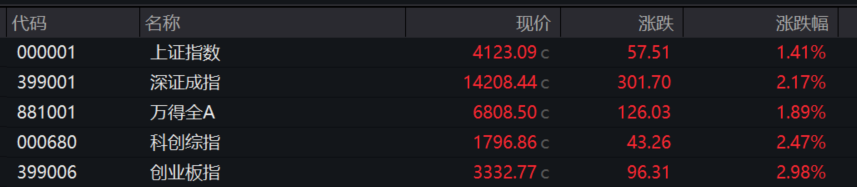
Market Overview - The total trading volume in the Shanghai and Shenzhen markets reached 2.25 trillion yuan, with all three major A-share indices closing higher on February 9 [1][7] - The Shanghai Composite Index rose by 1.41% to 4123.09 points, the Shenzhen Component Index increased by 2.17% to 14208.44 points, and the ChiNext Index gained 2.98% to 3332.77 points [2] Sector Performance - The photovoltaic equipment sector showed strong performance, with stocks like Juhua Materials, GCL-Poly Energy, and TCL Zhonghuan hitting the daily limit, while Tongxiang Technology surged over 24% [3][4] - The cultural media sector also saw gains, with stocks such as Rongxin Culture, Zhongwen Online, and Haikan Co. reaching their daily limits [5][6] Capital Flow - Major capital inflows were observed in the telecommunications, electronics, and power equipment sectors, with net inflows of 2.63 billion yuan for Xinyi Semiconductor, 2.61 billion yuan for Tianfu Communication, and 2.27 billion yuan for Guangku Technology [9] - Conversely, net outflows were noted in the textile and apparel sector, with Zhejiang Wenhuan, Aerospace Development, and CATL experiencing net sell-offs of 752 million yuan, 707 million yuan, and 678 million yuan respectively [9] Institutional Insights - CITIC Securities anticipates exponential growth in demand for space photovoltaic technology [9] - China International Capital Corporation (CICC) believes that the market for related resource stocks is not over, expecting a rebound after a short-term adjustment [9] - China Galaxy Securities predicts a volatile upward trend in the Hong Kong stock market before and after the Spring Festival [9]


鹿客科技递表港交所
Zhi Tong Cai Jing· 2026-02-09 05:28
Group 1 - The core viewpoint of the article is that Locket Technology (Beijing) Co., Ltd. has submitted its listing application to the Hong Kong Stock Exchange, aiming to leverage its innovative AI-powered home security solutions [1] - Locket Technology is recognized as the pioneer in the global market for AI home security systems, integrating hardware, software, and AI to provide comprehensive safety and management solutions for homes and communities [1] - The company is backed by China Galaxy International as the sole sponsor for its IPO [1] Group 2 - According to Frost & Sullivan, Locket Technology is the first company globally to achieve large-scale production of vein recognition smart locks, representing the future direction of smart locks and serving as a core foundation for home security [5] - In 2024, Locket Technology's shipment volume of vein recognition smart locks is projected to rank first globally, with a market share of 10.5% [5] - The company's overall smart lock shipment volume ranks fourth globally, with a market share of 2.6%, and in mainland China, it is expected to reach 1.2 million units shipped, ranking third with a market share of 5.8% [5]
机构:春节前后资金面预计仍将延续宽松状态!积极政策导向利好银行ETF华夏(515020)
Sou Hu Cai Jing· 2026-02-09 03:26
Group 1 - The China Banking Index (399986) saw a slight increase of 0.05% as of February 9, 2026, with notable gains from several banks, including Qingnong Commercial Bank up by 1.90% and Qilu Bank up by 1.70% [1] - The People's Bank of China conducted a 1,130 billion yuan reverse repurchase operation with a rate of 1.40%, maintaining the previous level, and achieved a net injection of 380 billion yuan into the market [1] - Analysts indicate that the central bank's actions, including the excess continuation of the 3-month reverse repurchase, reflect its intention to stabilize liquidity before the Spring Festival, suggesting a continued loose monetary environment [1] Group 2 - China Galaxy believes that the current proactive fiscal policy and stable monetary policy will support bank performance and benefit valuation recovery, making the banking sector an attractive investment opportunity [2] - The Huaxia Bank ETF (515020) is noted for having the lowest comprehensive fee rate among ETFs tracking the China Banking Index (399986) [2]
中国央行连续15个月增持黄金!现货黄金盘中重返5000美元关口上方,上海金ETF(518600)盘中最高涨超3%,连续3天净流入超4亿元
Sou Hu Cai Jing· 2026-02-09 02:51
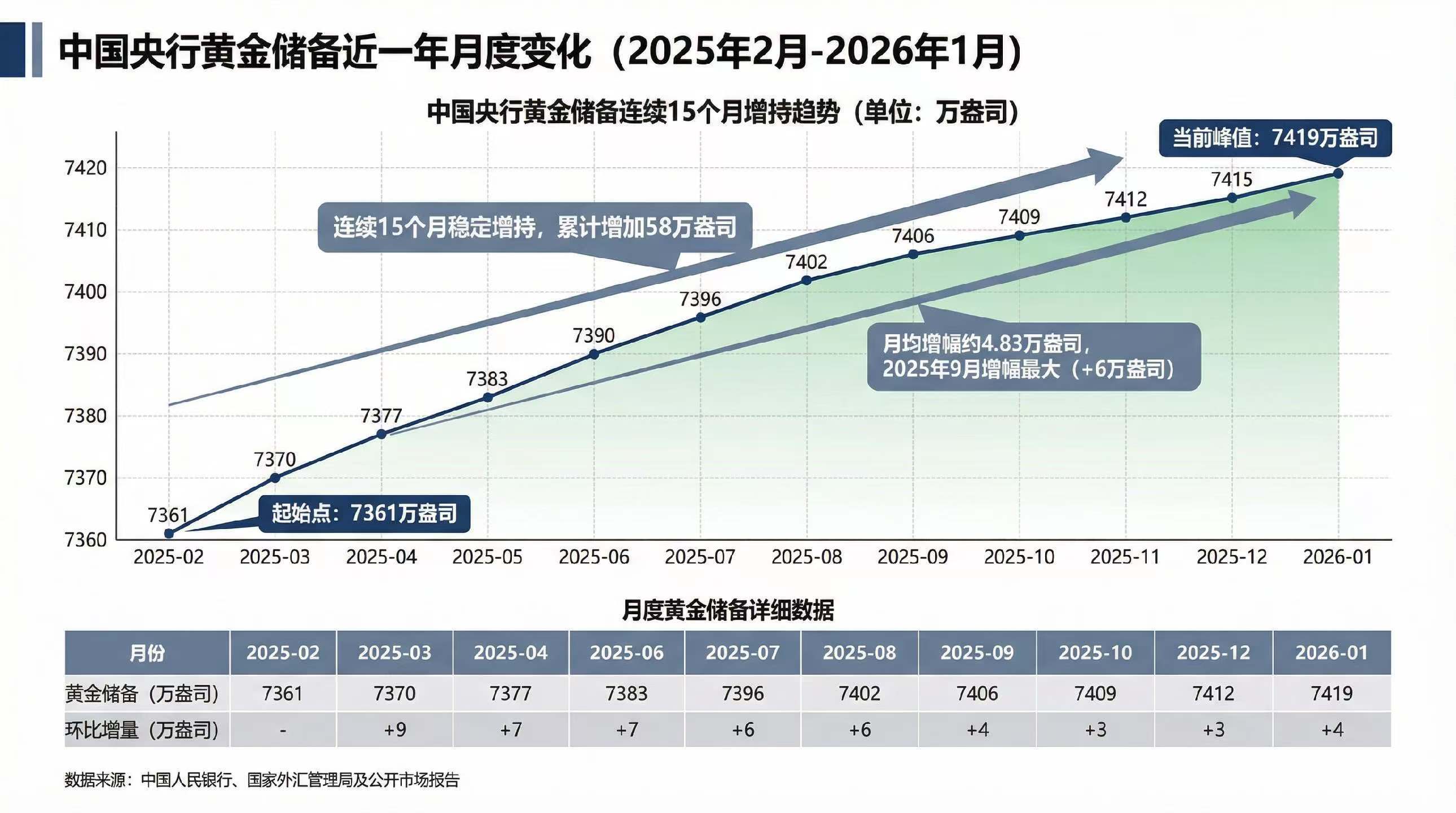
Core Viewpoint - The price of spot gold has surpassed the $5000 per ounce mark, reaching as high as $5040 per ounce, driven by an increase in China's gold reserves and positive market sentiment towards gold as a safe-haven asset [1][4]. Group 1: Gold Reserves and Market Trends - As of the end of January 2026, China's gold reserves stood at 74.19 million ounces, an increase of 40,000 ounces from December 2025 [1]. - The People's Bank of China has been increasing its gold reserves since November 2024, maintaining this trend for 15 consecutive months [1]. - The World Gold Council predicts that the current upward trend in gold prices will remain stable throughout the remainder of 2026 [4]. Group 2: Institutional Predictions and Investment Sentiment - Several financial institutions, including CITIC Securities, JPMorgan, Deutsche Bank, and Bank of America, have forecasted that gold prices could reach $6000 per ounce or higher in 2026 [4]. - Analysts from Galaxy Securities suggest that metal assets may continue to experience volatility, with a focus on the U.S. January CPI data to assess inflation persistence and adjust Federal Reserve policy expectations [5]. - Huatai Securities emphasizes that gold will remain an irreplaceable asset for value preservation, recommending a strategy of buying on dips due to ongoing dollar asset replacement logic and risk premiums [5]. Group 3: ETF Performance and Investment Opportunities - As of February 9, 2026, the Shanghai Gold ETF (518600) has risen by 2.81%, with a cumulative increase of 8.93% over the past month [5]. - The Shanghai Gold ETF has seen continuous net inflows, with a peak single-day net inflow of 177 million yuan, totaling 428 million yuan over three days [5]. - The Shanghai Gold ETF serves as a convenient investment tool for investors looking to hedge against rising gold jewelry prices [5].
鹿客科技递表港交所 2024年静脉智能锁出货量位居全球第一
Zhi Tong Cai Jing· 2026-02-09 02:39
Company Overview - LuKe Technology is a pioneer in AI home security management systems, providing integrated solutions centered around smart locks for home and community safety [3] - The company is the first globally to achieve mass production of vein recognition smart locks, with a market share of 10.5% in 2024 [3] - In 2024, LuKe Technology's smart lock shipments reached 1.2 million units in mainland China, ranking third with a market share of 5.8% [3] Product Innovation - The company launched the first mass-produced finger vein smart lock in 2021, followed by the first mass-produced palm vein smart lock in 2023, enhancing security and accuracy in biometric authentication [4] - LuKe Technology's proprietary AI image algorithms significantly improve security performance compared to traditional fingerprint and facial recognition solutions [4] Revenue Generation - LuKe Technology generates revenue through three main channels: sales of its own consumer products, providing ODM services for brand companies, and offering integrated software and hardware solutions under the "Yunding" brand [4] Industry Trends - The global home security management solutions market is rapidly growing, projected to increase from $25.5 billion in 2020 to $37.8 billion in 2024, with a CAGR of 10.4% [9] - The aging global population is driving demand for "tech-enabled elderly care" solutions, positioning LuKe Technology to benefit from market growth [5] Financial Performance - In the fiscal years 2023 and 2024, LuKe Technology reported revenues of approximately RMB 1.015 billion and RMB 1.086 billion, respectively [6] - The company's profit for the fiscal year 2023 was RMB 14.03 million, increasing to RMB 53.11 million in 2024 [6][8] Market Outlook - The global smart lock shipment volume is expected to grow from 37 million units in 2020 to 50 million units in 2024, with a CAGR of 7.8% [13] - By 2029, the global smart lock shipment volume is projected to reach 89.9 million units, driven by technological advancements and expanding application scenarios [13] Competitive Landscape - In the smart lock market, fingerprint recognition locks remain dominant, but palm vein and facial recognition locks are gaining traction due to improved security features [16] - The palm vein smart lock market is expected to grow significantly, with shipments projected to increase from 1.9 million units in 2025 to 6.3 million units by 2029, reflecting a CAGR of 35.6% [16]
中国银河证券:建材业传统品类走弱 涨价主线引领修复
Zhi Tong Cai Jing· 2026-02-09 01:47
Group 1: Cement Industry - The cement industry is expected to see the effects of capacity reduction by 2026, improving the supply-demand balance and leading to a price recovery, which will gradually restore corporate profitability [1] - In January, the cement market faced seasonal weakness with reduced demand and price pressure, but inventory levels are gradually decreasing, and prices are expected to stabilize in the short term, with potential increases in March due to seasonal construction [1] Group 2: Glass Fiber - In January, the price of raw glass fiber remained stable, supported by some demand recovery and inventory adjustments, while electronic fiber prices increased due to strong demand and supply constraints [2] - The demand for high-end glass fiber products remains robust, and prices are expected to maintain an upward trend in the short term, despite potential temporary declines in traditional electronic fiber demand [2] Group 3: Consumer Building Materials - The retail sales of building and decoration materials decreased by 2.7% year-on-year in 2025, with a significant drop in December, but demand is expected to recover slightly due to urban renewal strategies and the push for high-quality green building materials [3] - Leading companies in the consumer building materials sector are implementing price increases, which, along with anti-competitive policies, may help restore profitability [3] Group 4: Float Glass - The float glass market is experiencing weakening demand, with speculative purchasing increasing, leading to a decline in prices and high overall inventory levels [4] - Short-term demand is expected to continue decreasing, and the price center is likely to shift downward due to ongoing supply-demand pressures [4]