
吉祥航空

Search documents
招商交通运输行业周报:油运景气度回升,26年民航力争完成客运量8.1亿人次-20260111
CMS· 2026-01-11 08:04
Investment Rating - The report maintains a "Recommended" rating for the transportation industry [2] Core Insights - The shipping sector is experiencing a recovery in oil transportation due to improved demand post-holidays and geopolitical tensions [6][16] - The aviation industry aims to achieve a passenger volume of 810 million in 2026, reflecting a growth rate of 5.2% [23][24] - The express delivery sector is expected to see a gradual recovery in competition and profitability, with a focus on major players like SF Express [20] Shipping - The oil shipping sector is rebounding due to increased cargo availability from the Middle East and geopolitical sanctions affecting supply [6][16] - Container shipping rates are showing slight increases, with strong pricing power among shipowners before long-term contract negotiations [11][12] - Key stocks to watch include COSCO Shipping Energy, China Merchants Energy, and Pacific Shipping [16] Infrastructure - Weekly data indicates a decline in truck traffic and rail freight, with road truck traffic at 46.964 million vehicles, down 14.9% week-on-week [17][18] - Port throughput for the first week of 2026 was 25.4953 million tons, showing a slight decrease but a year-on-year increase of 7.7% in container throughput [18] - Recommended stock for infrastructure investment is Anhui Expressway [18] Express Delivery - In November 2025, express delivery volume reached 18.06 billion pieces, a year-on-year increase of 5%, while revenue decreased by 3.7% [19][20] - The competitive landscape is expected to stabilize, with major companies like SF Express anticipated to see profit growth in 2026 [20] - Recommended stocks include SF Express, ZTO Express, YTO Express, and Yunda Express [20] Aviation - The aviation sector is entering a critical period with the Spring Festival approaching, and passenger volume is projected to grow by 5.2% in 2026 [23][24] - Recent data shows a year-on-year increase in domestic passenger volume of 1.5% and a decrease in ticket prices [21][24] - Recommended stocks include Air China, China Southern Airlines, and Spring Airlines [24] Logistics - The cross-border air freight price index has decreased by 19.9% week-on-week, indicating a significant drop in logistics costs [25]



民航继续整治过低票价,继续重视油运布局
GOLDEN SUN SECURITIES· 2026-01-11 05:23
Investment Rating - The report maintains an "Overweight" rating for the transportation industry [4] Core Insights - The civil aviation sector is expected to continue addressing "involutionary competition" while focusing on "expanding domestic demand" and "countering involution," indicating a positive long-term outlook for the aviation sector [2][11] - The shipping market is experiencing a recovery in VLCC freight rates due to geopolitical risks, with some shipowners becoming optimistic about future market conditions [2][12] - The logistics sector shows promising growth in express delivery, particularly in overseas markets, with significant increases in package volumes reported [3][15] Summary by Sections Weekly Insights and Market Review - The transportation sector index rose by 0.23% from January 5 to January 9, 2026, underperforming the Shanghai Composite Index by 3.59 percentage points [1][17] - The top-performing segments included highway freight, public transport, and warehousing logistics, with increases of 4.90%, 2.34%, and 2.16% respectively [1][17] Aviation - The civil aviation sector is seeing a recovery in demand, with a focus on maintaining low growth in capacity supply and improving airline profitability as ticket prices stabilize [11] - Key stocks to watch include China Eastern Airlines, China Southern Airlines, and Spring Airlines [11] Shipping and Ports - VLCC freight rates have begun to rise, with the CT1 route rate reaching $54,455 per day as of January 9, 2026 [2][12] - The dry bulk shipping market is facing downward pressure, with the BDI index at 1,688 points as of January 9, 2026 [13][14] Logistics - The express delivery sector is expected to grow, with a focus on overseas expansion and the impact of e-commerce growth on delivery volumes [3][15] - The report highlights the performance of Jitu Express, which saw a 73.6% increase in package volume in Southeast Asia for Q4 2025 [15][16]
申万宏源交运一周天地汇:委变局油轮淡季预期逆转,航运景气度联动造船
Shenwan Hongyuan Securities· 2026-01-10 13:31
Investment Rating - The report maintains a positive outlook on the shipping industry, particularly focusing on VLCC and medium-sized oil tankers, indicating a strong demand due to geopolitical changes and seasonal shifts in shipping patterns [4]. Core Insights - The report highlights a significant increase in VLCC freight rates, with a 45% week-on-week rebound to $63,608 per day, driven by unexpected demand from the Middle East [4]. - New ship prices remain strong, with a slight weekly decline of 0.11%, indicating a robust pricing power in the shipbuilding sector [4]. - The aviation sector is expected to experience a significant improvement in profitability due to supply constraints and increasing passenger volumes, marking a potential golden era for airlines [4]. - The express delivery sector is entering a new phase of competition, with three potential scenarios outlined for future industry dynamics [4]. Summary by Sections Shipping Industry - The report notes a structural growth in VLCC demand, with compliance in Venezuelan oil exports potentially increasing transport volumes by approximately 1.4% [4]. - The average freight rate for VLCCs from the Middle East to the Far East reached $66,240 per day, reflecting a 71% increase from the previous week [4]. - The report emphasizes the strong performance of second-hand ship prices and suggests continued monitoring of companies like China Merchants Energy and COSCO Shipping Energy [4]. Aviation Sector - The report anticipates a significant uplift in airline profitability due to historical high passenger load factors and a constrained supply of aircraft [4]. - Airlines such as China Eastern Airlines, China Southern Airlines, and Spring Airlines are highlighted as key players to watch in this sector [4]. Express Delivery - The report discusses the potential for industry consolidation and improved profitability in the express delivery sector, with companies like Shentong Express and YTO Express being noted for their competitive advantages [4]. Road and Rail Transport - The report indicates resilience in railway freight volumes and highway truck traffic, with a slight decrease in recent weeks but overall stability expected [4]. - The report suggests that high-dividend investment themes and potential value management catalysts in the highway sector are worth monitoring [4].
航空机场板块1月9日跌1.19%,中国东航领跌,主力资金净流出4.08亿元
Zheng Xing Xing Ye Ri Bao· 2026-01-09 08:54
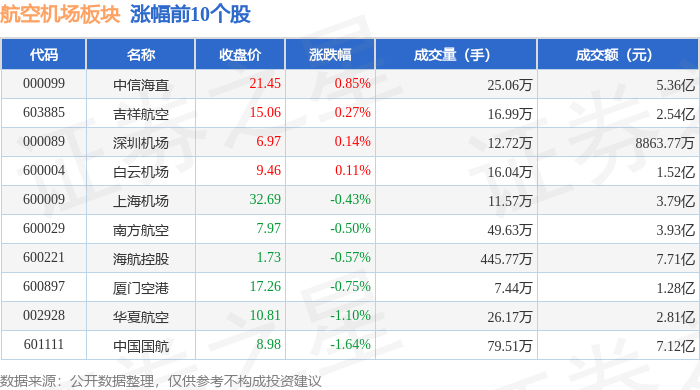
Core Viewpoint - The aviation and airport sector experienced a decline of 1.19% on January 9, with China Eastern Airlines leading the drop, while the overall Shanghai Composite Index rose by 0.92% [1] Group 1: Market Performance - The Shanghai Composite Index closed at 4120.43, up 0.92%, and the Shenzhen Component Index closed at 14120.15, up 1.15% [1] - The aviation and airport sector saw a net outflow of 408 million yuan from major funds, while retail investors contributed a net inflow of 377 million yuan [2] Group 2: Individual Stock Performance - China Eastern Airlines (600115) closed at 5.98, down 3.24%, with a trading volume of 1.3034 million shares and a transaction value of 778 million yuan [2] - Other notable declines included Spring Airlines (601021) down 1.87% and China National Airlines (601111) down 1.64% [2] - The highest trading volume was recorded for Hainan Airlines (600221) with 4.4577 million shares traded, despite a decline of 10.85% in net inflow from major funds [3] Group 3: Fund Flow Analysis - Major funds showed significant outflows in several stocks, including Hainan Airlines with a net outflow of 83.62 million yuan, and Spring Airlines with a net outflow of 28.47 million yuan [3] - Retail investors showed a positive net inflow in several stocks, with Hainan Airlines seeing a retail net inflow of 64.82 million yuan [3]



吉祥航空跌2.13%,成交额4438.69万元,主力资金净流出538.94万元
Xin Lang Cai Jing· 2026-01-09 02:24
Core Viewpoint - 吉祥航空's stock price has experienced fluctuations, with a recent decline of 2.13% and a year-to-date drop of 1.21%, indicating potential volatility in the market [1][2]. Company Overview - 吉祥航空, established on March 23, 2006, and listed on May 27, 2015, is primarily engaged in air passenger and cargo transportation, with passenger revenue accounting for 94.98% of total revenue [2]. - The company operates within the transportation sector, specifically in the aviation industry, and is part of various investment concepts including social security heavy positions and MSCI China [2]. Financial Performance - For the period from January to September 2025, 吉祥航空 reported a revenue of 17.48 billion yuan, a slight decrease of 0.06% year-on-year, and a net profit attributable to shareholders of 1.089 billion yuan, down 14.28% year-on-year [2]. - Cumulatively, since its A-share listing, 吉祥航空 has distributed a total of 2.35 billion yuan in dividends, with 565 million yuan distributed over the past three years [3]. Shareholder Structure - As of September 30, 2025, 吉祥航空 had 24,200 shareholders, an increase of 2.09% from the previous period, with an average of 90,121 circulating shares per shareholder, a decrease of 2.72% [2]. - Notable shareholders include 工银可转债债券 (003401) as the fourth largest shareholder with 22.07 million shares, and 南方中证500ETF (510500) as a new entrant in the top ten shareholders with 12.80 million shares [3].

低价机票正在被围剿
3 6 Ke· 2026-01-09 02:19
Core Insights - The Chinese civil aviation industry is projected to have 500 million air travelers by the end of 2025, making it the largest aviation population globally, but this also means that approximately 900 million people in China have never flown [1][24]. - The Civil Aviation Administration of China (CAAC) has reiterated its commitment to curbing "involution" in the industry, specifically by prohibiting airlines from selling tickets below cost [2][3]. Industry Trends - The media interprets the CAAC's stance as a signal that airfares may enter a rising trend, as discussions about price limits have been ongoing since early last year [3][6]. - Despite the CAAC's efforts, low-cost tickets below 200 yuan have not completely disappeared due to online travel agencies (OTAs) subsidizing fares to attract users [4][6]. - The civil aviation industry reported a profit of 6.5 billion yuan in 2025, with major airlines like Air China, China Eastern, and China Southern showing profitability, while private carriers like Spring Airlines have experienced significant growth [6][8]. Market Dynamics - The current situation presents a paradox where airlines are becoming profitable, yet consumers feel the pinch as low-cost tickets become scarce, raising concerns about the future of affordable air travel [7][26]. - The CAAC's push against involution reflects broader economic pressures in China, aiming to prevent companies from engaging in destructive price wars that could jeopardize cash flow across industries [8][9]. - The profitability of international routes, particularly to Japan, has been threatened by geopolitical uncertainties, leading to an oversupply of domestic flights and increased operational costs for airlines [9][12]. Competitive Landscape - The high-speed rail system in China poses a significant competitive threat to the aviation industry, as it offers a more convenient and often cheaper alternative for travelers, especially as airfares rise [15][22]. - The psychological pricing of air tickets is influenced by the cost of train tickets, and if airfares rise significantly, it may deter potential travelers who perceive flying as too expensive [25][26]. - The operational efficiency of airlines, such as Shandong Airlines, is increasingly driven by the need to compete with the extensive high-speed rail network in densely populated regions [17][18].

我国成为全球第一航空人口大国 民航业上市公司以多元化服务“护航”
Shang Hai Zheng Quan Bao· 2026-01-08 16:49
Core Insights - China's aviation population has surpassed 500 million, making it the world's largest aviation population country, with fixed asset investment in civil aviation reaching 630 billion yuan during the 14th Five-Year Plan period [1] - The growth in aviation population is supported by the steady expansion of the aviation industry's transport scale and accelerated infrastructure development, alongside measures to boost domestic demand and consumption [1] Group 1: Industry Growth and Performance - In 2025, China's civil aviation industry achieved a total transport turnover of 1,640.8 billion ton-kilometers and a passenger transport volume of 770 million, representing year-on-year growth of 10.5% and 5.5% respectively [2] - The international flight recovery reached over 90% of 2019 levels, with international passenger transport volume increasing by 21.6% year-on-year [2] - The civil aviation industry aims to achieve a transport turnover of 1,750 billion ton-kilometers and a passenger transport volume of 810 million in 2026, driven by macroeconomic development and policies to expand domestic demand [2] Group 2: Capacity and Operational Efficiency - The passenger load factor in 2025 reached 85.1%, an increase of 1.8 percentage points year-on-year, indicating a strong recovery in the passenger market [3] - Analysts predict that the load factor will continue to rise in 2026, suggesting potential for high price elasticity due to elevated load factors [3] - In 2025, the civil aviation industry reported a profit of 6.5 billion yuan, reflecting improved operational efficiency [4] Group 3: Route Expansion and Fleet Development - In 2025, significant route expansions were noted, including the resumption of regular flights between China and India and the launch of the longest single-route flight from Shanghai to Buenos Aires [4] - Airlines are actively opening new routes and increasing flight frequencies to enhance travel convenience, with Spring Airlines planning to open and restore several international and domestic routes in 2026 [4] - Major airlines have announced plans to purchase a total of 118 Airbus A320 aircraft, with a catalog price exceeding 18.1 billion USD, scheduled for delivery starting in 2028 [6] Group 4: Innovative Service Models - Airlines are exploring "Aviation+" business models, integrating services such as travel, culture, and education to enhance customer experience and stimulate consumption [7] - China Eastern Airlines plans to invest over 100 million yuan in aviation consumption vouchers in 2026 to promote travel and tourism consumption [7] - The average flight distance for domestic routes increased to 1,262 kilometers in 2025, indicating a shift towards longer-distance travel and a focus on underdeveloped markets [7][8] Group 5: Market Trends and Consumer Behavior - The demand for long-distance international routes is growing faster than domestic routes, indicating a structural improvement in overall aviation demand [8] - Airlines are leveraging local tourism resources to create unique travel experiences, contributing to local economic growth [8] - The recovery in business travel sentiment is expected to further drive aviation demand, supported by enhanced service quality and expanded consumer bases [8]


中国多条航线跻身全球“最忙”榜单,这里的人飞得最多
Guan Cha Zhe Wang· 2026-01-08 10:57
Core Insights - The OAG report highlights that several Chinese routes have excelled, with the Shanghai Hongqiao to Shenzhen Bao'an route making it into the top ten busiest global routes for the first time due to its high capacity and low ticket prices [1][2] Group 1: Global Route Rankings - The Asia-Pacific region dominates the top ten busiest routes, with nine out of ten routes located there [1] - The Jeju to Seoul Gimpo route in South Korea ranks first globally, offering 14.4 million seats and featuring seven airlines, leading to competitive pricing with one-way tickets as low as $44 [1] Group 2: Chinese Route Performance - Beijing Capital to Shanghai Hongqiao ranks ninth globally with 7.5 million seats, while Shanghai Hongqiao to Shenzhen Bao'an ranks tenth with 7.1 million seats, highlighting their significance in regional travel [1] - Other notable Chinese routes include Guangzhou Baiyun to Shanghai Hongqiao with 6.4 million seats, and routes from Chengdu to Beijing and Chengdu to Shenzhen showing stable performance [2] Group 3: Airport and Airline Rankings - By December 2025, Guangzhou Baiyun International Airport is projected to be the busiest airport in China, followed by Shenzhen Bao'an and Beijing Capital [2] - China Southern Airlines is expected to lead the domestic market with a 16% share, followed by China Eastern Airlines at 14% [2] Group 4: Growth Rates and Passenger Volume - Spring Airlines shows the highest growth rate in capacity with an 18% increase year-on-year, while China Southern Airlines follows with a 15% increase [2] - In terms of passenger volume, Shanghai Pudong Airport is expected to handle 84.995 million passengers, a 10.7% increase, making it the busiest airport for the second consecutive year [2][3] Group 5: Overall Aviation Trends - By 2025, China's total air travel population is projected to exceed 500 million, making it the largest in the world, with an annual passenger transport volume of 770 million, reflecting a 5.5% year-on-year growth [3] - The top ten cities for air travel in 2025 include Shanghai, Beijing, Chengdu, Guangzhou, and Shenzhen, collectively accounting for 47.8% of the national air travel volume [3]
航空机场板块1月8日跌0.33%,厦门空港领跌,主力资金净流出2.22亿元
Zheng Xing Xing Ye Ri Bao· 2026-01-08 08:56
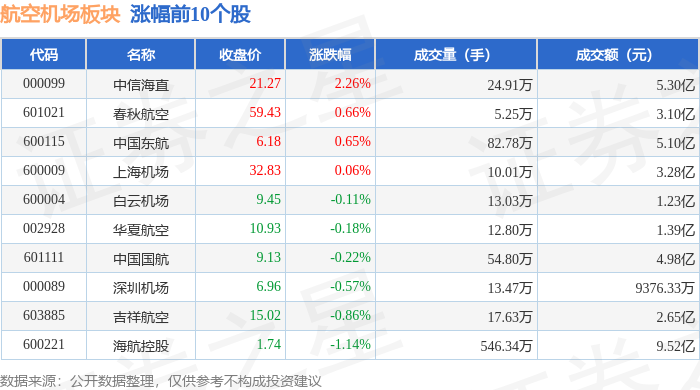
Market Overview - The aviation and airport sector experienced a decline of 0.33% on January 8, with Xiamen Airport leading the drop [1] - The Shanghai Composite Index closed at 4082.98, down 0.07%, while the Shenzhen Component Index closed at 13959.48, down 0.51% [1] Stock Performance - Notable stock performances include: - CITIC Hainan Airlines (Code: 6600000) rose by 2.26% to close at 21.27 with a trading volume of 249,100 shares and a turnover of 530 million yuan [1] - Spring Airlines (Code: 601021) increased by 0.66% to 59.43 with a turnover of 310 million yuan [1] - China Eastern Airlines (Code: 600115) saw a rise of 0.65% to 6.18 with a trading volume of 827,800 shares [1] - Xiamen Airport (Code: 600897) fell by 1.86% to 17.39 with a turnover of 162 million yuan [2] Capital Flow - The aviation and airport sector saw a net outflow of 222 million yuan from major funds, while retail investors contributed a net inflow of 243 million yuan [2] - The capital flow for individual stocks indicates: - CITIC Hainan Airlines had a net outflow of 33.83 million yuan from major funds [3] - Shanghai Airport experienced a net inflow of 11.45 million yuan from major funds [3] - Xiamen Airport had a net outflow of 15.54 million yuan from major funds but a net inflow of 16.07 million yuan from retail investors [3]


国泰海通:预计航司25Q4将同比继续大幅减亏 春运客流高峰票价可期
智通财经网· 2026-01-08 05:57
Core Viewpoint - The aviation industry in China is expected to continue its recovery, with significant improvements in demand and a potential turnaround in profitability by 2025, driven by a strong rebound in passenger traffic and strategic pricing adjustments [2][5]. Group 1: Short-term Outlook - The upcoming New Year holiday is anticipated to see robust air travel demand, with significant increases in both volume and pricing compared to previous years [4]. - The Spring Festival travel peak is expected to maintain active business and personal travel, although the holiday's impact may be weaker than in previous years [4]. Group 2: Demand and Supply Dynamics - Passenger traffic is projected to grow by 5-6% in 2025, with domestic routes increasing by 4% and international routes by over 20% [2]. - The industry is entering a low growth phase in supply, with a projected fleet size increase of approximately 3.7% by November 2025 compared to the end of 2024 [2]. Group 3: Performance Metrics - The passenger load factor is expected to reach a historical high, with a year-on-year increase of 1.7 percentage points, while ticket prices remain at historically low levels [2]. - Domestic ticket prices are estimated to decrease by 2-3% year-on-year, while international ticket prices may see significant increases in the latter half of the year due to strong inbound demand [2]. Group 4: Quarterly Performance Expectations - In Q1, passenger traffic is expected to reach new highs due to strong personal demand, but ticket prices may decline by about 10% year-on-year, limiting profitability improvements [3]. - Q2 is projected to see significant reductions in losses due to active business travel and favorable supply-demand conditions [3]. - Q3 may experience weaker business demand, impacting profitability despite a slight increase in ticket prices driven by recovering demand from September [3]. - Q4 is expected to continue the trend of significant loss reduction, supported by strong holiday travel and stable load factors [3]. Group 5: Long-term Outlook - The Chinese aviation industry is anticipated to enter a "super cycle," with sustainable growth in demand and a recovery in pricing and profitability expected to begin in 2026 [5]. - The market has achieved price liberalization, and the focus on improving network quality will be crucial for traditional airlines' future profitability [5].
