
康方生物

Search documents
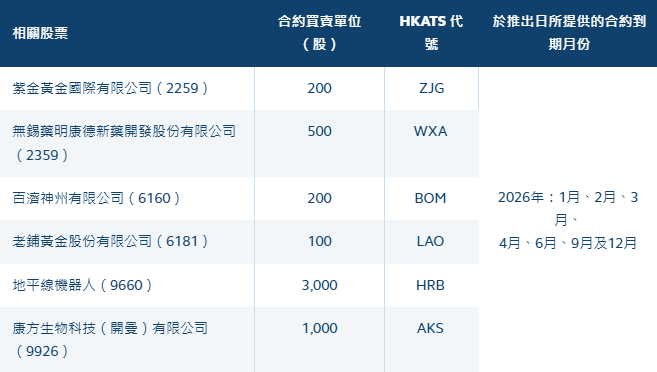
香港交易所将于1月19日推出百济神州(06160)等六只新股票期权
智通财经网· 2026-01-09 05:50
Core Viewpoint - Hong Kong Stock Exchange (HKEX) will launch six new stock options on January 19, 2026, expanding the stock options market and providing investors with more choices [1] Group 1: New Stock Options - The new stock options will include Zijin Gold International (02259), WuXi AppTec (02359), BeiGene (06160), Lao Poo Gold (06181), Horizon Robotics (09660), and CanSino Biologics (09926) [1] - The contract sizes for the new options are as follows: Zijin Gold International (200 shares), WuXi AppTec (500 shares), BeiGene (200 shares), Lao Poo Gold (100 shares), Horizon Robotics (3,000 shares), and CanSino Biologics (1,000 shares) [2] Group 2: Market Performance - The average daily trading volume of HKEX's derivatives market reached 1,662,751 contracts last year, marking a 7% year-on-year increase and setting a new record [1] - Stock options, including monthly and weekly expiry contracts, were among the most actively traded products, with an average daily trading volume of 879,831 contracts, a 22% year-on-year increase and a new record high [1]



恒生科技大幅回撤,互联网、银行等紧随其后;恒生医疗逆势大涨
Ge Long Hui· 2026-01-08 21:06
Group 1 - The Hang Seng Index closed down 0.94%, with the technology sector experiencing the largest decline [1] - The Hang Seng Technology Index fell by 1.81%, with notable drops from BYD Co. Ltd. (-3.93%), Alibaba (-3.25%), and NetEase (-2.88%) [3] - The Hang Seng Bank Index also saw a decline of 1.1%, with Standard Chartered down 2.43% and China Construction Bank down 1.42% [3] Group 2 - The Hang Seng Healthcare Index rose by 2.47%, driven by significant gains from companies like CanSino Biologics (+7.31%) and 3SBio (+7.16%) [3] - Other healthcare stocks such as WuXi Biologics and Innovent Biologics also saw increases of 5.92% and 5.38% respectively [3] - More than ten healthcare stocks recorded gains exceeding 3% [3]

创新药“首单”频现,患者用药门槛降低
Xin Lang Cai Jing· 2026-01-08 16:57
Core Insights - The new medical insurance directory has entered a substantial implementation phase, with multiple innovative drugs, including Tislelizumab and Fuzhengzhu, being covered by insurance in various hospitals, indicating a reduction in access barriers for patients [1][3] - The adjustment includes 114 new drugs and introduces a dual insurance model, combining basic medical insurance with commercial health insurance, which opens payment channels for high-value drugs in oncology and rare diseases [1][3] Group 1: Innovative Drug Inclusion - The rapid inclusion of innovative drugs in the new medical insurance directory reflects increased support for "true innovation" with high clinical value, as evidenced by the inclusion of 124 unique products [3] - Notably, Tislelizumab, the first targeted drug for thyroid eye disease in China, was included in the insurance directory within a year of its market launch, filling a 70-year treatment gap [3] - Heng Rui Medicine emerged as a significant beneficiary, with 20 products and indications adjusted, including 10 new drugs, enhancing patient access to innovative therapies [3][4] Group 2: Commercial Health Insurance Impact - The introduction of the commercial health insurance directory provides a secondary market for high-value drugs, with price reductions ranging from 15% to 50%, which is less severe than the typical 60% cuts seen in basic medical insurance [6] - The inclusion of five CAR-T therapy products in the commercial insurance directory marks a significant breakthrough for high-priced treatments, which previously struggled to gain insurance coverage [5][6] - The dual-directory model creates a payment system that supports innovation while allowing for profitable pricing strategies for pharmaceutical companies [7][11] Group 3: Market Dynamics and Adjustments - The adjustment process also involved the removal of 29 drugs from the insurance directory, including Benarutide, which faced competition from more effective alternatives, highlighting the dynamic nature of the market [9][10] - The exit of certain drugs signals a shift towards prioritizing high-efficiency and urgently needed medications, enhancing the overall efficiency of the medical insurance fund [11] - Companies are encouraged to focus on true innovation rather than "me-too" products, aligning their research and development strategies with the evolving insurance landscape [5][11]

新医保目录实施一周:创新药“首单”频现
Bei Jing Shang Bao· 2026-01-08 15:45
Core Insights - The new medical insurance directory has entered a substantial implementation phase, with multiple innovative drugs, including Tislelizumab and Fuzhengzhu, being covered by insurance in various hospitals, indicating a rapid reduction in access barriers for patients [1][3] - The adjustment includes 114 new drugs and introduces a commercial health insurance innovative drug directory for 2025, marking a significant shift towards a multi-tiered insurance payment system [1][3] Group 1: Innovative Drug Inclusion - The new medical insurance directory reflects increased support for "true innovation" with 124 unique products included, showcasing a strong emphasis on high clinical value [3][4] - Notable drugs like Tislelizumab, the first targeted therapy for thyroid eye disease, and Fuzhengzhu, a biological agent for psoriasis, have been rapidly integrated into the insurance system, filling long-standing treatment gaps [3][4] - Heng Rui Medicine is highlighted as a major beneficiary, with 20 products and indications adjusted, including 10 new drugs, enhancing patient access to innovative therapies [3][4] Group 2: Biotech Sector Impact - Companies like BeiGene, Innovent Biologics, and Kangfang Biotech are also benefiting from the new directory, accelerating their commercialization processes [4] - BeiGene is the only company with two products included in the first commercial insurance innovative drug directory, addressing unmet needs in cholangiocarcinoma and neuroblastoma [4] - Innovent Biologics has expanded its offerings to 12 innovative drugs under the new directory, creating a robust product matrix [4] Group 3: Shift in R&D Strategies - The introduction of the commercial insurance innovative drug directory is seen as a solution to the payment challenges faced by high-value innovative drugs, encouraging companies to focus on true innovation rather than me-too products [5][6] - The directory allows for a second market for high-priced therapies, with price reductions between 15% and 50%, which is less severe than the typical cuts seen in basic insurance [6][7] - This dual-directory model is expected to drive pharmaceutical companies to align their R&D strategies with real-world clinical needs, particularly in oncology and rare diseases [7][9] Group 4: Drug Exclusions - The adjustment also involved the removal of 29 drugs from the insurance directory, including Benalutide injection, which faced competition from more effective alternatives [8][9] - This "one in, one out" approach aims to enhance the efficiency of insurance fund usage by prioritizing high-demand and effective medications [9]

BD交易与政策红利共振 医药板块2025年强势反弹
BambooWorks· 2026-01-08 10:21
Core Insights - The core viewpoint of the article emphasizes that the surge in innovative drug licensing and BD transactions has significantly driven the stock price explosion in the pharmaceutical sector, with total transaction amounts reaching $135.655 billion in 2025, marking a 161% increase from 2024 [1][4]. Group 1: Market Performance - The Hong Kong biopharmaceutical sector has rebounded strongly in 2025, with the Hang Seng Healthcare Index (HSHCI) rising by 76%, outperforming the Hang Seng Index and the overall A-share biopharmaceutical sector, which saw a 25.64% increase [1]. - Southbound capital inflow reached a record high of HKD 1.4 trillion in 2025, with healthcare sector holdings increasing by 125.51% to HKD 540 billion, providing substantial liquidity to the market [1][3]. Group 2: Structural Differentiation - The structural differentiation within the biopharmaceutical sector is becoming more pronounced, with companies that have First-in-Class or Best-in-Class pipelines and stable BD revenue sources being favored, while those reliant on single core projects face valuation pressures [3]. - The CXO sector also performed well in 2025, benefiting from ongoing investments in innovative drugs, while the medical device and supplies sector showed solid performance due to stable cash flows [3]. Group 3: Policy and Regulatory Environment - The policy environment has been continuously optimized, with 76 innovative drugs approved for market entry by the National Medical Products Administration in 2025, significantly surpassing the 48 approvals in 2024 [5]. - The introduction of the first version of the innovative drug commercial insurance catalog marks a shift to a dual protection system of basic medical insurance and commercial health insurance, enhancing clinical medication standards and overall industry R&D returns [6]. Group 4: Future Outlook - The explosive growth in BD transactions and active IPOs is injecting strong cash flow and confidence into the biopharmaceutical industry, with expectations for leading companies like BeiGene to achieve profitability in 2026 [5]. - However, challenges remain, including potential market pressure from a wave of unlocks post-IPO lock-up periods and stricter regulatory scrutiny on IPO applications [7].

去年12月博时恒生医疗保健QDII-ETF跌10%?规模74亿元
Zhong Guo Jing Ji Wang· 2026-01-08 10:16
中国经济网北京1月8日讯 据同花顺数据显示,在刚过去的2025年12月份,博时恒生医疗保健 (QDII-ETF) 单月下跌10.17%。截至2025年三季度末规模为74.30亿元。 | 代码 名称 | | 12月复权单位 累计单位 | | | --- | --- | --- | --- | | | 净值增长率8 净值元 | | | | 513060. SH 博时恒生医疗保健(QDII-ETF) | -10.17 | 0.59 | 63.02 2021-03-18 万琼 | 来源:同花顺 2025年三季度前十大重仓股为百济神州、药明生物、信达生物、康方生物、中国生物制药、石药集 团、京东健康、三生制药、药明康德、阿里健康。基金经理万琼2004年起先后在中企动力科技股份有限 公司、华夏基金工作。2011年加入博时基金管理有限公司,历任投资助理、基金经理助理、基金经理。 (责任编辑:刘畅 ) 【免责声明】本文仅代表作者本人观点,与和讯网无关。和讯网站对文中陈述、观点判断保持中立,不对所包含内容 的准确性、可靠性或完整性提供任何明示或暗示的保证。请读者仅作参考,并请自行承担全部责任。邮箱: news_center@s ...

去年12月广发中证香港创新药ETF跌11% 规模138亿元
Zhong Guo Jing Ji Wang· 2026-01-08 08:22
(责任编辑:华青剑) 来源:同花顺 中国经济网北京1月8日讯 据同花顺数据显示,在刚过去的2025年12月份,广发中证香港创新药 (QDII-ETF)单月下跌11.16%。截至2025年三季度末规模为138.75亿元。 2025年三季度前十大重仓股为信达生物、百济神州、药明生物、康方生物、中国生物制药、石药集 团、三生制药、药明康德、翰森制药、科伦博泰生物。基金经理刘杰现任广发基金管理有限公司指数投 资部总经理助理、基金经理。 | 代码 名称 | 12月复权单位 累计单位 规模亿元 基金成立日 基金经理 | | --- | --- | | | 净值增长率8 净值元 | | 513120. SH 广发中证香港创新药(QDII-ETF) | -11.16 1.20 234.03 2022-07-01 刘杰 | ...

去年12月博时恒生医疗保健QDII-ETF跌10% 规模74亿元
Zhong Guo Jing Ji Wang· 2026-01-08 08:22
中国经济网北京1月8日讯 据同花顺数据显示,在刚过去的2025年12月份,博时恒生医疗保健 (QDII-ETF) 单月下跌10.17%。截至2025年三季度末规模为74.30亿元。 来源:同花顺 (责任编辑:康博) 2025年三季度前十大重仓股为百济神州、药明生物、信达生物、康方生物、中国生物制药、石药集 团、京东健康、三生制药、药明康德、阿里健康。基金经理万琼2004年起先后在中企动力科技股份有限 公司、华夏基金工作。2011年加入博时基金管理有限公司,历任投资助理、基金经理助理、基金经理。 | 代码 名称 | 12月复权单位 累计单位 规模亿元 基金成立日 基金经理 | | --- | --- | | | 净值增长率8 净值元 | | 513060.SH 博时恒生医疗保健(QDII-ETF) | -10.17 0.59 63.02 2021-03-18 万琼 | ...

万联证券:国内药企崭露头角 前沿平台与出海潜力成投资主脉
智通财经网· 2026-01-08 03:57
Core Insights - In 2025, the FDA approved 46 new drugs, indicating a decline in the number of approvals compared to 2024 and 2023, but the approved drugs are diverse and highly innovative [2][3] Group 1: Drug Approval Overview - The approved new drugs in 2025 are characterized by high innovation, with over half classified as "first-in-class" therapies [3] - The majority of the approved drugs are small molecule drugs, with others including monoclonal antibodies, ADCs, siRNA, ASOs, fusion proteins, and bispecific T-cell engagers [3] Group 2: Therapeutic Areas - Oncology is the predominant therapeutic area for the approved new drugs, covering various solid tumors and hematological malignancies [4] - Other therapeutic areas include respiratory, endocrine and metabolic, and cardiovascular diseases, with 34 of the new drugs undergoing special review processes [4] Group 3: Company Performance - Major multinational pharmaceutical companies such as Merck, Eli Lilly, Boehringer Ingelheim, and GlaxoSmithKline each had two new drugs approved [5] - Domestic companies also achieved approvals, with Zhongshan Kangfang Biopharmaceutical Co., Ltd.'s Paimupili monoclonal antibody and Dize (Jiangsu) Pharmaceutical Co., Ltd.'s Shuwotini receiving FDA approval [5] Group 4: Investment Recommendations - The report suggests focusing on companies with cutting-edge technology platforms, particularly those involved in ADC, siRNA, and cell gene therapy (CGT) [1] - It is recommended to invest in Chinese innovations with global competitiveness, especially those conducting or planning global multi-center clinical trials, and those utilizing a collaboration model where Chinese companies handle early-stage R&D while multinational companies manage later-stage clinical and commercialization efforts [1]
2026年1月8日:环球市场动态
citic securities· 2026-01-08 03:11
Market Overview - A-shares experienced a slight increase, with the Shanghai Composite Index achieving a 14-day consecutive rise, closing at 4,085.77 points, up 0.05%[16] - The Hang Seng Index and the Hang Seng Tech Index fell by 0.94% and 1.49%, respectively, amid weak performance in technology stocks[11] - European markets showed mixed results, with the German DAX reaching a new high, up 0.92%[9] Commodity and Forex - International oil prices dropped due to Trump's statement about Venezuela potentially transferring up to 50 million barrels of oil to the U.S., with NYMEX crude oil down 2.0% to $55.99 per barrel[28] - Gold prices fell by 0.7% to $4,462.5 per ounce as investors locked in profits after recent gains[28] - The Japanese yen depreciated against the dollar, with USD/JPY rising to 156.76, influenced by heightened tensions between China and Japan[28] Fixed Income - U.S. mid to long-term Treasury yields rose as signs of weakness in the job market emerged, with the market anticipating at least two rate cuts by the Federal Reserve this year[5] - The 10-year U.S. Treasury yield decreased by 2.6 basis points to 4.15%[32] - Asian bond markets remained strong, with new issues receiving good demand[5] Sector Performance - In the U.S. stock market, the S&P 500 fell by 0.34% to 6,920.9 points, while the Nasdaq rose slightly by 0.16% to 23,584.3 points[9] - The healthcare sector in the U.S. saw a notable increase, with Amgen's stock rising by 3.47% following its acquisition announcement[9] - In the Hong Kong market, the healthcare sector rose by 3.8%, while the energy sector fell by 2.1%[12]