
海信视像

Search documents
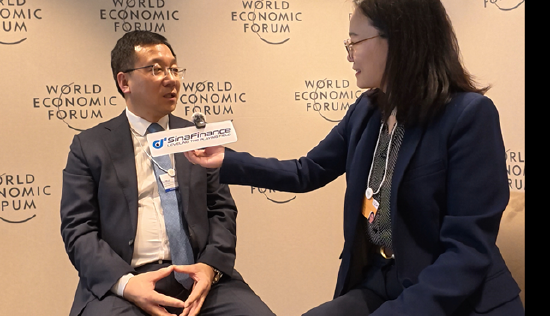
直击达沃斯|对话海信视像总裁李炜:真正的国际化,是在当地“扎下去”
Xin Lang Cai Jing· 2026-01-23 11:07
Core Insights - The discussion at the 2026 World Economic Forum highlighted the evolution of Hisense's internationalization strategy, emphasizing the importance of local integration rather than merely exporting products [1][3][14]. Group 1: Internationalization Strategy - Hisense's internationalization has transitioned from a supply chain focus to a model centered on local integration and coexistence [3][14]. - The company established its first overseas production base in South Africa in 1996 and has since maintained a long-term strategy focused on technological depth and integrated production, sales, and research [3][14]. - Hisense has set up production bases in Mexico, Slovenia, South Africa, and Vietnam, along with marketing headquarters and R&D centers in key regions, enhancing regional competitiveness and responsiveness to local market needs [3][14]. Group 2: Brand Globalization - The logic of Chinese brands going global has shifted from price competitiveness to a focus on technology and brand value over the past decade [4][15]. - Current competition is determined by understanding user needs and delivering superior technology rather than just offering lower prices [4][16]. - Challenges for Chinese brands in global markets now include ESG compliance, user data privacy, and adherence to patent and technology standards [4][16]. Group 3: AI and Industry Transformation - AI is reshaping the consumer electronics industry, particularly in the display sector, transforming devices into user-friendly partners [5][17]. - Hisense has made significant R&D investments, transitioning from a follower to a leader in display technology, exemplified by its RGB Mini LED technology, which outperforms competitors in quality and energy efficiency [7][19]. - The introduction of AI algorithms allows for real-time optimization of display quality across various content and applications, enhancing user experience [7][19]. Group 4: Technological Innovation Driven by Standards - Stringent energy efficiency and environmental standards in the European market are seen as drivers of technological innovation rather than mere cost burdens [8][20]. - Hisense's RGB Mini LED technology demonstrates a 30% improvement in energy efficiency compared to traditional Mini LED solutions, achieving higher energy efficiency ratings than QLED products in Europe [9][20]. - These advancements not only enhance market competitiveness but also contribute to environmental sustainability and reduced consumer energy costs [9][20]. Group 5: Smart Manufacturing and User-Centric Approach - Hisense's Qingdao factory has been recognized as a "lighthouse factory" by the World Economic Forum, emphasizing a user-centered approach to smart manufacturing [10][21]. - The factory employs over 40 AI technologies, significantly reducing the time from user demand recognition to product functionality conversion by 62% [10][21]. - Production efficiency for 85-inch televisions has improved to a cycle time of 20 seconds, showcasing significant advancements in manufacturing processes [10][21].


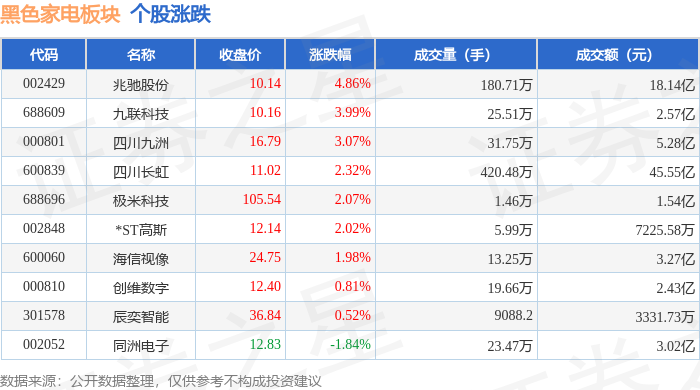
黑色家电板块1月23日涨2.65%,兆驰股份领涨,主力资金净流出6799.14万元
Zheng Xing Xing Ye Ri Bao· 2026-01-23 09:04
Core Viewpoint - The black home appliance sector experienced a rise of 2.65% on January 23, with Zhao Chi Co., Ltd. leading the gains [1] Group 1: Market Performance - The Shanghai Composite Index closed at 4136.16, up 0.33% [1] - The Shenzhen Component Index closed at 14439.66, up 0.79% [1] - Key stocks in the black home appliance sector showed varied performance, with Zhao Chi Co., Ltd. closing at 10.14, up 4.86% [1] Group 2: Stock Details - Zhao Chi Co., Ltd. (002429) had a trading volume of 1.8071 million shares and a transaction value of 1.814 billion [1] - Jiu Lian Technology (688609) closed at 10.16, up 3.99%, with a transaction value of 257 million [1] - Sichuan Jiuzhou (000801) closed at 16.79, up 3.07%, with a transaction value of 528 million [1] - Sichuan Changhong (600839) closed at 11.02, up 2.32%, with a transaction value of 4.555 billion [1] Group 3: Capital Flow - The black home appliance sector saw a net outflow of 67.9914 million from institutional investors and 166 million from retail investors, while retail investors had a net inflow of 234 million [1] - Specific stock capital flows showed that Sichuan Jiuzhou had a net inflow of 51.1923 million from institutional investors [2] - Jiu Lian Technology experienced a net outflow of 16.9316 million from speculative funds, while retail investors had a net inflow of 336.12 million [2]

索尼退场,日本电视全军覆没
芯世相· 2026-01-23 08:41
Core Viewpoint - Sony's decision to form a joint venture with TCL for its home entertainment business marks a significant shift in the global television market, indicating Japan's exit from the competitive landscape of television manufacturing [4][9]. Group 1: Sony's Strategic Move - Sony will transfer its television business and the BRAVIA brand to a joint venture with TCL, with TCL holding a 51% stake, effectively rebranding Sony's television operations [4]. - The move reflects Sony's lack of display panel production capabilities, which limits its profit margins in the television sector, relying instead on LG and TCL for panel supply [4][9]. - Sony's television market presence has been minimal, often categorized under "others" in market share rankings, and its television segment has historically underperformed compared to its other business units like CIS chips and gaming [4][9]. Group 2: Implications for the Japanese Market - The partnership signifies the end of Japan's independent television brands, as major players like Sharp, Toshiba, and Panasonic have either exited or significantly downsized their television operations [9][10]. - The historical context shows that since 2010, Japanese electronics companies have been selling off their consumer electronics divisions, with Sony's television business being the latest casualty [11][16]. - The decline of Japanese brands in the television market is attributed to their loss of panel production capabilities, which has led to a diminished ability to control pricing and market presence [20][26]. Group 3: The Rise of Chinese and Korean Competitors - TCL's acquisition of Sony's television business is positioned to enhance its competitive stance against Samsung, leveraging Sony's brand equity alongside its own manufacturing capabilities [9]. - The shift in market dynamics has seen Chinese and Korean companies dominate the display panel production, with significant investments leading to a loss of market share for Japanese firms [22][25]. - The transition from Japanese dominance in the television market to a landscape where Chinese and Korean manufacturers hold the majority of panel production capabilities illustrates a broader trend of technological and market leadership shifting eastward [20][29].



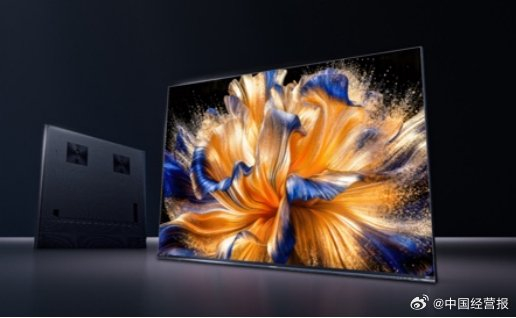
海信RGB-Mini LED电视销量占比超90%,节能40%领跑高端市场
Zhong Guo Jing Ying Bao· 2026-01-23 07:38
Group 1 - Hisense is accelerating its presence in the high-end television market with its RGB-Mini LED technology, which is gaining significant market share [1][2] - The RGB-Mini LED technology offers advantages over QD-Mini LED, including a 40% energy saving in daily use and a 42% reduction in harmful blue light, enhancing eye protection and color accuracy [1] - Hisense's overall market share in the RGB-Mini LED television sector reached 95.67% according to data from Aowei Cloud Network [2] Group 2 - The shift towards colored light sources is seen as the next generation of display technology, with laser TVs, Micro LED, and RGB-Mini LED being key developments [1] - The integration of innovation by companies like Hisense signifies that the Chinese display industry is moving beyond a follower role, leveraging its full industry chain advantages [2]
海信视像涨2.02%,成交额1.58亿元,主力资金净流入800.11万元
Xin Lang Zheng Quan· 2026-01-23 05:22
Group 1 - The core viewpoint of the news is that Hisense Visual has shown a positive stock performance with a 1.98% increase year-to-date and a 5.72% increase over the last five trading days, indicating strong market interest and potential growth [2] - As of January 23, the stock price reached 24.76 CNY per share, with a market capitalization of 32.31 billion CNY and a trading volume of 1.58 billion CNY [1] - The company reported a revenue of 42.83 billion CNY for the period from January to September 2025, reflecting a year-on-year growth of 5.36%, and a net profit of 1.63 billion CNY, which is a 24.28% increase compared to the previous year [2] Group 2 - Hisense Visual's main business revenue composition includes smart display terminals at 79.68%, new display businesses at 11.57%, and other categories at 7.88% [2] - The company has distributed a total of 6.97 billion CNY in dividends since its A-share listing, with 3.04 billion CNY distributed in the last three years [3] - As of September 30, 2025, the number of shareholders increased by 5.38% to 34,600, while the average circulating shares per person decreased by 4.73% to 37,614 shares [2]
索尼委身TCL,日企时代终落幕了
阿尔法工场研究院· 2026-01-23 04:09
Core Viewpoint - The collaboration between Sony and TCL marks a significant shift in the consumer electronics industry, highlighting the transition from traditional Japanese brands to Chinese manufacturers as key players in the market [5][24]. Group 1: Sony and TCL Collaboration - TCL announced a memorandum of understanding with Sony to establish a joint venture for Sony's home entertainment business, with TCL holding 51% and Sony 49% of the shares [5][7]. - The joint venture will focus on an integrated model for operating television and home audio businesses globally, indicating a shift in control from Sony to TCL [7][22]. - This partnership aims to combine Sony's high-quality audio-visual technology and brand value with TCL's advanced display technology and cost efficiency [20][22]. Group 2: Historical Context of Sony - Sony was once a dominant player in the television market, with its Trinitron technology setting the standard for picture quality in the 1980s and 1990s [9][10]. - The company enjoyed a long period of brand loyalty in China, despite higher prices compared to local brands [12]. - However, the rise of Chinese brands like TCL and Hisense, which offered lower prices and competitive technology, began to erode Sony's market share starting in the early 2000s [12][17]. Group 3: Challenges Faced by Sony - Sony's television business has faced significant challenges, including complaints about product reliability and a decline in brand trust among consumers [17]. - By 2025, Sony's television shipments had dropped to 2.6 million units, ranking it tenth in the market, far behind Chinese competitors [22][24]. - The company has been shifting its focus away from hardware to more profitable sectors like gaming, music, and image sensors, indicating a strategic realignment [24]. Group 4: Rise of Chinese Brands - Chinese brands have transitioned from being price competitors to leaders in technological innovation, with TCL and Hisense achieving significant market shares globally [31][33]. - By 2025, TCL's global television shipments reached 20.8 million units, marking a 4.1% increase year-on-year, while Hisense led the Chinese market in shipments [31][33]. - The collaboration between Sony and TCL symbolizes a broader trend of power shifting in the consumer electronics industry, with Chinese companies increasingly defining market standards [22][24].
中泰红利量化选股股票发起A:2025年第四季度利润34.94万元 净值增长率2.76%
Sou Hu Cai Jing· 2026-01-23 01:41
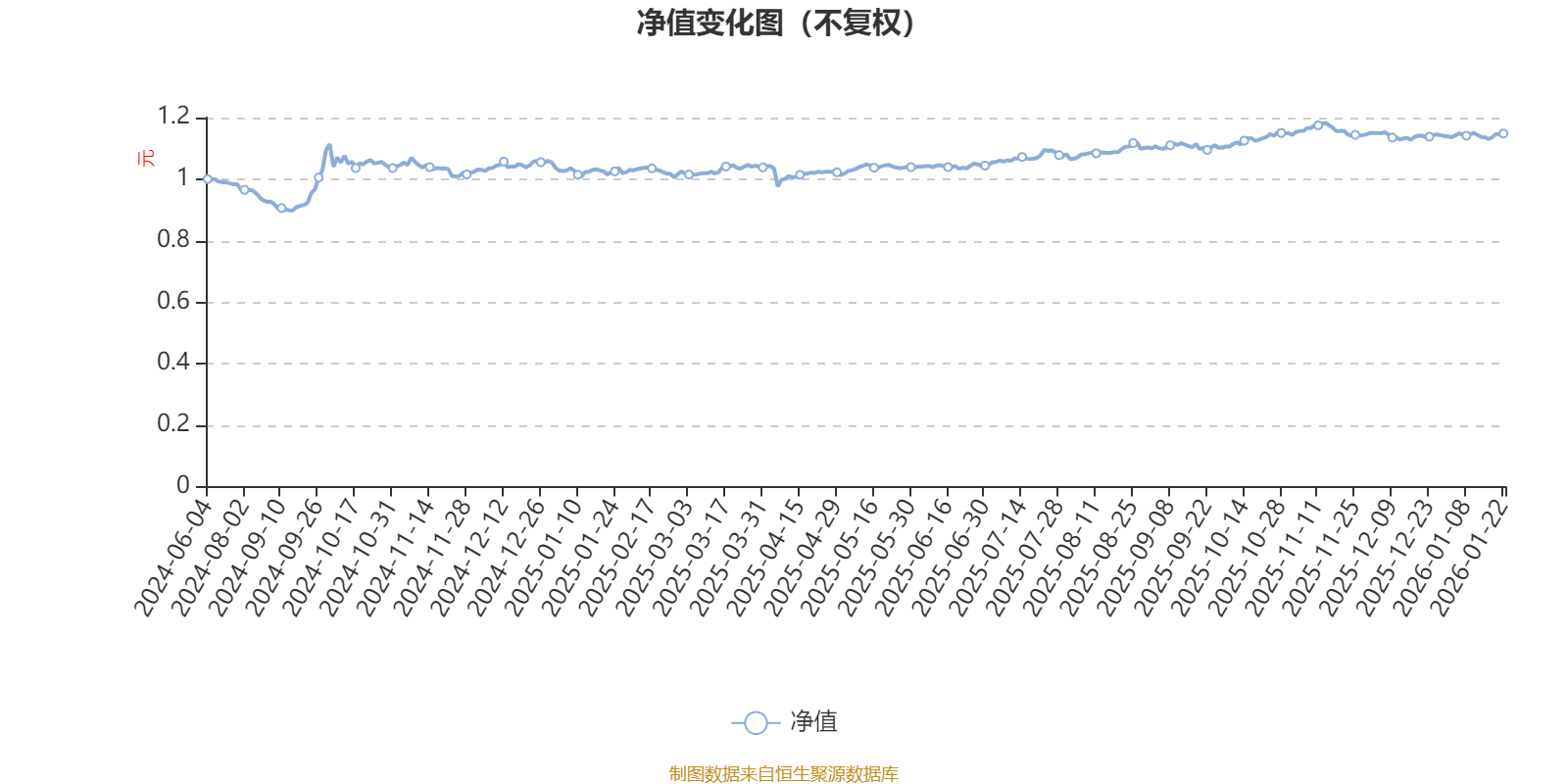
Core Viewpoint - The AI Fund Zhongtai Dividend Quantitative Stock Selection A (021167) reported a profit of 349,400 yuan in Q4 2025, with a weighted average profit per fund share of 0.0311 yuan. The fund's net value growth rate for the reporting period was 2.76%, and the fund size reached 12.6287 million yuan by the end of Q4 2025 [3]. Fund Performance - As of January 22, the fund's unit net value was 1.148 yuan. The fund manager, Zou Wei, currently manages five funds. The Zhongtai CSI 500 Index Enhanced A had the highest one-year growth rate at 43.81%, while the Zhongtai Dividend Quantitative Stock Selection A had the lowest at 13.09% [3]. - The fund's performance over the past three months showed a growth rate of 0.96%, ranking 105 out of 121 comparable funds. Over the past six months, the growth rate was 4.90%, ranking 103 out of 121. The one-year growth rate was 13.09%, ranking 110 out of 119 [4]. Risk and Management - The fund's Sharpe ratio since inception is 0.748 [9]. The maximum drawdown since inception is 12.37%, with the largest quarterly drawdown occurring in Q2 2025 at 6.3% [11]. - The average stock position since inception is 90.65%, compared to the peer average of 88.34%. The fund reached a peak stock position of 92.43% at the end of H1 2025 and a low of 85.08% at the end of Q3 2024 [13]. Fund Holdings - As of the end of Q4 2025, the fund's size was 12.6287 million yuan. The top ten holdings are stable and include China Merchants Bank, China State Construction, Agricultural Bank of China, Midea Group, Kweichow Moutai, Chengdu Bank, China National Offshore Oil Corporation, Hisense Visual Technology, Nanjing Steel, and Industrial and Commercial Bank of China [16][19].
菜鸟送装取一体服务覆盖超大件,国补半个月天猫大家电大涨超90%
Sou Hu Cai Jing· 2026-01-23 00:51
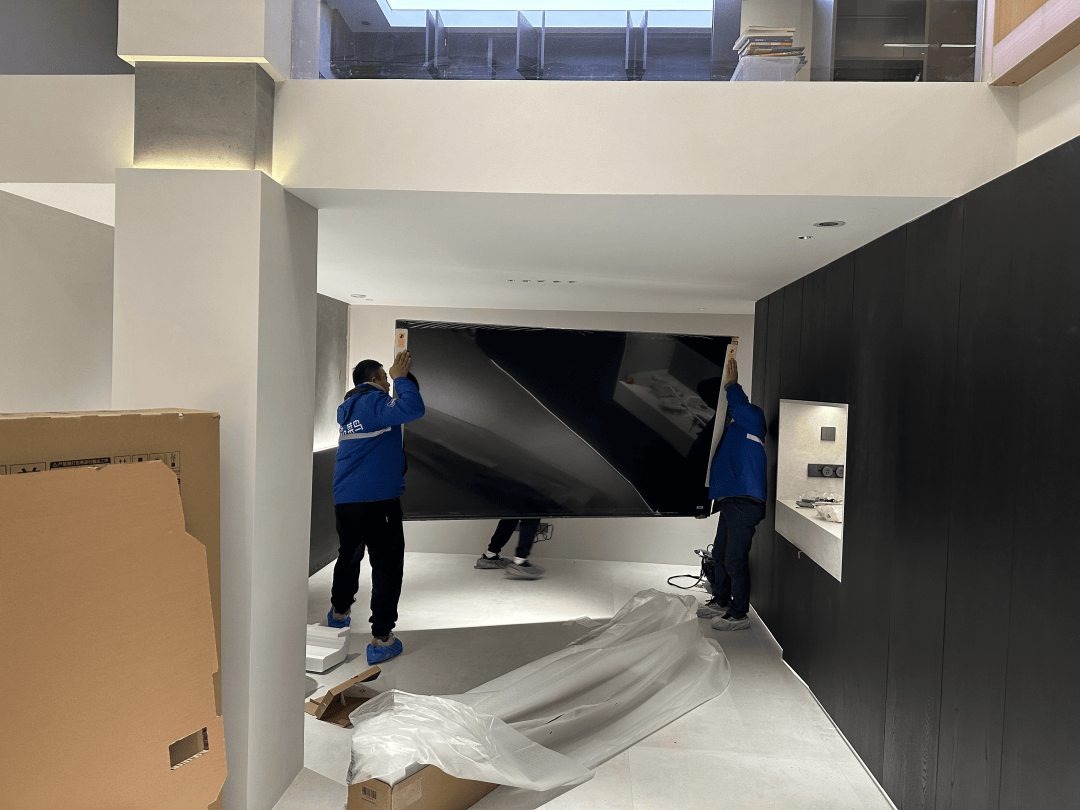
Core Viewpoint - The implementation of the new round of national subsidies in 2026 has significantly boosted the sales of large home appliances, particularly high-end products, with Tmall reporting over a 90% month-on-month increase in sales of large appliances [1][3]. Group 1: Sales Growth and Trends - Tmall's home appliance sector has seen a remarkable increase in sales, especially for mid-to-high-end products, with 100-inch ultra-large screen TVs, wallpaper TVs, and new Mini LED technology TVs doubling in sales year-on-year [3][6]. - The demand for smart, energy-efficient, and high-quality home appliances has surged, with popular items including voice-controlled smart appliances, frost-free ultra-thin energy-saving refrigerators, and multi-zone washing and drying sets [3][6]. Group 2: Service Enhancements - Cainiao has upgraded its delivery and installation services for large home appliances, achieving a 95% delivery rate for 100-inch TVs by implementing specialized lifting services and training workers [4]. - The logistics improvements have enabled next-day delivery for large appliances in major cities across the country, enhancing the overall customer experience [4]. Group 3: Future Growth Potential - The combination of national subsidy policies and brand innovation is expected to drive explosive growth for new products such as wall-mounted TVs, air conditioners with fresh air functions, and multi-zone washing machines in 2026 [6].
索尼退场,日本电视全军覆没
3 6 Ke· 2026-01-23 00:36
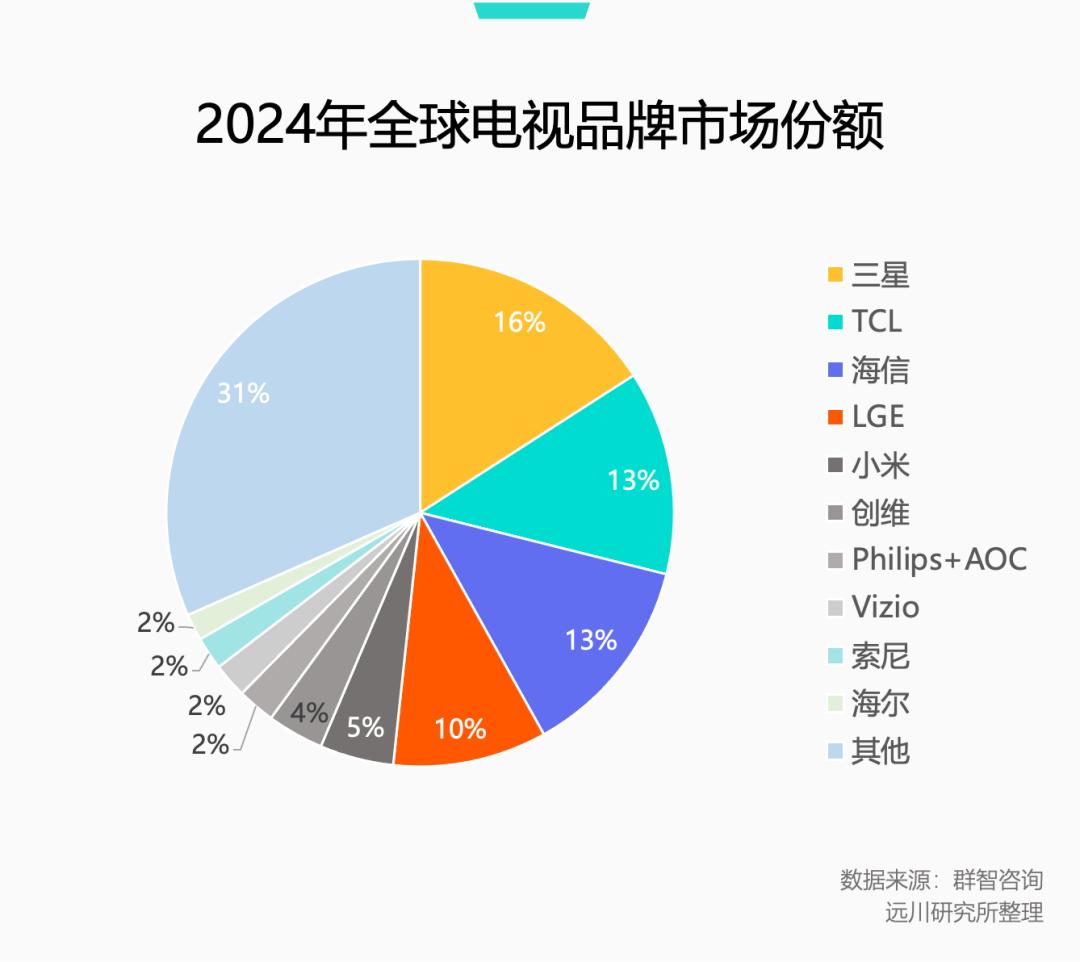
Core Viewpoint - Sony has announced a joint venture with TCL to manage its home entertainment business, with TCL holding a 51% stake, effectively transferring Sony's television operations and the BRAVIA brand to TCL, marking a significant shift in the consumer electronics market [1][5]. Group 1: Sony's Strategic Shift - Sony lacks display panel production capabilities, which are crucial for maximizing profits in the television market, relying on LG and TCL for panel supply and Mediatek for picture quality chips [1]. - Sony's television market presence is minimal, consistently ranking in the "others" category, and its television segment is less profitable compared to its other businesses like CIS chips, gaming, and music [1][5]. - The move signifies Sony's exit from the competitive global television market, following a trend where Japanese brands have been selling off their consumer electronics divisions [5][7]. Group 2: TCL's Positioning - For TCL, acquiring Sony's brand equity is a strategic asset that, combined with its own panel production capabilities, positions it to challenge Samsung's dominance in the global market [5]. - TCL is currently the only domestic television brand in China with display panel production capabilities, which is essential for maintaining competitive pricing and product quality [18][27]. Group 3: Decline of Japanese Brands - The exit of Sony marks the end of Japan's independent television brands, with other major players like Sharp, Toshiba, and Panasonic also having exited or significantly downsized their television operations [5][15]. - The decline of Japanese television brands is attributed to their loss of panel production capabilities, which has resulted in a lack of pricing power in the market [16][23]. - The financial crisis of 2008 and subsequent strategic missteps led to a shift in focus for Japanese companies from consumer electronics to higher-margin components, further diminishing their presence in the television market [7][12][13].



通过零碳工业园区加速中国的绿色转型
落基山研究所· 2026-01-23 00:25
Investment Rating - The report does not explicitly provide an investment rating for the industry Core Insights - The development of zero-carbon industrial parks is crucial for China's transition to a low-carbon economy, with over 15,000 industrial parks contributing more than 30% of GDP and accounting for over 30% of national greenhouse gas emissions [9][10] - Achieving zero-carbon targets in these parks could potentially avoid approximately 3.3 billion to 3.5 billion tons of CO₂ emissions, significantly aiding China's dual carbon goals [9] - The report identifies four major innovations necessary for the systematic transition to zero-carbon parks: integrated energy solutions, industrial symbiosis, investment and financing models, and emissions transparency [41] Summary by Sections 1. Industrial Parks as Engines for Zero-Carbon Development - Industrial parks are significant energy consumers and carbon emitters, with a potential to reduce carbon emissions intensity by 50% to avert approximately 1.95 billion tons of CO₂ emissions [9] - Zero-carbon parks can drive green supply chains and promote green production, serving as testing grounds for green technology innovations [13][14] 2. China's Industrial Parks Advancing toward Zero Carbon - The evolution of industrial park policies has progressed through ecological exploration, low-carbon piloting, and deepening zero-carbon objectives [15] - The national average carbon emissions per unit of energy consumption in industrial parks is approximately 2.1 tons/ton of standard coal, with zero-carbon standards aiming for a reduction of around 90% [16] - Local governments are developing regional construction plans and guidelines for zero-carbon parks, with a focus on industrial synergy and renewable energy utilization [20][21] 3. China's Zero-Carbon Park Development: Four Major Innovations Drive Systematic Transition - The report highlights the need for breakthroughs in renewable energy supply-demand mismatches, material flow carbon management, investment and financing innovations, and emissions data transparency [41] - Integrated energy solutions are essential for achieving zero-carbon energy, requiring deep decarbonization and management across multiple energy carriers [42] 4. Zero-Carbon Park Development Strategy: Multisystem Integration and Categorized Approaches - Achieving zero-carbon parks necessitates integrating measures across energy supply, consumption, management, and infrastructure [18] - Strategies include building green energy systems, upgrading industrial structures, and enhancing carbon management through innovative business models [29][30][31] 5. Low-Carbon Materials and Molecules: Industrial Symbiosis, Circular Economy, and Embodied Carbon Management - Zero-carbon parks should prioritize internal industrial material flow coupling and promote closed-loop recycling to enhance resource efficiency [57][58] - The potential for carbon reduction through recycled resource use is significant, with projections indicating that recycled materials will constitute a large portion of total production by 2050 [66]