
长城汽车

Search documents
崔东树:1月汽车出口走强带动厂家销量相对较好 新能源车走势平稳
智通财经网· 2026-02-15 03:59
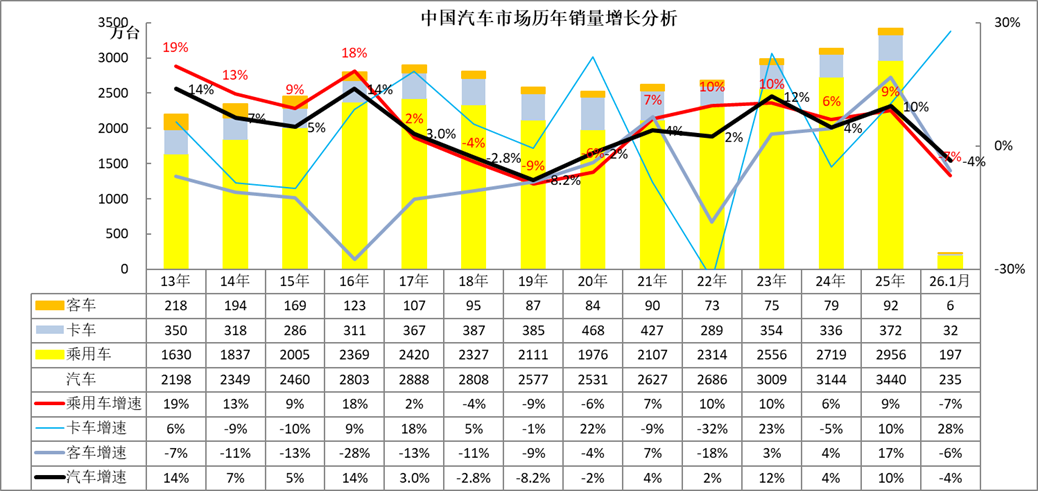
Group 1 - The automotive market in China is expected to maintain strong growth in 2025, driven by government policies promoting consumption, with significant recovery in both truck and bus markets [1] - In January 2026, the commercial vehicle market is anticipated to experience structural growth due to equipment upgrade subsidies, particularly in the electrification of logistics and transportation [1][4] - The overall automotive sales in 2025 are projected to reach 34.392 million units, with a cumulative growth rate of 9%, while January 2026 saw a decline of 4% year-on-year in total automotive sales [6][21] Group 2 - The differentiation between passenger and commercial vehicles has become more pronounced in recent years, with passenger vehicle consumption improving and commercial vehicle sales weakening [4][11] - In January 2026, the sales of new energy passenger vehicles totaled 870,000 units, reflecting a 2% year-on-year decline, influenced by policy adjustments and market pressures [21] - The competitive landscape among traditional fuel passenger vehicle manufacturers is shifting, with domestic brands gaining strength against joint ventures, particularly in the context of declining sales for traditional fuel vehicles [27] Group 3 - The truck market is showing robust growth, with January 2026 sales reaching 320,000 units, marking a 28% year-on-year increase, indicating a strong demand for logistics and transportation solutions [34][36] - The bus market is expected to remain stable, with head manufacturers performing well, primarily driven by demand for light and micro commercial vehicles [30][32] - The overall automotive industry is experiencing significant differentiation in growth rates among manufacturers, with private enterprises increasingly replacing state-owned enterprises as industry leaders [11][18]






启境入局:中国汽车智能化下半场的价值回归与高端突围
经济观察报· 2026-02-15 02:11
Core Viewpoint - The emergence of Qijing Automotive represents a significant exploration in the intelligent and high-end development path of the Chinese automotive industry during a critical period of transformation [1][26]. Group 1: Strategic Shift from Electrification to Intelligentization - By the end of 2025, the penetration rate of new energy vehicles in China is expected to approach 60%, indicating that the electrification phase is nearing completion, while the intelligentization phase is just beginning [2][6]. - The automotive industry is undergoing a structural transformation, with a shift in competition from mere electrification to intelligentization, as evidenced by the increasing demand for smart, personalized vehicles [6][8]. - Over 80% of automotive companies have initiated AI pilot projects, but only 15% have achieved large-scale application, highlighting the transition from "whether to do" to "how to do it right" in intelligentization [2][8]. Group 2: Challenges in Intelligent Transformation - The transition to intelligentization presents significant challenges, including the need for comprehensive capabilities in data collection, processing, and system integration [16][17]. - Companies must prepare for the responsibilities associated with Level 3 automation, requiring robust safety and quality management systems throughout the product lifecycle [16][20]. - The collaboration model in the intelligent era necessitates deep integration of hardware, software, algorithms, and data, moving beyond traditional supply chain relationships [17][20]. Group 3: Qijing's Unique Position and Strategy - Qijing is positioned as a strategic player in the intelligentization arena, focusing on redefining what constitutes a high-quality vehicle in the smart era [14][26]. - The collaboration between Qijing and Huawei is characterized by "embedded collaboration," allowing for joint product logic definition and system performance validation [16][20]. - Qijing aims to leverage its partnerships to create a new value benchmark in the high-end market, combining technology, luxury, and reliability [26][31]. Group 4: Value Transition of Chinese Brands - Chinese automotive brands are experiencing a value transition, with Qijing positioned to capitalize on this shift by enhancing product quality, user experience, and redefining value in the high-end market [24][26]. - The traditional dominance of luxury brands is declining, with Chinese brands making significant inroads into the high-end market through advancements in electric and intelligent technologies [24][26]. - Qijing's strategy emphasizes a comprehensive user experience and a differentiated dealer network, reflecting growing confidence in Chinese high-end intelligent automotive brands [26][31].

启境入局:中国汽车智能化下半场的价值回归与高端突围
Jing Ji Guan Cha Wang· 2026-02-15 02:07
Core Insights - The electric vehicle (EV) penetration rate in China is expected to approach 60% by the end of 2025, indicating that the initial phase of electrification is nearing completion, while the next phase of intelligent transformation is just beginning [1][4] - Market data suggests a slowdown in EV wholesale growth, with a forecasted decline from 28% in 2025 to 15% in 2026, signaling a shift from growth to competition among existing players [1][4] - The launch of the high-end intelligent EV brand "Qijing," co-created by Huawei and GAC Group, represents a significant step in addressing the industry's transition from electrification to intelligentization [1][3] Industry Transition - The Chinese automotive market is undergoing a structural transformation, with a predicted slowdown in growth rates for new energy vehicles as penetration exceeds 50% [4] - Deloitte's report highlights that over 80% of automotive companies have initiated AI pilot projects, but only 15% have achieved large-scale application, indicating a shift in focus from "whether to do" to "how to do it right" [1][4] - The automotive industry is recognized as being at a critical juncture, facing pressures on the supply side while experiencing explosive growth in demand for intelligent and personalized vehicles [4][6] Intelligent Transformation - Intelligentization is identified as the core of the automotive industry's transformation, integrating various advanced technologies such as perception, data processing, connectivity, execution control, and user experience [6] - The shift from traditional vehicles to intelligent terminals is reshaping the travel ecosystem, with AI expected to play a pivotal role in this evolution [6][12] - The competitive landscape is evolving, with a focus on the ability to continuously innovate and adapt intelligent capabilities rather than merely distinguishing between fuel and electric vehicles [12][14] Challenges and Opportunities - The transition to intelligent vehicles presents significant challenges, including the need for comprehensive technical capabilities, responsibility frameworks for Level 3 automation, and upgraded collaborative models within the industry [15][16] - Qijing's collaboration with Huawei is characterized as "embedded collaboration," allowing for a more integrated approach to product development and system performance validation [16][18] - The brand's supply chain and quality management systems are designed to meet the high standards of luxury vehicles, positioning Qijing to take on the challenges of intelligent vehicle production [18][20] Market Positioning - Qijing aims to redefine the high-end market by focusing on a combination of aesthetics, driving control, and intelligence, while also establishing a differentiated dealer network strategy [23][24] - The brand's strategy reflects a broader trend of Chinese automotive brands moving into the high-end market, with significant improvements in product quality and user experience [21][23] - The emergence of Qijing is seen as a critical exploration of the intelligent and high-end development path for the Chinese automotive industry, aligning with national policies promoting digital transformation [27][29]
China's stock bull run falters with corporate earnings set to underwhelm
Business· 2026-02-15 01:19
Economic Outlook - A worsening earnings picture is leading to a negative outlook for Chinese equities, with concerns that Lunar New Year holiday spending may not be sufficient to boost earnings [1] - Corporate profit pre-announcements indicate a "major deterioration" for Q4 2025, with negative alerts outnumbering positive ones by 14.8% among over 2,000 A-share companies [4] Consumer Demand - Economic indicators highlight weak consumer demand as government stimulus programs are being scaled back, contributing to concerns about the upcoming holiday's impact on earnings [2][6] - China's economic growth slowed to 4.5% last quarter, marking the weakest pace since the end of Covid lockdowns, with producer prices falling 1.4% year-on-year [5] Market Sentiment - Sentiment towards Chinese stocks is currently weak, influenced by investor caution before the long holidays, lack of new catalysts, heightened regulatory scrutiny, and intense competition [3] - The MSCI China Index has only risen 0.8% this year, contrasting with a 2.8% gain in the MSCI All World Index and significant increases in South Korea and Taiwan [3] Regulatory Environment - Increased regulatory intervention, including tightened margin financing rules, is adding to market caution and affecting investor sentiment [7] Industry Performance - Earnings are diverging across industries, with metal miners and companies in the AI supply chain performing well, while electric vehicle manufacturers like BYD and Great Wall Motor are struggling due to poor sales [8][9] - Overall A-share earnings are projected to grow about 6.5% year-on-year for 2025, primarily driven by policy support rather than a fundamental shift in market conditions [10]
车企“比惨大会”召开!全是特朗普惹的祸?
电动车公社· 2026-02-14 16:05
Core Insights - The global automotive landscape is undergoing significant changes due to the rise of new energy vehicles, with Chinese automakers emerging as top competitors while traditional giants face strategic transformation challenges [1][2]. Group 1: Tesla - Tesla's 2025 financial report shows total revenue of $94.827 billion, a 3% year-over-year decline, marking the first revenue drop in its history [7]. - The company delivered 1.636 million vehicles in 2025, an 8.6% decrease from 2024, leading to a 10% drop in automotive revenue, which constitutes over 70% of total income [9]. - Despite record revenue from energy generation and storage, Tesla's overall revenue decline remains unmitigated [10]. - R&D investment surged by 41% to $6.411 billion, focusing on autonomous driving and humanoid robots, indicating a shift in strategic priorities [14]. Group 2: General Motors - General Motors reported 2025 revenue of $185 billion, down 1.3%, with net profit falling 55.1% to $2.697 billion due to a $7.9 billion charge for strategic restructuring [17][19]. - The company maintains strong cash flow of $10.6 billion despite the profit drop, attributed to one-time restructuring costs and market adjustments [20]. - GM's outlook for 2026 is optimistic, expecting net profit between $10.3 billion and $11.7 billion, supported by a solid market position in the U.S. and new product launches in China [24]. Group 3: Ford - Ford's 2025 revenue reached $187.3 billion, a 1% increase, but it reported a net loss of $8.2 billion, primarily due to a $19.5 billion charge related to electric vehicle restructuring [26][30]. - The company faces challenges similar to GM, with traditional vehicles performing well while electric vehicle strategies require adjustment [32]. Group 4: Hyundai - Hyundai's 2025 revenue was 186.3 trillion KRW (approximately 888.7 billion RMB), a 6.3% increase, but operating profit fell 19.5% to 11.47 trillion KRW [34]. - The decline in profit is largely due to increased tariffs on exports to the U.S., despite a reduction in tariffs effective November 2025 [38]. - The company is also navigating the transition to electric vehicles, which requires adjustments to its product lineup [39]. Group 5: Volvo - Volvo's 2025 revenue was 357.3 billion SEK (approximately 278.8 billion RMB), down 11%, with operating profit plummeting 99% [42]. - The decline is attributed to tariffs, weak demand, and price pressures, prompting a cost-cutting plan involving layoffs [45]. - Despite challenges, Volvo's electric vehicle offerings are performing well, particularly in the Chinese market [48]. Group 6: Great Wall Motors - Great Wall Motors reported 2025 revenue of 222.79 billion RMB, a 10.19% increase, but net profit fell 21.71% to 9.912 billion RMB [52]. - The company achieved record sales of 1.3237 million vehicles, indicating strong growth despite profit declines due to increased investments in new technologies and marketing [54]. - The focus on electric vehicle development, particularly through its premium brand WEY, is expected to enhance growth potential [56]. Group 7: GAC Group - GAC Group's 2025 sales fell 14.06% to 1.72 million vehicles, with a projected loss of 8-9 billion RMB [58]. - The decline is linked to poor performance in traditional fuel vehicles and slower growth in its electric vehicle segment [59]. - The company is pursuing deep collaborations with local suppliers to accelerate its electrification strategy [60]. Group 8: Toyota - Toyota's revenue for the first three quarters of the 2026 fiscal year was 38.09 trillion JPY (approximately 1.72 trillion RMB), a 6.8% increase, but net profit dropped 26.1% to 3.03 trillion JPY [63]. - The profit decline is primarily due to the impact of U.S. tariff policies, despite a 10.5% profit increase in the Chinese market [66][68]. - Toyota is implementing a company-wide plan to reduce its breakeven point and improve operational efficiency [71].




国内汽车市场,突发重大转变!
Xin Lang Cai Jing· 2026-02-14 14:24
总书记说产业发展,不能喜新厌旧! 作 者 | 三里屯 责 编 | 李 丹 出 品 | 汽车K线 没想到汽车产业变化来的如此之快! 2026年中国车市,开年便上演了一幕出人意料的"反转"。 依靠新能源车"单腿跳"的上市车企集团,绝大多数陷入环比腰斩的困局,而坚持"燃油+新能源"两条腿走路的传统大厂巨头,却在市场寒流中展现出惊人 的韧性。 这不禁让人深思,在新能源汽车发展趋于理性,燃油车基盘究竟是转型的包袱,还是穿越周期的"压舱石"? 01 中国汽车流通协乘联分会数据显示,1月全国乘用车零售154.4万辆,同比下降13.9%,环比下滑31.9%。 在这轮销量寒潮中,新能源阵营率先感受到了刺骨凉意。 | 排名 | 公司名称 | 销量 | 当月同比 | 景月环比 | | --- | --- | --- | --- | --- | | 1 | 吉利控股集团 | 约340,000 | 2.78% | -2.94% | | | 吉利汽车集团 | 270,167 | 1.29% | 14.08% | | 2 | 上汽集团 | 327,413 | 23.94% | -18.03% | | 3 | 中国- 汽 | 243,000 ...

MSCI中国指数大调仓,37只股票新纳入,高盛测算14亿美元净流入居全球首位
Jin Rong Jie· 2026-02-14 08:49
Group 1 - MSCI announced the results of its quarterly index review on February 11, 2026, which included the addition of 37 stocks to the MSCI China Index and the removal of 16 stocks [1] - The adjustments will take effect after the market closes on February 27, 2026 [1] Group 2 - Goldman Sachs estimated that the MSCI core index adjustment will trigger over $17 billion and $14 billion in two-way passive trading in the Asia-Pacific and global emerging markets, with net inflows of approximately $1.6 billion and $450 million respectively [3] - Chinese stocks are expected to receive about $1.4 billion in net passive fund inflows, leading globally, while markets in France, the UK, and the US are projected to experience significant outflows [3] Group 3 - In the Asia-Pacific region, the main beneficiaries of passive fund inflows include technology hardware and semiconductors (+$2.2 billion), capital goods (+$930 million), and software and services (+$480 million), while sectors like consumer, transportation, and travel services are facing passive reductions [3] - In the Chinese market, the main paths for fund inflows are through semiconductors and related hardware, AI software and autonomous driving applications, and upstream resources and materials [4] Group 4 - Goldman Sachs predicts that newly added stocks such as SenseTime, Changfei Optical Fiber, Hesai Technology, and Pony.ai will each see at least $200 million in potential net passive fund inflows [4] - Historical data shows that stocks added to the MSCI index or with increased free float factors typically outperform those removed or with decreased factors between the announcement and effective dates [4]

【月度排名】2026年1月厂商销量排名快报
乘联分会· 2026-02-14 08:39
Core Viewpoint - The domestic narrow passenger car market in China experienced a retail sales decline of 13.9% year-on-year in January 2026, with sales reaching 1.544 million units, attributed to the end of the 12-year new energy vehicle purchase tax exemption policy, leading to a temporary dip in demand [2][4]. Sales Data Summary Wholesale Sales Rankings (January 2026) - Geely Automobile led with 270,167 units sold, a 1.3% increase, capturing 13.7% market share - BYD Automobile followed with 205,518 units, down 30.7%, holding 10.4% market share - Chery Automobile sold 193,969 units, down 12.0%, with a 9.8% market share - Volkswagen sold 128,001 units, down 1.7%, with a 6.5% market share - SAIC Passenger Vehicle sales increased by 53.6% to 77,421 units, capturing 3.9% market share [6]. Retail Sales Rankings (January 2026) - Geely Automobile again led with 209,661 units sold, down 12.6%, holding 13.6% market share - Volkswagen sold 132,300 units, down 3.5%, with an 8.6% market share - BYD's retail sales dropped significantly by 53.0% to 94,176 units, capturing 6.1% market share - SAIC Volkswagen sold 89,600 units, down 9.3%, with a 5.8% market share - Changan Automobile's sales decreased by 33.5% to 81,074 units, holding 5.2% market share [7]. New Energy Vehicle (NEV) Wholesale Sales Rankings (January 2026) - BYD led NEV sales with 205,518 units, down 30.7%, capturing 23.8% market share - Geely followed with 124,252 units, up 2.6%, holding 14.4% market share - Tesla China sold 69,129 units, up 9.3%, with an 8.0% market share - Chery sold 46,802 units, down 14.9%, with a 5.4% market share - SAIC Passenger Vehicle saw a significant increase of 576.9% to 28,179 units, capturing 3.3% market share [9]. New Energy Vehicle (NEV) Retail Sales Rankings (January 2026) - BYD again led with 94,176 units sold, down 53.0%, holding 15.8% market share - Geely sold 92,135 units, down 21.6%, with a 15.5% market share - Hongmeng Zhixing saw a significant increase of 65.5% to 57,915 units, capturing 9.7% market share - SAIC's sales increased by 83.3% to 40,016 units, holding 6.7% market share - Xiaomi Automobile sold 39,002 units, up 70.3%, with a 6.5% market share [10].



【快讯】每日快讯(2026年2月14日)
乘联分会· 2026-02-14 08:39
Domestic News - The Supreme Court of China clarified that the driver remains the primary responsible party even when using advanced driver-assistance systems, emphasizing that activating such systems does not absolve the driver of their responsibilities [2] - The Ministry of Industry and Information Technology (MIIT) has proposed a new national standard that removes all technical content related to half-width steering wheels, indicating that such designs will not receive official support in the short term [3] - SAIC Motor Corporation announced plans to establish a private equity investment fund with an initial subscription size of 2.5 billion yuan, focusing on solid-state batteries, digital chassis, and AI technologies [4] - Lantu Automotive plans to list approximately 885.38 million H-shares on the Hong Kong Stock Exchange on March 19, 2026, through an introduction method [5] - Zeekr has established a new sales service company in Shenzhen with a registered capital of 10 million yuan, focusing on the sale of new energy vehicles and related components [6] - GAC Trumpchi has launched a global naming campaign for its new rugged off-road vehicle, which is designed for various environments [7] - CATL and Chery Automobile have jointly established a new company with a registered capital of 2 billion yuan, focusing on battery manufacturing and sales [8] - Great Wall Motors' new parts factory in Tianjin is set to begin production in March 2026, with an investment of 1.153 billion yuan and an expected annual output value of approximately 3 billion yuan [9] International News - U.S. tariffs have caused Japanese automakers to lose approximately 137 billion yen (about 1.37 billion USD) in operating profits, significantly impacting their financial performance [11] - Global electric vehicle registrations saw a slight decline of 3% year-on-year in January 2026, totaling around 1.2 million units, attributed to changes in subsidy policies in China and the U.S. [12] - Vietnam's new car sales surged by 90% year-on-year in January 2026, reaching 29,774 units, despite a 30% decline from the previous month [13] - Baidu and Uber are set to launch an autonomous ride-hailing service in Dubai, aiming to support the government's goal of achieving 25% of trips via autonomous vehicles by 2030 [14][15] Commercial Vehicles - Chery's Wuling brand has launched the R08 EV, which has sold over 10,000 units in three months, emphasizing its cost-effectiveness and global market strategy [16] - New regulations for the TIR convention have been implemented to streamline cross-border road transport, enhancing efficiency while tightening compliance requirements [17] - In January 2026, Shenzhen's functional autonomous vehicles completed 2.42 million delivery orders, marking a 29% increase in operational efficiency [18] - XCMG showcased its pure electric dump truck at a green mining exhibition in Southeast Asia, designed for high-intensity operations in challenging environments [19]

汽车早报|长安汽车已就两起自媒体涉嫌网络侵权行为提起诉讼 日本七大车商预计2025财年共计净利润减35.5%
Xin Lang Cai Jing· 2026-02-14 00:43
Group 1: Used Car Market - In January 2025, the national used car market transaction volume reached 1.7292 million units, showing a year-on-year increase of 18.33% but a month-on-month decrease of 7.59% [1] - The transaction amount for January was 110.612 billion yuan, indicating a robust market performance across various vehicle types, particularly in passenger cars and commercial vehicles [1] - The demand for MPVs continued to rise significantly, contributing to the overall market growth, while the commercial vehicle sector also showed positive year-on-year growth in both passenger and cargo vehicles [1] Group 2: Automotive Dealer Inventory - The comprehensive inventory coefficient for automotive dealers in January was reported at 1.48, reflecting a month-on-month increase of 13.0% and a year-on-year increase of 5.7% [2] Group 3: Pickup Truck Market - In January 2026, the pickup truck market saw sales of 49,000 units, marking a year-on-year growth of 22.5%, the highest level in the past five years [3] - Pickup truck production in January was 52,000 units, with a year-on-year increase of 29.3%, while exports reached 28,000 units, showing a year-on-year increase of 12% [3] Group 4: Xiaomi Automotive - Xiaomi Automotive announced the delivery of the last unit of the first-generation SU7, with production halted to prepare for the next generation, expected to launch in April [4] - The company will continue to provide maintenance and spare parts for the first-generation SU7 for at least 10 years [4] Group 5: Changan Automobile Legal Action - Changan Automobile has filed lawsuits against two media outlets for alleged online infringement, which have been accepted by the court [5] Group 6: Zeekr Automotive - Zeekr Automotive has established a new sales service company in Shenzhen with a registered capital of 10 million yuan, focusing on the sale of new energy vehicles and related services [6] Group 7: Great Wall Motors - Great Wall Motors' chairman confirmed that the company is successfully promoting its MPV models in the U.S. market through intermediaries [7] Group 8: Japanese Automakers' Profit Forecast - Seven major Japanese automakers, including Toyota and Honda, expect a 35.5% decrease in net profits for the fiscal year 2025, totaling approximately 3.765 trillion yen (about 169.7 billion yuan) [8] - Specific forecasts include a 25.1% profit reduction for Toyota and a 64.1% decrease for Honda, with Nissan anticipating a net loss of 650 billion yen [8]
