
国家电网

Search documents
国泰海通晨报-20260119
GUOTAI HAITONG SECURITIES· 2026-01-19 01:37
Group 1: Strategy Research - The trading heat of hot themes has reached a historical high, with strong performance in semiconductor advanced packaging and equipment themes, while the commercial aerospace theme has cooled down. The average daily transaction amount for hot themes reached 1.436 billion yuan, with an average turnover rate of 5.9% [2][3] - The report emphasizes the importance of focusing on low-level technology sectors with strong demand support and concentrated industrial catalysts, particularly in domestic computing power, new power grids, robotics, and domestic consumption [3][4] Group 2: Computing Industry Research - The transition from traditional SEO to Generative Engine Optimization (GEO) is highlighted, where AI search shifts from "list clicks" to "direct answers," reducing the marginal utility of traditional SEO. GEO is becoming a new marketing paradigm, with a market space expected to reach "tens of billions of dollars" [8][9] - The market space for GEO is projected to grow significantly, with estimates of approximately 2.9 billion yuan in 2025 and around 24 billion yuan by 2030, reflecting a CAGR of about 52.4% from 2025 to 2030 [9][10] Group 3: Cosmetics Industry Research - The widespread adoption of AI recommendations is expected to catalyze the explosion of GEO, fundamentally changing the flow distribution in marketing. E-commerce operators are likely to benefit first, and brands that actively transform are expected to stand out in the long term [11][12] - The report recommends several companies that are well-positioned to leverage the changes brought by GEO, including 若羽臣, 壹网壹创, and 水羊股份 [11][12]
新浪财经资讯AI速递:昨夜今晨财经热点一览 丨2026年1月19日
Xin Lang Cai Jing· 2026-01-18 23:47
Group 1 - Bosch CEO confirmed that the company's sales for 2025 are expected to be around €91 billion, failing to meet targets, with actual revenue declining after excluding acquisition impacts [1] - The company's profit margin is significantly below 2%, far from the long-term target of 7%, attributed to tariffs and restructuring costs, with profitability goals expected to be achieved only after 2027 [1] Group 2 - Ten major brokerages have differing views on the A-share spring market outlook, but most believe there is still upward potential after short-term fluctuations [2] - The focus will shift to fundamental verification during the earnings disclosure period starting in late January, with attention on technology (AI hardware, applications, semiconductors) and cyclical sectors (non-ferrous metals, chemicals) [2] Group 3 - MSC continues its expansion strategy by acquiring at least 8 second-hand container ships in December, including a premium purchase from a Chinese shipowner [3] - This highlights MSC's strategy of exchanging capital for delivery certainty, while sellers successfully lock in substantial profit margins amid a tight second-hand ship market [3] Group 4 - The price of lithium carbonate has experienced significant volatility, yet upstream lithium battery companies remain confident in production expansion due to resource security and circular economy strategies [4][19] - Companies are optimistic about the future growth potential in energy storage and solid-state batteries, anticipating a balance in supply and demand by 2026 [19] Group 5 - The domestic pizza brand, Bige Catering, is pushing for an IPO with nearly ¥1.4 billion in revenue over the first three quarters of 2025, showing significant year-on-year growth [18] - The company, controlled by the founding couple, aims to open hundreds of new stores within three years to reach a target of 1,000 locations, although it faces challenges in southern market penetration [18] Group 6 - The National Energy Administration reported that China's total electricity consumption surpassed 10 trillion kilowatt-hours for the first time in 2025, reflecting a 5% year-on-year growth [21] - This growth is primarily driven by the tertiary industry and residential electricity use, indicating a robust economic performance and a shift towards high-tech and green low-carbon industries [21] Group 7 - SAIC Motor Corporation's profit forecast for 2025 indicates a staggering 438% to 558% increase in net profit attributable to shareholders, yet the stock price remains stagnant, highlighting a mismatch between market value and performance [22] - The company faces challenges in market perception and must enhance its core business profitability to improve its market valuation [22] Group 8 - The State Grid's investment plan of ¥4 trillion during the 14th Five-Year Plan focuses on building a smart green power system, expected to drive significant growth in the power equipment industry [24] - This initiative is anticipated to benefit leading companies in transformers, power automation, and energy storage, aligning with global energy transition trends [24]


这个“10万亿”,意味着什么(经济新方位)
Ren Min Ri Bao· 2026-01-18 23:47
Core Insights - In 2025, China's total electricity consumption is projected to exceed 10 trillion kilowatt-hours for the first time, marking a significant milestone in global energy consumption [3][4] - This consumption level is more than double that of the United States and surpasses the total consumption of the European Union, Russia, India, and Japan combined [3] - The growth in electricity consumption reflects China's robust manufacturing capabilities and enhanced energy security [3] Electricity Consumption by Sector - The primary industry is expected to consume 149.4 billion kilowatt-hours, showing a growth of 9.9% [1] - The secondary industry will account for 66,366 billion kilowatt-hours, with a growth rate of 3.7%, maintaining its status as the main consumer [1][4] - The tertiary industry is projected to consume 19,942 billion kilowatt-hours, growing by 8.2% [1][5] - Urban and rural residential electricity consumption is expected to reach 15,880 billion kilowatt-hours, with a growth of 6.3% [1][6] Industrial and Technological Developments - The electricity consumption in the industrial sector is increasingly driven by high-value-added and technology-intensive industries [5] - In Jiangsu, the semiconductor industry is experiencing significant growth, with companies like Huahong Semiconductor reporting over 43% year-on-year increase in electricity consumption [4] - The computer and communication equipment manufacturing sector has surpassed traditional industries like steel and chemicals in electricity consumption, indicating a shift in industrial structure [4] Electrification and Energy Efficiency - The electrification rate of end-use energy is approximately 30%, which is higher than that of major developed economies [6] - Innovations in agriculture, such as smart irrigation systems, are contributing to increased electricity consumption in rural areas [6][7] - The "14th Five-Year Plan" includes significant investments in rural power grid improvements, enhancing electricity access and reducing consumption disparities between urban and rural areas [6] Power Supply and Infrastructure - China's power supply system is the largest globally, with renewable energy sources like wind and solar surpassing traditional coal power [8][9] - The country has built 46 ultra-high voltage transmission lines to efficiently transport clean energy from resource-rich regions to consumption centers [9] - The national grid's investment has reached historical highs, ensuring robust electricity supply and infrastructure development [9][10] Market Dynamics and Energy Transition - The establishment of a unified national electricity market has significantly increased market transaction volumes, doubling from the previous five-year period [11] - The energy sector is actively transitioning towards a new energy system, focusing on green and low-carbon development [11] - The growth in electricity consumption is indicative of China's economic transformation and improvement in living standards [11]

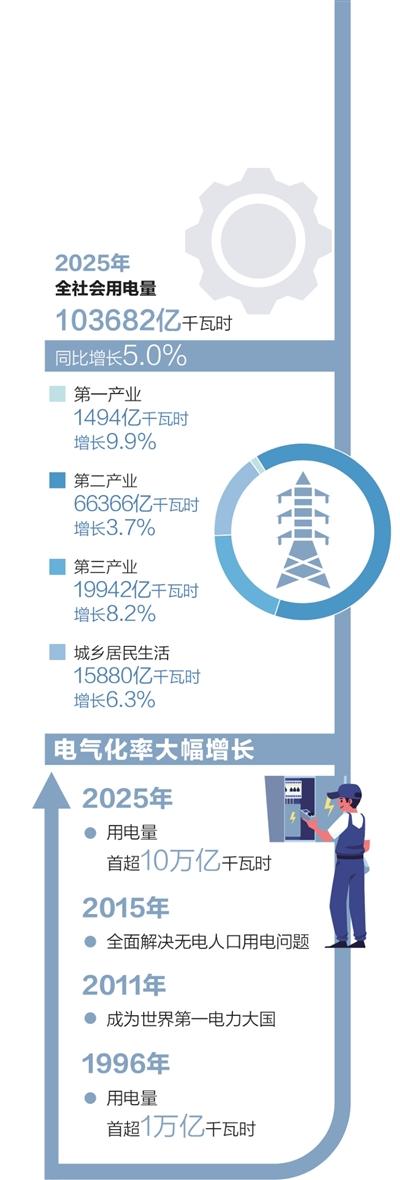
全球首次,2025年我国全社会用电量超10万亿千瓦时——这个“10万亿”,意味着什么
Xin Hua Wang· 2026-01-18 23:41
Core Insights - In 2025, China's total electricity consumption is projected to exceed 10 trillion kilowatt-hours for the first time, marking a significant milestone in global energy consumption [1] - This consumption level is more than double that of the United States and surpasses the combined total of the EU, Russia, India, and Japan [1] - The growth in electricity consumption reflects China's robust manufacturing capabilities and enhanced energy security [1] Group 1: Industrial Electricity Consumption - In 2025, the secondary industry is expected to consume 66,366 billion kilowatt-hours, accounting for approximately 64% of total electricity consumption [2] - The semiconductor industry, driven by AI applications, is experiencing a surge in demand, with companies like Huahong Semiconductor reporting over 43% year-on-year growth in electricity consumption [2] - The electricity consumption structure in Jiangsu is shifting, with the computer and communication equipment manufacturing sector surpassing traditional industries like steel and chemicals for the first time [2] Group 2: High-End and Green Development - The high-end manufacturing sector, including new energy vehicles and wind power equipment, is projected to grow electricity consumption by over 20% and 30% respectively [3] - The service sector is also becoming a significant driver of electricity consumption, with the data industry in Guizhou showing rapid growth [3] - By 2025, the tertiary sector's electricity consumption is expected to reach nearly 2 trillion kilowatt-hours, growing by 8.2% year-on-year [3] Group 3: Electrification Trends - The electrification rate of end-use energy is around 30%, surpassing that of major developed economies [4] - In Yunnan, smart irrigation systems have improved efficiency by approximately 65%, reflecting advancements in agricultural electricity consumption [5] - The gap in electricity consumption between urban and rural residents is gradually narrowing due to investments in rural power grid improvements [5] Group 4: Power Supply and Infrastructure - China's power generation capacity accounts for one-third of the global total, with over 50% of coal-fired power plants capable of deep peak regulation [6] - The country has built the world's largest power supply system and clean energy generation framework, with renewable energy sources surpassing thermal power for the first time [6] - The construction of ultra-high voltage transmission lines has strengthened the energy supply network, facilitating the transfer of clean energy from the west to the east [7] Group 5: Market Dynamics - The establishment of a unified national electricity market has significantly increased electricity trading volume, doubling from 10.7 trillion kilowatt-hours to 23.8 trillion kilowatt-hours [8] - The market's role as a regulator and price guide has become more pronounced, enhancing the efficiency of electricity resource allocation [8] - The ongoing transition towards a new energy system is expected to support high-quality development in renewable energy and contribute to China's modernization efforts [8]
2025年我国全社会用电量超10万亿千瓦时 意味着什么
Ren Min Ri Bao· 2026-01-18 23:32
Core Insights - China's total electricity consumption is projected to exceed 10 trillion kilowatt-hours by 2025, marking a significant milestone as the first country to reach this level globally [1] - This consumption level is more than double that of the United States and surpasses the combined total of the European Union, Russia, India, and Japan [1] - The growth in electricity consumption reflects China's robust manufacturing capabilities and enhanced energy security [1] Electricity Consumption Trends - By 2025, the secondary industry is expected to consume 66,366 billion kilowatt-hours, accounting for approximately 64% of total electricity consumption [2] - The semiconductor industry, driven by AI applications, is experiencing a surge in demand, with companies like Huahong Semiconductor reporting over 43% year-on-year growth in electricity consumption [2] - The electricity consumption structure is shifting, with the computer and communication equipment manufacturing sector surpassing traditional industries like steel and chemicals for the first time [2] Industrial and Service Sector Developments - High-end manufacturing and technology-intensive industries are becoming the primary contributors to electricity consumption growth, with new energy vehicles and wind power equipment manufacturing seeing growth rates exceeding 20% and 30%, respectively [3] - The service sector is also a significant driver of electricity consumption, with the third industry expected to consume nearly 2 trillion kilowatt-hours by 2025, reflecting an 8.2% year-on-year increase [3] Electrification and Rural Development - The electrification rate of end-use energy is around 30%, surpassing that of major developed economies, contributing to increased electricity consumption [4] - Rural electrification initiatives have led to significant investments, with over 800 billion yuan allocated to improve rural power grids, narrowing the electricity consumption gap between urban and rural residents [5] Power Supply and Infrastructure - China's power supply system is the largest globally, with renewable energy sources accounting for over one-third of total electricity generation [6] - The construction of high-voltage transmission lines has strengthened the electricity grid, facilitating the transfer of clean energy from western regions to eastern load centers [7] - The national electricity market has seen a significant increase in trading volume, doubling from 10.7 trillion kilowatt-hours to 23.8 trillion kilowatt-hours since the 13th Five-Year Plan [8] Conclusion - The anticipated electricity consumption of 10 trillion kilowatt-hours signifies an upgrade in power supply capabilities, reflecting China's economic transition towards higher quality and improved living standards [9]
【电新环保】国网“十五五”投资达4万亿,持续关注氢氨醇、AIDC电源、固态电池——行业周报20260118(殷中枢/郝骞/陈无忌/和霖/邓怡亮)
光大证券研究· 2026-01-18 23:04
Overall Viewpoint - The National Grid is expected to reach a fixed asset investment of 4 trillion yuan during the "14th Five-Year Plan," representing a 40% increase compared to the "13th Five-Year Plan," with an average annual compound growth rate of 7%, slightly exceeding expectations. This investment is driven by counter-cyclical adjustments, benefiting areas such as ultra-high voltage, main distribution networks, smart technology, and key projects like hydropower and clean energy bases [4]. Group 1: Hydrogen and Ammonia - During the "14th Five-Year Plan," the hydrogen and ammonia sector is expected to benefit from China's future industry developments and the EU carbon tariff in 2026. Shanghai is progressing rapidly, with plans to establish an international green fuel refueling and trading center by 2030, targeting a million-ton level for green methanol and biofuels [5]. Group 2: AIDC Power Supply - The domestic AIDC construction is promising and can align with AI applications for sector rotation. Internationally, the HVDC solutions are expected to expand, and progress in SST technology cooperation is anticipated. The capital expenditure for North American data centers in 2027 will be assessed during the US stock annual report period [5]. Group 3: Power Grid - A resonant pattern is expected to form between overseas and domestic power grid investments, with positive expectations for both. The construction of the hydropower grid and the integration of power and computing resources are areas that require close monitoring due to lower expectations [5]. Group 4: Lithium Battery and Energy Storage - The demand side for lithium batteries is currently competitive, with domestic energy storage tenders for 2026 still needing tracking. The overseas energy storage market is influenced by North American computing and electricity shortages, while domestic storage follows policy expectations and lithium material price trends. The lithium battery industry is currently thriving, but after the price increase expectations are realized, stock prices may lack upward momentum, making it essential to focus on new technologies like solid-state batteries [5].
全球首次,2025年我国全社会用电量超10万亿千瓦时—— 这个“10万亿”,意味着什么(经济新方位)
Ren Min Ri Bao· 2026-01-18 22:05
Group 1 - In 2025, China's total electricity consumption is projected to exceed 10 trillion kilowatt-hours for the first time, which is more than double the annual electricity consumption of the United States and higher than the combined total of the EU, Russia, India, and Japan [1] - The electricity consumption growth reflects China's status as a manufacturing powerhouse and indicates a significant improvement in energy security [1] - The electricity consumption in the secondary industry is expected to reach 66,366 billion kilowatt-hours, accounting for approximately 64% of total consumption, with a notable shift towards high-value-added and technology-intensive industries [2] Group 2 - The demand for electricity in the semiconductor industry is surging, with companies like Huahong Semiconductor reporting over 43% year-on-year growth in electricity consumption due to increased production [2] - The electricity consumption in the computer, communication, and other electronic equipment manufacturing sectors is projected to surpass 50 billion kilowatt-hours for the first time, overtaking traditional industries like steel and chemicals [2] - The third industry is also contributing significantly to electricity consumption, with a projected growth of 8.2% year-on-year, reaching nearly 2 trillion kilowatt-hours by 2025 [3] Group 3 - The electrification rate of end-use energy in China is around 30%, which is higher than that of major developed economies, contributing to increased electricity consumption [4] - The implementation of smart irrigation systems in agriculture has improved efficiency by approximately 65%, showcasing the impact of electrification on traditional sectors [5] - The gap in electricity consumption between urban and rural residents is gradually narrowing, supported by significant investments in rural power grid upgrades [5] Group 4 - China's power supply system is the largest globally, with renewable energy sources like wind and solar surpassing thermal power for the first time [6] - The country has built the world's largest clean coal power supply system, with over 95% of coal power units meeting ultra-low emissions standards [6] - The construction of high-voltage transmission lines has strengthened the electricity grid, facilitating the transfer of clean energy from resource-rich regions to consumption centers [7] Group 5 - The establishment of a unified national electricity market has significantly increased electricity trading volume, doubling from 10.7 trillion kilowatt-hours to 23.8 trillion kilowatt-hours since the 13th Five-Year Plan [8] - The electricity market's role as a regulator and price guide has been enhanced, contributing to the efficient allocation of resources [8] - The energy sector is actively promoting a new energy system and advancing green and low-carbon transitions, supporting high-quality development of renewable energy [8]
国家能源局:2025年全社会用电量突破10万亿度!
Xin Lang Cai Jing· 2026-01-18 16:23
#能聊# 【国家能源局:2025年全社会用电量突破10万亿度!】#用电量首破10万亿##我国年用电量首次 超过10万亿千瓦时##我国全年用电量是美国两倍多##我国年用电量超过欧盟俄印日总和# @人民网 @新 华社 @央视财经 @国资小新 @中国石油 @中国石化 @海油螺号 @中核集团 @国家电网 @电网头条 @ 南网50Hz @中国华能 @中国大唐 @中国华电 @国家能源集团之声 @国家电投 @中国三峡集团 @中国 电建 @中国能建 @中国广核集团 @中国电气装备 @中国电力企业联合会 文案:周潇、张栋钧出镜、拍 摄:周潇视频:关子晴 转自:中国能源新闻 ...
——电新环保行业周报20260118:国网十五五投资达4万亿,持续关注氢氨醇、AIDC电源、固态电池-20260118
EBSCN· 2026-01-18 14:51
Investment Ratings - The report maintains a "Buy" rating for both the power equipment and environmental sectors [1]. Core Insights - The National Grid's fixed asset investment during the "14th Five-Year Plan" is expected to reach 4 trillion yuan, a 40% increase compared to the previous plan, with an average annual growth rate of 7%, slightly exceeding expectations. Key areas benefiting from this investment include ultra-high voltage, main distribution networks, smart technology, and major projects [3]. - The domestic energy storage project bidding scale for 2025 is projected to be 447 GWh, with a significant portion being non-collective bidding [3]. - The report highlights the potential for hydrogen, ammonia, and methanol industries, particularly in Shanghai, which aims to establish an international green fuel refueling and trading center by 2030 [4]. Summary by Sections Power Equipment and New Energy - The report emphasizes the importance of the National Grid's investment and its implications for various sectors, including ultra-high voltage and smart grid technologies [3]. - It suggests monitoring companies like TBEA, Pinggao Electric, and XJ Electric for potential investment opportunities [4]. Energy Storage - The report notes a continuous increase in the domestic energy storage market, with significant project bids already in place for 2026 [8]. - It highlights the ongoing demand for energy storage solutions in both domestic and international markets, particularly in North America and Ukraine [8]. Wind Power - The report indicates a substantial increase in new wind power installations, with a projected 82.5 GW added in 2025, marking a 59.42% year-on-year growth [10]. - It suggests that companies involved in offshore wind projects in Europe are likely to benefit from upcoming orders and market growth [23]. Lithium Battery and Materials - The report discusses the dynamics of lithium battery materials, noting a recovery in demand and price stabilization across various segments, including lithium carbonate and iron phosphate lithium [25][27]. - It emphasizes the potential for a surge in demand due to changes in export tax policies and the ongoing transition to solid-state batteries [28]. Environmental Sector - The report maintains a positive outlook on the environmental sector, driven by increased investments and policy support for clean energy initiatives [1][4]. - It suggests that companies involved in hydrogen and ammonia production, as well as those in the energy storage sector, are well-positioned for growth [4].
千问APP升级,Agent时代来临
Guotou Securities· 2026-01-18 13:38
Investment Rating - The report maintains an investment rating of "Outperform the Market - A" [5] Core Insights - The report highlights the upgrade of Alibaba's Qianwen APP, marking its transition from a "chat dialogue" tool to an "AI service era" with over 400 new functionalities integrated into Alibaba's ecosystem, including Taobao, Alipay, and Fliggy [1][10][23] - The upgrade is driven by three key technological advancements: AI coding capabilities for real-time tool construction, multimodal understanding for enhanced perception, and long-context processing for complex task execution [2][11] - The emergence of the AI Agent era is expected to reshape traffic entry points and accelerate application deployment, with large model apps becoming new traffic hubs in the "AI+" era [3][12] Summary by Sections Industry Performance - The computer sector outperformed the Shanghai Composite Index by 4.76% this week, with a weekly increase of 4.31% and a year-to-date increase of 13.10% [14][15][17] Market Trends - The report suggests focusing on new service demands related to traffic entry points and AI marketing companies, as well as products stemming from AI model upgrades [13] Important News - The report mentions significant developments such as Shanghai's plan for brain-computer interface industry cultivation and the State Grid's investment of 4 trillion yuan in new power systems during the 14th Five-Year Plan [21][22]
