
奔驰

Search documents
【合资篇】新的一年开始了,各家的情况都怎么样?
车fans· 2026-01-20 00:29
Core Viewpoint - The automotive market is experiencing a cautious start to the year, with customer foot traffic and orders showing slight declines compared to previous periods, influenced by policy changes and customer sentiment towards pricing and incentives [6][11][22]. Group 1: Customer Behavior and Market Trends - Customer foot traffic has decreased by approximately 10% compared to last year, with a notable drop in orders, reaching only one-third of last year's levels [6][9]. - Many customers are hesitant to make purchases, with a significant portion waiting for potential new policies or better pricing after the Chinese New Year [7][21]. - The majority of current buyers are driven by urgent needs, such as first-time purchases or vehicle replacements due to accidents [7][9]. Group 2: Pricing and Promotions - There have been no new promotional policies introduced, with most incentives remaining consistent with the previous year, although some models have seen slight increases in trade-in support [12][24]. - The average transaction prices have increased by about 1% compared to December, with smaller vehicles rising by 2,000-3,000 and larger vehicles by 3,000-5,000 [14][15]. - The perception of higher prices has led some customers to reconsider their purchasing decisions, with many opting to wait for potential future discounts [21][25]. Group 3: Sales Performance and Forecast - Despite a slight increase in orders by around 20% compared to the previous month, the overall sentiment remains cautious, with concerns about the sustainability of sales driven by current policies [24][28]. - The sales performance is heavily reliant on existing policies, and there are worries that the current sales figures are only two-thirds of what they were in previous years [29]. - The first quarter is expected to be challenging, with a significant portion of sales coming from online orders rather than in-store visits, indicating a lack of confidence among potential buyers [27][28].

从“全球车”到“中国定制” BBA在华转型路径渐明
Xin Lang Cai Jing· 2026-01-19 23:21
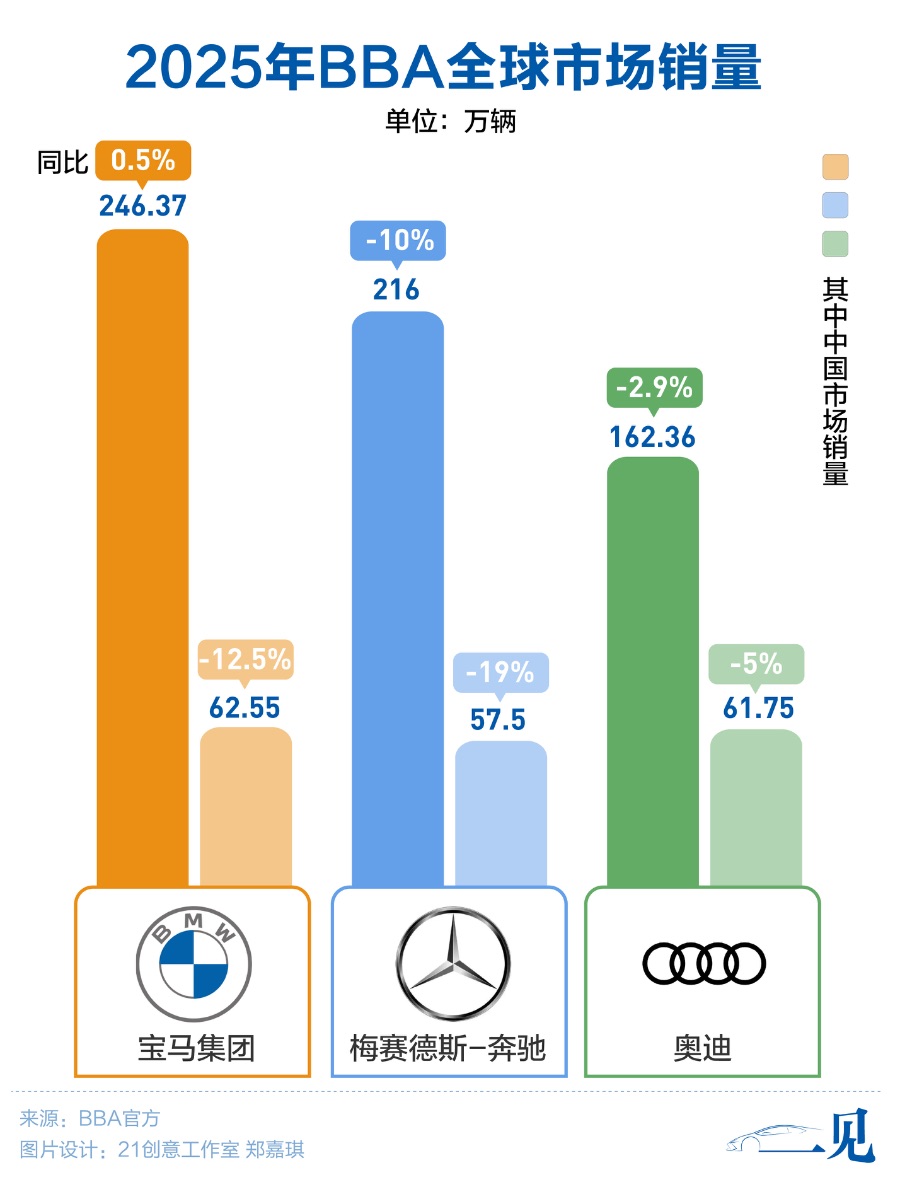
Core Insights - The traditional luxury car brands are losing their appeal in the wave of new energy vehicles, as evidenced by the sales data from BBA (Benz, BMW, Audi) [1] - BBA's global sales fluctuations are closely tied to their weak performance in the Chinese market, which remains their largest single market but has seen a significant reduction in contribution [2] Group 1: Sales Performance - BMW leads with global sales of 2.4637 million units in 2025, a slight increase of 0.5% year-on-year; Mercedes-Benz sold 2.16 million units, down 10%; Audi's sales were 1.6236 million units, down 2.9% [1] - In China, BMW's sales fell to 625,500 units in 2025, a decline of 12.5%; Mercedes-Benz's sales dropped to 575,000 units, down 19%; Audi's sales decreased to 617,500 units, down 5% [2] - BMW's sales in China have seen a continuous decline from 825,000 units in 2023 to 714,500 units in 2024, and further to 625,500 units in 2025, losing approximately 200,000 units in two years [2] Group 2: Market Dynamics - The core models of BBA, such as the BMW 3 Series, Mercedes-Benz C-Class, and Audi A4L, are facing significant threats as the market for fuel vehicles in the 300,000 to 400,000 yuan price range is declining [4] - In 2025, the market share of Chinese brands in passenger vehicles reached 69.5%, while the share of German brands shrank to 12.1% [4] Group 3: Electric Vehicle Transition - BBA is facing a dual challenge of a shrinking fuel vehicle market and a lack of presence in the electric vehicle segment, with traditional fuel vehicle sales declining by 4% in 2025 [5] - In 2025, Mercedes-Benz sold 168,800 pure electric vehicles, accounting for only about 11% of its total sales, while BMW's new energy vehicle sales reached 642,100 units, making up about 26% [6] Group 4: Strategic Responses - BMW plans to implement aggressive price cuts starting January 1, 2026, with 24 models seeing price reductions of over 10%, and flagship models like the i7 M70L seeing a drop of 301,000 yuan [7] - Mercedes-Benz aims to focus on product upgrades and intelligent transformation, planning to launch over 15 new and updated models in 2026 [8] - Audi is also defining 2026 as a "product year," continuing its localization strategy with new models set to launch [8] Group 5: Future Outlook - BBA is shifting from a "global car" approach to a "China customization" strategy, emphasizing the importance of local development and operations [9] - The success of BBA's transformation in 2026 will depend not only on product improvements but also on the courage to disrupt traditional manufacturing thinking and restructure their organizations [9]

奔驰、宝马、奥迪在华销量集体下滑,开启自救
21世纪经济报道· 2026-01-19 14:45
Core Viewpoint - The traditional luxury car brands, particularly BBA (BMW, Benz, Audi), are losing their appeal in the face of the new energy wave, as evidenced by their declining sales figures in the Chinese market, which is their largest single market [1][4]. Sales Performance - In 2025, BMW led with global sales of 2.4637 million units, a slight increase of 0.5% year-on-year; Mercedes-Benz sold 2.16 million units, down 10%; and Audi sold 1.6236 million units, down 2.9% [1]. - In China, BMW's sales fell to 625,500 units, a decrease of 12.5%; Mercedes-Benz's sales dropped to 575,000 units, down 19%; and Audi's sales decreased to 617,500 units, down 5% [1]. Market Dynamics - BMW's sales in China have been on a continuous decline, dropping from 825,000 units in 2023 to 714,500 units in 2024, and further to 625,500 units in 2025, resulting in a loss of approximately 200,000 units over two years [3]. - Mercedes-Benz's sales have seen a steeper decline, falling from a peak of 774,000 units in 2020 to 575,000 units in 2025 [3]. Strategic Challenges - The decline in sales is attributed to the slow transition to electrification and a weakening brand premium. BBA must reassess its strategy in China as its traditional competitive advantages are being challenged [4]. - The luxury segment's core models, such as the BMW 3 Series, Mercedes-Benz C-Class, and Audi A4L, are facing significant threats, with the 300,000 to 400,000 yuan price range seeing a market decline of 19.2% and 15% respectively [6]. Electric Vehicle Market - In 2025, China's new energy vehicle sales reached 13.875 million units, with a penetration rate of 54%, while the traditional fuel vehicle market shrank by 4% [7]. - BBA's presence in the electric vehicle market is weak, with Mercedes-Benz selling 168,800 pure electric vehicles (11% of total sales), BMW selling 642,100 (26%), and Audi delivering 223,000 (with a 36% increase) but lacking significant brand impact [7]. Competitive Landscape - Chinese high-end new energy brands are rapidly gaining market share, with brands like Hongmeng Zhixing and Li Auto each surpassing 400,000 units in sales, posing a significant challenge to BBA [7]. - The shift in dealership channels reflects the changing market dynamics, with many traditional luxury brand dealers transitioning to domestic new energy brands due to declining profitability [7]. Strategic Responses - BBA views 2026 as a critical year for transformation. BMW plans aggressive price cuts across 31 models, with reductions exceeding 10% for 24 models and over 20% for 5 models, aiming to stabilize its dealer network and support its electric vehicle transition [10]. - BMW is also set to launch around 20 new models in 2026, focusing on next-generation electric technologies [11]. - Mercedes-Benz is emphasizing product upgrades and smart technology, planning to introduce over 15 new and updated models in 2026 [11]. - Audi aims to enhance its local strategy with new models and technology partnerships, marking 2026 as a significant year for product development [11]. Localization Strategy - BBA is shifting from a "global car" approach to a "China customization" strategy, recognizing the need for localized development to meet the rapidly evolving demands of the Chinese market [12]. - Positive changes are occurring, such as increased involvement of Chinese teams in the development of new technologies, although these efforts are still in the exploratory phase [13].
奔驰、宝马、奥迪在华销量集体下滑,开启自救
2 1 Shi Ji Jing Ji Bao Dao· 2026-01-19 14:37
Core Insights - The traditional luxury car brands are losing their appeal in the wave of new energy vehicles, as evidenced by the sales data from BBA (Benz, BMW, Audi) [1][5] - BBA's global sales performance is closely tied to their weak performance in the Chinese market, which is their largest single market [2][6] Group 1: Sales Performance - BMW leads with global sales of 2.4637 million units in 2025, a slight increase of 0.5% year-on-year; Mercedes-Benz sold 2.16 million units, down 10%; Audi's sales were 1.6236 million units, down 2.9% [1] - In China, BMW's sales fell to 625,500 units in 2025, a decrease of 12.5%; Mercedes-Benz's sales dropped to 575,000 units, down 19%; Audi's sales were 617,500 units, down 5% [2] - BMW's sales in China have seen a continuous decline from 825,000 units in 2023 to 714,500 units in 2024, and further down to 625,500 units in 2025, losing about 200,000 units in two years [4] Group 2: Market Dynamics - The core models of BBA, such as BMW 3 Series, Mercedes-Benz C-Class, and Audi A4L, are facing significant threats as the market for fuel vehicles in the 300,000 to 400,000 yuan price range is declining [7] - In 2025, the market share of Chinese brands in passenger vehicles reached 69.5%, while the share of German brands shrank to 12.1% [8] Group 3: Strategic Responses - BBA is facing a dual challenge of a shrinking fuel vehicle market and a lack of presence in the electric vehicle segment [8] - BMW plans to implement aggressive price cuts across 31 models starting January 1, 2026, with reductions exceeding 10% for 24 models and over 20% for 5 models [11] - Mercedes-Benz aims to focus on product upgrades and smart technology, planning to launch over 15 new and updated products in 2026 [13] Group 4: Future Outlook - BBA's strategic shift towards localized development and operations is becoming increasingly important in the rapidly evolving Chinese market [14] - The success of BBA's transformation efforts in 2026 will depend on their ability to enhance product capabilities and restructure their organizational frameworks [14]

从“全球车”到“中国定制”,BBA在华转型路径渐明
2 1 Shi Ji Jing Ji Bao Dao· 2026-01-19 12:36
Core Insights - The traditional luxury car brands are losing their appeal in the face of the new energy wave, as evidenced by the sales data from BBA (Benz, BMW, Audi) [1] - BBA's global sales performance is closely tied to their weak performance in the Chinese market, which remains their largest single market but has seen a significant reduction in contribution [1][4] Group 1: Sales Performance - BMW leads with global sales of 2.4637 million units in 2025, a slight increase of 0.5% year-on-year; Mercedes-Benz sold 2.16 million units, down 10%; Audi sold 1.6236 million units, down 2.9% [1] - In China, BMW's sales fell to 625,500 units in 2025, a decrease of 12.5%; Mercedes-Benz's sales dropped to 575,000 units, down 19%; Audi's sales decreased to 617,500 units, down 5% [1] - BMW's sales in China have seen a continuous decline from 825,000 units in 2023 to 714,500 units in 2024, and further down to 625,500 units in 2025, losing approximately 200,000 units in two years [3] - Mercedes-Benz's sales have sharply declined from a peak of 774,000 units in 2020 to 575,000 units in 2025 [3] Group 2: Market Dynamics - The core models of BBA, such as BMW 3 Series, Mercedes-Benz C-Class, and Audi A4L, are facing significant threats as the market for fuel vehicles in the 300,000 to 400,000 yuan price range is declining [6] - In 2025, the market share of Chinese passenger cars reached 69.5%, while the share of German brands shrank to 12.1% [6] - BBA is caught in a dual dilemma of a shrinking fuel vehicle market and a lack of presence in the electric vehicle segment [7] Group 3: Strategic Responses - BMW plans to implement aggressive price cuts starting January 1, 2026, with reductions exceeding 10% for 24 models and over 20% for 5 models, including a significant drop of 301,000 yuan for the flagship electric model i7 M70L [10] - Mercedes-Benz is focusing on product upgrades and smart technology, planning to launch over 15 new and updated products in 2026, including a new generation of S-Class and GLC electric models [12] - Audi aims to continue its localization strategy in 2026, with new models like the Q5L and A6L, and plans to leverage local technology to enhance market competitiveness [12] Group 4: Future Outlook - The year 2026 is seen as a critical period for BBA to transform and recover in the Chinese market, with a focus on localizing product development and enhancing customer experience [13] - Positive changes are occurring, such as increased involvement of local teams in the development of new technologies tailored to Chinese consumer preferences [13]
新股精要—国内领先的一体化供应链物流服务商世盟股份
GUOTAI HAITONG SECURITIES· 2026-01-19 10:35
Investment Rating - The report assigns an "Accumulate" rating for the company, indicating a potential upside of over 15% relative to the CSI 300 index [38]. Core Insights - The company, Shimon Logistics (世盟股份), is a leading integrated supply chain logistics service provider in China, with significant partnerships with global enterprises such as Mercedes-Benz and Maersk. The company is well-positioned to benefit from the rapid growth of third-party logistics services, with a projected revenue of 1.028 billion yuan and a net profit of 170 million yuan for 2024 [1][5]. - The company has a stable customer base, with revenue from existing clients growing year-on-year, and is actively expanding into new industry sectors. The compound annual growth rates (CAGR) for revenue and net profit from 2022 to 2024 are projected at 12.81% and 22.96%, respectively [7][11]. Company Overview - Shimon Logistics provides comprehensive logistics services, including transportation, warehousing, and customs services, tailored to the needs of manufacturing enterprises. The company has established strong customer loyalty through long-term partnerships with major clients in the automotive and packaging sectors [5][6]. - The company’s revenue is primarily derived from integrated supply chain logistics services and trunk transportation services, with a steady increase in revenue from its core business [7][17]. Financial Performance - The company’s revenue for 2022, 2023, and 2024 is reported as 807.88 million yuan, 834.52 million yuan, and 1.028 billion yuan, respectively, with a net profit of 112.49 million yuan, 132.98 million yuan, and 170.95 million yuan for the same years [9][11]. - The gross margin has shown a steady increase, with the overall gross margin for 2022, 2023, and 2024 recorded at 19.95%, 23.16%, and 24.95%, respectively [11][18]. Industry Analysis - The logistics industry in China is experiencing rapid growth, with total social logistics costs increasing from 9.4 trillion yuan in 2012 to 19.0 trillion yuan in 2024. The proportion of logistics costs to GDP has decreased, indicating improved efficiency in the logistics sector [20][21]. - The third-party logistics market is expanding quickly, with the market size projected to grow from 749.9 billion yuan in 2012 to 2.4099 trillion yuan in 2024, highlighting the significant growth potential for specialized third-party logistics services [21][22]. Competitive Landscape - The logistics industry is characterized by intense competition, particularly in the manufacturing logistics sector, where the ability to integrate resources is crucial. The company operates in a high-barrier environment, particularly in automotive logistics, where it is classified as an independent comprehensive logistics provider [22][24]. - Key competitors in the industry include Haichen Co., Ltd., Yuanshang Co., Ltd., and Jiacheng International, among others [26]. IPO and Fundraising - The company plans to issue 23.0725 million shares, representing 25% of the total share capital post-IPO, with a total fundraising target of 708 million yuan. The funds will be used to enhance transportation network capabilities and improve operational efficiency [27][29].
IPO专题:新股精要:国内领先的一体化供应链物流服务商世盟股份
GUOTAI HAITONG SECURITIES· 2026-01-19 09:00
Company Overview - Shimon Co., Ltd. (001220.SZ) is a leading integrated supply chain logistics service provider in China, with significant market potential due to the rapid growth of third-party logistics services[1] - The company is projected to achieve revenue and net profit of CNY 1.028 billion and CNY 170 million, respectively, in 2024[1] Financial Performance - Revenue and net profit from 2022 to 2024 are expected to grow at compound annual growth rates (CAGR) of 12.81% and 22.96%, respectively[7] - The company's gross margin has steadily increased, reaching 24.95% in 2024, with the core logistics service gross margin at 30.06%[11] Market Position and Client Base - Shimon Co. has established long-term partnerships with major global clients such as Mercedes-Benz, Maersk, and Tetra Pak, enhancing customer loyalty[5] - The company’s revenue from its top five clients accounted for 87.03% of total revenue, with Maersk contributing 44.19% in the first half of 2025[16][19] Industry Trends - The total social logistics cost in China is projected to grow from CNY 9.4 trillion in 2012 to CNY 19 trillion by 2024, indicating increasing logistics demand[20] - The third-party logistics market in China is expected to expand from CNY 749.9 billion in 2012 to CNY 2.4099 trillion in 2024, reflecting a robust growth trajectory[21] Competitive Landscape - The logistics industry is highly competitive, with significant barriers to entry in the manufacturing logistics sector, where resource integration capabilities are crucial[22] - Shimon Co. operates as an independent automotive logistics provider, facing competition from both automotive manufacturers' logistics arms and smaller transport-focused firms[24] IPO and Fundraising - The company plans to issue 23.0725 million shares, representing 25% of the total post-IPO share capital, with a fundraising target of CNY 708 million[27] - The funds will be allocated to enhance transportation network capabilities and improve operational efficiency through technology upgrades[27] Valuation Metrics - As of January 16, 2026, comparable companies in the "G54 Road Transportation" sector have an average PE ratio of 22.73 for 2024, with Shimon Co. projected to have a PE ratio of 6.14 based on its 2024 earnings[30][31] Risk Factors - Potential risks include changes in US-China tariff policies, particularly affecting logistics services for lithium batteries, which accounted for 44.19% of revenue in the first half of 2025[32] - Downstream industry fluctuations, particularly in the automotive and packaging sectors, could adversely impact the company's performance due to their correlation with macroeconomic conditions[33]
奔驰、宝马销量跌回十年前,押注“本土化”背水一战
Xin Hua Cai Jing· 2026-01-19 01:48
Core Viewpoint - The BBA (Benz, BMW, Audi) brands are experiencing significant sales declines in China, with projections indicating a return to sales levels not seen in a decade, highlighting the increasing pressure from domestic competitors and changing market dynamics [1][2][4]. Sales Performance - In 2025, Benz's global sales are projected to be 2.16 million units, a 10% decrease year-on-year, with sales in China at 551,900 units, down 19% [1]. - BMW's global sales are expected to reach 2.46 million units, a slight increase of 0.5%, while its Chinese sales are forecasted at 625,500 units, a decline of 12.5% [1]. - Audi's global sales are projected at 1.62 million units, down 2.9%, with Chinese sales at 617,500 units, a decrease of 5% [1]. - BBA brands have seen consecutive sales declines in China for two years, dropping to levels last seen in 2017 [1]. Market Dynamics - By 2026, both Benz and BMW are expected to forecast annual sales of less than 500,000 units in China, reverting to sales levels from a decade ago [2]. - Domestic high-end brands are setting ambitious sales targets, with NIO aiming for 456,400 to 489,000 units, Xiaomi targeting 550,000 units, and Hongmeng Zhixing projecting 1 to 1.3 million units by 2026 [3]. Financial Performance - BBA brands reported significant profit declines in recent financial statements, with Benz's net profit down 50%, Audi's down 25%, and BMW's down 6.8% [4]. Pricing Strategies - BMW initiated a price reduction across 31 models, with discounts reaching up to 301,000 yuan, indicating market pressure [6]. - The luxury car pricing structure is under significant strain, with reports of discounts reaching as low as 60-70% on various models [6]. Competitive Landscape - The BBA brands face intense competition from domestic brands that are rapidly gaining market share, particularly in the high-end segment [8]. - The shift towards electric and smart vehicles has left BBA brands lagging, as their products are often based on older platforms, leading to a competitive disadvantage [7][8]. Strategic Responses - BBA brands are beginning to adapt to the Chinese market by enhancing their product offerings and integrating local technology solutions [9][10]. - Benz plans to launch over 15 new models by 2026, while BMW aims to introduce around 20 new products, focusing on electric and smart vehicle technologies [10][11].
合资车企在华将迎来电动化“背水一战”
Zhong Guo Qi Che Bao Wang· 2026-01-19 00:35
Group 1 - The core viewpoint of the article highlights the significant challenges faced by multinational automotive companies in the Chinese electric vehicle (EV) market, with a notable decline in sales and market share [3][4]. - In 2025, Volkswagen's sales in China dropped to 2.69 million units, a decrease of 8% year-on-year, with only 116,900 units being electric vehicles [3]. - BMW's sales in China fell by 12.5% to 625,500 units, while Mercedes-Benz experienced a 19% decline, selling only 575,000 units [3]. - Chinese domestic brands have captured nearly 70% of the passenger car market share, with a retail penetration rate of 53.9% for new energy vehicles [4]. Group 2 - The year 2026 is viewed as a critical turning point for multinational car manufacturers, with intensified product strategies aimed at regaining market share in China [5][6]. - Volkswagen plans to launch over 20 new energy models in 2026, marking it as a year for accelerated delivery of new energy products [6]. - BMW aims to introduce around 20 new products across all powertrain types, leveraging a new generation platform [6]. - Audi and other manufacturers are focusing on localizing R&D and product offerings to better meet Chinese consumer demands [6]. Group 3 - Multinational companies still hold significant advantages in brand recognition, craftsmanship, and global service systems, particularly in the high-end electric vehicle market [8]. - The transition from traditional fuel vehicle users to electric vehicle buyers is a key challenge for these companies, necessitating effective strategies to convert brand loyalty into electric vehicle sales [9]. - Companies are encouraged to innovate in battery technology and smart driving features to differentiate themselves in the competitive landscape [9].
奔驰宝马奥迪,在中国市场集体遇冷
Xin Lang Cai Jing· 2026-01-18 16:22
电动化成救命稻草,欧洲老家是主战场 智通财经记者 吴遇利 2025年对BBA而言又是充满挑战的一年。 近日,传统豪华车三强BBA(奔驰、宝马、奥迪)先后发布了2025年全球销量数据。数据显示,奔驰 和奥迪去年全球销量均有明显下滑,仅宝马微增0.5%。 具体来看,宝马以246.37万辆的全球交付量稳居三强首位,同比微增0.5%,成为唯一保持增长的品牌; 奥迪全球交付162.36万辆,同比下降2.9%;奔驰表现最弱,集团全年交付216万辆,同比下滑10%,其 核心乘用车板块交付180万辆,同比下滑9%,已连续六年销量走低。 就中国市场的表现来看,BBA悉数下跌。其中,宝马销量最高;奔驰跌幅最大,下跌近两成。整体计 算,三家车企2025年在华销量比2024年减少了约26万辆。 | 车企 | 2025 年全球销量 | 全球同比 | 2025 年在华销量 在华同比 | | | --- | --- | --- | --- | --- | | 事」 | 246.37 万辆 | 0.5% | 62.55 万辆 | -12.5% | | 奔驰 | 216 万辆 | -10% | 57.5 万辆 | -19% | | 奥迪 | ...
