
天籁

Search documents
神车直降10万元,中年男人爱不动了
凤凰网财经· 2026-02-26 06:13
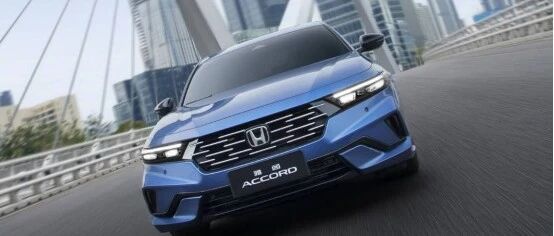
Core Viewpoint - The significant price reduction of the Honda Accord, a once-popular model in China, reflects a broader trend in the automotive market where traditional combustion engine vehicles are losing their appeal to consumers, particularly in the face of rising electric vehicle options and changing consumer preferences [1][2][4]. Group 1: Price Reduction and Market Impact - GAC Honda announced a price drop for the Accord e:PHEV model to 138,800 yuan, a reduction of 100,000 yuan from the official price, marking the highest discount since its launch [1]. - The Accord, which has been a staple in the Chinese market for 27 years, is experiencing a significant decline in sales, with a 25.22% year-on-year drop to 351,900 units by the end of last year [6]. - In January, GAC Honda's sales plummeted by 69.86% year-on-year, with only 4,558 vehicles sold, highlighting its struggles compared to other brands within the GAC Group [9]. Group 2: Changing Consumer Preferences - The traditional appeal of the Accord, which was based on reliability and low maintenance costs, is being challenged by the rising importance of energy costs in consumer purchasing decisions, with 68.85% of consumers now prioritizing energy costs [12]. - The depreciation of the Accord's resale value, which previously boasted a 60.23% three-year retention rate, is causing concerns among consumers about the long-term value of their investments [13]. - As domestic electric vehicles improve in design, luxury, and technology, the unique status of foreign brands like Honda is diminishing, leading consumers to prioritize lower operating costs and better features over brand prestige [13][14].


放出1000辆,“中年人的一代神车”直降10万元
Mei Ri Jing Ji Xin Wen· 2026-02-25 22:23
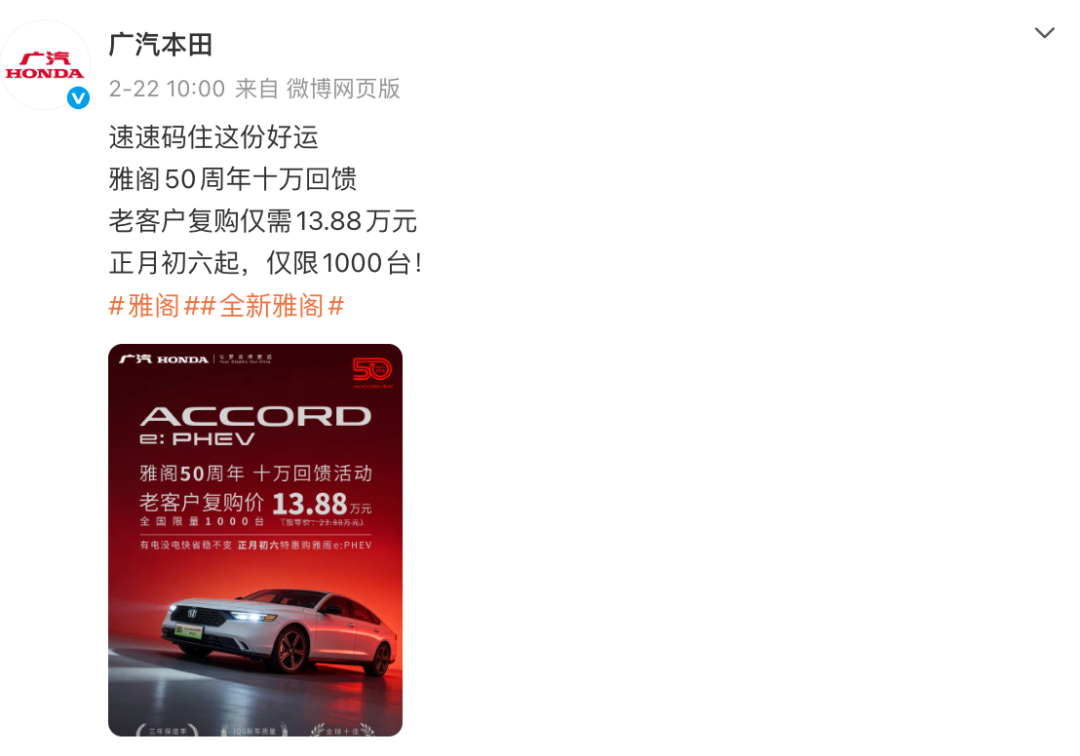
Group 1 - The Honda Accord has significantly reduced its price to celebrate its 50th anniversary, with a discount of 100,000 yuan, bringing the price down to 138,800 yuan for the e:PHEV model, marking the highest price drop since its launch [1] - In January 2026, the Accord's sales were approximately 13,800 units, a month-on-month decrease of 27%, ranking 6th in the mid-size car segment, primarily driven by its gasoline version [5] - The Accord and similar models like the Camry have historically been popular among middle-aged consumers due to their reliability and low maintenance costs, but are now facing price reductions due to increasing penetration of electric vehicles [5] Group 2 - The automotive market remains competitive in the 100,000 to 150,000 yuan price range, with various manufacturers, including Tesla and NIO, offering low-interest financing options to stimulate consumer demand [8] - In January, the automotive consumption index in China was reported at a historical low of 31.1, indicating weak consumer confidence [9] - The sales of mid to high-end electric vehicles have increased, driven by new trade-in policies that provide higher subsidies for these models [9] Group 3 - GAC Toyota has launched the fuel vehicle Wildlander AIR version with a limited-time cash subsidy of 22,000 yuan, alongside other promotional offers [10] - Nissan's new version of the Tianlai Hongmeng cockpit is also offering a limited-time discount of 21,000 yuan [16] - Luxury brands like BMW, Mercedes-Benz, and Audi are providing substantial discounts, with some models seeing reductions of up to 270,000 yuan, indicating aggressive competition for market share [17][18]
放出1000辆,“中年人的一代神车”直降10万元!
Mei Ri Jing Ji Xin Wen· 2026-02-25 16:39
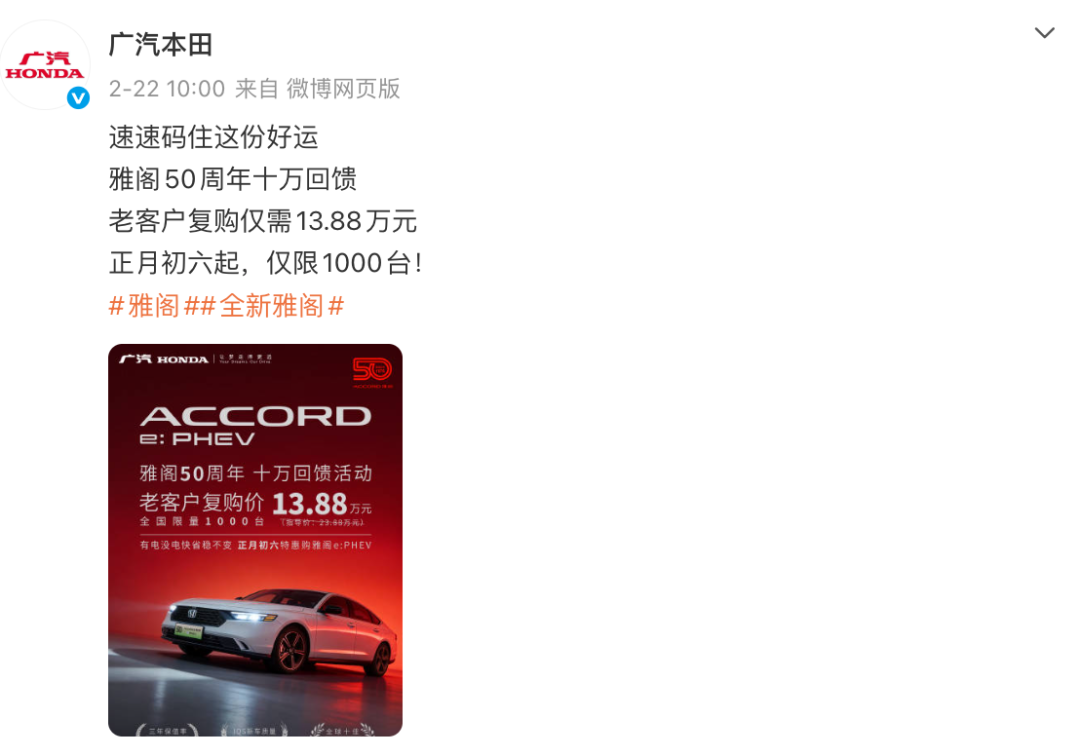
Group 1 - The Honda Accord has significantly reduced its price to celebrate its 50th anniversary, with a discount of 100,000 yuan for returning customers, making the new price 138,800 yuan, which is the highest discount since its launch [1] - In January 2026, the Accord's sales were approximately 13,800 units, a month-on-month decrease of 27%, ranking 6th in the mid-size car segment, primarily driven by its fuel version [4] - The Accord and similar models like the Camry were once sold at a premium of 20,000 to 50,000 yuan due to their reliability and low maintenance costs, but are now facing price reductions due to increasing penetration of electric vehicles [4] Group 2 - The automotive market is experiencing intense competition in the 100,000 to 150,000 yuan price range, with various manufacturers offering significant discounts to stimulate consumer demand [4][9] - In January, the automotive consumption index in China was at a historical low of 31.1, indicating weak consumer confidence [8] - Major car manufacturers, including Tesla and NIO, are implementing low-interest financing options to attract budget-conscious consumers, addressing the pain points of young buyers [7] Group 3 - The luxury car segment is also seeing substantial discounts, with brands like BMW, Mercedes-Benz, and Audi offering reductions of up to 270,000 yuan on various models, indicating a fierce competition for market share [16][17] - The new version of the Tianlai Hongmeng cockpit is being offered with a limited-time discount of 21,000 yuan, reflecting the trend of price reductions across different vehicle categories [15]
“中年人的一代神车”直降10万元
Di Yi Cai Jing· 2026-02-25 10:10
Group 1 - The automotive market is experiencing a new round of price competition, initiated by joint venture car manufacturers, with the Honda Accord significantly reducing its price to celebrate its 50th anniversary, offering the e:PHEV model at 138,800 yuan, a reduction of 100,000 yuan from the official price, marking the highest discount since its launch [1] - In January 2026, the retail sales of the Accord were approximately 13,800 units, a month-on-month decrease of 27%, ranking 6th in the mid-size car segment, with most sales coming from the fuel version [1] - The Accord and similar models like the Camry have historically been popular among middle-aged consumers due to their reliability and low maintenance costs, but the rise of electric vehicles has forced these once highly sought-after models to lower their prices [1] Group 2 - In January, the Honda Fit, marketed as a car for young people, also adopted a limited purchase strategy, pricing the new generation at 60,000 yuan, a reduction of 20,000 yuan from the previous generation, with a limited availability of 3,000 units [2] - The automotive market remains competitive in the 100,000 to 150,000 yuan price range, with the automotive consumption index in January at a historical low of 31.1 [2] - New energy vehicles are seeing a shift towards mid-to-high-end models, with sales of A00 and A0 class vehicles at 88,000 units, A-class at 141,000 units, and B-class and above at 399,000 units, accounting for 14%, 22.5%, and 63.4% of total sales respectively [2] Group 3 - The competition in the automotive market continues, with GAC Toyota launching the new fuel vehicle Vellfire AIR version, offering a cash subsidy of 22,000 yuan and additional trade-in subsidies [3] - Dongfeng Nissan has introduced four new models, including a new version of the Sylphy with a limited-time discount of 10,000 yuan, and the new version of the Teana with a discount of 21,000 yuan [3] - Premium brands like BMW, Mercedes-Benz, and Audi are also offering significant discounts, often exceeding 100,000 yuan, to capture market share [3]
日系车1月在华销量:丰田日产转增,本田跌幅缩小
日经中文网· 2026-02-11 03:23
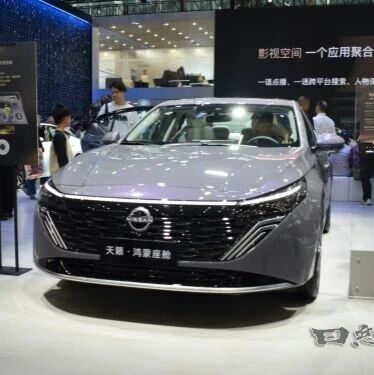
Group 1 - Toyota's sales increased by 6.6% year-on-year, reaching 145,500 units, marking the first growth in four months. The successful sales of the 2025 updated Corolla Cross contributed to this growth [3][6]. - In the electric vehicle (EV) segment, Toyota introduced new models such as the bZ3X and bZ5, resulting in a 70.9% increase in EV sales, totaling 6,400 units [3][6]. - Nissan's sales grew by 10.1%, reaching 50,024 units, driven by the upgraded fuel sedan "Tianlai," which features Huawei's smart cockpit, appealing to younger consumers [5][6]. Group 2 - Honda's sales declined by 16.5%, falling to 57,489 units. Although the decline was less severe compared to a 40% drop in December 2025, it still faced intense competition from Chinese automakers [6][7]. - The Chinese government plans to halve the vehicle purchase tax exemption for EVs starting January 2026, and adjustments to the vehicle trade-in subsidy system are also underway, leading to consumer hesitation in purchasing decisions [6].


2026车圈第一瓜,比亚迪与东风日产在“斗地主”上起热议
3 6 Ke· 2026-01-29 13:47
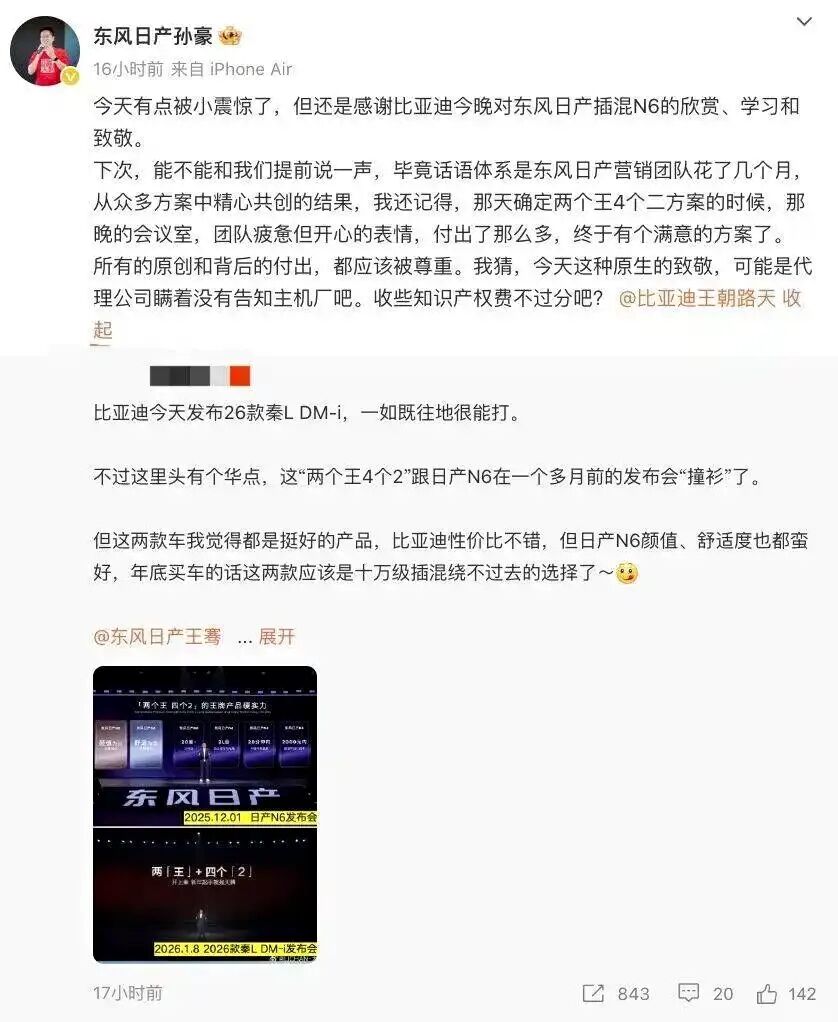
Core Viewpoint - The recent controversy surrounding BYD's product launch and its similarity to Dongfeng Nissan's marketing language highlights the competitive dynamics and creative strategies within the automotive industry, particularly in the context of brand identity and innovation [1][3]. Group 1: Industry Dynamics - Dongfeng Nissan's recent marketing strategy has shifted towards "traffic-driven" approaches, aiming to attract consumer attention amid declining sales and market share [9][10]. - The company has faced a continuous decline in sales for seven consecutive years, with a reported 4.94% drop in 2025, leading to a reliance on a single model, the Sylphy, to maintain sales figures [11][12]. - The electric vehicle segment shows potential growth, but the N7 model has seen a significant drop in sales after an initial spike, indicating challenges in sustaining momentum [11][12]. Group 2: Brand Identity and Strategy - Historically, Nissan was synonymous with technology and reliability, but the shift towards a "traffic marketing" strategy suggests a departure from its technical roots [10][11]. - The company has been criticized for its slow response to the rise of domestic electric vehicle brands, which have rapidly adapted to market demands, while Nissan has lagged in its transition to electric vehicles [17][28]. - Nissan's decision to sell its global headquarters for 97 billion yen (approximately 4.5 billion RMB) reflects financial struggles, with reported losses of 670.9 billion yen (approximately 30.3 billion RMB) in the 2023-2024 fiscal year [12][13]. Group 3: Future Prospects - The partnership between Dongfeng and Nissan aims to leverage each other's strengths, with Dongfeng providing local market insights and Nissan contributing its global brand recognition [56][58]. - The introduction of the "GLOCAL" model in 2024 allows for greater autonomy in product development for the Chinese team, indicating a strategic shift to better align with local consumer preferences [36][58]. - Despite these changes, challenges remain, including geopolitical factors and the increasing focus on domestic brands, which may further complicate Nissan's market position in China [38][48].

【合资篇】新的一年开始了,各家的情况都怎么样?
车fans· 2026-01-20 00:29
Core Viewpoint - The automotive market is experiencing a cautious start to the year, with customer foot traffic and orders showing slight declines compared to previous periods, influenced by policy changes and customer sentiment towards pricing and incentives [6][11][22]. Group 1: Customer Behavior and Market Trends - Customer foot traffic has decreased by approximately 10% compared to last year, with a notable drop in orders, reaching only one-third of last year's levels [6][9]. - Many customers are hesitant to make purchases, with a significant portion waiting for potential new policies or better pricing after the Chinese New Year [7][21]. - The majority of current buyers are driven by urgent needs, such as first-time purchases or vehicle replacements due to accidents [7][9]. Group 2: Pricing and Promotions - There have been no new promotional policies introduced, with most incentives remaining consistent with the previous year, although some models have seen slight increases in trade-in support [12][24]. - The average transaction prices have increased by about 1% compared to December, with smaller vehicles rising by 2,000-3,000 and larger vehicles by 3,000-5,000 [14][15]. - The perception of higher prices has led some customers to reconsider their purchasing decisions, with many opting to wait for potential future discounts [21][25]. Group 3: Sales Performance and Forecast - Despite a slight increase in orders by around 20% compared to the previous month, the overall sentiment remains cautious, with concerns about the sustainability of sales driven by current policies [24][28]. - The sales performance is heavily reliant on existing policies, and there are worries that the current sales figures are only two-thirds of what they were in previous years [29]. - The first quarter is expected to be challenging, with a significant portion of sales coming from online orders rather than in-store visits, indicating a lack of confidence among potential buyers [27][28].
监管出手 给车市价格战“退烧”
Mei Ri Shang Bao· 2025-12-17 23:26
Core Viewpoint - The Chinese automotive industry is facing a chaotic price war driven by "internal competition," leading to significant price drops and financial losses for dealerships, prompting regulatory intervention to establish pricing compliance standards [1][2][3]. Group 1: Industry Challenges - The automotive market is experiencing drastic price reductions, with over 200 models seeing price cuts in 2024 and 173 models in the first 11 months of 2025, including luxury brands like Audi and Maserati [2]. - A report indicates that 52.6% of automotive dealers are operating at a loss, with 74.4% facing price discrepancies, leading to issues such as reduced quality, false advertising, and bundled sales [2]. Group 2: Regulatory Response - The State Administration for Market Regulation has released a draft guideline aimed at addressing pricing issues in the automotive sector, emphasizing clear pricing and delivery timelines [3]. - Key requirements include mandatory public disclosure of vehicle information and strict penalties for violations, such as fines ranging from 10,000 to 30,000 yuan for non-compliance with pricing regulations [3]. Group 3: Corporate Responses - Following the draft guideline, several automakers, including BYD and XPeng, have committed to compliance measures, such as revising dealer rebate policies and improving transparency in promotional activities [4][5]. - Traditional automakers like Great Wall and Chery are also implementing measures to enhance delivery accountability and clarify pricing structures for consumers [4][5].

中产特供「大车」挤满广州车展,接下来还能卷什么?
Xin Lang Cai Jing· 2025-11-23 13:25
Core Insights - The Guangzhou Auto Show showcases the latest products and technologies from various automakers, marking the end of the year and setting trends for the next year [1] - The event featured 1,085 vehicles, with 93 new car launches, and 58% of the vehicles being new energy cars, indicating a significant shift towards electrification [1] - Traditional luxury brands are adapting to market trends by introducing electric models, while the demand for larger vehicles, particularly SUVs, is on the rise [2][4] Industry Trends - The market for new energy passenger vehicles in China saw a 24% year-on-year increase in sales for the first ten months of 2025, with a market penetration rate exceeding 52.9% [1] - The SUV market share reached 50.7% in October 2025, surpassing that of sedans, with a 9.1% year-on-year increase in retail sales for SUVs [4] - The demand for larger vehicles is driven by changing family structures and consumer preferences for space and comfort, particularly among families with multiple children [6][7] Company Strategies - Automakers are increasingly focusing on producing larger vehicles, as evidenced by the significant presence of large SUVs and MPVs at the auto show [4][5] - Companies like BYD and GAC Group are showcasing their ambitions with dedicated exhibition spaces, highlighting their commitment to innovation and market presence [1] - The profitability of larger vehicles is appealing to manufacturers, as they can accommodate more optional features, leading to higher profit margins [8][9] Consumer Behavior - The shift towards larger vehicles is influenced by a change in consumer mindset, where buyers prioritize space and comfort over basic transportation needs [6][7] - The age demographic of consumers purchasing larger vehicles is primarily between 35 and 45 years old, reflecting a trend towards family-oriented purchases [6] - The market is experiencing a "K-shaped" differentiation, where high-net-worth individuals are seeking premium vehicles, while average consumers focus on practicality [7] Future Outlook - The auto industry is facing challenges as the tax exemption for new energy vehicles is set to expire, potentially dampening demand for larger vehicles [11] - Companies must differentiate themselves in an increasingly homogeneous market, with a focus on unique features and technology to attract consumers [10] - The success of larger vehicles is contingent on brand strength, as weaker brands may struggle to gain consumer trust in producing high-quality larger models [11]
日产卖楼求生 日系汽车巨头陷“至暗时刻”
Xin Jing Bao· 2025-11-13 14:42
Core Viewpoint - Nissan is facing a severe financial crisis, reporting significant losses for the first half of the 2025 fiscal year, with a net loss of 221.9 billion yen, marking a drastic decline from profitability in the previous year [1][2]. Financial Performance - For the first half of the 2025 fiscal year, Nissan's global sales reached 1.48 million units, a year-on-year decrease of 7.27% [2]. - Revenue for the same period was 5.58 trillion yen, down 6.8% compared to the previous year [2]. - Operating loss was 27.7 billion yen, contrasting with an operating profit of 32.9 billion yen in the same period last year [2]. - The net loss of 221.9 billion yen is a stark contrast to a net profit of 19.2 billion yen in the previous year [2]. Market Challenges - Sales in key markets, including Japan and China, have seen double-digit declines of 16.5% and 17.6%, respectively [2]. - The company attributes its performance issues to weak sales in Japan and other regions, as well as the impact of U.S. tariffs [2]. - Nissan's slow transition to new technologies and product iterations has led to competitive disadvantages in markets like North America and Southeast Asia [3]. Cost-Cutting Measures - Nissan has initiated a series of cost-cutting measures, including halting vehicle production at its Yokosuka plant and converting another plant to produce auto parts [3]. - The company plans to reduce its global vehicle manufacturing plants from 17 to 10 by the 2027 fiscal year [3]. Asset Liquidation - To alleviate financial pressure, Nissan has sold its global headquarters building in Yokohama for 97 billion yen, reflecting the company's urgent need for cash [4][5]. - The buyer is a consortium led by China's Minth Group and U.S. private equity firm KKR, with Nissan planning to lease the building for 20 years [4]. Strategic Focus - Nissan's recovery plan, dubbed "Re:Nissan," emphasizes the importance of the Chinese market, with plans to launch 10 new energy models by summer 2027 [6]. - The company aims to establish a joint venture with Dongfeng focused on exports and to set up a new light commercial vehicle R&D center in Zhengzhou [6]. - Nissan anticipates an operating profit loss of 275 billion yen for the 2025 fiscal year, highlighting the ongoing financial challenges [6].