传音控股

Search documents
AI大模型产业“风起云涌”,从“商业兑现”走向“资本闭环”
Xin Hua Cai Jing· 2025-12-29 05:48
Core Insights - The AI industry is experiencing a significant transformation, moving from conceptual hype to a focus on practical value and commercial applications, particularly in the realm of large models [1][2][3] Group 1: Industry Trends - The large model sector in China is witnessing a "Matthew effect," where resources are increasingly concentrated among leading companies, marking the end of the "hundred model battle" [3] - Major players like DeepSeek and ByteDance are leading the charge with innovative products, such as DeepSeek-R1 and the Doubao model, which have significantly lowered the barriers for AI application in enterprises [3][4] - The introduction of AI applications in various sectors, including health care, education, and finance, is rapidly increasing, with over 200 new applications incorporating AI features [7] Group 2: Technological Advancements - The development of large models has transitioned from mere technical validation to practical tools that enhance productivity in workplaces, as evidenced by user experiences in financial analysis and software development [6][7] - The AI hardware market is gaining momentum, with significant investments in AI glasses and smartphones, indicating a shift towards integrating large models with hardware for improved human-computer interaction [8][9] Group 3: Market Performance - The AI sector in the A-share market has seen a cumulative increase of over 35% in 2025, reflecting strong investor interest and confidence in the industry's growth potential [11]
科创信息技术ETF摩根(588770)开盘涨0.44%,重仓股海光信息跌0.33%,中芯国际涨0.74%
Xin Lang Cai Jing· 2025-12-29 02:56
Core Viewpoint - The article discusses the performance of the Science and Technology Innovation Information Technology ETF Morgan (588770), highlighting its opening price and the performance of its major holdings [1]. Group 1: ETF Performance - The Science and Technology Innovation Information Technology ETF Morgan (588770) opened at 1.382 yuan, with a gain of 0.44% [1]. - Since its establishment on March 14, 2025, the fund has achieved a return of 37.55%, with a monthly return of 4.71% [1]. Group 2: Major Holdings Performance - Among the major holdings, Haiguang Information opened down by 0.33%, while SMIC (Semiconductor Manufacturing International Corporation) increased by 0.74% [1]. - Other notable performances include Cambrian (up 0.47%), Chipone (up 1.64%), and Stone Technology (up 0.03%), while Kingsoft Office and Huahong Group saw declines of 0.25% and 0.48%, respectively [1].




豆包的朋友又多了一个?
Hua Er Jie Jian Wen· 2025-12-27 11:27
Core Insights - ByteDance and ZTE launched the "Doubao Phone," intensifying competition for the next-generation super entry point in the industry [2] - Lenovo plans to unveil its first global "AI Super Intelligent Body" at CES, directly competing with Doubao Phone Assistant, focusing on cross-device connectivity [2][3] - Lenovo's strategy emphasizes a hybrid AI approach, integrating personal, enterprise, and public intelligence over the next decade [6] Group 1 - Lenovo is collaborating closely with ByteDance's Doubao and Volcano Engine, indicating a partnership despite potential competition with the new AI Super Intelligent Body [4][5] - The smartphone market is experiencing a "Matthew Effect," where Lenovo must leverage AI opportunities to enhance Motorola's global market position [8] - ByteDance's strategy involves pre-installing AIGC plugins on partner devices, empowering more hardware terminals with Doubao Phone Assistant's capabilities [9] Group 2 - Vivo and ByteDance are reportedly in discussions for collaboration, while Meizu has expressed interest in working with Doubao [10] - OPPO has denied rejecting collaboration with ByteDance, emphasizing an open approach to partnerships based on user experience [10][11] - The competition for AI super entry points is just beginning, with hardware manufacturers concerned about becoming mere hardware providers if they overly rely on ByteDance's Doubao Assistant [13]



散户跑输指数20%,社保却抓到16只200%牛股:2025年名单梳理
Sou Hu Cai Jing· 2025-12-26 20:37
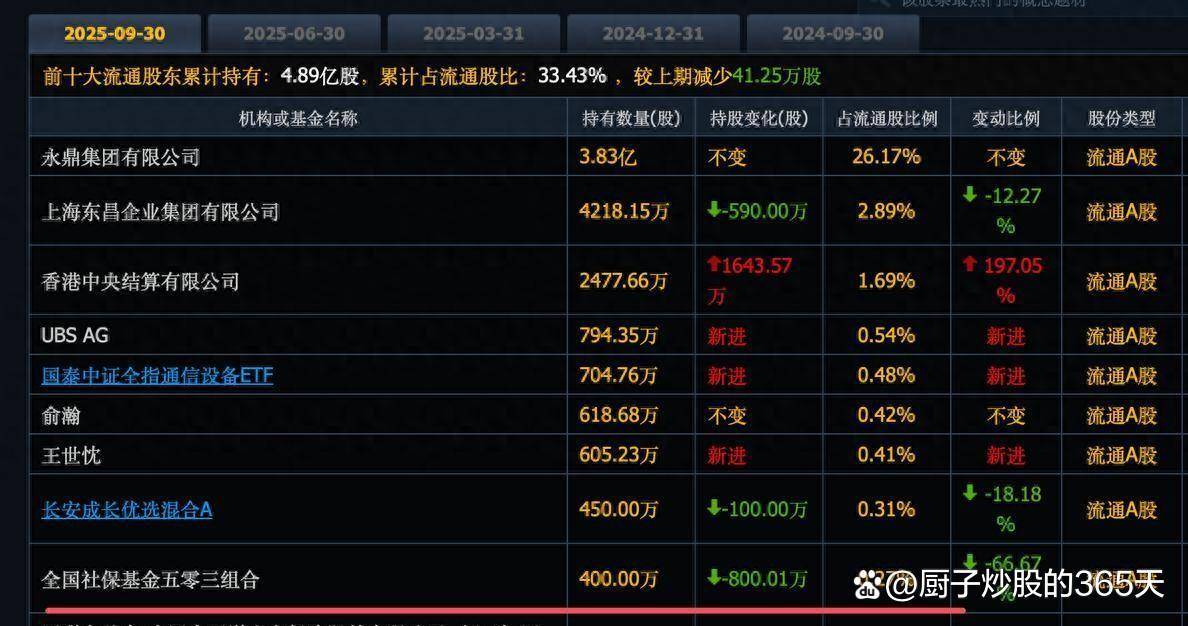
Group 1 - The A-share index increased from 3300 to 3900 points, a 20% overall rise, while many retail investors experienced account shrinkage, highlighting a disparity between the index bull market and retail bear market [1] - The National Social Security Fund (NSSF) successfully identified 59 stocks that doubled in value, with 16 stocks rising over 200%, and the highest increase reaching 430% [1] - NSSF's holdings include Yongding Co., which saw a 430% increase, and other stocks like Chaojie Co. and Beifang Changlong with increases of 370% and 325% respectively, demonstrating NSSF's strategic focus on high-growth sectors [1][2] Group 2 - NSSF's investment strategy is characterized by a balanced approach, combining high-growth sectors with low-valuation defensive stocks, as evidenced by their significant investments in consumer leaders like Chengde Lulu and Gu Yue Long Shan [5] - In the technology sector, NSSF maintained substantial positions in companies like Transsion Holdings and Yilian Network, with a total market value exceeding 46.9 billion yuan, marking a 61% increase from the previous year [7][6] - NSSF's recent investments include 63 new positions in listed companies, with a focus on resource sectors and high-end manufacturing, reflecting a proactive stance on economic trends [10] Group 3 - Yongding Co.'s surge is driven by AI computing power in optical communication and energy superconductivity, with significant orders from international clients [2] - Chaojie Co. capitalized on the commercial aerospace and humanoid robot sectors, holding over 40% market share in rocket body structures [4] - NSSF's long-term investment strategy is evident in its continuous holdings in companies like Hualu Hengsheng for over 51 quarters, allowing it to benefit from corporate growth over time [11]



寻求更多手机厂商合作,豆包准备隔山打牛
3 6 Ke· 2025-12-25 23:37
Core Viewpoint - The article discusses the recent challenges faced by Doubao, a mobile phone assistant developed by ByteDance, which has been blocked by major apps like WeChat, Taobao, and Alipay. In response, ByteDance is seeking partnerships with hardware manufacturers to pre-install AIGC plugins on mid-range devices priced above 2000 yuan [1][3]. Group 1: Partnerships and Collaborations - ByteDance is actively pursuing collaborations with smartphone manufacturers such as Vivo, Lenovo, and Transsion to pre-install AIGC plugins on their devices [3]. - Reports indicate that Vivo employees have confirmed a partnership agreement with ByteDance, and Lenovo is also in close communication regarding potential collaborations in the smart terminal sector [3]. - The strategy of partnering with hardware manufacturers is seen as a clever move by ByteDance to address the challenges posed by major app blockages [3]. Group 2: Industry Dynamics - The relationship between internet companies and smartphone manufacturers is characterized by significant conflicts of interest, particularly regarding app store revenue sharing [4]. - Internet giants like Tencent and ByteDance have developed "mini-programs" to circumvent the revenue-sharing model imposed by hardware manufacturers [4]. - Smartphone manufacturers have historically relied on software for profitability, leading to a competitive landscape where they must depend on internet companies for revenue [6]. Group 3: AI Integration and Cost Management - Without Doubao, many second and third-tier smartphone manufacturers would struggle to develop their own AI assistants due to resource limitations [7]. - ByteDance is not only providing technology but also creating a new revenue-sharing model that allows smartphone manufacturers to participate in traffic distribution and subscription services [7]. - By absorbing the costs associated with AI token usage, ByteDance makes it financially attractive for smartphone manufacturers to adopt its AI services [8]. Group 4: Market Implications - The success of the Doubao mobile assistant with ZTE sets a precedent, encouraging more smartphone manufacturers to explore similar collaborations with ByteDance [9].

AI浪潮转向硬科技 专家:2026年大概率成为AI手机元年
Mei Ri Jing Ji Xin Wen· 2025-12-25 14:57
Core Insights - In 2025, DeepSeek emerged, significantly lowering the application cost and threshold of AI technology, leading to a boom in vertical applications and a shift in industry competition from single model comparisons to full-stack ecosystem battles [1] - The AI landscape is transitioning from a dominance of OpenAI to a multi-polar competition, with applications expanding from software to intelligent hardware [1][2] - The "Hundred Mirrors War" in AI hardware is intensifying, with major tech companies investing heavily in AI glasses and smartphones, marking a significant shift in human-computer interaction [6] Group 1: AI Application Market Dynamics - The introduction of DeepSeek in February 2025 has drastically reduced AI inference costs, spurring growth in vertical applications such as AI in health, education, and office settings, leading to a reshuffling of the AI application market [2] - User data shows a concentration effect, with DeepSeek achieving an average monthly download of 34.72 million and ByteDance's Doubao at 31.44 million, dominating the general AI assistant market [2] - Vertical scenarios are becoming crucial for AI applications, evolving from language Q&A and content generation to multi-task intelligent agents across various industries [2][3] Group 2: Hardware Developments and Market Trends - McKinsey predicts a surge in vertical AI intelligent agents by 2025, with over 70% of AI value potential expected to come from these applications [3] - The global smart glasses market saw a shipment of 4.065 million units in the first half of 2025, a 64.2% year-on-year increase, with China accounting for 26.6% of the market share [6] - The global smart glasses market is projected to reach $42 billion by 2030 and $117 billion by 2040, despite facing challenges in technology maturity and privacy compliance [6] Group 3: Future Growth Areas - Key growth points in the AI field for 2026 include large models with continuous learning capabilities, real-time interactive 3D models, and seamless intelligent agents that integrate tools, data, and workflows [4] - The AI smartphone market is expected to see a shipment of 147 million units in China in 2026, a 31.6% year-on-year growth, capturing 53% of the overall market [8] - The "Doubao phone" model is gaining attention, with a focus on a multi-to-multi intelligent connection ecosystem, avoiding a zero-sum game in the internet ecosystem [9]
消费电子板块12月25日涨1.38%,信维通信领涨,主力资金净流出8.43亿元
Zheng Xing Xing Ye Ri Bao· 2025-12-25 09:07
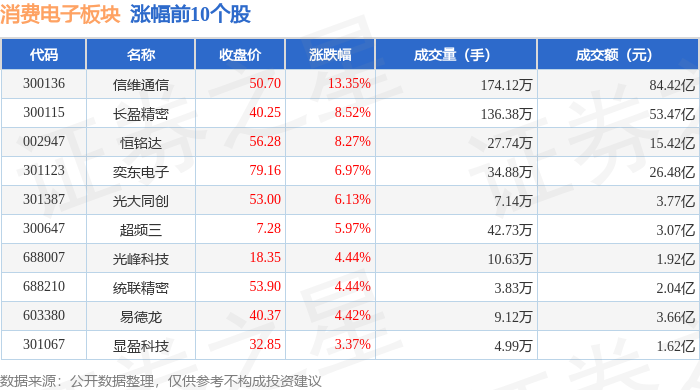
Market Performance - The consumer electronics sector increased by 1.38% on December 25, with Xunwei Communication leading the gains [1] - The Shanghai Composite Index closed at 3959.62, up 0.47%, while the Shenzhen Component Index closed at 13531.41, up 0.33% [1] Top Gainers in Consumer Electronics - Xunwei Communication (300136) closed at 50.70, up 13.35% with a trading volume of 1.74 million shares [1] - Changying Precision (300115) closed at 40.25, up 8.52% with a trading volume of 1.36 million shares [1] - Hengmingda (002947) closed at 56.28, up 8.27% with a trading volume of 277,400 shares [1] - Yidong Electronics (301123) closed at 79.16, up 6.97% with a trading volume of 348,800 shares [1] - Other notable gainers include Guangda Tongchuang (301387) and Chaoping San (300647) with increases of 6.13% and 5.97% respectively [1] Top Losers in Consumer Electronics - Yitian Co., Ltd. (300812) closed at 29.53, down 2.86% with a trading volume of 115,300 shares [2] - Kecuan Technology (603052) closed at 33.04, down 2.74% with a trading volume of 84,500 shares [2] - Anker Innovation (300866) closed at 115.02, down 2.54% with a trading volume of 39,800 shares [2] - Other notable losers include Transsion Holdings (688036) and Zhishang Technology (301486) with declines of 2.13% and 1.79% respectively [2] Capital Flow Analysis - The consumer electronics sector experienced a net outflow of 843 million yuan from institutional investors, while retail investors saw a net inflow of 1.316 billion yuan [2] - Notable stocks with significant capital flow include Changying Precision and Yidong Electronics, which had varying levels of net inflow and outflow from different investor types [3]



从非洲杯看传音,一个中国品牌的长期主义样本
3 6 Ke· 2025-12-25 08:39
Core Insights - The 35th Africa Cup of Nations (AFCON) has officially commenced in Rabat, Morocco, with TECNO, a brand under Transsion Holdings, as the official global partner, highlighting its significant presence in the event [2][4] - TECNO's partnership with AFCON is a strategic move to enhance brand visibility and connect with local consumers, showcasing its commitment to the African market [4][6] Market Position and Strategy - Transsion Holdings, known as the "King of Africa," has a dominant market share in the African smartphone market, with over 40% in 2024, and ranked fourth globally with a shipment of 29.2 million units in Q3 2025 [6][7] - The company has tailored its products to meet local needs, focusing on features like high-volume speakers, long battery life, and multi-SIM capabilities, which are essential for African consumers [8][9] Technological Innovation - Transsion has invested in AI technology to address local user needs, launching a smartphone assistant that supports over 100 languages, including many African dialects, enhancing accessibility for users [9][11] - The company emphasizes the importance of localized technology, with AI features designed for real-world applications, such as image enhancement for diverse skin tones and voice interaction for low literacy scenarios [13][16] Brand Engagement and Community Involvement - TECNO's sponsorship of AFCON is not just for exposure but aims to create deeper connections with users by integrating practical AI features into the viewing experience [16][18] - The brand engages in community projects, such as sports field renovations and educational support, fostering a long-term relationship with consumers beyond mere transactions [9][18] Global Expansion and Market Adaptation - Transsion is expanding its market presence globally, achieving a 14% market share in the global smartphone market by 2024, with significant growth in Southeast Asia and the Middle East [15] - The company's strategy of "Think Globally, Act Locally" allows it to adapt to different markets by understanding local consumer needs and preferences [15][19] Long-term Vision and Sustainability - Transsion's approach to building trust in emerging markets is through consistent presence and engagement, rather than short-term marketing tactics [16][19] - The company's ability to create sustainable social connections while generating commercial value positions it as a model for global brands in emerging markets [19]

资本三城记:京沪深上市企业全景图鉴(一)
Sou Hu Cai Jing· 2025-12-25 01:20
Group 1: Shenzhen's Capital Landscape - As of December 18, 2025, Shenzhen has 592 listed companies, with 15 new additions in 2025, including 424 A-share companies across various exchanges [1] - Shenzhen's A-share companies have a total market capitalization of 11.34 trillion yuan, accounting for 10.83% of the national total, with a year-on-year growth of 36.82% [1] - The total revenue of Shenzhen's A-share companies reached 3.2955 trillion yuan, a year-on-year increase of 5.96%, contributing to 9.43% of the national revenue [1] Group 2: R&D Investment in Shenzhen - In the first half of 2025, Shenzhen companies disclosed R&D expenses exceeding 102.57 billion yuan, a year-on-year increase of 14.60%, representing 13.9% of the national A-share R&D expenses [2] - The R&D intensity of Shenzhen companies stands at 3.11%, leading other major cities, with manufacturing firms accounting for 90.95% of R&D spending [2] - Over 60% of A-share companies in Shenzhen have overseas revenue totaling 553.33 billion yuan, with significant contributions from manufacturing [2] Group 3: Beijing's Capital Dynamics - By December 2025, Beijing is expected to have over 800 listed companies, leading the nation, with approximately 480 A-share companies and a total market capitalization exceeding 35 trillion yuan [3] - R&D expenses for Beijing's A-share companies are around 120 billion yuan, the highest in the country, with a focus on foundational research and original innovation [3] - The Beijing Stock Exchange plays a crucial role in supporting innovative SMEs, with about 18% of its listed companies being from Beijing [3] Group 4: Shanghai's Capital Environment - Shanghai has around 680 listed companies, with approximately 430 A-share companies and a total market capitalization of about 13 trillion yuan [4] - The Shanghai Stock Exchange's Sci-Tech Innovation Board features 110 companies, accounting for 22% of the national total, with a market capitalization of about 2.8 trillion yuan [4] - Over 50% of Shanghai's Sci-Tech companies have more than 30% of their revenue from overseas, indicating a strong international presence [4] Group 5: Comparative Analysis of the Three Cities - Beijing's capital structure is characterized by state-owned enterprises contributing over 65% of its total market value, while Shanghai has a balanced multi-industry layout [5] - Shenzhen focuses on rapid industrialization and iteration, while Beijing emphasizes foundational research and Shanghai prioritizes application and internationalization [5] - The financial sector in Beijing is heavily regulated, while Shanghai's financial services are market-oriented, and Shenzhen's financial sector is closely integrated with manufacturing [5] Group 6: Complementary Capital Ecosystem - The three cities are forming a complementary capital ecosystem, with Beijing evolving into an "innovation source," Shanghai solidifying its "capital hub" status, and Shenzhen enhancing its role as an "industrial innovation arena" [6] - Investment from Beijing's venture capital firms in Shenzhen's tech companies increased by 31% year-on-year, indicating growing inter-city capital flow [6] - The differences in company numbers and market values reflect the strategic positioning and resource endowments of each city, contributing to a resilient national innovation system [6]

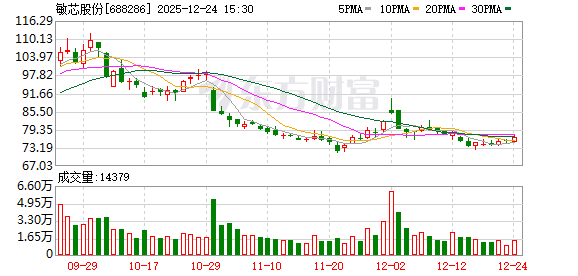
敏芯股份:以全链路自研竞逐全球传感器市场
Shang Hai Zheng Quan Bao· 2025-12-24 20:11
Core Insights - The article highlights the significant growth and development of the MEMS (Micro-Electro-Mechanical Systems) industry in China, particularly through the achievements of Minxin Co., which has become a leader in MEMS sensors, producing 100 million sensors monthly and accumulating over 5 billion units shipped since its inception in 2007 [1][2]. Group 1: Company Development - Minxin Co. has evolved from a startup in 2007, when there were no domestic MEMS wafer foundries, to a leading MEMS chip company in China, achieving a revenue share of 47.61% from MEMS acoustic sensors in 2024 [1][3]. - The company has expanded its product matrix to include acoustic sensors, pressure sensors, inertial sensors, and posture sensors, with global rankings of fourth in MEMS microphones and third in MEMS acoustic sensor chip shipments [3][5]. Group 2: Product Strategy - The company aims to produce world-class products, with ongoing development of high-performance MEMS microphones and sensors for emerging markets such as humanoid robots and AR/VR applications [3][5]. - Minxin Co. emphasizes the importance of continuous R&D investment, with a planned R&D expenditure of over 80 million yuan in 2024, representing 16.01% of its revenue [5][6]. Group 3: Customer Relationships - The company collaborates with high-profile clients like Samsung, Xiaomi, and OPPO, focusing on building relationships that allow for mutual growth and high-quality product development [5][6]. - Minxin Co. recognizes that the value of its customers directly influences its own value, driving the company to invest heavily in assets to meet the quality and delivery expectations of premium clients [6][7]. Group 4: Industry Positioning - Minxin Co. has played a pivotal role in establishing the MEMS production capabilities in China, contributing to the creation of the first MEMS wafer fab through collaboration with state initiatives [7][8]. - The company aims to transition from being a participant in the industry chain to becoming an ecosystem builder, offering a comprehensive range of sensors for various applications [7][8]. Group 5: Future Outlook - The company has a clear strategic plan for the next five years, focusing on technology reserves in emerging fields like humanoid robots and IoT, as well as pursuing mergers and acquisitions to avoid homogenization in competition [8]. - Minxin Co. is committed to strengthening its R&D innovation, expanding its product categories, and targeting top-tier clients to become a global leader in MEMS solutions [8].