农业银行

Search documents
系统重要性银行分层洗牌:谁在晋级,谁在降组?
Jing Ji Guan Cha Wang· 2026-02-14 06:32
Core Insights - The People's Bank of China and the National Financial Regulatory Administration released the list of systemically important banks (D-SIBs) for 2025, expanding the number of institutions from 20 to 21, with Zheshang Bank being the new addition [1][3] - The list reflects a significant internal reshuffling, with Industrial Bank being downgraded from the third group to the second group, indicating a re-evaluation of systemic risk profiles by regulators [3][8] Group Summaries - **First Group (10 Banks)**: Includes China Everbright Bank, China Minsheng Bank, Ping An Bank, Huaxia Bank, Ningbo Bank, Jiangsu Bank, Guangfa Bank, Shanghai Bank, Nanjing Bank, and Beijing Bank [5] - **Second Group (4 Banks)**: Comprises CITIC Bank, Shanghai Pudong Development Bank, China Postal Savings Bank, and now includes Industrial Bank [5][8] - **Third Group (3 Banks)**: Contains Bank of Communications, China Merchants Bank, and Industrial Bank [5][6] - **Fourth Group (4 Banks)**: Dominated by the four major state-owned banks: Industrial and Commercial Bank of China, Bank of China, China Construction Bank, and Agricultural Bank of China [5][6] - **Fifth Group (0 Banks)**: No banks are currently classified in this group, which has the highest additional capital requirements [10] Zheshang Bank's Inclusion - Zheshang Bank's inclusion in the first group is attributed to its performance across four dimensions: scale, interconnectedness, substitutability, and complexity, achieving a weighted score that meets the threshold [6][11] - As of Q3 2025, Zheshang Bank's asset size reached 3.39 trillion yuan, with a core Tier 1 capital adequacy ratio rising by 0.02 percentage points to 8.40% [6][11] Industrial Bank's Downgrade - Industrial Bank's downgrade to the second group signifies a reduction in regulatory costs, as the additional capital requirement drops from 0.75% to 0.5%, potentially freeing up hundreds of billions in capital [8][10] - The downgrade reflects a shift in the competitive landscape, where Industrial Bank's relative advantages in market operations may have diminished due to the performance of peer banks [8][11] Regulatory Dynamics - The release of the new list comes after a gap of nearly 18 months, indicating a shift in regulatory oversight and a more cautious approach to data evaluation by the authorities [9][10] - The regulatory framework emphasizes both macro-prudential and micro-prudential management, requiring banks to meet various additional capital and leverage ratio requirements based on their group classification [10][11]



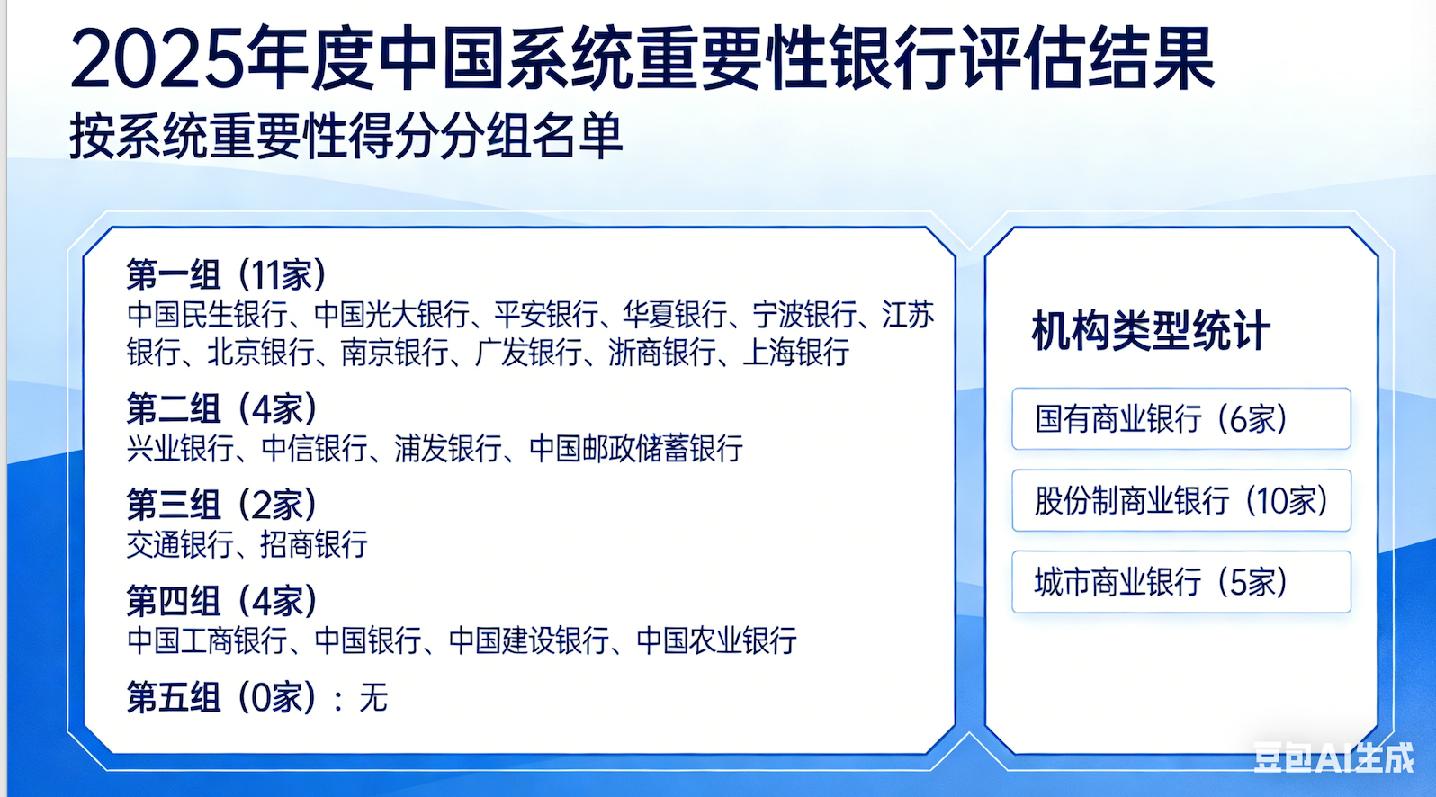
系统重要性银行扩围至21家:浙商银行突围,兴业银行跌落第三组
Jing Ji Guan Cha Wang· 2026-02-14 06:32
Core Viewpoint - The People's Bank of China and the National Financial Regulatory Administration have updated the list of Domestic Systemically Important Banks (D-SIBs), increasing the total from 20 to 21, with Zhejiang Commercial Bank being newly included [2][3]. Group Summaries Group 1 - The first group now includes 10 banks, such as China Everbright Bank, Minsheng Bank, and Ping An Bank, reflecting a strong position in the financial system [6]. - Zhejiang Commercial Bank's inclusion in this group indicates its significant role and improved risk profile within the banking sector [4][8]. Group 2 - The second group consists of four banks, including Citic Bank, Shanghai Pudong Development Bank, and Postal Savings Bank, with the addition of Industrial Bank [3][6]. - The adjustment of Industrial Bank to this group signifies a shift in its risk assessment and regulatory requirements [4]. Group 3 - The third group includes three banks: Bank of Communications, China Merchants Bank, and Industrial Bank, which maintain advantages in cross-regional operations and market coverage [3][6]. - The downgrade of Industrial Bank from the third to the second group reflects a relative loss of competitive edge in the financial market [6]. Group 4 - The fourth group remains unchanged with the four major state-owned banks: ICBC, ABC, BOC, and CCB, which continue to be the backbone of the national financial system [3][6]. - These banks are subject to the highest regulatory scrutiny due to their systemic importance [3]. Regulatory Insights - The update of the D-SIB list demonstrates a dynamic adjustment in the assessment of systemic risk, emphasizing the importance of both macro and micro-prudential regulations [3][7]. - The additional capital requirements for each group range from 0.25% to 1.5%, with the first group facing the lowest and the fifth group (currently empty) facing the highest [7][8]. - The regulatory framework aims to ensure that banks not only meet micro-level indicators but also adhere to macro-level capital and leverage requirements [7].
跌入熊市!超10万亿“大溃败”!两大巨头,疯狂减持!
Xin Lang Cai Jing· 2026-02-14 06:04
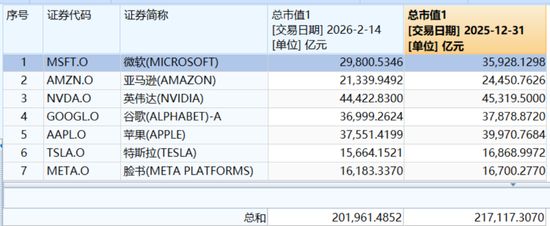
Group 1 - Amazon's stock price has fallen for nine consecutive days, entering a technical bear market, becoming the second member of the "Magnificent Seven" (Mag7) to do so, following Microsoft [1][2] - The total market capitalization of the Mag7 has decreased by approximately $1.51 trillion (about 10.4 trillion yuan) this year [3] - Microsoft was the first Mag7 member to enter a bear market, with its stock price down 27.8% from recent highs as of Friday's close [2][3] Group 2 - UBS and Goldman Sachs have significantly reduced their holdings in several major U.S. tech stocks, as indicated in their recent 13F filings with the SEC [1][5] - UBS reduced its stake in Nvidia by 10.57%, Microsoft by 7.64%, Apple by 10.57%, Amazon by 4.57%, and Google by 9.05% [5] - Goldman Sachs also reduced its holdings in Microsoft by 5.86%, Tesla by 8.27%, Broadcom by 9.33%, and Meta by 13.51% [5] Group 3 - The decline in the Mag7 stocks coincides with similar trends in the A-share market, indicating a potential shift in global investment styles [6] - Factors contributing to these changes include investor skepticism regarding the return on investment from AI spending by tech giants and a potential shift in global liquidity and macroeconomic conditions [7] - The U.S. short-term liquidity market is reportedly experiencing a significant contraction, with overnight reverse repos dropping to a very low level, indicating a tightening of liquidity [7]
跌入熊市!超10万亿“大溃败”!两大巨头,疯狂减持!
券商中国· 2026-02-14 06:02
美股风格大变局! 今年以来,Mag7杀跌惨重。微软是首家进入熊市的Mag7成员,股价于1月29日跌入熊市。截至周五收盘,微软股价较近期高点下跌27.8%。Meta可能成为下一个跌 入熊市的Mag7成员,截至周五收盘,较去年高点累跌19.6%,距离熊市的20%跌幅门槛仅差0.4%。 据券商中国记者统计,今年以来,Mag7市值皆出现了显著收缩,总市值蒸发约1.51万亿美元。 | 序号 | 证券代码 | 证券简称 | 总市值1 | 总市值1 | | | --- | --- | --- | --- | --- | --- | | | | | [交易日期] 2026-2-14 [单位] 亿元 | [交易日期] 2025-12-31 [单位] 亿元 | | | 1 | MSFT.O | 微软(MICROSOFT) | 29,800.5346 | | 35,928.1298 | | 2 | AMZN.O | 亚马逊(AMAZON) | 21.339.9492 | | 24.450.7626 | | 3 | NVDA.O | 英伟达(NVIDIA) | 44,422.8300 | | 45,319.5000 | | ব | ...

广发银行资产托管中心获批筹建!银行业托管业务哪家强?
Nan Fang Du Shi Bao· 2026-02-14 05:55
近日,国家金融监督管理总局发布批复称,同意广发银行筹建广发银行股份有限公司资产托管中心。财 报显示,该行已设有一级部门资产托管部。2024年末,该行资产托管及基金服务业务规模达4.2万亿 元,较年初增长超一成。在业内人士看来,此番筹建资产托管中心,将助力其托管服务向精细化、专业 化的运营体系升级。 将视野放大,近年来,我国商业银行资产托管业务持续扩容。数据显示,截至2024年末,中国银行业资 产管理类产品托管规模为182.20万亿元,较上年末增长12.64%。从行业格局来看,四家银行资产托管规 模超过20万亿元,头部效应明显。 广发银行获批筹建资产托管中心 国家金融监督管理总局发布的批复显示,广发银行筹建广发银行股份有限公司资产托管中心获得同意。 筹建工作接受北京金融监管局的监督指导。筹建工作完成后,向北京金融监管局提出开业申请。 根据中国银行业协会发布的《中国资产托管行业发展报告(2025)》,截至2024年末,中国银行业资产 管理类产品托管规模为182.20万亿元,较上年末增长12.64%;与客户资金保管类产品服务规模合计达 239.90万亿元;资管产品营运外包业务规模8.88万亿元。 具体到国有大行和股 ...

我国系统重要性银行上新
Zhong Guo Xin Wen Wang· 2026-02-14 05:45
Group 1 - The list of systemically important banks in China was published on February 13, 2025, including 21 banks categorized into five groups based on their systemic importance scores [2][4] - The first group consists of 11 banks, including China Minsheng Bank, China Everbright Bank, and Ping An Bank, while the fourth group includes major state-owned banks like ICBC, Bank of China, and China Construction Bank [2][3] - The inclusion in the systemically important bank list signifies both honor and responsibility, enhancing the bank's reputation and requiring them to invest more in internal controls and risk management systems [3][5] Group 2 - Zhejiang Bank was included in the systemically important bank list for the first time, signaling its significant market position and requiring adherence to stricter regulatory standards [5] - Industrial Bank was moved from the third group to the second group, reflecting a relative decline in its systemic importance score, which may provide it with more capital space and lower compliance costs [6][7] - The People's Bank of China and the National Financial Regulatory Administration will continue to enforce additional regulations for systemically important banks to ensure their safe and sound operation [7]
金价一夜大反转!2月14日全国金店最新价出炉,现在入手划算吗?
Sou Hu Cai Jing· 2026-02-14 05:28
Group 1 - Domestic gold prices continued to decline, with brand gold jewelry prices falling between 1272 to 1538 RMB per gram, a decrease of 11 to 32 RMB compared to the previous day [1][2] - On February 14, the Shanghai Gold Exchange reported AU9999 gold closing at 1108 RMB per gram, down 15.6 RMB, with a daily drop of 2.31% [2] - The international gold price experienced slight recovery, with London gold spot at 4975.42 USD per ounce, an increase of 54.61 USD [4] Group 2 - Several gold enterprises and banks adjusted their repurchase business due to recent price volatility and the Spring Festival, with companies like Caibai and China Gold announcing temporary suspensions [5][6] - The adjustment in repurchase business is aimed at risk control and operational optimization, helping companies reduce exposure risk during price fluctuations [6] - The market for "lucky money gold notes" and "New Year gold" is seeing increased sales, but there are concerns about discrepancies in material and promotional claims [8][10] Group 3 - Gold stocks showed mixed performance, with the CSI Hong Kong-Shenzhen Gold Industry Stock Index constituents reflecting varied movements, such as Caibai shares rising by 2.36% [4] - International institutions maintain an optimistic outlook for gold prices, with ANZ raising its Q2 2026 gold price forecast from 5400 to 5800 USD per ounce [4] - The paper gold market mirrored fluctuations, with banks reporting a drop of approximately 1.7% to 1.9% in USD-denominated paper gold prices [4]

2026年1月金融数据点评:存款搬家加速,M1、M2增速大幅回升
GF SECURITIES· 2026-02-14 05:23
Investment Rating - The industry rating is "Buy" [6] Core Insights - The overall social financing growth slightly declined to 8.2% in January, while M1 and M2 growth rates significantly rebounded, with M1 growing by 4.9% and M2 by 9.0% [6][16] - Government net financing increased significantly by 2,831 billion yuan year-on-year, contributing to the overall social financing growth [6][17] - The report indicates a shift in deposit structure due to accelerated deposit migration, impacting M1 negatively while having limited effect on M2 [6][16] Summary by Sections Overall Situation - Social financing growth decreased slightly to 8.2%, while M1 and M2 growth rates increased significantly [15][16] - M1 and M2 growth rates rose by 1.1 percentage points and 0.5 percentage points respectively compared to the previous month [6][16] Government Sector - Fiscal strength showed a year-on-year decline, impacting overall financing dynamics [39] Household Sector - Demand remained stable year-on-year, with short-term loan demand increasing [39] Corporate Sector - Short-term loan demand increased year-on-year, while bill financing saw a significant reduction [39] Non-Bank Sector - The acceleration of deposit migration was noted, with non-bank deposits increasing by 1.45 trillion yuan year-on-year [6][39]



1月信贷社融点评:温和开门红
ZHESHANG SECURITIES· 2026-02-14 05:23
Investment Rating - The industry investment rating is "Positive" (maintained) [4] Core Insights - The report highlights a "strong deposit, weak loan" characteristic in the opening month of the year [4] - In January 2026, new social financing increased by 7.2 trillion yuan, a year-on-year increase of 166.2 billion yuan, with a balance growth of 8.2% [4][5] - New RMB loans in January 2026 amounted to 4.7 trillion yuan, a year-on-year decrease of 420 billion yuan, with a balance growth of 6.1% [4][5] - The report indicates that consumer demand has shown some recovery, particularly in short-term loans, but overall consumer credit demand may remain pessimistic throughout the year [1][2] Summary by Sections Credit Overview - Entity credit remained stable, with a significant reduction in bill financing [1] - Retail loans saw an increase of 456.5 billion yuan in January, with short-term loans contributing 109.7 billion yuan [1] - Corporate loans totaled 4.5 trillion yuan, a year-on-year decrease of 330 billion yuan, influenced by a substitution effect between short-term loans and bill financing [2] Social Financing - Government bonds contributed significantly to social financing, with new issuance of 976.4 billion yuan in January, a year-on-year increase of 283.1 billion yuan [5] - The report notes a trend of "deposit migration," with non-bank deposits reaching 36 trillion yuan, accounting for 10.7% of total deposits [5] Investment Recommendations - The report recommends a "New Momentum Portfolio" including banks like Nanjing Bank, Shanghai Bank, and others, highlighting their potential for value recovery [3][5] - It emphasizes the importance of high-dividend bank stocks in the current environment, suggesting that banks with new growth drivers may achieve greater value restoration [5]





金价疯涨并不是牛市,而是警报!全球银行狂囤金,旧秩序正在碎裂
Sou Hu Cai Jing· 2026-02-14 05:14
地缘政治风险从短期扰动变成了长期定价因素。 美伊冲突、中东局势、俄乌战争,这些事件不再引发金价的短线 波动后迅速回落,而是持续推高金价的定价中枢。 2026年1月,美国与伊朗、格陵兰岛及部分欧洲地区地缘政治 紧张升级,持续激发投资者对黄金的兴趣。 反过来,只要一有和谈消息,比如美委突然说要坐下来谈,金价当天 就可能下跌5.68%。 这说明当前价格很虚,靠的是"万一出事"的预期,而不是"已经出事"的事实。 金价冲上4985美元,不是牛市,而是全球美元信用体系松动的警报。 2026年2月13日,国际金价在剧烈震荡中触 及4985美元,随后又回落至4950美元附近徘徊。 这种价格走势与历史上任何一次黄金牛市都截然不同。 一个月前 的1月29日,金价曾飙升至每盎司5598.75美元的历史巅峰,但随后三天内直线下挫,最低探至4402.06美元,跌幅 超过21%。 市场像坐上了过山车,而驱动它的,不再是简单的供需关系。 价格的剧烈波动成了常态。 2026年1月,伦敦金现价格单月上涨了13.01%,首次站上5000美元大关。 但这种飙升 伴随着极端的日内震荡。 1月30日,伦敦金现遭遇了40年来最大单日跌幅,下跌超过9.2 ...