
迈瑞医疗

Search documents
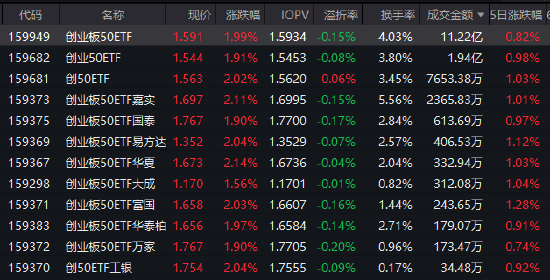
三大指数全线反弹!创业板50ETF(159949)成交11.22亿居同类首位,政策助力科技成长主线
Xin Lang Cai Jing· 2026-01-14 04:09
Market Performance - On January 14, the A-share market experienced a collective rebound, with the Shanghai Composite Index rising over 1%, the ChiNext Index increasing by over 2%, and the Sci-Tech 50 Index gaining over 4% [1][8] - The ChiNext 50 ETF (159949) rose by 1.99%, reaching a price of 1.591 yuan, with a turnover rate of 4.03% and a transaction volume of 1.122 billion yuan, leading among similar ETF products [1][8] Top Holdings Performance - As of the midday session, most of the top ten holdings of the ChiNext 50 ETF showed an upward trend, with notable performances including: - Dongfang Wealth up by 4.82% - Sunshine Power up by 4.16% - Tonghuashun up by 9.33% - Other stocks like Ningde Times and Zhongji Xuchuang saw slight declines of 0.22% and 1.04% respectively [2][10] Policy Developments - A meeting on January 13 highlighted the focus on enhancing the self-controllable capabilities of the supply chain in the energy-saving and new energy vehicle industry, aiming for high-quality development actions [4][12] - The Ministry of Industry and Information Technology released a plan for the high-quality development of industrial internet platforms from 2026 to 2028, targeting the establishment of over 450 influential platforms and connecting over 120 million industrial devices [4][12] Investment Insights - Multiple institutions are paying attention to the "AI + manufacturing" policies, which are expected to accelerate the development of the industrial AI sector, with recommendations to focus on AI applications, data labeling, and AI computing power [5][12] - The ChiNext 50 ETF has shown a return of 41.83% over the past three years, outperforming its benchmark and ranking 475th among 1630 products, making it an efficient investment tool for those optimistic about China's tech growth sector [7][13]


迪安诊断领涨,AI医疗持续火爆!全市场规模最大的医疗器械ETF(159883)近10日吸金超10亿!
Xin Lang Cai Jing· 2026-01-14 02:51
Group 1 - The brain-computer interface has significantly impacted the medical industry this year, with a medical device ETF attracting over 1 billion yuan in the last 10 days, indicating a surge in market interest [1] - Companies like Di'an Diagnostics and Yuyue Medical have seen stock increases of over 10% and 8% respectively, while the medical device ETF (159883) has risen over 3% [1] - Di'an Diagnostics highlighted that AI will drive rapid development in healthcare applications, particularly in primary care and health management, emphasizing the need for high-quality multimodal data [1] Group 2 - Multiple research institutions are optimistic about the medical device industry by 2026, with a focus on overseas market growth, high-value consumables procurement, and the profitability turning point for innovative devices [2] - The overseas market, especially in Europe and the US, is expected to be a major growth driver, with significant growth anticipated in high-value consumables such as orthopedics, electrophysiology, and surgical robots [2] - The application of AI in healthcare is accelerating, supported by national policies, with a clear trend towards commercialization and revenue growth in AI medical applications [2] Group 3 - The Hong Kong medical ETF (159366) is strategically positioned to benefit from AI in healthcare, with a high concentration of CROs and being the largest ETF in its category, offering good liquidity and T+0 support [3] - This ETF focuses on leading companies in the Hong Kong medical sector, allowing investors to share in the growth dividends of these enterprises [3]


研判2025!中国创新药械行业政策、产业链、获批上市数量、市场规模及市场支付结构分析:批准上市数量创历史新高,市场持续扩容,商业险赔付占比小[图]
Chan Ye Xin Xi Wang· 2026-01-14 01:20
Core Insights - The innovative pharmaceutical and medical device market is a crucial part of China's healthcare industry, experiencing rapid growth despite its late development compared to developed economies [1][6] - By 2025, the number of approved innovative drugs reached 69, and innovative medical devices reached 73, marking a historical high in approvals [1][7] - The market size for innovative drugs and devices is projected to grow from 162 billion yuan in 2025 to 440 billion yuan by 2035, driven by demographic changes, clinical needs, and favorable policies [1][7] Group 1: Market Overview - The innovative drug and device market in China is expected to see significant growth, with projections of 2,186 billion yuan in 2026 and 4,102 billion yuan by 2030 [1][7] - The number of innovative drugs approved for market entry in 2024 is 48, while 65 innovative medical devices are expected to be approved [1][6] - The market is characterized by a high number of new drug approvals, with China ranking second globally in the number of drugs under development [1][6] Group 2: Payment Structure - In 2024, personal cash expenditure on innovative drugs and devices is estimated at 786 billion yuan, accounting for 49% of total spending, while insurance funds contribute approximately 710 billion yuan (44%) [7] - By 2035, it is anticipated that personal cash expenditure will decrease to 20%, while insurance fund contributions will rise to 36% [7] Group 3: Industry Chain - The innovative drug and device industry chain includes upstream components such as raw materials and research services, midstream research and manufacturing, and downstream distribution and application [8][9] - The government has been enhancing the policy framework to support the entire chain from research to application, facilitating faster approvals and market entry [9] Group 4: Future Outlook - The innovative drug and device industry in China is poised for opportunities due to ongoing national strategic support, the integration of new technologies like AI, and improved payment environments [11] - Challenges include insufficient global clinical capabilities and geopolitical factors affecting international expansion [11]

趋势研判!2025年中国互联网医院行业发展历程、政策、医院数量、重点品牌及未来趋势:互联网医疗为互联网医院提供核心服务支撑,推动其数量达3756家[图]
Chan Ye Xin Xi Wang· 2026-01-14 01:13
Core Insights - The article discusses the emergence and growth of Internet hospitals in China, highlighting their role in providing convenient and efficient medical services, especially during the COVID-19 pandemic [1][14] - Internet hospitals are seen as a new model in the healthcare system, addressing issues like access to care and hospital transformation [1][14] Industry Overview - Internet hospitals are platforms that integrate online consultations, prescriptions, payments, and drug delivery, connecting patients with healthcare providers [4] - The services offered by Internet hospitals include remote diagnosis, post-hospital management, and health management [4] Industry Development History - The first Internet hospital in China was established in 2015, marking a significant milestone in the integration of healthcare and technology [9] - The COVID-19 pandemic accelerated the growth of Internet hospitals, with over 500 new hospitals established in 2020 alone [1][14] - By October 2022, there were over 2,700 Internet hospitals in China, serving more than 25.9 million patients [1][14] - Projections indicate that by the end of 2024, the number of Internet hospitals will reach 3,340, providing over 100 million consultations annually [1][14] Industry Policies - The Chinese government has increasingly recognized and supported Internet hospitals, leading to a period of policy benefits [11] - Recent policies aim to enhance the integration of artificial intelligence in healthcare, with a goal of widespread implementation by 2030 [11] Industry Value Chain - The upstream of the Internet hospital industry involves medical equipment and information technology, while the midstream consists of solution integrators [12] - The downstream primarily includes patients who utilize these services [12] User Scale and Usage Rate - As of December 2024, the user base for Internet healthcare in China reached 418 million, with a usage rate of 37.7% [13] - By June 2025, the user scale is expected to be 393 million, with a usage rate of 35% [13] Key Companies in the Industry - Notable companies in the Internet hospital sector include Ping An Good Doctor, JD Health, Alibaba Health, and WeDoctor, among others [2][15] - Ping An Good Doctor reported a revenue of 1.278 billion yuan in the first half of 2025, marking a year-on-year growth of 20.23% [15] - JD Health's revenue from health product sales reached 29.331 billion yuan in the first half of 2025, with a growth of 22.67% [17] Challenges Facing the Industry - Issues such as patient information sharing, cross-regional medical insurance reimbursement, and regulatory frameworks remain significant challenges for Internet hospitals [18][19][20] - The complexity of online diagnosis and potential medical risks also pose challenges that need to be addressed [21] Future Trends - The future of Internet hospitals is expected to focus on personalized health management driven by data and AI technologies [22] - Remote medical services will become standardized and integrated into the healthcare system, enhancing accessibility and efficiency [23] - A seamless integration of online and offline services will create a comprehensive healthcare ecosystem centered around patient needs [24]


美国政府批准向中国出口英伟达H200芯片;五部门出手规范网络招聘秩序丨盘前情报
2 1 Shi Ji Jing Ji Bao Dao· 2026-01-14 00:47
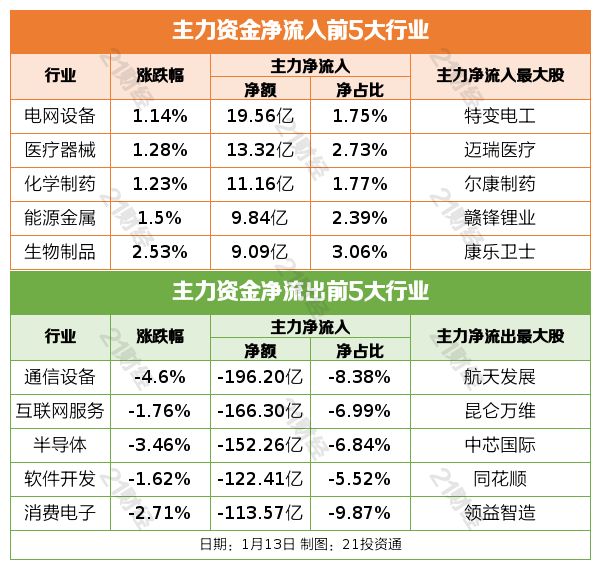
Market Overview - On January 13, major indices in China experienced collective adjustments, with the Shenzhen Component Index falling over 1% and the ChiNext Index dropping nearly 2%. The Shanghai Composite Index closed down 0.64%, the Shenzhen Component Index down 1.37%, and the ChiNext Index down 1.96%. The total trading volume in the Shanghai and Shenzhen markets reached 3.65 trillion yuan, an increase of 49.6 billion yuan compared to the previous trading day [1] - In the U.S. stock market, the three major indices also declined on January 13. The Dow Jones Industrial Average fell by 398.21 points to close at 49,191.99, a decrease of 0.80%. The S&P 500 Index dropped by 13.53 points to 6,963.74, down 0.19%, while the Nasdaq Composite Index decreased by 24.03 points to 23,709.87, a decline of 0.10% [1] Sector Performance - In the Chinese market, over 3,700 stocks declined, with the AI application concept sector rising against the trend, seeing over ten constituent stocks hitting the daily limit up. The AI medical concept remained active, while the power grid equipment sector strengthened in the afternoon. The retail sector also showed active performance. Conversely, the commercial aerospace and controllable nuclear fusion sectors experienced significant declines [1] - In the U.S., the performance of major indices reflected a general downward trend, indicating a cautious market sentiment [1] Commodity Prices - International oil prices rose on January 13. The price of light crude oil futures for February delivery on the New York Mercantile Exchange increased by $1.65 to $61.15 per barrel, a rise of 2.77%. The March delivery Brent crude oil futures price rose by $1.60 to $65.47 per barrel, an increase of 2.51% [2] Policy and Regulatory Updates - The Ministry of Commerce of China announced the continuation of anti-dumping duties on imported solar-grade polysilicon from the U.S. and South Korea, effective from January 14, 2026, for a period of five years [2] - The Ministry of Industry and Information Technology issued an action plan for the high-quality development of industrial internet platforms from 2026 to 2028, aiming for significant progress in platform development and resource connectivity by 2028 [3][4] Company-Specific Developments - The approval of NVIDIA to export its H200 AI chips to China is expected to restart shipments to Chinese customers. This decision will be overseen by the U.S. Department of Commerce, which will also impose a fee of approximately 25% on the related transactions [7]






JPM峰会上的中国医疗公司,现在都走了到哪一步?
GLP1减重宝典· 2026-01-13 14:15
Core Viewpoint - The article discusses the evolving landscape of the Chinese healthcare sector, particularly in the context of the upcoming JP Morgan Healthcare Conference, highlighting the diversification of Chinese companies and their strategic positioning in the global market [4][29]. Group 1: Conference Overview - The JP Morgan Healthcare Conference is the largest and most informative international healthcare investment and business development meeting, scheduled for January 12-15, 2026, in San Francisco [4]. - Approximately 22 Chinese companies are participating, categorized into four distinct roles: transaction-oriented innovative drug companies, disclosure companies at commercialization or regulatory milestones, supply-side platforms for global R&D and production outsourcing, and device companies focusing on efficiency and international expansion [4]. Group 2: Supply-Side Platforms - Supply-side platform companies are becoming essential in the global innovation chain, as they focus on delivering stable and efficient R&D and production capabilities, especially during periods of increased volatility in innovative drug companies [6][8]. - WuXi Biologics is shifting its focus from project quantity to project quality, emphasizing capacity utilization and long-term contract stability as key indicators of its value in the global biopharmaceutical supply chain [8]. Group 3: Cross-Border Licensing and Outbound Companies - The pricing logic for Chinese innovative drugs in cross-border licensing has evolved, with a focus on the overall deliverable capabilities rather than just the individual molecules [14]. - Companies like Kelun-Blotech and BaiLi Tianheng are exemplifying this trend by integrating their platforms into global R&D systems and establishing long-term collaborations with multinational pharmaceutical companies [16][18]. Group 4: Regulatory and Commercialization Companies - Companies that have accumulated clinical data and registration progress are transitioning towards verifiable sales and profit curves, shifting their valuation logic from future expectations to tangible cash flows [19]. - Zai Lab and Antengene are in the early commercialization stages, with their success hinging on their products' acceptance in clinical settings and the speed of prescription growth [21][23]. Group 5: Medical Device Companies - Mindray Medical is recognized for its comprehensive coverage of hospital workflows, with a focus on multi-product synergy rather than single-device performance, which is crucial for establishing long-term customer relationships [26]. - MicroPort Scientific is navigating a challenging environment where operational efficiency and cash flow management are critical for sustaining long-term clinical validation and international expansion [28]. Group 6: Industry Trends and Insights - The Chinese healthcare sector is transitioning from a phase of visibility to one of selection, where companies must clearly define their positions and deliverables in a high-intensity global exchange [29]. - The differentiation among Chinese companies in the global system is accelerating, with a clear divide between transaction-oriented innovative drug companies and those that have crossed critical regulatory milestones, focusing on verifiable growth [31].



国泰海通:25年设备更新政策如期落地 医疗设备全年招采规模同比快速增长 维持“增持”评级
智通财经网· 2026-01-13 13:29
Core Viewpoint - The medical equipment procurement scale is expected to grow rapidly year-on-year due to the implementation of the 2025 equipment renewal policy, with a significant increase in demand for high-end medical devices [1][2][3] Group 1: Equipment Procurement Trends - In December 2025, the procurement scale for new medical devices showed a decline in MR by 11.8%, CT by 7.3%, DR by 3.9%, and ultrasound by 1.3%, while endoscopes increased by 1.4% and surgical robots decreased by 23.9% [1][2] - Cumulatively for the year 2025, the procurement scale for MR increased by 31.4%, CT by 53.2%, DR by 53.2%, ultrasound by 42.3%, endoscopes by 16.3%, and surgical robots by 21.9% [2] Group 2: Company Performance - In December 2025, the performance of specific companies showed that Union Medical's MR declined by 17.4%, while its CT increased by 17.4%. Mindray's ultrasound grew by 13.8%, and KAILI's ultrasound decreased by 13.5%. KAILI's endoscope increased by 61.1%, and Aohua's endoscope grew by 9.4% [2] - For the entire year of 2025, Union Medical's MR grew by 15.6%, CT by 47.7%, Mindray's ultrasound by 56.3%, KAILI's ultrasound by 69.7%, KAILI's endoscope by 85.0%, and Aohua's endoscope by 24.4% [2] Group 3: Policy Impact - The 2024 policy aims to increase medical equipment investment by over 25% compared to 2023 by 2027, enhancing the configuration of high-end equipment to levels seen in middle-income countries [3] - The implementation of the equipment renewal policy is expected to significantly boost procurement levels across various medical institutions, leading to a recovery in the domestic market and a turning point for equipment companies [3]



国泰海通|医药:25年设备更新政策如期落地,医疗设备全年招采规模同比快速增长
国泰海通证券研究· 2026-01-13 13:20
Core Viewpoint - The medical equipment bidding scale continues to show good growth, driven by the implementation of equipment renewal policies, which is expected to stimulate long-term procurement levels in the medical equipment sector [1][4]. Group 1: Equipment Renewal Policy Impact - The equipment renewal policy is set to be implemented as planned in 2025, with a rapid year-on-year growth in the annual bidding scale for medical equipment. For instance, in December 2025, the bidding scale for MR decreased by 11.8%, while CT and DR saw declines of 7.3% and 3.9%, respectively. However, the overall annual cumulative growth for 2025 shows significant increases: MR grew by 31.4%, CT by 53.2%, DR by 53.2%, ultrasound by 42.3%, endoscopes by 16.3%, and surgical robots by 21.9% [3][4]. - The four ministries jointly issued a notice in 2024, aiming for a more than 25% increase in medical equipment investment by 2027 compared to 2023, enhancing high-end equipment configurations to levels seen in middle-income countries [4]. Group 2: Market Recovery and Company Performance - The domestic market is showing signs of effective recovery due to policy implementation, with medical equipment companies expected to experience a performance turnaround. For example, in the first three quarters of 2025, United Imaging's domestic revenue reached 6.866 billion yuan, reflecting a year-on-year growth of 23.7%, indicating a recovery and structural upgrade trend in the medical equipment industry [4]. - The demand for innovative diagnostic and treatment equipment, particularly in imaging and radiotherapy, is rapidly increasing as a result of the ongoing equipment renewal policies [4].

43.48亿元资金今日流入医药生物股
Zheng Quan Shi Bao Wang· 2026-01-13 10:06
Market Overview - The Shanghai Composite Index fell by 0.64% on January 13, with six industries experiencing gains, led by the oil and petrochemical sector (up 1.62%) and the pharmaceutical and biotechnology sector (up 1.21%) [1] - The defense and military industry and the electronics sector saw the largest declines, down 5.50% and 3.30% respectively [1] Capital Flow Analysis - The net outflow of capital from the two markets was 162.743 billion yuan, with only four industries seeing net inflows [1] - The pharmaceutical and biotechnology sector had the highest net inflow of capital at 4.348 billion yuan, followed by the oil and petrochemical sector with a net inflow of 586 million yuan [1] - The electronics industry experienced the largest net outflow, totaling 37.010 billion yuan, followed by the computer industry with a net outflow of 23.107 billion yuan [1] Pharmaceutical and Biotechnology Sector Performance - The pharmaceutical and biotechnology sector rose by 1.21%, with a total of 478 stocks in the sector, of which 329 stocks increased in value and 16 stocks hit the daily limit [2] - A total of 256 stocks in the sector saw net capital inflows, with 21 stocks receiving over 100 million yuan in net inflows; leading was Mindray Medical with a net inflow of 372 million yuan [2] - The stocks with the highest net outflows included Hainan Haiyao, Huahai Pharmaceutical, and Sanbo Brain Science, with net outflows of 204 million yuan, 164 million yuan, and 153 million yuan respectively [2] Top Gainers in Pharmaceutical Sector - Notable gainers included: - Mindray Medical: up 0.09% with a capital flow of 371.57 million yuan [3] - International Medical: up 9.96% with a capital flow of 290.33 million yuan [3] - Haiwang Biological: up 9.97% with a capital flow of 242.73 million yuan [3] - Boji Pharmaceutical: up 19.96% with a capital flow of 241.23 million yuan [3] - Erkang Pharmaceutical: up 19.95% with a capital flow of 237.43 million yuan [3] Top Losers in Pharmaceutical Sector - Notable losers included: - Hainan Haiyao: down 4.82% with a capital outflow of 203.78 million yuan [5] - Huahai Pharmaceutical: down 3.60% with a capital outflow of 163.67 million yuan [5] - Sanbo Brain Science: down 3.93% with a capital outflow of 153.22 million yuan [5] - Xiangrikui: down 5.49% with a capital outflow of 147.26 million yuan [5] - Luyan Pharmaceutical: down 3.74% with a capital outflow of 110.10 million yuan [5]


医药行业2026年度医疗器械策略报告出海篇:破局内卷,向全球价值链中高端迈进-20260113
NORTHEAST SECURITIES· 2026-01-13 09:14
Core Insights - The report emphasizes that the Chinese medical device industry is transitioning from rapid domestic growth to a more stable development phase, driven by increasing pressure from medical insurance funding and comprehensive payment reforms. As a result, "going global" has become a strategic necessity for advanced domestic manufacturers [2][3] - The report highlights that the Chinese medical device sector has developed the hard power necessary for global competition, with high-end equipment and high-value consumables rapidly establishing their presence in global supply chains. The increasing share of overseas revenue will become a core indicator of growth and valuation for medical device companies [2][3] Group 1: Market Growth and Strategic Shifts - The medical device market is expected to reach CNY 941.7 billion by 2024 and CNY 1,813.4 billion by 2035, with a CAGR of 6.14% from 2024 to 2035. The global market is projected to grow from USD 623 billion in 2024 to USD 1,157.6 billion by 2035, with a CAGR of 5.80% [17] - Domestic companies are accelerating their international expansion due to internal pressures, including the impact of centralized procurement policies that have significantly reduced prices in the domestic market [21][22] Group 2: International Expansion and Challenges - The report notes that many domestic high-value consumables are gaining FDA and CE certifications, indicating a growing international recognition of Chinese manufacturing capabilities. This trend is particularly evident in Southeast Asia and South America, where companies are gaining experience before tackling more stringent markets like the EU and the US [3][4] - The report discusses various patent disputes faced by Chinese companies during their international expansion, highlighting the challenges of overcoming established international competitors' patent barriers. This includes cases involving major companies like Mindray and Times Angel [27][28] Group 3: Product Categories and Market Dynamics - High-end medical devices, such as imaging equipment and surgical robots, are leading the charge in international markets, with companies like United Imaging and Mindray making significant strides in Europe and the US [3][4] - The report indicates that the demand for high-value consumables is increasing, with companies focusing on innovation and clinical effectiveness to enhance their competitive edge in global markets [4][5] Group 4: Supply Chain and Localization Strategies - The establishment of global marketing networks and supply chain systems is essential for the international success of medical device companies. This includes setting up local subsidiaries, warehouses, and production bases in key markets [3][4] - The report emphasizes the importance of academic promotion and clinical trials in gaining market acceptance, particularly in high-end markets where local healthcare systems may require extensive clinical data for reimbursement [32][33]