保利发展

Search documents
房企座次再洗牌,万科下滑中旅投资成“黑马”
第一财经· 2026-02-01 05:21
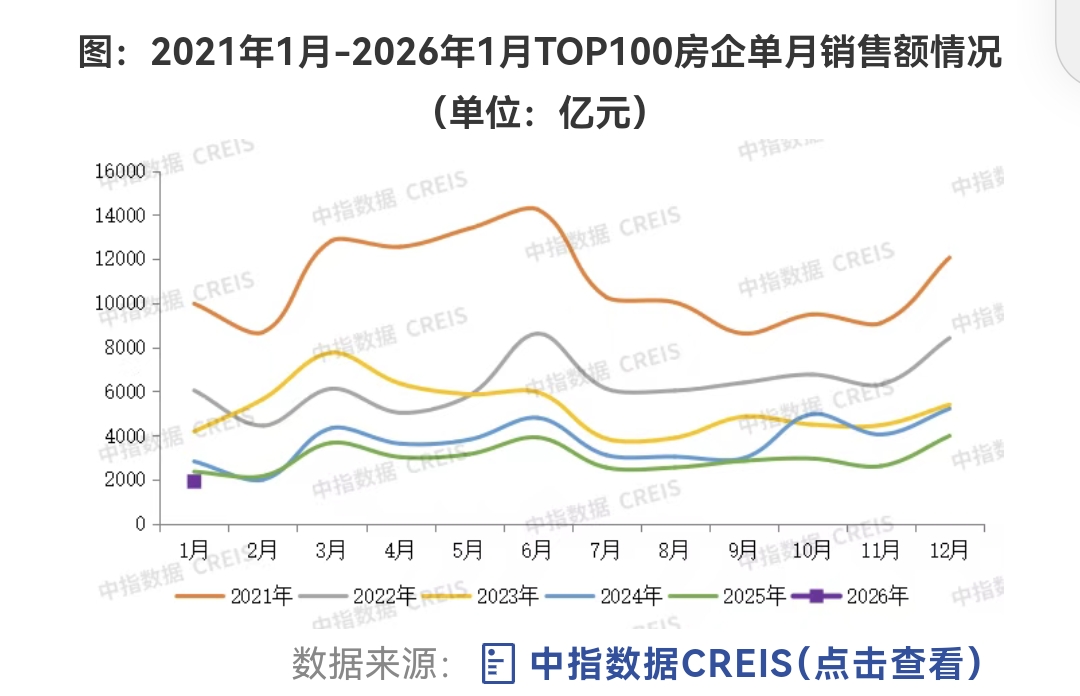
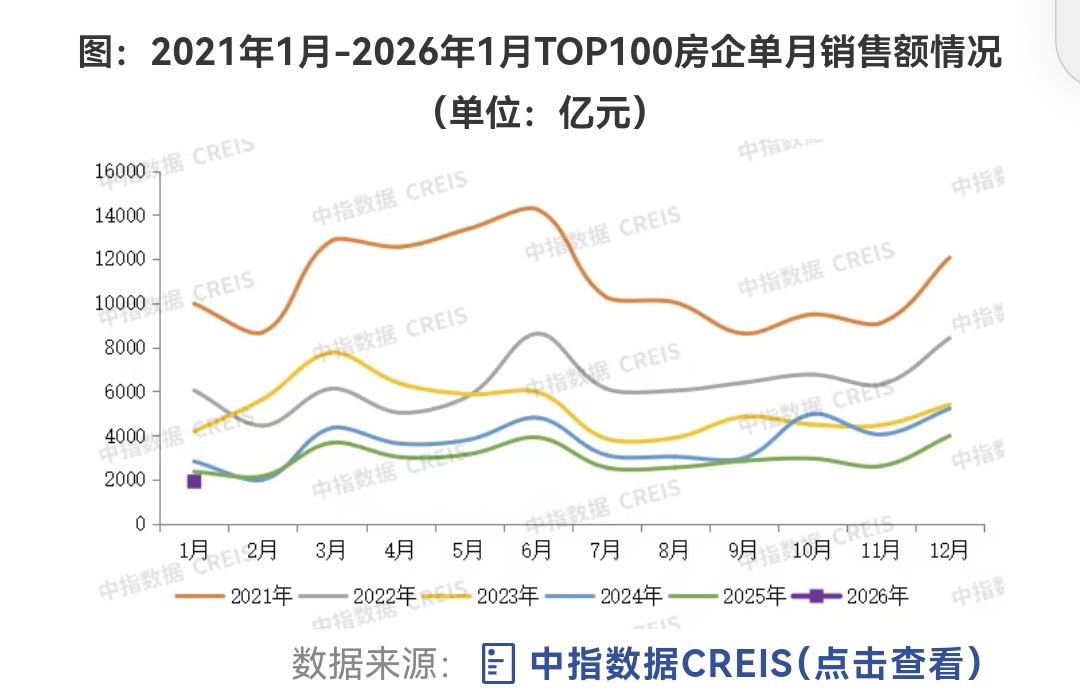
Core Insights - In January 2026, the total sales of the top 100 real estate companies amounted to 190.52 billion yuan, a year-on-year decrease of 18.9% [3] - The equity sales for the same group reached 132.14 billion yuan [3] - The top ten companies by sales include Poly Development, China Overseas, China Resources, Greentown China, China Travel Investment, China Merchants Shekou, China Jinmao, Jianfa Real Estate, Vanke, and Binjiang Group, with only Poly, China Overseas, and China Resources exceeding 10 billion yuan in sales for the month [3] Sales Performance - The average sales for the top 10 companies was 9.33 billion yuan, down 11.6% year-on-year, while the average for companies ranked 11-30 was 2.6 billion yuan, also showing a decline [4] - The ranking of companies has shifted significantly compared to the previous year, with Vanke dropping from 5th to 9th place, while China Travel Investment emerged as a "dark horse" in 5th place [3][4] Market Trends - The decline in sales is attributed to the high base from January of the previous year when the market was more active following the September 2024 policy changes [6] - The industry is undergoing an adjustment phase, with a decrease in the number of companies achieving over 10 billion yuan in sales, while those achieving over 5 billion yuan have increased, indicating a shift from "scale competition" to "quality competition" [6] - In January 2026, 32 companies among the top 100 saw year-on-year sales growth, with 10 companies experiencing growth exceeding 100% [6] Real Estate Market Dynamics - The new housing market showed weak performance in January, with approximately 8.1 million square meters of new residential sales in 50 key cities, while the second-hand housing market saw a notable increase, with transaction volumes rising by 33% year-on-year [7][8] - The second-hand market's recovery is contributing to stabilizing market expectations, with some cities experiencing a reduction in listing volumes [8] Policy and Future Outlook - The central government has been signaling a focus on stabilizing market expectations, with recent policy measures including interest rate cuts and adjustments to down payment ratios for commercial properties [9] - The upcoming Spring Festival may lead to increased marketing efforts from real estate companies, and the introduction of quality projects could maintain a certain level of market activity in core cities [9] - As of the end of 2025, 21 distressed real estate companies have made progress in debt restructuring, but the challenge remains in converting financial relief into sustainable operational capacity [9]







百强房企1月卖房“成绩单”出炉!
Shen Zhen Shang Bao· 2026-02-01 03:22
Core Viewpoint - The sales performance of the top 100 real estate companies in January shows a total sales amount of 190.5 billion yuan, reflecting an 18.9% year-on-year decline, consistent with the overall decline observed in the previous year [1] Group 1: Sales Performance - In January, the top three companies by sales were Poly Developments, China Overseas Land & Investment, and China Resources Land, each exceeding 10 billion yuan in sales [1] - The equity sales amount for the top 100 companies was 132.14 billion yuan, with an equity sales area of 6.548 million square meters [1] - The average sales amount for the top 10 companies was 9.33 billion yuan, down 11.6% year-on-year; for companies ranked 11-30, the average was 2.6 billion yuan, down 25.6%; for 31-50, it was 1.03 billion yuan, down 21.0%; and for 51-100, it was 490 million yuan, down 26.7% [1] Group 2: Market Trends - The number of companies achieving over 10 billion yuan in sales decreased by 2 compared to the previous year, while the number of companies achieving over 5 billion yuan increased by 2, indicating a shift towards healthier and more sustainable development in the industry [2] - The focus of competition is shifting from "scale racing" to "quality racing," which is expected to concentrate resources on outstanding companies, thereby reducing systemic risks and enhancing the industry's resilience [2] - Various cities have released "14th Five-Year" planning suggestions, emphasizing the need for a new development model in real estate, increasing the supply of affordable housing, and improving safety management systems for housing [2] Group 3: Policy Environment - The central government has repeatedly signaled the importance of "stabilizing expectations" for the real estate market, emphasizing the need for effective expectation management [2] - The People's Bank of China has lowered the interest rates on structural monetary policy tools, while several provinces have reduced the down payment ratio for commercial property loans to 30% [2] - Local governments, such as Sichuan and Zhejiang, have issued approximately 10.5 billion yuan in special bonds to recover and acquire idle land [2] Group 4: Market Outlook - As the Spring Festival approaches, real estate companies are expected to increase marketing efforts, and the core city real estate market is likely to maintain a certain level of activity due to the introduction of quality projects [3] - However, market expectations remain weak, necessitating coordinated policy efforts from both the demand and supply sides to effectively reverse market sentiment [3]

房企座次再洗牌,万科下滑、中旅投资成“黑马”
Di Yi Cai Jing· 2026-01-31 15:00
Core Insights - In January 2026, the top 100 real estate companies in China reported a total sales revenue of 190.52 billion yuan, a year-on-year decrease of 18.9% [1] - The equity sales amount for the same group was 132.14 billion yuan [1] - The top ten companies by sales included Poly Developments, China Overseas Land, and China Resources Land, with only Poly, China Overseas, and China Resources exceeding 10 billion yuan in sales for the month [1] Sales Performance - The average sales revenue for the top 10 companies was 9.33 billion yuan, down 11.6% year-on-year [2] - Companies ranked 11-30 had an average sales revenue of 2.6 billion yuan, a decline of 25.6% [2] - Companies ranked 31-50 reported an average sales revenue of 1.03 billion yuan, down 21.0% [2] Market Dynamics - The decline in sales is attributed to the high base from January of the previous year when the market was more active due to policy changes [5] - The real estate industry is undergoing an adjustment, with a shift from "scale competition" to "quality competition," leading to resource concentration among stronger companies [5] - In January 2026, 32 companies among the top 100 reported year-on-year sales growth, with 10 companies experiencing growth exceeding 100% [5] Market Trends - The new housing market showed weak performance in January, while the second-hand housing market demonstrated notable growth, with transaction volumes increasing by 33% year-on-year [6] - The central government has been signaling stability in market expectations, emphasizing the importance of managing expectations to stabilize the real estate market [6] - Recent policy measures include lowering the down payment ratio for commercial property loans and adjusting monetary policy tools [6] Future Outlook - As the Chinese New Year approaches, real estate companies are expected to increase marketing efforts, which may sustain some activity in core city markets [7] - There are ongoing challenges for companies to convert financial restructuring into sustainable operational capabilities [7]

房企座次再洗牌,万科下滑中旅投资成“黑马”
Di Yi Cai Jing· 2026-01-31 14:52
百强房企1月卖房"成绩单"出炉。 2026年开年,百强房企1月卖房"成绩单"出炉。 1月31日,中指研究院发布数据显示,2026年1月,TOP100房企销售总额为1905.2亿元,同比下降18.9%;同期,TOP100房企权益销售额为1321.4亿元。 房企销售金额前十依次为:保利发展、中海地产、华润置地、绿城中国、中旅投资、招商蛇口、中国金茂、建发房产、万科、滨江集团,其中仅保利、中 海、华润单月销售过百亿。 对比上年同期,房企销售位次已经发生了较大变化。头部房企中,保利、中海、华润、绿城的顺序未变,但万科从上年1月的第5位,下滑至今年1月的第9 位。中旅投资短期内成为"黑马",闯到今年1月房企全口径销售榜第5位。 TOP10随后的房企中,招商蛇口、建发房产、滨江集团变化不大、依然位列其中,但是华发股份从去年1月的第6位降至今年1月的第18位,同期中国铁建 从第10位降至第13位,中国金茂则从去年1月的第13位升至今年1月的第7位。 克而瑞数据显示,1月全国重点50城市新建商品住宅成交面积约810万平方米,表现较为清淡,新房市场整体进入淡季;同期,重点13城市二手房成交面积 约810万平方米,环比上升16% ...
信用利差周度跟踪 20260130:利率震荡信用利差略有回落二永债表现偏弱-20260131
Huafu Securities· 2026-01-31 14:48
1. Report Industry Investment Rating No information provided in the content. 2. Core Viewpoints of the Report - Interest rates are fluctuating narrowly, credit bond yields have slightly declined, and most credit spreads are still narrowing. [3][9] - Most urban investment bond spreads have decreased by 1 - 2BP. [14] - Real - estate bond spreads are still widening, while most other industrial bond spreads are converging. [25] - This week, Tier 2 and perpetual bonds (Two - and - Perpetual bonds, "Two - and - Perpetual" bonds refer to bank Tier 2 capital bonds and perpetual bonds) have shown weak performance. Except for the 5Y variety, most yields have increased. [4][33] - The excess spread of 3Y industrial perpetual bonds has narrowed, while the excess spread of urban investment bonds has shown differentiation. [4][36] 3. Summary According to Relevant Catalogs 3.1 Interest rates are fluctuating narrowly, credit bond yields have slightly declined, and most credit spreads are still narrowing - Interest - rate bond yields fluctuated narrowly. The yields of 1Y and 10Y China Development Bank bonds increased by 1BP, the yield of 3Y decreased by 1BP, and the yields of 5Y and 7Y remained flat. [3][9] - Credit bond yields generally declined slightly. The yields of 1Y AA + and above - grade credit bonds increased by 1BP, while the other grades remained flat; the yield of 3Y AAA remained flat, and the other grades decreased by 2 - 4BP; the yields of 5Y AA + and above - grade remained flat, and the other grades increased by 1BP; the yields of 7Y all grades decreased by 1 - 3BP; the yields of 10Y all grades increased by 1BP. [3][9] - Most credit spreads slightly converged. The credit spreads of 1Y AA + and above - grade remained flat, and the other grades narrowed by 1BP; the spread of 3Y AAA increased by 1BP, the spread of AA - decreased by 1BP, and the other grades compressed by 3BP; the spreads of 5Y AA + and above - grade remained flat, and the other grades widened by 1BP; the spreads of 7Y all grades narrowed by 1 - 3BP; the spreads of 10Y all grades narrowed by 1BP. [3][9] 3.2 Most urban investment bond spreads have decreased by 1 - 2BP - In terms of external ratings, the credit spreads of external - rated AAA platforms generally decreased by 1BP compared with last week, and the credit spreads of AA + and AA platforms generally decreased by 2BP. [14] - By administrative level, the credit spreads of provincial - level platforms generally decreased by 1BP compared with last week, and the credit spreads of prefecture - level and district - county - level platforms generally decreased by 2BP. [19] 3.3 Real - estate bond spreads are still widening, while most other industrial bond spreads are converging - Most industrial bond spreads converged. The spread of Vanke continued to compress significantly, but the spreads of central and state - owned enterprise real - estate bonds and other private - enterprise real - estate bonds still widened overall. [25] - The spreads of central and state - owned enterprise real - estate bonds widened by 1 - 3BP, the spread of mixed - ownership real - estate bonds converged by 188BP, and the spread of private - enterprise real - estate bonds increased by 15BP. [25] - The spread of Longfor decreased by 2BP, that of CIFI increased by 49BP, that of Vanke decreased by 1802BP, that of Midea Real Estate decreased by 1BP, that of Huafa increased by 13BP, and that of Poly increased by 3BP. [25] - The spread of AA - grade coal bonds increased by 1BP, and the other grades decreased by 1BP; the spread of AAA - grade steel bonds remained flat, and that of AA + decreased by 2BP; the spread of AAA - grade chemical bonds remained flat, and that of AA + decreased by 1BP. [25] 3.4 This week, Tier 2 and perpetual bonds have shown weak performance. Except for the 5Y variety, most yields have increased - The yields of 1Y all - grade Tier 2 capital bonds remained flat, and the spreads decreased by 0 - 1BP; the yields of all - grade perpetual bonds increased by 1 - 2BP, and the spreads increased by 0 - 1BP. [33] - The yields of 3Y all - grade Tier 2 capital bonds increased by 2 - 3BP, and the spreads widened by 3 - 4BP; the yields of all - grade perpetual bonds remained flat, and the spreads widened by 1BP. [33] - The yields of 5Y all - grade Tier 2 capital bonds decreased by 0 - 2BP, the yields of perpetual bonds remained flat, and the spreads changed by the same margin. [33] - The yields of 10Y all - grade Tier 2 capital bonds increased by 2 - 5BP, and the spreads widened by 1 - 3BP; the yields of perpetual bonds increased by 5BP, and the spreads increased by 3BP. [33] 3.5 The excess spread of 3Y industrial perpetual bonds has narrowed, while the excess spread of urban investment bonds has shown differentiation - The excess spread of industrial AAA - grade 3Y perpetual bonds converged by 0.76BP compared with last week to 13.91BP, at the 36.17% percentile since 2015. The excess spread of industrial 5Y perpetual bonds remained the same as last week at 13.21BP, at the 33.60% percentile since 2015. [36] - The excess spread of urban - investment AAA - grade 3Y perpetual bonds increased by 0.83BP to 4.86BP, at the 5.43% percentile. The excess spread of urban - investment 5Y perpetual bonds decreased by 3.72BP to 9.62BP, at the 11.15% percentile. [36] 3.6 Credit Spread Database Compilation Instructions - The overall market credit spreads, commercial bank Tier 2 and perpetual spreads, and urban - investment/industrial perpetual bond credit spreads are calculated based on ChinaBond Medium - and Short - Term Notes and ChinaBond Perpetual Bonds data. The historical percentiles are since the beginning of 2015. [38] - The credit spreads related to urban - investment and industrial bonds are compiled and statistically analyzed by the Huafu Securities Research Institute, and the historical percentiles are since the beginning of 2015. [38] - The credit spreads of industrial and urban - investment individual bonds = the ChinaBond valuation (exercise) of individual bonds - the yield to maturity of the same - term China Development Bank bonds (calculated by the linear interpolation method), and finally the arithmetic average method is used to calculate the credit spreads of the industry or regional urban - investment bonds. [40] - The excess spread of bank Tier 2 capital bonds/perpetual bonds = the credit spread of bank Tier 2 capital bonds/perpetual bonds - the credit spread of bank ordinary bonds of the same grade and term. The excess spread of industrial/urban - investment perpetual bonds = the credit spread of industrial/urban - investment perpetual bonds - the credit spread of medium - term notes of the same grade and term. [40] - Sample screening criteria and other information: Both industrial and urban - investment bonds select medium - term notes and public - offering corporate bond samples, and exclude guaranteed bonds and perpetual bonds. If the remaining term of an individual bond is less than 0.5 years or more than 5 years, it will be excluded from the statistical samples. Industrial and urban - investment bonds are all external entity ratings, while commercial banks use ChinaBond implicit debt ratings. [40]
首批商业不动产REITs上报点评:首批商业不动产REITs上报,优质商业地产迎来价值重估
Shenwan Hongyuan Securities· 2026-01-31 14:35
Investment Rating - The report maintains an "Overweight" rating for the real estate and property management sectors, indicating a positive outlook for quality commercial real estate and potential value reassessment [4][6]. Core Insights - The first batch of three commercial real estate REITs has been accepted by the CSRC, covering underlying assets such as office buildings, hotels, and outlet malls. The expected fundraising sizes are CNY 4.002 billion for Huatai Fu Shanghai Real Estate REIT, CNY 7.47 billion for CICC Vipshop REIT, and CNY 1.703 billion for Huaan Jinjiang REIT, with projected cash distribution rates of 4.50%, 4.57%, and 5.05% respectively for 2026 [2][4][5]. - The rapid advancement of commercial real estate REITs by the CSRC is expected to lead to a broader range of participants and faster approvals in the future. This contrasts with the slower progress seen in infrastructure REITs under the NDRC [4][5]. - The establishment of a multi-tiered market for commercial real estate asset securitization is anticipated to activate existing assets, mitigate risks, and assist in corporate transformation. This will provide new financing channels and enhance the visibility of asset values [4][5]. - The report highlights two significant opportunities: the reassessment of quality commercial real estate values and the strength of premium products in core cities, suggesting that further supportive policies for the real estate market are likely to emerge [4][6]. Summary by Sections REITs Overview - The first three commercial real estate REITs cover assets including office buildings and hotels, with expected fundraising sizes of CNY 40.02 billion, CNY 74.7 billion, and CNY 17.03 billion, and cash distribution rates projected at 4.50%, 4.57%, and 5.05% for 2026 respectively [4][5]. Differences Between REITs - The report outlines key differences between NDRC and CSRC REITs, including the asset ownership structure, approval processes, and types of underlying assets, indicating a shift towards including private enterprises in the CSRC REITs [4][5]. Investment Recommendations - The report recommends several companies for investment, including New Town Holdings, China Resources Land, Kerry Properties, Longfor Group, and others in the commercial real estate sector, as well as quality property management firms [4][6].




沈阳昔日顶流板块“杀”回来!时隔6年将再拍2宗压箱底热地,教育配套拉满成最大王牌!
Sou Hu Cai Jing· 2026-01-31 13:53
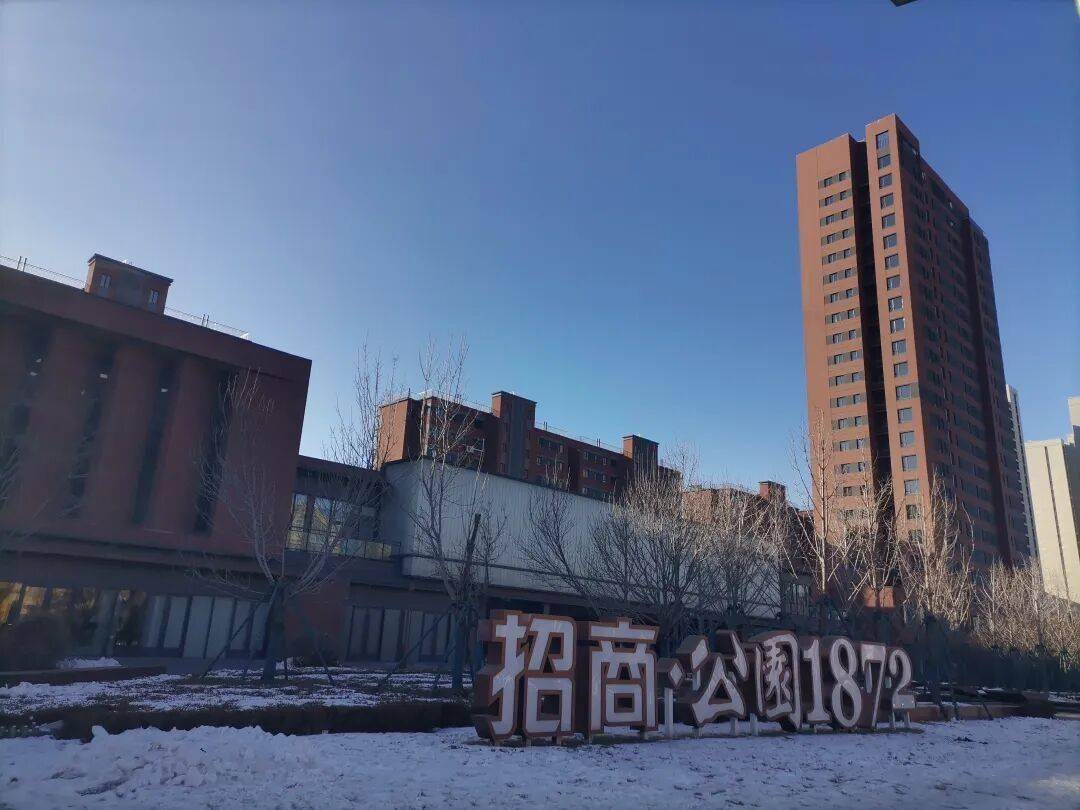
北皇姑四台子,曾经是沈阳"炙手可热"的楼市板块,万科、华润置地、保利发展、龙湖、招商蛇口等品牌房企纷纷屯兵于此。但随着在售楼盘的陆续售 罄,板块随之沉寂。 板块上一次供地,还要追溯到2020年。招商蛇口以5600元/建筑平方米的价格,以及配建27000平租赁用房的附加条件竞得北四台子村二期-2地块,打造招 商公园1872项目。 重磅消息传来,2026政府工作报告显示,皇姑区加快怒江北街西-1、澜沧江街西等总面积27.55万平方米的5宗土地整理和出让工作,四台子板块又 要"杀"回来了! 地上建筑拆除?怒江北街西-1地块终于要拍了 据了解,怒江北街西-1地块并非新面孔。 2023年2月24日,皇姑区举行核心板块项目推介签约大会暨城市更新合伙人启动仪式,怒江北街西-1地块就曾亮相。 地块整体呈"长方形",较"方正",目前已为"净地"。地块整体体量不大,猜测土地面积20000平方米左右。 另外,值得一提的是,地块位于皇姑与于洪区交界处。2025年10月21日,富禹地产以楼面价2250元/建筑平方竞得于洪区17.9万平正良四路1-1地块。 随着该地块的建设以及怒江北街西-1地块的出让,未来区域整体面貌将大幅提升,皇姑、 ...
A股52家上市房企:5家预亏超百亿,12家预计盈利!
Sou Hu Cai Jing· 2026-01-31 13:15
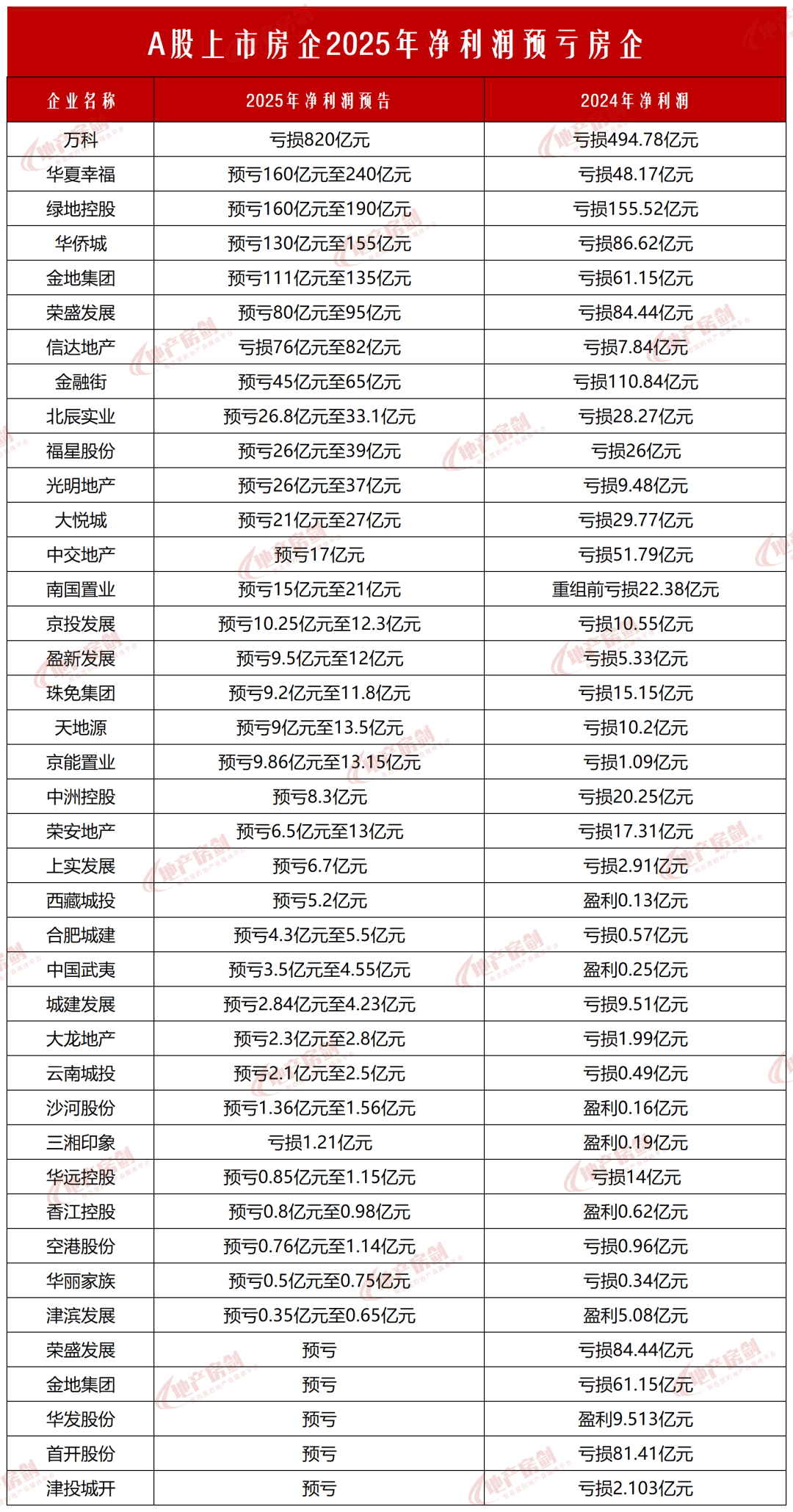
Core Viewpoint - The majority of A-share listed real estate companies are expected to report significant losses for the year 2025, indicating a challenging market environment for the industry [1][2]. Group 1: Loss Predictions - Out of 52 listed real estate companies, 40 are expected to report losses for 2025, which means over 80% of these companies are projected to be in the red [1]. - Five companies are expected to report losses exceeding 10 billion yuan, with Vanke leading at a projected loss of 820 billion yuan, followed by China Fortune Land Development, Greenland Holdings, Overseas Chinese Town, and Gemdale [2][3]. - Vanke's cumulative losses for 2024 and 2025 are projected to be nearly 1,315 billion yuan, surpassing the total profits from 2019 to 2023 [3]. Group 2: Reasons for Losses - The losses are attributed to declining property prices and significant impairment provisions that companies have had to make over the past two years [9][10]. - Many companies had previously anticipated a market recovery and began to recognize inventory impairments, but the continued market downturn has forced them to increase these provisions [10]. Group 3: Companies Reporting Profits - Twelve companies are expected to report profits, with Jinke Real Estate projected to achieve a net profit of 300 billion to 350 billion yuan, primarily due to successful restructuring [12][13]. - Poly Developments and China Merchants Shekou are also expected to report profits, albeit with significant declines compared to 2024, primarily due to impairment provisions [16][17]. Group 4: Market Dynamics - The list of loss-making companies includes a mix of private, state-owned, and central enterprises, indicating that the nature of the company does not correlate with the likelihood of losses [7]. - State-owned platform companies, which previously supported land acquisitions, are now facing increased pressure due to the ongoing market decline [8]. Group 5: Future Outlook - The upcoming annual report season in March and April 2025 will provide more detailed insights into the operational conditions of these companies [25].


公募 REITs 周度跟踪(2026.01.26-2026.01.30):首批 8 单商业不动产 REITs 正式申报!-20260131
Shenwan Hongyuan Securities· 2026-01-31 12:57
Report Industry Investment Rating No relevant content provided. Core View - 1月29 - 30日上交所申报8单商业不动产REITs,拟募资314.8亿元,截至1月30日,2025年以来已成功发行20单,发行规模403亿元,本周10单首发公募REITs有新进展,中核清洁能源REIT将于2月2日上市 [4]。 - 本周中证REITs全收益指数收于1052.42点,涨幅0.47%,年初至今涨幅4.22%,产权类REITs涨0.27%,特许经营权类REITs涨0.69%,能源、环保水务等板块表现占优 [4]。 - 流动性方面,产权类/特许经营权类REITs本周日均换手率0.58%/0.44%,较上周-14.01/-2.61BP,周内成交量6.14/1.46亿份,周环比-17.82%/-5.64% [4]。 - 估值方面,产权类/特许经营权类REITs中债估值收益率分别为3.69%/4.78%,交通、仓储物流、园区板块位列前三 [4]。 Summary by Directory 1. Primary Market - 本周共10单首发公募REITs取得新进展,8单商业不动产REITs申报至证监会并获受理,中航北京昌保租赁住房REIT、中金火炬产业园REIT已问询 [4][14]。 - 截至2026/1/30,2025年以来已成功发行20单,发行规模403亿元 [4]。 2. Secondary Market 2.1 Market Review - 本周中证REITs全收益指数涨幅0.47%,跑赢沪深300 0.39个百分点、跑输中证红利1.11个百分点,年初至今涨幅4.22%,跑赢沪深300 2.57个百分点、跑赢中证红利0.65个百分点 [4]。 - 分项目属性,本周产权类REITs上涨0.27%,特许经营权类REITs上涨0.69%;分资产类型,能源(+1.43%)、环保水务(+0.87%)、交通(+0.45%)、园区(+0.39%)板块表现占优 [4]。 2.2 Liquidity - 产权类/特许经营权类REITs本周日均换手率0.58%/0.44%,较上周-14.01/-2.61BP,周内成交量6.14/1.46亿份,周环比-17.82%/-5.64%,数据中心板块活跃度最高 [4][23]。 2.3 Valuation - 中债估值收益率方面,产权类/特许经营权类REITs分别为3.69%/4.78%,交通(5.92%)、仓储物流(5.29%)、园区(4.39%)板块位列前三,保障房板块估值较高 [4][27]。 3. This Week's News and Important Announcements 3.1 This Week's News - 1月24日,南京提出把握基础设施REITs扩围机遇,做好多领域项目储备申报 [31]。 - 1月27日,保利发展宣布申报商业不动产REITs [31]。 - 1月29日,北京举办商业不动产REITs政策解读培训会,首批商业不动产REITs申报至证监会,茂业商业调整底层资产 [31]。 - 1月30日,石锦瑞股权投资基金拟申报商业不动产公募REITs,5只商业不动产REITs申报至上交所 [31]。 3.2 Important Announcements - 华夏中核清洁能源REIT将于2月2日上市 [32]。 - 华夏越秀高速REIT公布2025年12月运营数据 [32]。 - 华夏南京交通高速公路REIT拟变更资金用途 [32]。 - 华安外高桥REIT拟申请扩募并新购入仓储项目 [32]。
首批商业不动产 REITs 申报:商业不动产 REITs,资产出表再添工具
GUOTAI HAITONG SECURITIES· 2026-01-31 12:53
Investment Rating - The report assigns an "Overweight" rating for the commercial real estate REITs sector [6]. Core Insights - The launch of commercial real estate REITs in China is expected to significantly improve corporate cash flow and performance, optimizing financial statements and guiding the industry towards a new model of development [2][6]. - The first batch of commercial real estate REITs has entered the application stage, accelerating the development process [6]. - The report highlights several recommended companies across different categories, including development, residential-commercial, property management, and cultural tourism [6]. Summary by Relevant Sections Investment Highlights - The first batch of commercial real estate REITs covers diverse asset types such as hotels, offices, and commercial complexes, enhancing the range of underlying assets [2]. - Specific REITs mentioned include: 1. Huazhong Jinjiang Closed-end Commercial Real Estate Securities Investment Fund, with a projected fundraising scale of 1.703 billion yuan and an annualized cash distribution rate forecast of 3.44% for 2025 [6]. 2. Huitianfu Shanghai Real Estate Closed-end Commercial Real Estate Securities Investment Fund, with a projected fundraising scale of 4.002 billion yuan and an annualized cash distribution rate forecast of 4.50% for 2026 [6]. 3. CICC Vipshop Closed-end Commercial Real Estate Securities Investment Fund, with a projected fundraising scale of 7.47 billion yuan and an annualized cash distribution rate forecast of 4.57% for 2026 [6]. Company Profitability Forecast - The report provides profitability forecasts for key companies, indicating expected earnings per share (EPS) and price-to-earnings (PE) ratios for 2024 to 2026, with all listed companies receiving an "Overweight" rating [8]. - Notable companies include: - Vanke A, with a projected EPS of -4.17 yuan for 2024 and a market cap of 54.22 [8]. - China Overseas Development, with a projected EPS of 1.43 yuan for 2024 and a market cap of 8.93 [8]. - Longfor Group, with a projected EPS of 1.58 yuan for 2024 and a market cap of 5.93 [8].