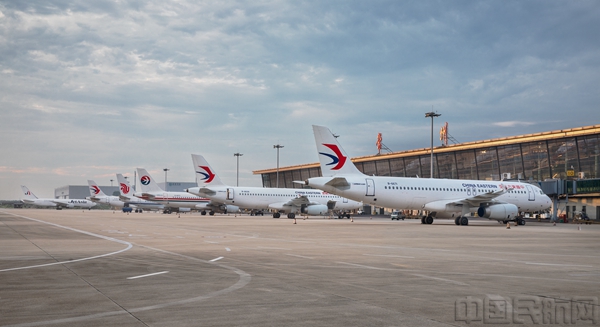
中国东航

Search documents
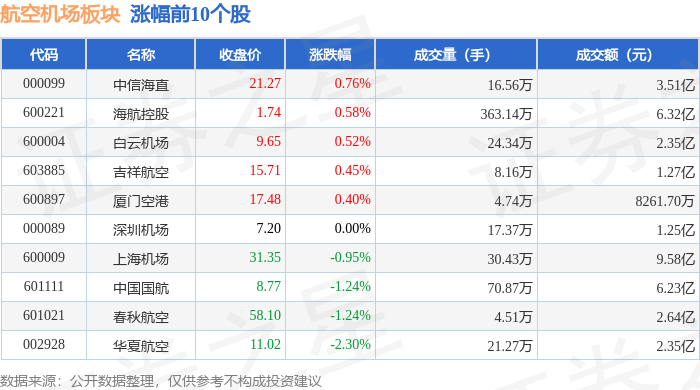
航空机场板块1月23日跌1.3%,中国东航领跌,主力资金净流出2.55亿元
Zheng Xing Xing Ye Ri Bao· 2026-01-23 09:04
Group 1 - The aviation and airport sector experienced a decline of 1.3% on January 23, with China Eastern Airlines leading the drop [1] - The Shanghai Composite Index closed at 4136.16, up 0.33%, while the Shenzhen Component Index closed at 14439.66, up 0.79% [1] - Major stocks in the aviation sector showed mixed performance, with China Eastern Airlines closing at 5.88, down 3.13%, and other companies like Xiamen Airport and Shenzhen Airport showing slight gains [3][1] Group 2 - The net outflow of main funds in the aviation and airport sector was 255 million yuan, while retail funds saw a net inflow of 42.27 million yuan [3][4] - The detailed fund flow indicated that Shenzhen Airport had a net inflow of 28.21 million yuan from main funds, while China Eastern Airlines had a significant net outflow of 17.01 million yuan [4] - The overall trend in fund flow suggests a cautious sentiment among institutional investors, contrasting with retail investors' activity [4] Group 3 - The Aerospace ETF (product code: 159227) tracked the aerospace industry index and saw a decline of 4.93% over the past five days, with a net redemption of 85.37 million yuan [6] - The General Aviation ETF (product code: 159230) also faced a decline of 5.89%, but experienced a net inflow of 24.84 million yuan [7] - The tourism ETF (product code: 562510) showed a positive trend with a 2.08% increase, indicating a potential area of interest within the broader market [7]


国泰海通晨报-20260123
GUOTAI HAITONG SECURITIES· 2026-01-23 05:55
Group 1: Aviation Industry - The core viewpoint of the aviation industry report indicates that the demand for air travel in China remains strong, particularly during the Spring Festival travel season, with pre-sales already initiated for 2026 [3][5] - It is estimated that the passenger flow in China's civil aviation will grow by 5-6% year-on-year in 2025, with a cumulative increase of 17% compared to 2019 [3] - The report highlights that the airline industry is entering a low growth era, with structural changes in demand being a key issue, as the proportion of business travel remains below 2019 levels [3][4] Group 2: Netflix (NFLX.O) - The report on Netflix projects that the company's revenue for FY26-28 will be $51.1 billion, $57.6 billion, and $64.6 billion respectively, reflecting year-on-year growth of 13.2%, 12.7%, and 12.0% [7] - Netflix's content amortization cost guidance for 2026 indicates a 10% increase year-on-year, with a focus on enhancing advertising revenue and content quality [9] - The company is expected to maintain a net profit margin of 20.1% in Q4 2025, with a significant increase in advertising revenue projected for 2026 [8][9] Group 3: BAIC Blue Valley (北汽蓝谷) - The report provides a first coverage of BAIC Blue Valley, giving it an "Accumulate" rating with a target price of 11.49 yuan, driven by dual-brand synergy and a diversified product matrix [11][26] - The company is expected to achieve revenues of 29 billion, 58.2 billion, and 88.9 billion yuan for 2025, 2026, and 2027 respectively, with a projected net profit turning positive by 2027 [11][26] - BAIC Blue Valley's dual-brand strategy, focusing on the premium and luxury segments, is anticipated to drive revenue growth, with significant sales increases expected for its models [12][27]
加配大盘与红利——主动权益类公募基金年报持仓透视
Huafu Securities· 2026-01-22 09:48
Core Insights - The report highlights that as of January 22, 2025, the disclosure rate of active equity public funds is 95.6%, with a notable increase in A-share holdings and a decrease in Hong Kong stock holdings [2][11] - The report indicates a strategic shift towards large-cap and dividend stocks while reducing exposure to small-cap stocks [2][11] - There is a clear preference for cyclical and consumer sectors, with increased allocations to these areas and a reduction in growth stocks [2][11] - In terms of industry allocation, there is an increase in exposure to non-ferrous metals, telecommunications, and machinery, while reducing allocations to defense, media, and electronics [2][11] Fund Position Changes - As of Q4 2025, the stock position of active equity public funds stands at 86.45%, reflecting a decrease of 0.97 percentage points from the previous quarter. A-share holdings increased by 1.07 percentage points, while Hong Kong stock holdings decreased by 2.05 percentage points [3][12] Sector Allocation Broad Indices - The report notes an increase in allocation to the CSI 300 index, with a holding ratio of 60.12%, and an over-allocation of 14.51% to the CSI 300 and 3.68% to the CSI 500. There is a tendency to reduce exposure to the CSI 1000 index [4][15] Listed Sectors - The report indicates a decrease in Hong Kong stock holdings, with an increased allocation to the ChiNext board. The Hong Kong stock position decreased by 0.68 percentage points, while the ChiNext allocation increased by 1.09 percentage points [4][20] Style Preferences - The report shows an increase in allocations to cyclical and consumer sectors, with cyclical stocks seeing an increase of 1.58 percentage points and consumer stocks an increase of 0.66 percentage points. Conversely, growth stocks saw a decrease of 2.48 percentage points [4][24] Industry Distribution First-Level Industries - The report highlights increased allocations to non-ferrous metals, telecommunications, and machinery, while reducing allocations to defense, media, and electronics. The top five industries with increased allocations include non-ferrous metals (+0.95 percentage points), telecommunications (+0.93 percentage points), and machinery (+0.63 percentage points) [4][27][30] Second-Level Industries - The report identifies increased allocations to semiconductors, internet e-commerce, batteries, chemical pharmaceuticals, and biological products. The top five industries with increased holdings include semiconductors (+0.57 percentage points) and batteries (+3.86 percentage points) [4][34][38] Individual Stock Allocation - The concentration of the top 10 holdings (CR10) in active equity public funds remains stable at 13%. The top 20 stocks with increased market value are primarily in the power equipment, electronics, and non-ferrous metals sectors, while companies like CATL, Industrial Fulian, and Alibaba have seen significant declines in their market values [5][42]
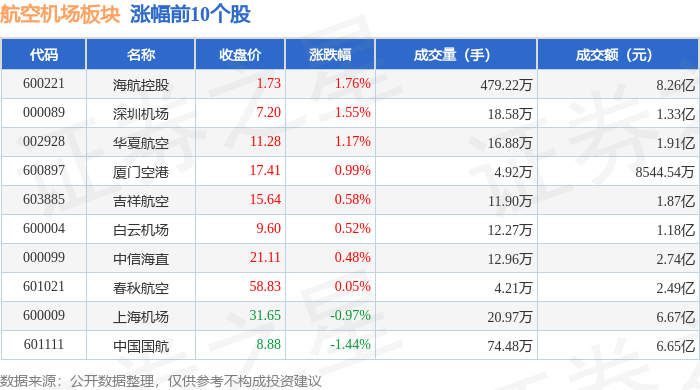
航空机场板块1月22日跌0.69%,中国东航领跌,主力资金净流出1.47亿元
Zheng Xing Xing Ye Ri Bao· 2026-01-22 09:02
Market Overview - The aviation and airport sector experienced a decline of 0.69% on January 22, with China Eastern Airlines leading the drop [1] - The Shanghai Composite Index closed at 4122.58, up 0.14%, while the Shenzhen Component Index closed at 14327.05, up 0.5% [1] Stock Performance - Notable stock performances included: - HNA Holding (600221) closed at 1.73, up 1.76% with a trading volume of 4.79 million shares and a turnover of 826 million yuan - Shenzhen Airport (000089) closed at 7.20, up 1.55% with a trading volume of 185,800 shares and a turnover of 133 million yuan - China Eastern Airlines (600115) closed at 6.07, down 2.41% with a trading volume of 1.43 million shares and a turnover of 873 million yuan [1][3] Capital Flow - The aviation and airport sector saw a net outflow of 147 million yuan from institutional investors, while retail investors had a net inflow of 97.06 million yuan [3] - Specific stock capital flows included: - HNA Holding had a net inflow of 57.12 million yuan from institutional investors - China Eastern Airlines experienced a net outflow of 7.07 million yuan from institutional investors [4] ETF Performance - The Aerospace ETF (159227) tracking the aerospace industry index saw a decline of 4.99% over the past five days, with a net subscription of 100 million yuan [6] - The General Aviation ETF (159230) tracking the general aviation industry index declined by 4.77%, with a net subscription of 12.71 million yuan [7]
白云机场T3航站楼国际业务22日全面开启
Xin Lang Cai Jing· 2026-01-22 04:45
Group 1 - The core point of the article is the operational transition of international flights from T1 to T3 terminal at Baiyun Airport, effective from January 22, 11:30 AM [1] - A total of 30 international (regional) airlines, along with China Eastern Airlines, Hainan Airlines, Shenzhen Airlines, and Spring Airlines, will move their international flights to T3 terminal [1] - Domestic flights operated by Air China, Hainan Airlines, Shenzhen Airlines, and others will continue to operate from T1 terminal, except for Spring Airlines [1] Group 2 - Baiyun Airport's T1 terminal, which has been in operation for over 20 years, plans to initiate upgrade and renovation work after serving the Spring Festival travel peak this year [1] - The upgrade aims to better meet the travel needs of passengers in the future [1]

白云机场T3航站楼国际业务22日全面开启 大湾区航空枢纽能级进一步提升
Xin Lang Cai Jing· 2026-01-22 04:30
Group 1 - Starting from January 22 at 11:30, all international (regional) airlines operating in Terminal 1 (T1) will transfer their flights to Terminal 3 (T3) [1] - The domestic flights of Air China, Hainan Airlines, Shenzhen Airlines, and other domestic airlines that originally operated in T1 will continue to operate from T1, except for Spring Airlines [1] - The T1 terminal of Baiyun Airport, which has been in operation for over 20 years, plans to gradually initiate upgrade and renovation work after serving this year's Spring Festival travel peak, aiming to better meet passenger travel needs in the future [1]
交通运输物流行业2025年12月航空数据点评:国内客座率涨幅扩大,看好国际航线2026年继续扩张
Guolian Minsheng Securities· 2026-01-21 13:38
Investment Rating - The report maintains a "Buy" rating for major airlines, including China National Aviation (China Air), China Eastern Airlines, Southern Airlines, and others, based on their projected earnings growth and favorable market conditions [2][3]. Core Insights - The domestic passenger load factor has increased significantly, reaching a historical high of 85.7% in December 2025, with a year-on-year increase of 2.4 percentage points [7][10]. - The international passenger load factor has shown a slight increase, but the growth rate has slowed due to disruptions in the Japanese route, with December figures reflecting a year-on-year increase of 0.9 percentage points [14][15]. - The overall industry demand growth continues to outpace supply growth, with a combined ASK/RPK increase of 6.6% and 9.1% respectively for the six listed airlines in December [7][10]. Summary by Sections 1. December International Supply and Demand Trends - The demand growth in December 2025 exceeded supply growth, with both domestic and international load factors reaching historical highs [10][11]. - The domestic routes saw a supply increase of 4.2% in ASK and a demand increase of 7.2% in RPK, while international routes experienced a 12.0% increase in ASK and a 13.3% increase in RPK [7][14]. 2. Aircraft Introductions and Fleet Growth - The total fleet of the six airlines increased by 0.4% in December, with a net addition of 14 aircraft, bringing the total to 3,386 [22][24]. - The A320 series was the primary aircraft introduced, with significant contributions from China National Aviation and Southern Airlines [22][27]. 3. Investment Recommendations - The report suggests that the tight supply-demand relationship in domestic routes will lead to a moderate increase in ticket prices in 2026, supported by regulatory measures to address low pricing [7][11]. - The international routes are expected to benefit from increased inbound tourism, with airlines like China Eastern Airlines and Spring Airlines positioned to gain from this trend [7][15].





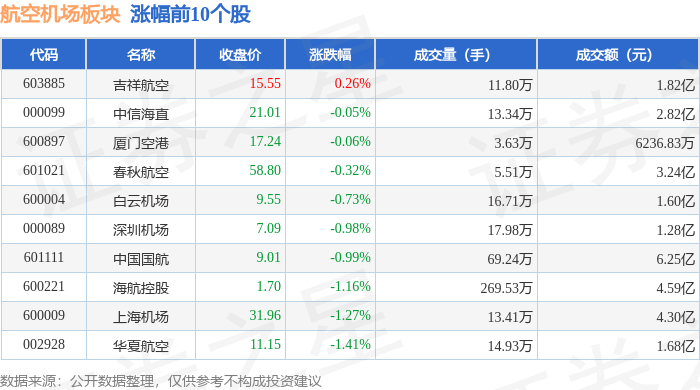
航空机场板块1月21日跌1.17%,中国东航领跌,主力资金净流出8483.06万元
Zheng Xing Xing Ye Ri Bao· 2026-01-21 08:54
Core Viewpoint - The aviation and airport sector experienced a decline of 1.17% on January 21, with China Eastern Airlines leading the drop, while the Shanghai Composite Index rose by 0.08% and the Shenzhen Component Index increased by 0.7% [1]. Group 1: Market Performance - The closing price of China Eastern Airlines was 6.22, reflecting a decrease of 2.20% with a trading volume of 1,109,700 shares and a transaction value of 6.95 million [2]. - The aviation and airport sector saw a net outflow of 84.83 million from major funds, while retail investors experienced a net outflow of 10.9 million, and speculative funds had a net inflow of 194 million [2][3]. Group 2: Individual Stock Performance - China National Aviation (China National Airlines) had a net outflow of 22.99 million from major funds, with a net inflow of 5.52 million from speculative funds and a net outflow of 28.51 million from retail investors [3]. - Xiamen Airport reported a net outflow of 2.03 million from major funds, while speculative funds had a net inflow of 1.35 million, and retail investors saw a net inflow of 0.68 million [3]. - Shenzhen Airport experienced a net inflow of 12.93 million from major funds, with a net inflow of 2.77 million from speculative funds and a net outflow of 15.69 million from retail investors [3].

南航物流开通上海—哈尔滨—墨西哥圣卢凯货运航线
Zhong Guo Min Hang Wang· 2026-01-21 00:50
Core Viewpoint - The launch of the new cargo route from Shanghai to Mexico via Harbin by China Southern Airlines Logistics marks a significant step in enhancing air logistics connectivity between the Yangtze River Delta and the Latin American market, supporting bilateral trade cooperation [1][5]. Group 1: Route Launch and Significance - The new cargo route, operated by a Boeing 777F freighter, aims to establish a reliable air logistics channel for high-quality Chinese products entering the Latin American market [3]. - This route will strengthen the air logistics connection between the Yangtze River Delta and Latin America, facilitating trade upgrades and enhancing economic cooperation [1][5]. Group 2: Operational Excellence and Safety Measures - To ensure the safe and efficient delivery of goods, the company has implemented a comprehensive control process, including real-time digital tracking of key logistics stages such as booking, collection, and loading [4]. - A dedicated green inspection channel has been established for special cargo like lithium batteries, significantly reducing warehouse entry times and enabling companies to seize market opportunities [4]. Group 3: Global Network and Trade Facilitation - The new route is part of the "Air Silk Road" initiative, enhancing the logistics network of China Southern Airlines in Latin America, which already includes routes to Mexico and Chile [5]. - As China-Latin America economic cooperation deepens, this route will link the manufacturing strengths of the Yangtze River Delta with the resource advantages of Latin America, providing stable air logistics support for exports and efficiently handling imports [5].

常州机场春运期间加密多条航线 满足“探亲+旅游”双高峰出行需求
Zhong Guo Min Hang Wang· 2026-01-20 10:58
Core Viewpoint - The Changzhou Benniu International Airport is enhancing its flight schedules in anticipation of the 2026 Spring Festival travel rush, which will run from February 2 to March 13, to accommodate the dual demand for family visits and tourism during the holiday season [1]. Flight Schedule Enhancements - The airport plans to increase the frequency of flights on popular routes such as Changzhou to Changsha, Xishuangbanna, Dalian, and Jinzhou to facilitate smoother travel for passengers [1][5]. - The Changzhou to Changsha route will see an increase from one to two flights daily, operated by Eastern Airlines [5]. - The Changzhou to Xishuangbanna route will add flights operated by Guilin Airlines, achieving two flights daily [5]. - The Changzhou to Dalian route will also be enhanced to two flights daily, while the Jinzhou route will increase to one flight daily [5]. Connectivity and Service Improvements - The airport is maintaining high-frequency operations to major urban clusters such as Beijing-Tianjin-Hebei and Guangzhou-Shenzhen-Macau, with five direct flights daily to Chengdu [5]. - A comprehensive transfer network connects southern warm winter destinations like Sanya and Haikou, as well as northern winter tourism spots like Harbin and Changchun [5]. - With the steady recovery of the outbound tourism market, Southeast Asia and Hong Kong-Macau regions are becoming short-term travel hotspots, supported by the airport's interline network with airlines [5]. Overall Strategy - The airport aims to create a seamless travel experience through flight frequency increases, service upgrades, and capacity coordination, ensuring a smooth journey for travelers during the Spring Festival [6].