丸美生物

Search documents
化妆品板块11月6日跌1.21%,贝泰妮领跌,主力资金净流出8263.52万元
Zheng Xing Xing Ye Ri Bao· 2025-11-06 08:50
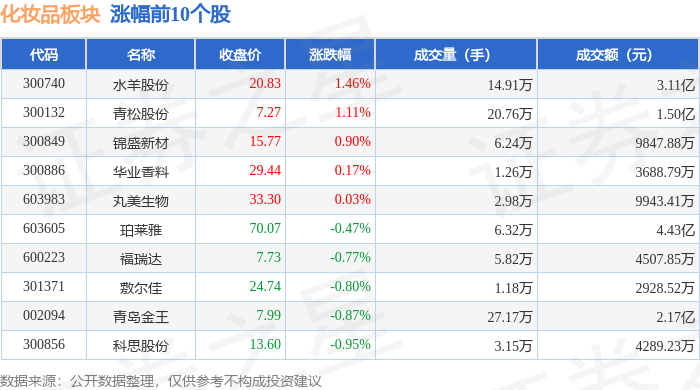
Market Overview - The cosmetics sector experienced a decline of 1.21% on November 6, with Betaini leading the drop [1] - The Shanghai Composite Index closed at 4007.76, up 0.97%, while the Shenzhen Component Index closed at 13452.42, up 1.73% [1] Individual Stock Performance - Notable gainers included: - Shuiyang Co., Ltd. (300740) with a closing price of 20.83, up 1.46% [1] - Qingsong Co., Ltd. (300132) with a closing price of 7.27, up 1.11% [1] - Significant decliners included: - Betaini (300957) with a closing price of 42.22, down 4.89% [2] - Jiahen Home Care (300955) with a closing price of 36.68, down 3.47% [2] Trading Volume and Capital Flow - The cosmetics sector saw a net outflow of 82.6352 million yuan from institutional investors, while retail investors had a net inflow of 58.2199 million yuan [2] - The trading volume for Shuiyang Co., Ltd. was 149,100 shares, with a transaction value of 311 million yuan [1] Capital Flow Analysis - Major net inflows were observed in: - Shuiyang Co., Ltd. with a net inflow of 23.1839 million yuan [3] - Qingsong Co., Ltd. with a net inflow of 7.1227 million yuan [3] - Major net outflows were noted in: - Betaini with a net outflow of 90.237 million yuan [3] - Shanghai Jahwa (600315) with a net outflow of 90.237 million yuan [3]



从盖楼到卖精华,珂谧能否捡到重组胶原蛋白的余热?
Tai Mei Ti A P P· 2025-11-06 01:46
Core Viewpoint - The emergence of the new skincare brand Key C (珂谧) by the company Furuida (福瑞达) marks a strategic shift from its traditional real estate and hyaluronic acid business to the collagen protein skincare market, aiming to differentiate itself through innovative technology and competitive pricing [1][2][4]. Company Transformation - Furuida, originally focused on real estate, has transitioned to the cosmetics sector, with its two existing brands, Yilian and Aier Doctor, contributing significantly to its revenue [4][5]. - In 2023, Furuida officially established a cosmetics-led business direction as its brands became the main revenue contributors [4][5]. Market Context - The beauty industry is experiencing a slowdown, and the competition in the collagen protein segment is intensifying, making Key C's entry particularly noteworthy [2][6]. - The overall revenue for Furuida's cosmetics segment in 2024 was 2.475 billion yuan, showing only a slight increase of 2.46% year-on-year, with Yilian's revenue at 963 million yuan (up 12.36%) and Aier Doctor's at 1.301 billion yuan (down 3.48%) [4][6]. Product Differentiation - Key C focuses on affordable medical beauty, utilizing transdermal penetration technology to compete against high-end anti-aging products priced in the thousands [2][6]. - The brand has achieved seven Class II medical device certifications and is developing additional Class III medical device projects, enhancing its credibility in the medical beauty space [7][8]. Pricing Strategy - Key C's pricing strategy is aimed at capturing market share through high cost-performance products, with its best-selling transdermal collagen essence priced at 600 yuan for 56 units, which can drop to 332 yuan during promotional events [8][10]. - This pricing approach disrupts the long-standing premium pricing of collagen products while maintaining a focus on effective ingredients [10][12]. Technological Innovation - Key C's transdermal penetration technology claims to improve skin absorption rates by 27.5 times compared to standard collagen products, addressing a significant industry challenge [11][12]. - The technology involves embedding transdermal peptide segments into the collagen sequence, allowing for effective penetration without compromising the integrity of the collagen [11][12]. Industry Challenges - The collagen protein market has faced scrutiny, with previous market leaders experiencing significant declines in market value, averaging over 40% from their peak [16][17]. - Consumer skepticism regarding the efficacy of collagen products has increased, leading to a more cautious approach from investors and the market [19][20]. Strategic Opportunities - Key C's entry into the collagen protein market represents a potential opportunity for differentiated competition amid industry challenges, contingent on its ability to innovate, educate consumers, and balance online and offline operations [19][20].


+25.51%,丸美生物如何成为A股美妆“增速第一”?
FBeauty未来迹· 2025-11-05 15:20
Core Viewpoint - The domestic beauty market in 2025 is experiencing a "growth cold wave," with many leading companies facing revenue declines or significantly slowed growth. However, Guangdong Marubi Biotechnology Co., Ltd. (Marubi) has reported impressive growth, achieving a 25.51% year-on-year increase in revenue for the first three quarters, making it one of the few companies in the industry to achieve both revenue and profit growth during this challenging period [2][3]. Industry Overview - The beauty industry is entering a competitive phase characterized by slow consumer recovery and peak channel benefits. Rational consumption has become mainstream, making growth for leading companies increasingly difficult [5]. - Among eight leading domestic beauty companies, four reported a year-on-year revenue decline, with three experiencing declines exceeding 10%. Marubi stands out with a significant revenue increase of 25.51% [8][9]. Financial Performance of Marubi - Marubi's revenue for the first three quarters reached 2.450 billion yuan, a year-on-year increase of 25.51%. In Q3 alone, revenue was 686 million yuan, up 14.28% year-on-year. The net profit attributable to shareholders was 244 million yuan, reflecting a year-on-year growth of 2.13% [11][12]. - The company's operating cash flow for the first three quarters was 1.589 billion yuan, a substantial increase of 132.19%, indicating that revenue growth is supported by actual sales collections [13]. Growth Drivers - Marubi's growth is attributed to internal factors rather than external market benefits, focusing on product, cost, and operational improvements. The company has optimized its product structure and upgraded to higher-end products, particularly in the eye care category, which saw a price increase of 52.83% year-on-year [14][16][18]. - The skincare category has become the primary revenue driver, contributing 306 million yuan in Q3, aligning with Marubi's strategy to transition from an eye care expert to a leader in comprehensive anti-aging solutions [19]. Cost Management and R&D - Marubi has implemented refined cost control through bulk purchasing and the use of quality domestic raw materials, enhancing profitability and pricing flexibility. The company has balanced marketing expenses and R&D investments, with sales expenses increasing by 32.09% and R&D expenses growing by 15.34% [20]. - The company has maintained a strong focus on technological innovation, receiving multiple awards and patents, which solidifies its competitive edge in the market [23]. Strategic Positioning - Marubi's strategic upgrades encompass brand positioning, technological development, and product matrix enhancements, providing sustained momentum for growth. The company has shifted its branding to emphasize anti-aging and has engaged well-known celebrities to enhance brand recognition [22][24]. - The company has achieved significant recognition in the market, being named the top brand in several product categories, which reflects its effective "R&D-product-market" closed-loop strategy [26][29]. Conclusion - Marubi's performance in Q3 2025 not only highlights its financial growth but also underscores its strategic advantages in product structure, operational efficiency, and market positioning. The company's transition from a marketing-driven to a technology-driven approach is crucial for sustaining competitive advantages in a challenging industry landscape [30].

“口红效应”失灵?2025美妆行业迎来艰难时刻
3 6 Ke· 2025-11-05 12:11
Core Insights - The domestic beauty industry in China, once thriving due to traffic dividends, is showing signs of fatigue as evidenced by the financial reports for the first three quarters of 2025, with major brands experiencing significant declines in revenue and profit [2][3][8] Financial Performance - Proya's revenue for the first three quarters reached 7.098 billion yuan, a year-on-year increase of 1.89%, while net profit was 1.026 billion yuan, up 2.65%. However, in Q3 alone, revenue fell to 1.736 billion yuan, a decrease of 11.63%, and net profit dropped to 227 million yuan, down 23.64% [2][8] - Other domestic brands like Fulejia, Betaini, Huaxi Biological, and Aimeike reported declines in both revenue and net profit, with Fulejia's revenue down 11.54% and net profit plummeting 36.73% [2][8] Market Trends - The beauty market in China has grown from 131.8 billion yuan in 2014 to 420.3 billion yuan in 2024, with domestic brands achieving a compound annual growth rate of 13.18%, surpassing foreign brands for the first time in 2023 [4][5] - The "lipstick effect" is failing as consumer confidence and willingness to spend among young people have significantly decreased, impacting sales in the beauty sector [3][9] Consumer Behavior - Young consumers are increasingly opting not to wear makeup due to busy lifestyles and a shift in priorities, with many expressing a preference for sleep over makeup application [9][10] - The perception of makeup as a necessary tool for professional success is changing, with more women focusing on their professional abilities rather than appearance [10] Industry Challenges - Many domestic beauty brands are facing a "path dependence" issue, relying heavily on established marketing strategies that are becoming less effective as the market matures [11][12] - The over-reliance on social media marketing and influencer partnerships is leading to diminishing returns, with brands struggling to maintain growth in a saturated market [11][12] R&D and Innovation - There is a growing need for product innovation as consumers become more discerning and demand transparency regarding product ingredients and efficacy [15][16] - Proya's R&D expenditure was only 2.1 billion yuan in 2024, significantly lower than its sales expenses, highlighting a trend of prioritizing marketing over innovation [16][17] Strategic Shifts - Proya is shifting its focus towards digitalization and technological innovation, appointing experienced executives to enhance its product development and marketing strategies [17][18] - The company aims to leverage digital tools for better product iteration and to integrate AI into various business functions, indicating a strategic pivot towards long-term sustainability [18][19]
美护商社行业周报:黄金税收新政落地,泡泡玛特中东首店开业-20251104
Guoyuan Securities· 2025-11-04 10:42
Investment Rating - The report maintains an "Overweight" rating for the industry, with a focus on new consumption sectors such as beauty care, IP derivatives, and gold jewelry [5][32]. Core Insights - The report highlights the recent tax policy changes regarding gold, which exempts value-added tax for standard gold transactions, potentially boosting market activity [3][22]. - The beauty care sector shows mixed performance, with some companies reporting significant revenue growth while others face declines [4][25]. - The report emphasizes the importance of domestic brands in the beauty market, with notable rankings in the Douyin beauty list indicating a shift towards local products [22][23]. Market Performance - During the week of October 27 to October 31, 2025, the retail trade, social services, and beauty care sectors experienced changes of +1.63%, +0.45%, and -2.21% respectively, ranking 8th, 17th, and 30th among 31 primary industries [13][15]. - The cosmetics sector faced a decline of -2.57%, while segments like trade and e-commerce performed well with increases of +3.44% and +2.97% [15][18]. Key Company Announcements - Shanghai Jahwa reported a revenue of 4.961 billion yuan for the first three quarters of 2025, a year-on-year increase of 10.8%, with a net profit growth of 149.1% [25]. - Proya Cosmetics achieved a revenue of 7.098 billion yuan, reflecting a modest growth of 1.89% [25]. - The opening of Pop Mart's first store in the Middle East marks a significant expansion for the brand [29]. Investment Recommendations - The report suggests focusing on companies such as Shiseido, Giant Bio, Marubi, Runben, Proya, Chaohongji, and Furuida as potential investment targets within the recommended sectors [5][32].





格局生变,优选成长
Haitong Securities International· 2025-11-04 09:08
Group 1: Industry Overview - The cosmetics retail sales in China grew by 3.9% year-on-year from January to September 2025, slightly underperforming the overall retail market by 0.6 percentage points, indicating a stable demand environment [4][14]. - Online platforms like Tmall and Douyin are experiencing a shift, with Tmall showing signs of recovery due to flash sales and member subsidies, while Douyin's growth has slightly slowed down [17][20]. - The demand for high-end and cost-effective products is increasing, while the mid-range segment is facing pressure due to a more conservative consumer environment [5][41]. Group 2: Competitive Landscape - The trend of domestic brands replacing foreign ones is slowing down, with leading foreign brands like L'Oréal and Estée Lauder showing signs of recovery in the Chinese market [23][24]. - The growth of domestic brands is becoming more differentiated, with some brands like Proya and Shiseido experiencing declines, while others like Youngor and Shanghai Jahwa continue to grow [23][24]. - The industry is witnessing an acceleration in the multi-brand matrix among leading companies, which is expected to increase market concentration [27][28]. Group 3: Key Companies - The report highlights several companies with strong growth potential, including Ruya Chen, Shumei Co., and Maogeping, which are expected to benefit from their brand strength and market positioning [3][54]. - Companies like Dekang Oral Care and Shanghai Jahwa are noted for their stable fundamentals and potential for marginal improvement, while others like Jinbo Biological and Huaxi Biological are anticipated to reach turning points [54]. - Ruya Chen's self-owned brand, Zhenjia, has shown significant growth, with a revenue increase of 345% year-on-year in Q3 2025, indicating strong brand development capabilities [60].


食品饮料及新消费行业跟踪报告:茅台降速纾压,白酒加速出清
Shanghai Aijian Securities· 2025-11-04 09:02
Investment Rating - The industry investment rating is "Outperform the Market" [1][22]. Core Insights - The report highlights that the liquor industry is experiencing a phase of accelerated clearing, with major companies like Kweichow Moutai showing resilience despite a slowdown in growth [1][4]. - The overall performance of the food and beverage sector has been mixed, with certain sub-sectors like pre-processed foods and snacks performing well, while soft drinks and other alcoholic beverages have seen declines [3][4]. - The report emphasizes the importance of focusing on high-quality companies with stable earnings during the industry's adjustment period, particularly recommending Kweichow Moutai and Shanxi Fenjiu for their strong fundamentals and attractive dividend yields [4]. Summary by Sections Liquor Industry - Kweichow Moutai reported Q3 2025 revenue of 39.064 billion yuan, a year-on-year increase of 0.56%, with net profit of 19.224 billion yuan, up 0.48% [3]. - The revenue from Moutai liquor increased by 7.26% to 34.924 billion yuan, while series liquor revenue fell by 34% [3]. - The company's gross margin improved to 91.44%, reflecting a better product mix, while net profit margin remained stable at 49.21% [3][4]. Dairy Industry - Yili Group's Q3 2025 revenue was 28.564 billion yuan, down 1.63%, with net profit of 3.226 billion yuan, a decrease of 3.35% [3]. - Liquid milk sales were under pressure, declining by 8.83%, while milk powder and dairy products saw a growth of 12.65% [3]. - The gross margin for Yili was 33.92%, down 1.13 percentage points, indicating cost pressures from raw milk prices [3]. Beauty Industry - Marubi Biotech achieved Q3 2025 revenue of 686 million yuan, up 14.28%, with net profit of 69 million yuan, an increase of 11.59% [4]. - The main brand Marubi saw a revenue increase of 33.93%, driven by strong performance of key products [4]. - The gross margin improved to 75.72%, supported by product mix optimization, despite increased marketing expenses [4].


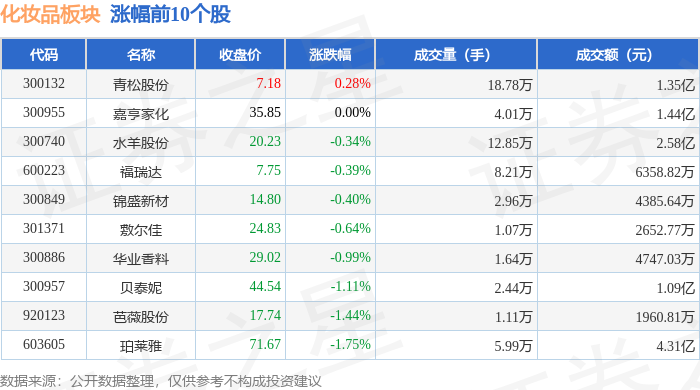
化妆品板块11月4日跌1.75%,丸美生物领跌,主力资金净流出2.08亿元
Zheng Xing Xing Ye Ri Bao· 2025-11-04 08:51
Core Viewpoint - The cosmetics sector experienced a decline of 1.75% on November 4, with Marubi Biotechnology leading the drop [1][2] Group 1: Market Performance - The Shanghai Composite Index closed at 3960.19, down 0.41%, while the Shenzhen Component Index closed at 13175.22, down 1.71% [1] - Major stocks in the cosmetics sector showed varied performance, with Qing Song Co. slightly up by 0.28% and Marubi Biotechnology down by 3.92% [1][2] Group 2: Trading Volume and Value - The trading volume and value for key stocks in the cosmetics sector were significant, with Qingdao Kingway recording a trading volume of 576,600 shares and a transaction value of 470 million yuan [2] - The total net outflow of main funds in the cosmetics sector was 208 million yuan, while retail investors saw a net inflow of 155 million yuan [2] Group 3: Fund Flow Analysis - The main funds showed a net outflow in several companies, including Marubi Biotechnology with a net outflow of 7.54 million yuan, while retail investors had a net inflow of 17.24 million yuan [3] - LaFang Co. had a net inflow of 8.17 million yuan from retail investors, despite a net outflow from main funds [3]

东吴证券晨会纪要-20251104
Soochow Securities· 2025-11-04 00:29
Macro Strategy - The macroeconomic environment shows a mild improvement in manufacturing PMI for September, but government shutdowns create data vacuums, increasing market volatility and uncertainty [1] - The lower-than-expected CPI data boosts interest rate cut expectations, while the US-China Busan meeting at the end of October reaches a consensus on tariffs, providing a stable period for trade relations [1] - The tech sector's earnings reports in October indicate that the AI narrative is undergoing a "stress test," with Nvidia's market cap surpassing $5 trillion due to its ecosystem advantages [1] Industry Outlook - The technology sector exhibits increasing differentiation, with the ongoing evolution of AI themes providing significant upward catalysts, while the performance of the new energy vehicle sector faces pressure [2] - The Nasdaq 100 index is expected to experience fluctuations in November, influenced by macroeconomic conditions and policy expectations, with a mid-term upward trend supported by the AI industrial revolution [1] Company Analysis - The report on Mannsster indicates that the company's Q3 performance aligns with expectations, but adjustments to profit forecasts for 2025-2027 reflect a decline in downstream demand [12] - Samsung Medical's Q1-3 revenue shows a 6.2% year-on-year increase, but net profit declines by 15.9%, primarily due to price drops in electric meters and delivery of distribution orders [13] - The report on Ziyuan Food anticipates a revenue decline in 2025, with a projected net profit decrease of 28% in 2025, but a recovery is expected in subsequent years [15] Investment Recommendations - The report suggests a balanced ETF allocation strategy, as the market is likely to remain in a wide fluctuation pattern, with structural opportunities continuing to emerge [7] - The analysis of the bond market indicates that the adjustment of redemption fees for public debt funds may lead to significant short-term redemptions, impacting credit bonds and perpetual bonds [8] - The report on Huafeng Measurement Control highlights the company's strong performance in high-end testing equipment, with an upward revision of profit forecasts for 2025-2027 due to the demand for ASIC chips [28]
本土彩妆头牌被爆闭店?
3 6 Ke· 2025-11-03 23:36
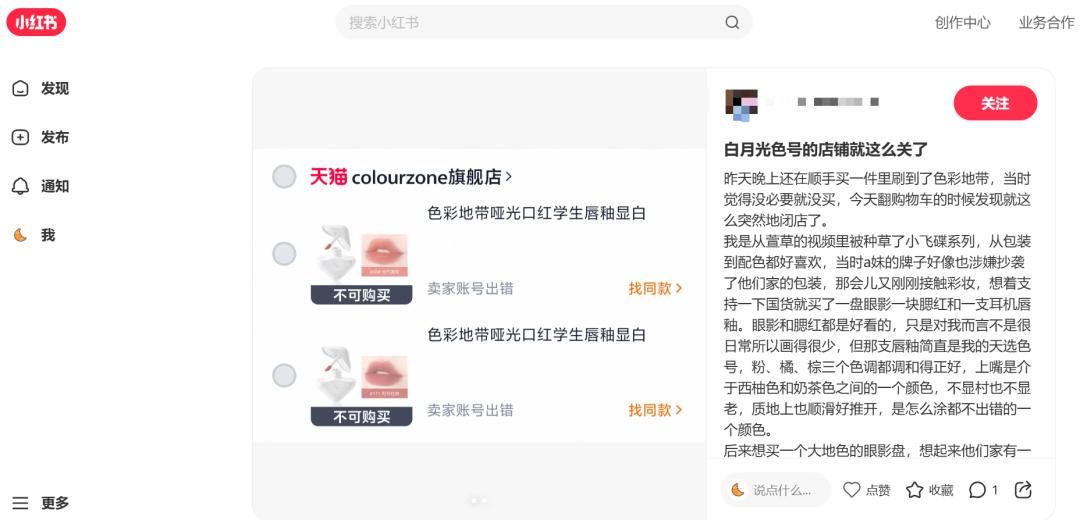
在中国化妆品行业高歌猛进之际,一些曾承载着时代记忆的经典国货品牌,往往会以"回忆杀"、"有历史感的国货宝藏品牌"等关键词引发关注和共鸣。其 中也有悄然离场的老牌彩妆引发"时代的眼泪"的感慨。 近日,聚美丽关注到,有用户在小红书平台发文疑指昔日国货彩妆TOP品牌Colourzone色彩地带(下文统称:色彩地带)天猫旗舰店闭店。"昨天晚上还在顺 手买一件里刷到了色彩地带,当时觉得没必要就没买,今天翻购物车的时候发现就这么突然地闭店了。" △图源:小红书 聚美丽记者发现,目前在天猫平台已搜索不到品牌官方旗舰店,抖音店铺清空;品牌官方微信公众号、视频号也分别于2021年、2022年停更;小红书账号 目前粉丝数4万,最后一条笔记发布时间为今年5月,但仍有产品销售;另在京东平台搜索发现,官方店铺正常运营。 △上图截自:抖音、京东、小红书、微信公众号 在社交平台上,"色彩地带"已成为不少用户心目中的怀旧符号。在小红书平台上搜索"色彩地带"相关笔记,不少用户均称其为"时代的眼泪",表示:"很 喜欢这个唇膏……又便宜又好用!可惜再也买不到了"、"色彩地带的这盘眼影好像停售了,还能买到吗?" 针对上述"色彩地带疑似闭店"的传闻, ...