双环传动

Search documents
双环传动11月11日获融资买入5236.53万元,融资余额10.24亿元
Xin Lang Cai Jing· 2025-11-12 01:36
Core Insights - The stock of Zhejiang Shuanghuan Transmission Co., Ltd. experienced a slight decline of 0.15% on November 11, with a trading volume of 553 million yuan. The net financing purchase for the day was 20.98 million yuan, indicating strong investor interest despite the minor drop [1] Financing and Margin Trading - On November 11, the financing buy amount for Shuanghuan Transmission was 52.37 million yuan, with a total financing balance of 10.24 billion yuan, representing 3.04% of the circulating market value. This financing balance is above the 90th percentile of the past year, indicating a high level of leverage [1] - The company had a margin trading activity where 17,700 shares were repaid and 23,200 shares were sold short, with a short selling amount of approximately 919,600 yuan. The remaining short selling balance was 967,220 yuan, which is above the 60th percentile of the past year, also indicating a high level of short interest [1] Financial Performance - For the period from January to September 2025, Shuanghuan Transmission reported a revenue of 6.466 billion yuan, a year-on-year decrease of 4.10%. However, the net profit attributable to shareholders increased by 21.73% to 898 million yuan [2] - Cumulatively, the company has distributed 958 million yuan in dividends since its A-share listing, with 510 million yuan distributed over the past three years [3] Shareholder Structure - As of September 30, 2025, the number of shareholders increased by 27.51% to 70,800, while the average circulating shares per person decreased by 21.40% to 10,659 shares [2] - The largest circulating shareholder is Hong Kong Central Clearing Limited, holding 140 million shares, a decrease of 12.23 million shares from the previous period. New institutional investors include E Fund National Robot Industry ETF, which holds 15.57 million shares [3]

国信证券晨会纪要-20251112
Guoxin Securities· 2025-11-12 01:03
Macro and Strategy - The report discusses the integration of AI in financial research, transitioning from "universal models" to specialized AI agents, enhancing efficiency in tasks like financial modeling and policy analysis [8][9] - AI tools like AlphaEngine can quickly generate DCF models and analyze policy impacts, improving decision-making processes for investors [8][9] Non-Banking Financial Sector - The report anticipates a positive interaction between macroeconomics and capital markets in 2026, driven by policy guidance and industrial upgrades, creating structural opportunities in technology and green economy sectors [10] - The capital market is expected to achieve a more balanced funding structure, with increased investments in public funds and insurance products, stabilizing market fluctuations [10][11] Home Appliance Industry - The home appliance sector showed resilience with a 4% year-on-year revenue growth in Q3 2025, despite a slowdown due to external sales pressures [11][12] - White goods revenue reached 268.7 billion, growing 5% year-on-year, while small appliances saw a 6.3% increase in revenue [12][14] - The report highlights the strong performance of leading companies in the sector, indicating a positive outlook for the industry [12][14] Public Utilities and Environmental Protection - The report notes a 2.71% increase in the environmental index, with significant gains in the power generation sector, particularly in renewable energy [16] - The introduction of the "Ecological Environment Monitoring Regulations" is expected to enhance monitoring capabilities and support the growth of the environmental sector [16][17] Retail Industry - The retail sector is experiencing a low recovery phase, with a 4.5% year-on-year increase in retail sales for the first three quarters of 2025, indicating a mixed performance across different segments [19][20] - The report emphasizes the divergence in performance among individual stocks, with some regional chains showing improved operational efficiency [19][20] Food and Beverage Industry - The food and beverage sector is characterized by a stable total volume but structural differentiation, with a notable decline in the liquor segment due to inventory adjustments [22][23] - The report highlights the growth of snack foods and beverages, with specific brands showing significant revenue increases [22][23] Medical Industry - The medical sector is witnessing a marginal improvement in revenue and profit, with innovative drugs and the CXO sector showing strong growth [29][30] - The report recommends focusing on undervalued stocks in the medical device and pharmacy sectors, which are expected to benefit from market stabilization [31][32] Media and Internet - The media sector has outperformed the broader market, with a 2.56% increase, driven by the popularity of AI platforms like Pokee AI [34][35] - The report suggests continued optimism for the media sector, highlighting advancements in AI technology that enhance operational efficiency [34][35]
高盛:对人形机器人技术的长期趋势仍持积极看法
Zhi Tong Cai Jing· 2025-11-11 11:41
Core Insights - Goldman Sachs recently released a field research report on the supply chain of humanoid robots in China, indicating that most companies plan to gradually scale up after receiving actual orders, suggesting that current plans may not imply an imminent risk of oversupply [1] - The report highlights a positive long-term outlook for humanoid robot technology, but emphasizes the need to monitor the performance of key robotic products and specific end applications to assess whether a technological inflection point is approaching [1] Summary by Sections Company Insights - The report surveyed nine companies in the Chinese robotics industry chain, including Sanhua Intelligent Controls, Top Group, and Shuanghuan Transmission, none of which confirmed receiving significant large orders or provided clear mass production timelines [1] - These companies are actively planning production capacity both domestically and overseas, with annual capacity plans ranging from approximately 100,000 to 1 million units of robots [1] Industry Trends - Goldman Sachs forecasts a global shipment of 1.38 million robots by 2035, contrasting with the optimistic capacity planning of supply chain companies, which raises concerns about potential "oversupply" in the market [1] - An industry analyst cautioned against prematurely concluding "oversupply," noting that the specific application scenarios and technological paths for humanoid robots are still in exploratory development [2] - The current "order vacuum" should be understood as a natural phase in the early development of the industry, where trial and error costs and time are expected [2] - The analyst believes that proactive capacity planning by supply chain companies is a necessary preparation for potential demand surges, and that the future demand volume and technological evolution remain highly variable [2]

A股机器人“订单荒”?相关公司回应
财联社· 2025-11-11 10:47
Core Viewpoint - Goldman Sachs conducted a field research report on the supply chain of humanoid robots in China, revealing that companies are planning significant production capacity expansions despite a lack of confirmed large orders [1][2]. Group 1: Research Findings - The report surveyed nine companies in the Chinese robotics industry, including Sanhua Intelligent Control, Top Group, and Shuanghuan Transmission, indicating a planned annual production capacity ranging from 100,000 to 1,000,000 robot equivalents [1]. - Goldman Sachs predicts a global shipment of 1.38 million units by 2035, highlighting an optimistic outlook for the supply chain's growth potential [1]. - None of the surveyed companies confirmed receiving substantial orders or provided a clear mass production timeline, raising concerns about potential "overcapacity" in the robotics supply chain [1]. Group 2: Industry Insights - Despite the current contrast between the vacuum of orders and the expansion of production capacity, industry insiders caution against prematurely concluding "overcapacity," as proactive planning is often characteristic of emerging industries on the rise [2].



双环传动(002472) - 关于公司为全资子公司提供担保的进展公告
2025-11-11 10:30
证券代码:002472 证券简称:双环传动 公告编号:2025-070 浙江双环传动机械股份有限公司 关于公司为全资子公司提供担保的进展公告 本公司及董事会全体成员保证信息披露的内容真实、准确、完整,没有虚 假记载、 误导性陈述或重大遗漏。 一、担保情况概述 浙江双环传动机械股份有限公司(以下简称"公司")于 2025 年 4 月 23 日召开的第七届董事会第三次会议和 2025 年 5 月 16 日召开的 2024 年年度股东 大会,审议通过了《关于 2025 年度公司及子公司提供融资担保的议案》。根据整 体生产经营计划和资金需求情况,公司合并报表范围内的部分公司拟向金融机构、 融资租赁公司进行融资,为确保生产经营持续、健康发展,公司拟为部分全资子 公司、控股子公司提供不超过 43.10 亿元额度的融资担保;部分控股子公司与其 下属全资子公司之间互相提供不超过 1.40 亿元额度的融资担保,实际担保金额 以最终签订的担保合同为准。上述担保额度的有效期自 2024 年年度股东大会审 议通过之日起至 2025 年年度股东大会召开之日止。 以上担保事项具体内容详见公司于 2025 年 4 月 25 日、2025 ...
高盛调研发现A股机器人“订单荒”?产业链上市公司:静待订单落地
第一财经· 2025-11-11 10:11
Core Viewpoint - The article discusses the contrasting expectations and realities in the humanoid robot sector, highlighting a recent Goldman Sachs report that indicates a lack of confirmed large orders despite optimistic production capacity plans from several companies [4][12]. Group 1: Market Sentiment and Capacity Planning - Goldman Sachs conducted a survey of nine Chinese robot supply chain companies, revealing that while they are planning annual production capacities ranging from 100,000 to 1 million units, none have confirmed large orders or clear timelines for mass production [4][6]. - Companies like Top Group and Sanhua Intelligent Control are actively planning production facilities in Thailand and Mexico, with Top Group's Thai factory projected to have an annual capacity of 1 million units and an investment of 7-8 billion yuan [7][8]. - Despite the current lack of orders, industry insiders suggest that the proactive capacity planning is typical for emerging industries and does not necessarily indicate an impending oversupply [5][12]. Group 2: Company Responses and Market Dynamics - Several companies, including Sanhua Intelligent Control and Top Group, have acknowledged the absence of confirmed orders but emphasize that their capacity planning is based on guidance from major clients [10][11]. - The article notes that the current "order vacuum" should not be hastily interpreted as a sign of oversupply, as the industry is still in its early development stages, and the demand-supply mismatch is common in new sectors [13]. - Companies like Minth Group and Double Ring Transmission are expanding their production capabilities in anticipation of future demand, with Minth expecting humanoid robot-related revenue to reach 5 billion yuan by 2030 [8][12]. Group 3: Long-term Industry Outlook - The report suggests that the current lack of orders does not negate the long-term growth potential of humanoid robots, as the industry is still exploring specific applications and technological paths [13]. - Goldman Sachs maintains a positive outlook on the long-term trends in humanoid robot technology, although it emphasizes the need to monitor key product performance and specific end-use applications to assess potential technological breakthroughs [12][13].
高盛调研发现A股机器人订单荒?产业链公司回应
Di Yi Cai Jing· 2025-11-11 09:17
Core Viewpoint - The human-shaped robot sector is experiencing a clash between optimistic expectations and the current reality, as highlighted by a Goldman Sachs report indicating that nine surveyed supply chain companies have not confirmed any significant mass production timelines or large orders [2][3]. Group 1: Survey Findings - Goldman Sachs conducted a survey from November 3 to 6, covering nine companies in the Chinese robot supply chain, including prominent firms like Sanhua Intelligent Control and Top Group [2][3]. - The surveyed companies are planning annual production capacities ranging from 100,000 to 1,000,000 robot equivalents, reflecting a positive outlook on industry growth despite the absence of confirmed large orders [3][4]. - Companies like Top Group and Sanhua Intelligent Control are actively establishing production lines in Thailand and Mexico, with Top Group's Thai factory projected to have an annual capacity of 1,000,000 units and an investment of approximately 7 to 8 billion yuan [4]. Group 2: Production Capacity and Market Response - Despite the ambitious production plans, none of the surveyed companies have confirmed receiving substantial orders, leading to concerns about potential overcapacity in the robot supply chain [3][6]. - Companies are preparing for future demand based on guidance from major clients, even though they currently lack confirmed orders [6][7]. - Analysts suggest that the current lack of orders should not be interpreted as a sign of overcapacity, as proactive capacity planning is typical in emerging industries [8]. Group 3: Industry Outlook - The optimism surrounding production capacity expansion is driven by the belief in the long-term potential of the human-shaped robot market, with companies like Minth Group projecting revenues of 5 billion yuan from related businesses by 2030 [5][8]. - The current phase of order scarcity is viewed as a natural part of the industry's early development, with significant uncertainties regarding future demand and technological evolution [8]. - Goldman Sachs maintains a positive long-term outlook on human-shaped robot technology, emphasizing the need to monitor key product performance and applications to assess potential technological breakthroughs [8].
汽车行业跟踪报告:10月批发同比+7%,新能源渗透率超55%
Huachuang Securities· 2025-11-11 09:16
Investment Rating - The industry investment rating is "Recommended," indicating an expected increase in the industry index by more than 5% over the next 3-6 months compared to the benchmark index [70]. Core Insights - In October, the wholesale sales of narrow passenger vehicles reached 2.93 million units, a year-on-year increase of 7% and a month-on-month increase of 4% [2]. - The penetration rate of new energy vehicles exceeded 55%, with wholesale sales of electric vehicles at 1.62 million units, marking an 18% year-on-year increase [8]. - The report highlights potential investment opportunities in companies such as Geely Automobile and BYD, with a focus on Geely's low valuation for the upcoming year [4]. Summary by Sections Industry Overview - In October, the production of narrow passenger vehicles was 2.95 million units, reflecting an 11% year-on-year increase and a 4% month-on-month increase [2]. - The report estimates that retail sales for October were approximately 2.34 million units, showing a 3% year-on-year increase [8]. Sales Performance - The wholesale sales of new energy vehicles in October were 1.62 million units, with a penetration rate of 55%, which is a 5 percentage point increase year-on-year [8]. - The report indicates that the wholesale sales of domestic car manufacturers reached 2.14 million units in October, a 12% year-on-year increase [8]. Pricing and Inventory - The industry discount rate slightly increased in late October, with an average discount rate of 9.6%, reflecting a 0.1 percentage point increase month-on-month [8]. - The total inventory is estimated to be around 3.1 million units, with fuel vehicle inventory at approximately 850,000 units, indicating a higher overall inventory compared to the same period last year [8]. Future Outlook - The report anticipates that the fourth quarter will see a seasonal inventory reduction, with retail sales expected to reach 7.73 million units, a 6% year-on-year increase, while wholesale sales are projected to be 8.67 million units, a 1% year-on-year decrease [8]. - Potential catalysts for recovery in the automotive sector include better-than-expected retail sales post-Spring Festival and improved export performance [8].




高盛调研发现A股机器人“订单荒”?产业链上市公司:静待订单落地
Di Yi Cai Jing· 2025-11-11 08:40
Core Insights - The human-shaped robot sector is experiencing a clash between optimistic expectations and the current reality of order shortages, as highlighted by a recent Goldman Sachs report on the Chinese supply chain [1][2] Industry Overview - Goldman Sachs conducted a survey from November 3 to 6, involving nine Chinese companies in the robot supply chain, revealing that none confirmed receiving large orders or clear mass production timelines [2][3] - The surveyed companies are planning annual production capacities ranging from 100,000 to 1,000,000 units, indicating a positive outlook on industry growth despite the lack of confirmed orders [2][3] Company Responses - Companies like Top Group and Sanhua Intelligent Control have stated that their production capacity planning is based on guidance from major clients, despite not having received specific orders [5][6] - Sanhua Intelligent Control is focusing on technological improvements and product development, while Top Group is preparing capacity in anticipation of future demand [5][6] Capacity Expansion Plans - Top Group plans to establish production lines in Thailand, Mexico, and the U.S., with a projected annual capacity of 1,000,000 units and an investment of approximately 7 to 8 billion yuan [3] - Sanhua Intelligent Control has acquired land in Thailand for assembling humanoid robot actuators and has initiated capacity for humanoid robots [3] - Minth Group has completed a production line with an annual capacity of 10,000 sets for head and facial assemblies, expecting to achieve mass production by Q1 2026 [4] Market Sentiment - There are concerns about potential overcapacity in the robot supply chain due to the aggressive capacity expansion without confirmed demand [2][6] - Industry analysts suggest that the current order vacuum should not lead to premature conclusions about overcapacity, as it is typical for emerging industries to experience initial trial and error phases [7]
IRON堪称“以假乱真”,小鹏汽车逆势涨近16%!机构:中国人形机器人市场处在产业化落地的关键阶段
2 1 Shi Ji Jing Ji Bao Dao· 2025-11-11 06:28
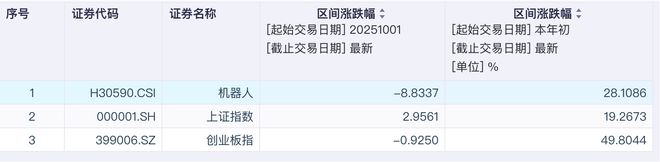
Core Viewpoint - The robotics sector is experiencing volatility, with the robotics index ETF (560770) declining by 8.83% from October 1 to November 7, significantly underperforming compared to the Shanghai Composite Index, which rose by 2.96% during the same period [1][2]. Market Performance - The robotics index ETF (560770) has seen a net inflow of nearly 600 million yuan over the past 14 days, with a year-to-date share increase of 160.04%, bringing its latest scale to over 2.468 billion yuan [3]. - The overall performance of the robotics sector has been mixed, with notable declines in key component stocks such as Huichuan Technology and Yuntian Lifeng, while companies like Stone Technology and Julun Intelligent have shown gains [1]. Industry Trends - The humanoid robot sector is witnessing multiple catalysts, with companies preparing for mass production expected to begin in the second half of 2026 [4][5]. - High-profile companies like Xpeng and Tesla are making significant advancements in humanoid robotics, with Xpeng unveiling its humanoid robot IRON and Tesla announcing ambitious production goals for its "Optimus" humanoid robot [6]. - The global humanoid robot market is projected to grow significantly, with estimates suggesting a compound annual growth rate of 58.90%, expanding from approximately 6.339 billion yuan in 2025 to 64.222 billion yuan by 2030 [6]. Investment Landscape - The current market environment indicates a potential shift in investment styles, with high valuations and downward adjustments in growth expectations possibly leading to a phase of sectoral adjustments [5]. - The top ten components of the robotics index ETF include companies across various segments of the robotics industry, indicating a diversified exposure to the robotics supply chain [5].