联发科

Search documents
人民币最大的敌人,是中国人自己?
Sou Hu Cai Jing· 2026-02-20 04:02
阅读须知:本文内容所有信息和数据,均为作者查阅官方信息和网络已知数据整合解析,旨 在让读者更清晰了解相应信息,如有数据错误或观点有误,请文明评论,作者积极改正! (创作不易,一篇文章需要作者查阅多方资料,整合分析、总结,望大家理解) 一份措辞犀利的讲话稿在网上流传,核心观点就一句,人民币最大的敌人,是中国人自己。 这话听起来刺耳,甚至有些"恨铁不成钢"的味道。 但如果你仔细看完里头的逻辑链,再对照当下的现实,背后那股寒意,恐怕不是空穴来风。 全球半导体产业的半壁江山,现在是谁在掌舵? 英特尔的陈立武、博通的陈福阳、AMD的苏姿丰……全球前五大芯片厂商,华裔掌门人占了多数。 再看营收巨头,台积电、联发科、英伟达(文中"漫威304"疑为笔误)、瑞昱、联咏、SK海力士,哪个 背后没有华人技术和管理团队的身影? 这说明了什么?说明在决定人类下一轮科技革命走向的顶级智力竞赛场,华人族群的表现,堪称碾压 级。 再看奥数、AI这些硬核竞技场,西方国家的顶尖代表队里,华裔面孔几乎成了"标配"。 这背后是东亚儒家文化圈极致的"内卷"自强,叠加一些研究中提到的族群智力优势,共同造就的恐怖竞 争力。 按理说,拥有这样一群"最强大脑 ...


联发科分红,人均95万
半导体行业观察· 2026-02-16 01:58
联发科的员工分红总金额与当期获利表现连动,大致是以公司税前盈余提拨一定比率发放,外界推 估比率约在二成左右。 IC设计大厂联发科2025年下半年的员工分红,预计将于今年2月底发放。外界估算,这次该公司分 红总金额约114亿元,大约比去年8月底发放2025年上半年分红减少15.7%。以该公司有资格参与 分红的员工约1.2万人估算,平均每人约可分得95万多元。 联发科每年的员工分红共分两次发放,上半年度分红是于同年8月发放,下半年度分红则是于隔年 2月发放。联发科对外界推估的员工分红数字向来不予评论。 据了解,虽然此次联发科员工分红平均每人约可分得超过95万元,惟每人实际可分得的金额,会 根据部门、职级、考绩等条件而有所不同。近日市场上流传该公司这次所领员工分红的数字,在工 程师E7职等中,有人所领分红为半个月薪资,有人则达六个月薪资,副理E9职等则有人分红可获 上百万元,差异甚大。 | | 지적 | | --- | --- | | ケア 17 21 | · 去年下半年的員工分紅·預計將於今年2月底發 収 | | | · 去年下半年視前盈餘約571.07億元,比去年上半 | | | 年視前盈餘677.81億元減少 ...

联发科分红每人平均95万元新台币 预估1.2万员工受惠
Jing Ji Ri Bao· 2026-02-15 23:21
联发科是中国台湾IC设计龙头,也是全球第五大IC设计厂,其员工薪酬水准长年保持在台湾上市柜公司 的前段班。依照该公司申报的2024年非主管职全时员工薪资,全年薪资平均数为431万元新台币,中位 数为343.8万元新台币,在上市柜公司中都仅次于股王信骅,也都比该公司2023年的数字增加。 另外,为与员工共享公司长期营运成果,联发科自2023年起于中国台湾导入集团员工持股补助计划,员 工可自每月薪资提拨一定金额,并偕同公司补助金一同参与购买联发科股票。 联发科去年下半年税前盈余约571亿元新台币,比去年上半年税前盈余677.8亿元新台币减少15.7%,外 界推算今年2月底发放的去年下半年员工分红约为114.2亿元新台币,以共约1.2万名员工符合领取资格来 估算,平均每人约可领95.1万元新台币。 外界认为,由于参与联发科员工分红者还包括公司的初中高阶主管,因此分红总金额可反映出该公司员 工每期所获合计分红数字的起伏变化,但分红平均数与个别员工所获金额可能有差异。 IC设计大厂联发科(2454) 2025年下半年的员工分红,预计将于今年2月底发放。外界估算,这次该公 司分红总金额约114亿元新台币,大约比去年8月底 ...
想买的抓紧!安卓手机涨价潮已定:部分或超千元
猿大侠· 2026-02-14 04:11
在这种情况下,提高终端售价或者降低部分配置几乎成为品牌维持利润的必然选择。 自2025年底以来,小米、OPPO、vivo等品牌新机型起售价普遍上调100-600元。而苹果iPhone的高端机型内存成本仅占平均售价的4%,受冲击极小。 为了控制成本,部分厂商还取消了8GB+128GB的低配版,强制用户购买更高利润的版本;甚至有厂商在考虑重新支持MicroSD卡,让用户自己买卡扩容,从而规避 内置存储的高成本库存风险。 不少人期待着2026年存储价格能够回落,但往往事与愿违,消费者反而面临一个更贵的电子产品市场。 有数码博主爆料称,今年安卓机型整体涨幅达15%-20%,中低端预计涨价200-400元,高端机型涨幅超1000元。 当前存储芯片成本的上涨正引发连锁反应,这一影响已波及手机行业。 过去,存储芯片在智能手机BOM(物料成本)中的占比约为10%-15%,如今已快速攀升至30%-40%,成本压力明显加重。 不过在这位博主看来,手机涨价的原罪并非存储,而是全供应链材料集体涨价带来的结果。 该博主表示,实际上,锡暴涨、银暴涨,2nm芯片报价较3nm再涨50%+,就连中框、金属机身原料都涨了接近一倍。 据悉,手机主 ...

近50家芯片大厂最新业绩:谁在赚钱,谁还在复苏?
芯世相· 2026-02-14 04:07
Core Viewpoint - The semiconductor industry is expected to recover in 2025, with significant revenue growth driven by rising storage prices and increasing demand from data centers, leading to improved performance for major chip manufacturers [3][4]. Group 1: Semiconductor Sales and Growth - Global semiconductor sales are projected to reach $791.7 billion in 2025, a 25.6% increase from $630.5 billion in 2024, with further growth expected towards $1 trillion in 2026 [3]. - The recovery is attributed to strong demand from emerging technologies such as AI, IoT, 6G, and autonomous driving [3]. Group 2: Chip Design and IDM - Texas Instruments (TI) is expected to achieve approximately $17.68 billion in revenue for 2025, reflecting a 13% year-over-year growth, with significant contributions from industrial and automotive sectors [6]. - STMicroelectronics (ST) anticipates a revenue decline of 11% to around $11.8 billion, with Q4 showing slight improvement driven by personal electronics [8]. - NXP's revenue is projected at $12.27 billion, down 3%, with automotive and industrial sectors remaining stable [10]. - Renesas reported a revenue drop of 2% to 1.3212 trillion yen, marking its first loss in six years due to significant impairment losses [12]. - Microchip Technology expects growth in both year-over-year and quarter-over-quarter sales, with a projected revenue of $1.186 billion for Q3 2026 [12]. - Qorvo's revenue exceeded expectations at $993 million, with an 8.4% year-over-year increase [12]. - Infineon's revenue is projected at €14.662 billion, down 2%, but with strong demand in AI driving growth [14]. Group 3: Memory Chips - Samsung's revenue is expected to reach 333.6059 trillion won (approximately $233.8 billion), a 10.9% increase, with the semiconductor division achieving 130.1 trillion won in revenue [29]. - SK Hynix anticipates a record revenue of 97.15 trillion won (approximately $681.6 billion), a 47% increase year-over-year [31]. - Micron's revenue is projected to rise from $25.11 billion to $37.38 billion, with HBM chip capacity sold out for 2026 [33]. - GigaDevice expects a revenue increase of approximately 25% to 9.203 billion yuan [35]. Group 4: Wafer Foundry - TSMC's revenue is projected to reach approximately 3.8 trillion new Taiwan dollars (around $122.42 billion), a 31.6% increase, with advanced processes contributing significantly [47]. - UMC expects a slight revenue increase of 2.3% to 237.55 billion new Taiwan dollars, with a focus on mature process technologies [49]. - SMIC anticipates a record revenue of $9.3268 billion, a 16.2% increase, with improved profitability driven by increased wafer sales [51]. Group 5: Testing and Packaging - ASE Group's revenue is expected to reach 645.388 billion new Taiwan dollars, an 8.4% increase, with advanced packaging services contributing significantly [57]. - Amkor's revenue is projected at $6.71 billion, a 6% increase, with strong performance in advanced packaging and computing business [59]. Group 6: Equipment - ASML's total net sales are expected to reach €32.667 billion, a 15.6% increase, with a record order backlog reflecting strong demand for AI-related technologies [61]. - Lam Research anticipates a record year with significant growth driven by advanced process technologies [63]. Group 7: Distribution - WPG Holdings expects a revenue of 999.12 billion new Taiwan dollars, a 13.4% increase, driven by AI and high-performance computing demand [66]. - WPG's revenue is projected to exceed 1 trillion new Taiwan dollars, marking a significant milestone [68].



——26年1月台股电子板块景气跟踪:台积电营收环增20%创新高,淡季不淡
Shenwan Hongyuan Securities· 2026-02-13 12:20
Investment Rating - The report indicates a positive outlook for the semiconductor and AI-related sectors, with strong revenue growth expected in 2026 [1][5]. Core Insights - The AI sector is experiencing robust demand, particularly in AI servers, HPC, and cloud data centers, contributing to a significant revenue increase for TSMC, which reported NT$401.26 billion in January 2026, a year-on-year growth of 36.8% [1][5]. - The report highlights that advanced packaging capacity remains tight, which is a critical factor supporting revenue growth [5]. - Companies like Xinxia and JY Electronics are also seeing substantial revenue increases due to the demand for AI-related applications and advanced testing requirements [1][8]. Summary by Sections AI Sector - TSMC's revenue in January 2026 reached NT$401.26 billion, driven by strong demand for AI servers and HPC, maintaining high utilization rates in advanced processes [1][5]. - Xinxia's revenue reached NT$9 billion, a year-on-year increase of 28.5%, reflecting the growing importance of server management chips in AI server architectures [7][8]. Advanced Packaging and Testing - JY Electronics reported NT$33.7 billion in revenue, a 41% year-on-year increase, driven by the complexity of next-generation GPU testing and increased demand for AI ASICs [8]. - Chroma ATE's revenue reached NT$38.3 billion, a 72.1% increase, supported by rising power testing demands and advanced packaging capacity expansion [8]. Semiconductor Manufacturing - UMC, VIS, and PSMC reported revenue increases of 5%, 18%, and 26% respectively, with PSMC achieving a 39-month revenue high due to rising memory wafer prices [15]. - Nanya Technology, Winbond, and Macronix reported significant revenue growth of 608%, 94%, and 51% respectively, driven by structural supply-demand imbalances in the memory market [16]. EMS Sector - Foxconn, Wistron, and Quanta reported revenues of NT$730.04 billion, NT$2,283.7 billion, and NT$2,308.3 billion respectively, with year-on-year growth rates of 36%, 152%, and 62% [12]. - Wistron's chairman emphasized that AI-related orders in 2026 will significantly exceed those of the previous year, indicating a strong outlook for the EMS sector [12]. Passive Components - YAGEO reported NT$130.3 billion in revenue, a 27% year-on-year increase, driven by strong demand from AI-related applications and pre-holiday stocking in Greater China [19].

26年1月台股电子板块景气跟踪:台积电营收环增20%创新高,淡季不淡
Shenwan Hongyuan Securities· 2026-02-13 11:21
Investment Rating - The report maintains a positive outlook on the semiconductor industry, particularly in the AI and HPC sectors, indicating a strong demand that supports revenue growth [2][5]. Core Insights - TSMC reported a record revenue of NT$401.26 billion in January 2026, a year-on-year increase of 36.8%, driven by strong demand in AI servers, HPC, and cloud data centers [2][5]. - The advanced packaging capacity remains tight, which is a key factor supporting revenue growth [5]. - The report highlights that the AI sector continues to drive demand, with companies like Xinxia and JY Electronics also reporting significant revenue increases [2][5][20]. Summary by Sections AI Sector - TSMC's revenue growth is attributed to the sustained demand for AI servers and advanced process technologies, maintaining high utilization rates [5]. - Xinxia's revenue reached NT$900 million in January 2026, up 28.5% year-on-year, reflecting the strong demand for server management chips [7]. - JY Electronics reported a revenue of NT$3.37 billion, a 41% increase year-on-year, driven by the rising complexity and demand for AI-related testing [8]. Mature Process - UMC, World Advanced, and PSMC reported revenues of NT$20.86 billion, NT$4.01 billion, and NT$4.62 billion respectively, with year-on-year growth rates of 5%, 18%, and 26% [16]. - PSMC's revenue reached a 39-month high, driven by rising prices in memory wafer foundry and increased demand for logic foundry [16]. Storage - Nanya Technology, Winbond, and Macronix reported revenues of NT$15.31 billion, NT$11.78 billion, and NT$3.02 billion respectively, with year-on-year growth rates of 608%, 94%, and 51% [17]. - Nanya indicated that various DRAM products may remain tight due to limited new capacity, particularly DDR4 and LPDDR4 [17]. End-Side Chips - MediaTek's revenue was NT$46.98 billion, down 8% year-on-year, with expectations of a significant decline in mobile terminal demand due to rising costs [18]. - The Smart Edge business is expected to grow, with data center ASIC revenue projected to exceed USD 1 billion in 2026 [20]. Passive Components - Yageo reported a revenue of NT$13.03 billion, a 27% year-on-year increase, driven by strong demand from AI-related applications [20].
行业景气观察:1月PPI同比降幅收窄,各类挖机销量同比增幅扩大
CMS· 2026-02-12 11:35
Group 1: Core Insights - In January, the year-on-year increase in CPI narrowed to 0.2%, while the year-on-year decline in PPI narrowed to -1.4%, indicating a recovery in certain sectors driven by supply-side reforms and improved downstream demand [1][13][25] - The report recommends focusing on sectors with improved supply constraints and price recovery, including non-ferrous metals, electrical equipment, chemical fibers, construction materials, and machinery [2][25] Group 2: Information Technology Sector - The Philadelphia Semiconductor Index and the Taiwan Semiconductor Industry Index increased, while the DXI Index decreased, indicating mixed performance in the semiconductor sector [2][27] - In December, global semiconductor sales saw a year-on-year increase, and in January, most Taiwanese electronic manufacturers reported improved revenues [2][27] Group 3: Midstream Manufacturing - In January, sales of various excavators and loaders saw a year-on-year increase, while automotive production and sales showed a rolling three-month year-on-year decline [2][26] - The report highlights an increase in cargo throughput and container throughput at Chinese ports, indicating a positive trend in logistics [2][26] Group 4: Consumer Demand - The prices of fresh milk remained stable, while sugar prices declined; pork prices and chicken seed prices also decreased [3][25] - The report notes a decrease in box office revenue averages, while movie ticket prices increased, reflecting a mixed recovery in the entertainment sector [3][25] Group 5: Resource Sector Tracking - The report indicates a decline in the ten-day average transaction volume of construction steel, while industrial metal prices mostly increased, with copper, tin, and nickel prices rising [6][26] - Brent crude oil prices increased, while the chemical product price index showed a downward trend, with most chemical prices declining [6][26] Group 6: Financial and Real Estate Sector - The report notes a decrease in land transaction premium rates and a decline in the area of commercial housing transactions, indicating challenges in the real estate market [6][26] - The A-share turnover rate and daily transaction volume also decreased, reflecting a slowdown in market activity [6][26] Group 7: Public Utilities - The ex-factory price of natural gas in China decreased, along with a decline in UK natural gas futures prices [6][26]
Ricursive获3亿美元融资,将芯片设计周期从几年缩短到几天
3 6 Ke· 2026-02-11 13:09
Core Insights - The development of AI heavily relies on the ability to validate ideas quickly, but the cost of doing so has increased significantly compared to the internet era, primarily due to the high costs of computing hardware [1] - Ricursive Intelligence, founded by Anna Goldie and Azalia Mirhoseini, aims to revolutionize chip design by significantly reducing the time and cost associated with creating custom chips, thereby addressing the bottlenecks in AI development [4][12] Group 1: Company Overview - Ricursive Intelligence was founded in December 2025 with an initial valuation of $750 million after raising $35 million in seed funding, followed by a $300 million Series A round led by Lightspeed Venture Partners, bringing its post-money valuation to $4 billion [2] - The company focuses on automating the entire chip design process, which is currently dominated by Cadence and Synopsys, both generating annual revenues of $5-6 billion [12] Group 2: Technology and Innovation - AlphaChip, developed by Ricursive Intelligence, can design semiconductor components in hours instead of years, having been applied to multiple generations of Google TPU [3][7] - The design process for advanced chips currently takes 12-36 months and costs between $200 million to $650 million, with a significant portion of costs attributed to labor and electronic design automation (EDA) tools [3][11] Group 3: Vision and Future Plans - Ricursive Intelligence envisions a shift from a "Fabless" model to a "Designless" model, where the entire chip design process can be outsourced, allowing for rapid transformation of ideas into manufacturable designs [12] - The company has outlined three development phases: reducing chip design time to weeks, achieving end-to-end design capabilities, and vertically integrating to create its own chips that enhance AI performance [11] Group 4: Impact on the AI Industry - The reduction in chip design costs and time could unleash significant innovation within the AI industry, allowing for more customized chips that meet specific needs for various applications, from cloud AI to hardware terminals [13] - The recursive cycle of AI empowering chip design and vice versa is expected to accelerate advancements in both fields, creating a feedback loop that enhances capabilities [10]

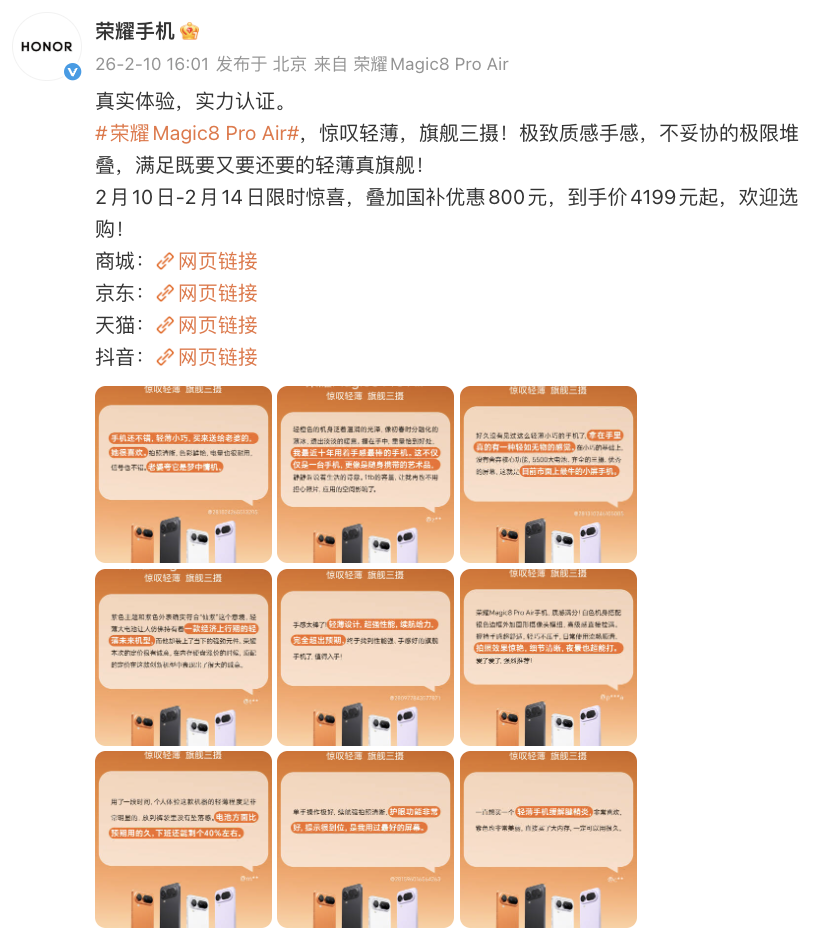
荣耀Magic8ProAir降价300 | 曝某大厂新机要做阔屏幕 16:10复古回归?
Xin Lang Cai Jing· 2026-02-11 10:33
Core Insights - The recent price drop of Apple's ultra-thin flagship iPhone Air by 2000 yuan has sparked discussions, leading to a promotional price cut of 300 yuan for Honor's Magic8 Pro Air [1][7]. Group 1: Promotional Activities - Honor Magic8 Pro Air is running a Valentine's Day limited-time promotion from February 10 to February 14, offering a discount of 300 yuan, which, when combined with national subsidies, totals an 800 yuan discount [2][8]. - The promotional prices for the Magic8 Pro Air after the discount are as follows: - 12+256GB version originally priced at 4999 yuan is now 4699 yuan, with a final price of 4199 yuan after subsidies - 12+512GB version originally priced at 5299 yuan is now 4999 yuan, with a final price of 4499 yuan after subsidies - 16+512GB version originally priced at 5599 yuan is now 5299 yuan, with a final price of 4799 yuan after subsidies [5][11]. Group 2: Product Specifications - The Honor Magic8 Pro Air features a lightweight design at 155g, a slim profile of 6.1mm, and a 6.31-inch display with a 1.5K resolution and 1-120Hz LTPO technology [5][11]. - It is powered by the MediaTek Dimensity 9500 processor, equipped with a 5500mAh battery, and supports 80W wired and 50W wireless charging. The camera setup includes a 50MP front camera and a triple rear camera system [5][11]. Group 3: Industry Trends - There is a growing interest in "wide foldable" devices, with expectations that three smartphone brands will launch such models by 2026, following the trend initiated by Huawei's Pura X [11][12]. - Additionally, a new "wide screen" straight phone with a 16:9 or 16:10 aspect ratio is reportedly in development by a top five smartphone manufacturer, indicating a shift in design trends within the industry [12].