北大荒

Search documents
逆市四连阳!业内首只农牧渔ETF(159275)单日吸金超5200万元
Xin Lang Ji Jin· 2025-10-14 00:47
Core Viewpoint - The agricultural, animal husbandry, and fishery (农牧渔) sector is showing resilience in the A-share market, with the Agricultural and Fishery ETF (159275) experiencing significant net inflows and maintaining a strong performance despite broader market pressures [1][2]. Industry Overview - The agricultural, animal husbandry, and fishery sector has undergone a prolonged correction from February 2021 to September 2024, but has recently rebounded alongside the A-share market, although valuations remain low [2]. - The current price-to-book ratio of the index tracked by the Agricultural and Fishery ETF is 2.64, placing it in the 32.14 percentile over the past decade, indicating a favorable long-term investment opportunity [2]. - The pig farming industry, a core segment of the agricultural sector, is currently at a price low not seen in four years, suggesting limited downside risk. Future trends may include production stabilization and price increases, leading to improved profitability for quality enterprises [2]. Policy and Market Dynamics - Recent government policies have focused on controlling production capacity and optimizing the competitive landscape within the pig farming industry, with expected acceleration in capacity reduction in the fourth quarter [2]. - The seed industry is also receiving significant policy support, with advancements in biotechnology and the potential for accelerated commercialization of genetically modified crops, enhancing the competitive edge of leading companies [3]. - The animal health sector is expected to see increased market share for leading firms, driven by ongoing policy focus [3]. Investment Opportunities - The Agricultural and Fishery ETF (159275) is the first ETF to track the comprehensive agricultural index, covering various segments such as pig farming, aquaculture feed, animal health, and seeds, thus providing broad exposure to the agricultural value chain [4]. - The top ten holdings of the index account for 61.1% of its weight, featuring leading companies in the sector, which enhances the index's representativeness [4]. - Historically, the index has outperformed similar thematic indices and broad market indices, with a cumulative return of 95.45% since December 31, 2013, and a remarkable 145.61% return from January 1, 2019, to March 1, 2021 [4].
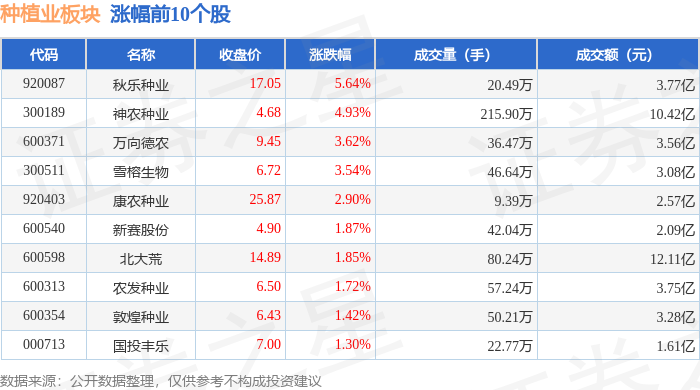
种植业板块10月13日涨0.65%,秋乐种业领涨,主力资金净流出206.53万元
Zheng Xing Xing Ye Ri Bao· 2025-10-13 12:38
Core Insights - The agriculture sector saw a rise of 0.65% on October 13, with Qiu Le Seed Industry leading the gains [1] - The Shanghai Composite Index closed at 3889.5, down 0.19%, while the Shenzhen Component Index closed at 13231.47, down 0.93% [1] Sector Performance - Qiu Le Seed Industry (code: 920087) closed at 17.05, up 5.64% with a trading volume of 204,900 shares and a transaction value of 377 million [1] - Other notable gainers included: - Shen Nong Seed Industry (code: 300189) at 4.68, up 4.93%, with a trading volume of 2.159 million shares and a transaction value of 1.042 billion [1] - Wanxiang Deno (code: 600371) at 9.45, up 3.62%, with a trading volume of 364,700 shares and a transaction value of 356 million [1] Fund Flow Analysis - The agriculture sector experienced a net outflow of 2.0653 million from institutional investors, while retail investors saw a net outflow of 55.7436 million [2] - Conversely, speculative funds recorded a net inflow of 57.8089 million [2] Individual Stock Fund Flow - North China Agricultural (code: 600598) had a net inflow of 58.2983 million from institutional investors, but a net outflow of 67.3320 million from retail investors [3] - Snow Rong Biological (code: 300511) saw a net inflow of 38.0955 million from institutional investors, with a net outflow of 19.9775 million from retail investors [3] - Su Kan Agricultural Development (code: 601952) had a net inflow of 27.7753 million from institutional investors, while retail investors experienced a net outflow of 14.2399 million [3]


粮食概念板块领涨,上涨1.05%
Di Yi Cai Jing· 2025-10-13 06:32
Core Viewpoint - The grain sector is leading the market with a rise of 1.05%, indicating strong performance in agricultural stocks [1] Company Performance - Shennong Seed Industry increased by 10.54%, showcasing significant growth in its stock price [1] - *ST Wanfang saw a rise of 5.08%, reflecting positive market sentiment [1] - XinSai Co. experienced a 4.78% increase, contributing to the overall sector performance [1] - Beidahuang, Nongfa Seed Industry, and Qianyinhigh-Tech all rose over 3%, indicating a broad-based rally in the grain sector [1]
我国粮油作物单产提升效果显著 “吨半粮”装满农户“粮袋子”
Yang Shi Wang· 2025-10-13 02:13
Core Insights - The article highlights the significant improvements in crop yields across various regions in China due to the implementation of advanced agricultural techniques and technologies [1][3][5][7]. Group 1: Crop Yield Improvements - A total of 702 counties in China have implemented large-scale actions to enhance the single yield of grain and oil crops, leading to notable improvements in crop production nationwide [1]. - In Xinjiang's Ili region, a team of 64 corn experts conducted yield measurements on 200,000 acres of corn fields, achieving an average yield of 1,209.1 kg per mu, with some areas exceeding 1,500 kg per mu [3]. - In Guangde City, Anhui Province, the introduction of precision sowing techniques in collaboration with the China Rice Research Institute has resulted in rice yields reaching 700 kg per mu during the harvest season [5]. Group 2: Technological Innovations - The Beidahuang Group's Sifangshan Farm has successfully cultivated soybeans on 1,260 acres of saline-alkali land using ARC biological coupling technology, resulting in a yield increase of 47.7% compared to the national average for soybeans [7]. - The ARC biological coupling technology, developed independently in China, significantly enhances soybean and peanut yields while allowing for a reduction of 3-5 kg of urea fertilizer per mu [9].

农业板块盘初集体冲高,秋乐种业涨超20%
Xin Lang Cai Jing· 2025-10-13 01:35
Core Viewpoint - The agricultural sector experienced a significant rally in early trading, with multiple companies showing substantial gains in their stock prices [1] Group 1: Company Performance - Qiu Le Seed Industry surged over 20% [1] - Kang Nong Seed Industry increased by more than 15% [1] - Shen Nong Seed Industry rose over 10% [1] - Other companies such as Green Heng Technology, Dunhuang Seed Industry, Beidahuang, Jinhe Biological, and Agricultural Development Seed Industry also saw increases [1] Group 2: Market Activity - The Agricultural ETF (159825) recorded a trading volume of 23.0411 million yuan [1]
中美博弈加剧,种植产业链会重演4
2025-10-13 01:00
Summary of Conference Call on Sino-U.S. Agricultural Trade Dynamics Industry Overview - The conference call discusses the agricultural trade dynamics between China and the United States, focusing on key products such as soybeans, corn, sorghum, and cotton. The trade volume is projected to be around $40 billion in 2024, with China being a significant buyer of U.S. agricultural products, particularly in soybeans and sorghum [1][2][3]. Key Points and Arguments - **Impact of Tariffs**: The implementation of reciprocal tariffs by the U.S. could lead to retaliatory measures from China, resulting in increased domestic agricultural prices. This scenario would benefit companies in the planting sector, such as Beidahuang and Suqian Agricultural Development [1][3]. - **Import Trends**: From May to August 2025, China's soybean imports increased by 15.7% year-on-year, with Brazilian soybeans accounting for 87% of imports. Conversely, sorghum imports plummeted by 99% due to a significant reduction in U.S. imports [1][5][10]. - **Tariff Effects on Imports**: The imposition of a 10% tariff on soybeans and sorghum has effectively reduced import volumes. For corn and cotton, a 15% tariff led to an 87% and 75.3% decline in imports, respectively [2][12][16]. - **Market Reactions**: The market's concern over food security has led to a notable increase in the stock prices of planting-related companies following the announcement of tariffs. The planting sector has shown more resilience compared to the livestock sector, which has a longer supply chain and less immediate impact from tariff changes [2][4]. - **Long-term Food Security**: China's long-term food security risks are manageable, with proactive international soybean procurement in early 2025. The abundant soybean harvests in Brazil and Argentina have helped stabilize international prices [1][9]. - **Future Trade Challenges**: If the U.S. tariffs are fully implemented, both countries may face significant challenges, particularly in key agricultural products. The lack of new purchasing agreements could lead to supply shortages in China and increased pressure on U.S. agriculture [6][7][9]. Additional Important Insights - **Vegetable Seed Imports**: China imports about 20% of its vegetable seeds from the U.S. The potential for increased costs due to tariffs could benefit domestic companies like Green Hen Technology and COFCO Sugar, which have already seen stock price increases [1][8]. - **U.S. Agricultural Exports**: The U.S. is expected to see a 10% decline in soybean exports in 2025, with a significant increase in carryover stocks if China continues to refrain from purchasing U.S. soybeans [2][16]. - **Global Agricultural Market Impact**: The ongoing trade tensions may lead to fluctuations in global agricultural planting areas, particularly in North America and Brazil. Observations of planting area changes will be crucial in assessing future price movements [17]. - **Regional Weather Effects**: Recent heavy rainfall in Henan has raised concerns about corn quality, potentially impacting prices. However, further information is needed to assess the overall impact on production [18].
东方证券农林牧渔行业周报:生猪行业深亏,提速去产能-20251012
Orient Securities· 2025-10-12 11:44
Investment Rating - The report maintains a "Positive" investment rating for the agriculture industry [5] Core Viewpoints - The swine industry is experiencing significant losses, prompting a rapid reduction in production capacity, which is expected to enhance long-term performance in the sector [3][8] - The report highlights the importance of quality companies in the swine breeding sector, which continue to show profitability and increasing dividend rates as key drivers for long-term performance and valuation [3] - The report emphasizes the upward trend in grain prices and the favorable fundamentals in planting and seed industries, indicating significant investment opportunities [3] Summary by Sections Swine Industry - The current market for swine is under pressure, with prices for fat pigs nearing 11 yuan/kg and weaned piglet prices dropping below 200 yuan/head, leading to widespread losses in the industry [8][11] - As of August 2025, the number of breeding sows has slightly decreased to 40.38 million heads, with slaughter volumes increasing significantly [8] - The average price of commodity pigs fell to 14.23 yuan/kg in August, a decrease of 4.1% month-on-month and 31% year-on-year, indicating a rapid deterioration in industry profitability [8][49] Poultry Industry - The white feather broiler price has slightly decreased to 6.88 yuan/kg, while chick prices have increased to 3.22 yuan/bird, reflecting a mixed market response [15][22] - The yellow feather chicken price remains strong at 7.09 yuan/jin, supported by seasonal demand [22] Feed Industry - The report notes fluctuations in raw material prices, with corn prices averaging 2304.12 yuan/ton, down 2.70% week-on-week, while wheat and soybean meal prices have seen slight increases [27][49] Investment Recommendations - The report recommends focusing on quality companies in the swine breeding sector, such as Muyuan Foods and Wens Foodstuffs, which are expected to benefit from ongoing capacity reductions [3][41] - It also suggests that the recovery in swine inventory will boost demand for feed and animal health products, benefiting companies like Haida Group and Reap Bio [3][41] - In the planting sector, the report identifies investment opportunities in companies like Suqian Agricultural Development and Beidahuang [3][41] - The pet food sector is highlighted as a growth area, with increasing domestic brand recognition and market expansion [3][41]
沃土为基 粮丰满仓
Xin Hua She· 2025-10-12 06:55
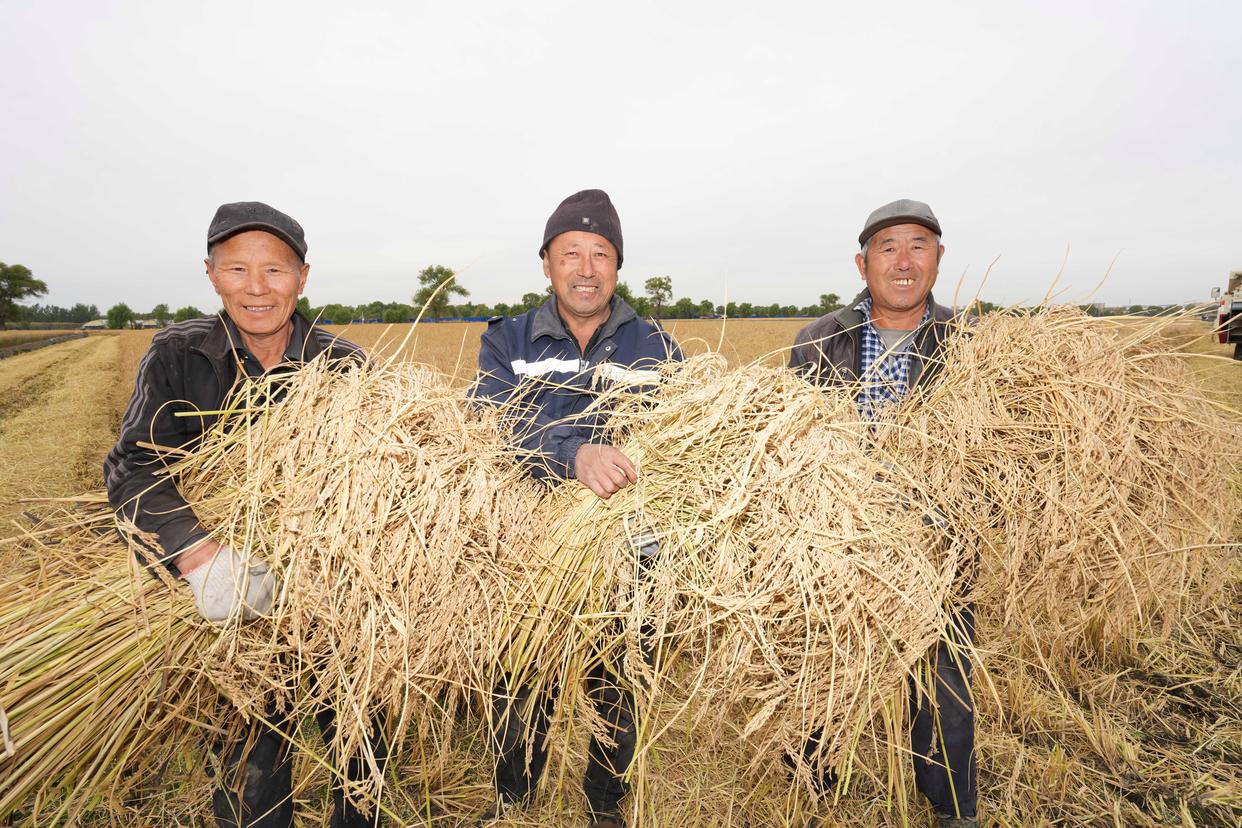
Core Insights - Heilongjiang Province, known as China's granary, is experiencing a bountiful harvest this year, with a focus on improving grain yield and quality through enhanced farming practices [1] - By 2025, the total autumn harvest area for Beidahuang Agricultural Reclamation Group Co., Ltd. is projected to reach 46.72 million acres, with 39.69 million acres harvested as of October 10, 2023, achieving 84.86% completion [1] Group 1 - Heilongjiang Province is the largest grain-producing province in China, showcasing a promising growth in grain crops [1] - The province has concentrated efforts on increasing grain yield and quality, thereby strengthening the foundation for a successful harvest [1] - As of October 10, 2023, Beidahuang Agricultural Reclamation Group has made significant progress in its harvest, with nearly 85% of the planned area already harvested [1]
一顿分析猛如虎,涨跌全靠特朗普!下周的风险与机会!
Qi Lu Wan Bao· 2025-10-12 06:43
Core Viewpoint - Trump's threats to impose additional tariffs on Chinese goods have triggered significant market turmoil, leading to substantial losses in global stock markets, particularly in the U.S. [1][2] Tariff Policy Overview - The Trump administration has implemented a multi-layered tariff system since 2025, with recent tariffs including a 100% tariff on brand and patent drugs, 50% on steel and aluminum products, and an additional 100% on all Chinese goods effective November 1 [1][2][3] - The automotive sector is particularly affected, with tariffs aimed at reshaping the North American automotive supply chain [4] Industry Policy Direction - The pharmaceutical industry is targeted with a 100% tariff to promote domestic production [3] - The steel, aluminum, and copper industries face a 50% tariff to support the revival of the U.S. steel industry [3] Risk Sectors - The consumer electronics sector is identified as a major risk area due to potential supply chain disruptions [4] - The semiconductor industry faces dual challenges from tariffs and technology restrictions, significantly increasing production costs and hindering technological advancements [4] - The machinery equipment sector is experiencing a sharp decline in export orders, with tariffs leading to potential cancellations and increased costs [5] - The automotive parts industry is under pressure from automakers, with predictions of a significant drop in global automotive profits due to tariffs [6] Opportunities - The rare earth permanent magnet sector is seeing a strategic revaluation due to China's export controls, which could lead to price increases [7][8] - The defense and military industry is expected to benefit from increased defense budgets amid geopolitical tensions [11][12] - The agricultural sector is positioned to gain from import tariffs on U.S. agricultural products, driving domestic prices up [12][13] Strategic Responses - China has implemented comprehensive countermeasures against U.S. tariffs, including export controls on rare earth materials, which could reshape global resource competition [17] - The tariff policies are expected to lead to a restructuring of supply chains, with a shift towards regionalization and localization of production [19] Conclusion - Trump's tariff policies are reshaping global trade dynamics and industry landscapes, creating both challenges and structural investment opportunities in various sectors [19][20]
又一国企迁驻雄安
中国基金报· 2025-10-10 12:31
Group 1 - The relocation of the Beijing-Tianjin-Hebei Railway Company to Xiong'an New Area aims to enhance railway construction investment and support the high-quality development of Xiong'an and the coordinated development of the Beijing-Tianjin-Hebei region [2] - The company, established in March 2015 with a registered capital of 80 billion yuan, is responsible for planning, construction, operation, financing, and comprehensive development of intercity railway projects in the Beijing-Tianjin-Hebei area [2] - During the 14th Five-Year Plan period, the company is tasked with the construction of 11 railway projects, covering approximately 1,220 kilometers and involving a total investment of about 295 billion yuan [2] Group 2 - The National Development and Reform Commission is actively promoting the relocation of non-capital functions from Beijing, with significant progress in landmark projects in Xiong'an New Area [3] - Four universities, including Beijing Jiaotong University and Beijing University of Science and Technology, are accelerating the construction of their campuses in Xiong'an, while five other universities have confirmed their site selection and are preparing overall planning [3] - Major hospitals, including Peking University People's Hospital and Peking Union Medical College Hospital, are advancing construction and planning for their facilities in Xiong'an [3] Group 3 - Several central enterprises, including China Star Network and China Sinochem, have established their headquarters in Xiong'an, with ongoing projects and site selections for additional enterprises [4] - The main structure of the China Mineral Headquarters project has been completed, and various central enterprises are expediting project design and planning [4] - A total of 30 subsidiaries of State Grid, China Sinochem, and China Huaneng have completed their relocation and registration in Xiong'an [4]