金山办公

Search documents
AI人工智能ETF(512930)连续5天净流入,浙江广电华智数媒推出短剧AI智能剪辑系统DramaFlow
Xin Lang Cai Jing· 2026-01-19 01:52
Group 1 - The core viewpoint of the news highlights the performance of the China Securities Artificial Intelligence Theme Index, with notable stocks such as Beijing Junzheng leading the gains at 3.75% and AI ETF pricing at 2.38 yuan [1] - Zhejiang Guangdian Huazhi Shumei and DramaByte launched the DramaFlow AI intelligent editing system at the "AI + Micro Short Drama" industry development conference, which aims to enhance editing efficiency and quality while significantly reducing labor costs [1] Group 2 - Citic Securities' report anticipates a high certainty in computing power development by 2026, with supernode technology reaching a pivotal opportunity, and suggests focusing on domestic computing chip and system-level manufacturers for investment opportunities [2] - The China Securities Artificial Intelligence Theme Index consists of 50 listed companies involved in providing resources, technology, and application support for artificial intelligence, reflecting the overall performance of AI-related securities [2] - As of December 31, 2025, the top ten weighted stocks in the index include companies like Zhongji Xuchuang and Hikvision, accounting for 58.08% of the total weight [2]

计算机周观点第 31 期:千问发布 AI 助手,C 端进入超级 Agent 时代-20260118
GUOTAI HAITONG SECURITIES· 2026-01-18 13:43
Investment Rating - The report maintains an "Overweight" rating for the computer sector [4]. Core Insights - In January, Qianwen App achieved over 100 million monthly active users (MAU) and fully integrated with Alibaba's ecosystem to create a "Super Agent" [3][4]. - Alibaba Cloud is significantly increasing its investment in AI infrastructure, aiming to capture 80% of the incremental AI cloud market in China by 2026 [4]. - The brain-computer interface (BCI) industry is experiencing dual drives from policy and capital, with a focus on medical applications and ambitious targets set for 2027 and 2030 [4]. - AI4S is benefiting from policy support, with significant potential for applications in pharmaceuticals and new materials, as well as global innovation in AI applications [4]. Summary by Sections Qianwen App and AI Assistant - Qianwen App's MAU surpassed 100 million within two months of launch, integrating over 400 new features and becoming the first AI assistant to achieve a full-service chain from "search-decision-payment-fulfillment" [4]. Alibaba Cloud Investment - Alibaba Cloud plans to invest over 380 billion yuan in AI infrastructure over the next three years, with a goal to dominate the AI cloud market in China by 2026 [4]. Brain-Computer Interface Industry - The Shanghai government has issued a plan for BCI development, targeting high-quality "brain control" by 2027 and establishing a global innovation hub by 2030 [4]. - Zhejiang Qiang Brain Technology recently raised approximately 2 billion yuan for R&D and production, focusing on non-invasive technologies for rehabilitation [4]. AI4S Policy Support - The Chinese government has prioritized AI4S in its policy framework, with extensive support for its development across various sectors [4]. - Major tech companies like Apple and Google are collaborating to enhance their AI capabilities, indicating a robust market for AI innovations [4].





计算机行业周报:太空光伏能源迎来拐点时刻-20260118
HUAXI Securities· 2026-01-18 12:30
Investment Rating - Industry Rating: Recommended [6] Core Insights - Space photovoltaic energy is reaching a turning point, becoming a strategic solution for commercial space and high-end applications [1][2] - Photovoltaic technology is the only viable solution for energy in space, outperforming traditional fossil fuels and nuclear energy due to its sustainability, stability, and lightweight characteristics [2][15] - The demand for space photovoltaic energy is driven by the increasing number of satellites and the expansion of power requirements for individual satellites, leading to exponential growth in space photovoltaic needs [20][21] Summary by Sections 1. Space Photovoltaic Energy Reaches a Turning Point - Space photovoltaic energy is defined as utilizing solar photovoltaic technology in outer space to generate and supply energy, which is crucial for powering satellites and space stations [1] - The transition from traditional energy sources to photovoltaic technology is essential due to the high risks and complexities associated with fossil fuels and nuclear energy in space [2][15] 2. Photovoltaic Becomes the Only Solution for Space Energy - The cost of traditional energy sources in space is prohibitively high, with gallium arsenide solar panels costing around 200,000 to 300,000 yuan per square meter [12] - SpaceX has adopted the P-type HJT battery technology as the main route for large-scale production of space solar cells, with over 10,000 units tested since 2023 [2][26] - Perovskite tandem batteries are expected to become the mainstream technology for future space photovoltaics, with China leading in production capacity [12][29] 3. Space Computing Strongly Relies on Space Photovoltaic Power Generation - Space photovoltaic energy is identified as the primary energy source for space computing data centers, significantly reducing operational costs compared to ground-based systems [3][38] - The total cost of a space data center over ten years is projected to be approximately $8.2 million, compared to $167 million for a terrestrial equivalent [40] - The coupling of computing power and energy generation in space is expected to drive exponential growth in the space photovoltaic industry [39] 4. Investment Recommendations - Beneficiary companies in the solar photovoltaic sector include: JunDa Co., Maiwei Co., Yujing Co., Dongfang Risheng, Jiejia Weichuang, Gaoce Co., Aotewei, Qianzhao Optoelectronics, and Shanghai Port [4][41]
光大周度观点一览:光研集萃(2026年1月第2期)-20260118
EBSCN· 2026-01-18 12:08
Strategy Overview - The report suggests that the market may experience fluctuations, and it is advisable to maintain a steady approach before the Spring Festival. Structural interest rate cuts are expected to support economic recovery, leading to improved economic data in the first quarter. However, the market is unlikely to sustain its previous rapid growth, and a shift towards a more stable and oscillating market is anticipated. Post-Spring Festival, a new upward momentum is expected [1] Key Industries Computer - AI application hype is transitioning from peak excitement to a more rational phase. Focus should be on large-cap stocks with practical application cases and positive earnings expectations. Three major opportunities in China's AI applications are identified: deepening industrial applications, overseas expansion, and hardware and algorithm restructuring [2] Electric New Energy - In the energy storage and lithium battery upstream sector, investment priorities are outlined for lithium carbonate, lithium hexafluorophosphate, and other materials. AI power demand remains strong, and the hydrogen and ammonia sector is expected to receive more investment during the 14th Five-Year Plan period. The State Grid plans to invest 4 trillion yuan in fixed assets during the 14th Five-Year Plan, with a focus on ultra-high voltage and microgrid investments [2] Nonferrous Metals - The report is optimistic about gold, copper, aluminum, lithium, and tin due to the transition towards a metal-intensive energy landscape. Gold prices are expected to rise due to the interest rate cycle and weakened dollar credit. Copper prices are projected to increase to $14,000 per ton due to supply tightness and demand from data centers and energy storage [2] Chemical Industry - The chemical sector is moving towards "intelligent manufacturing" driven by AI policies. Companies are adopting various paths to implement AI in manufacturing, including self-developed models and partnerships with AI startups. Key companies in this sector are highlighted for their potential in leveraging AI for new materials and fine chemicals [2] High-end Manufacturing - The report suggests focusing on the robotics sector and high-demand PCB and liquid cooling equipment due to short-term investment direction shifts. The anticipated rollout of Tesla's Optimus V3 in Q1 2026 is expected to create investment opportunities in the supply chain [2] Automotive - The automotive market in 2026 is expected to be driven by policy support, with a slight decline in domestic retail sales of passenger vehicles. However, the export of new energy vehicles is projected to maintain rapid growth. Structural investment opportunities in auto parts are recommended [2] Financial Sector - The insurance sector is expected to perform well due to a favorable liability side and high equity market exposure. The banking sector is anticipated to benefit from policies aimed at promoting consumption and investment [2] Real Estate - The report indicates a significant decline in new home transaction volumes in major cities, with a slight increase in average prices. Leading state-owned enterprises are expected to benefit from improved competitive structures [2]
策略点评:AI应用行情未完
Bank of China Securities· 2026-01-18 08:50
Core Insights - The report emphasizes that the AI application market is not yet over, with a shift from broad-based gains to a focus on stocks with strong fundamentals expected to occur [2][4]. - Three key factors are identified as catalysts for the continuation of the AI application market: macroeconomic conditions, industry trends, and performance validation [4][5]. Macroeconomic Background - A relatively abundant liquidity environment in the A-share market supports high-growth software applications, with expectations for continued loose monetary policy in 2026 [4]. - The Chinese yuan has been appreciating, and increased geopolitical tensions abroad have heightened global interest in Chinese assets, creating favorable conditions for the stock market [4]. Industry Trends - The underlying technology framework for AI applications is rapidly maturing, with significant improvements in computing efficiency and cost-effectiveness supporting commercialization [5]. - AI application business models are transitioning from concept validation to revenue generation, with some vertical models entering the performance validation phase [5]. Performance Validation - The third-quarter performance of AI applications shows a notable recovery, with revenue growth accelerating from 0.74% in the mid-2025 report to 1.55% in the third quarter, marking the highest level since 2023 [5][6]. - Specific AI vertical companies have demonstrated impressive performance, such as 360's net profit growth increasing from 17.43% in the mid-year report to 78.88% in the third quarter [6]. Focus on Strong Fundamentals - The software application market is expected to shift from broad gains to a focus on stocks with strong fundamentals, similar to trends observed in the 2013-2015 mobile internet boom [9]. - Companies with strong fundamentals in AI applications are concentrated in sectors like "AI + entertainment," "AI + office," "AI + gaming," and "AI + marketing," indicating potential investment opportunities in these niches [10].
中国银河证券:计算机行业开门红迎底部反转 AI应用与国产算力成全年投资双主线
Xin Lang Cai Jing· 2026-01-16 09:24
Core Viewpoint - The computer industry is expected to experience a strong start in early 2026, with a potential bottom reversal in industry prosperity driven by AI applications and opportunities in the domestic computing power supply chain [1][5]. Industry Performance - As of early 2026, the computer industry index has increased by 18.04%, ranking third among SW primary industries, significantly outperforming major indices such as the Shanghai Composite Index (3.96%), CSI 300 (2.42%), ChiNext Index (4.56%), and STAR Market 50 Index (11.66%) [6]. - The Wind AI application index has risen by 19.25%, indicating strong market recognition of the AI application sector, which is becoming a core driver for the rebound in the computer sector's prosperity [6]. AI Application Trends - The AI application sector is witnessing a series of favorable catalysts, reshaping flow logic. Major AI model companies like Zhipu and MiniMax have recently gone public and performed strongly, while international movements, such as NVIDIA's $1 billion collaboration with Eli Lilly and OpenAI's acquisition of Torch, further enhance the positive outlook for AI applications [2][6]. - The transition from traditional SEO (Search Engine Optimization) to GEO (Generative Engine Optimization) is accelerating, pushing AI applications from a technology validation phase to a commercial value realization phase [2][6]. Commercialization Pathways - B-end AI applications are expected to see the first wave of explosive growth, with a focus on sectors such as AI + marketing, AI + industrial software, AI + healthcare, and AI + finance [7]. - Traditional C-end companies with strong user bases and brand influence can further solidify their competitive advantages through AI empowerment, making them worthy of long-term investment tracking [7]. Computing Power Infrastructure - The domestic computing power sector is entering a new development cycle, with a recovery trend in AIDC bidding observed in Q4 2025. Major internet companies in China are expected to accelerate data center layouts in 2026 [3][7]. - If H200 supply is restored, it will significantly enhance large model training efficiency, further accelerating the implementation of AI applications and driving demand for domestic computing power chips in inference [3][7]. Investment Recommendations - The report suggests focusing on two main investment lines for 2026, with eight specific sub-sector recommendations: 1. Large model and MaaS vendors, including Alibaba-W, Zhipu, MiniMax, and iFlytek 2. Domestic computing power and data center supply chain, including Cambrian, Haiguang Information, Runze Technology, and Inspur 3. AI + marketing sector, including BlueFocus and Visual China 4. AI + industrial software sector, including Dingjie Zhizhi and BGI 5. AI + healthcare sector, including Jingtai Holdings and Weining Health 6. AI + office sector, including Kingsoft Office and Wanjing Technology 7. AI + ERP sector, including Kingdee International and Yonyou Network 8. AI + finance sector, including Hengsheng Electronics and Tonghuashun [8].

再度反弹!科创人工智能ETF华夏(589010)12月规模增长超5亿!
Mei Ri Jing Ji Xin Wen· 2026-01-16 06:52
Core Viewpoint - The article highlights the performance and growth of the Huaxia Sci-Tech Artificial Intelligence ETF, indicating strong investor interest and significant increases in both scale and trading volume. Group 1: Performance Metrics - As of January 16, 2026, the Sci-Tech Artificial Intelligence Index (950180) rose by 0.74%, with notable increases in constituent stocks such as Aobo Zhongguang (up 8.03%) and Tianzhun Technology (up 6.16%) [1] - The Huaxia Sci-Tech Artificial Intelligence ETF increased by 1.19%, with a latest price of 1.61 yuan, and has seen a cumulative increase of 7.19% over the past week [1] Group 2: Trading Activity - The ETF recorded a turnover rate of 3.27% during the trading session, with a transaction volume of 86.2761 million yuan [1] - The average daily trading volume over the past week reached 263 million yuan, ranking among the top three comparable funds [1] Group 3: Scale and Share Growth - Over the past three months, the Huaxia ETF's scale increased by 1.339 billion yuan, marking significant growth and ranking first among comparable funds [1] - The ETF's share count grew by 738 million shares in the last three months, also ranking first among comparable funds [1] Group 4: Leverage and Risk Metrics - The latest margin buying amount for the ETF reached 4.8178 million yuan, with a margin balance of 10.3 million yuan, indicating continued interest from leveraged investors [1] - As of January 15, 2026, the maximum drawdown for the ETF this year was 3.09%, with a relative benchmark drawdown of 0.03%, suggesting lower risk compared to comparable funds [2] Group 5: Fee Structure and Tracking Accuracy - The management fee for the Huaxia ETF is set at 0.5%, with a custody fee of 0.1% [3] - The tracking error for the ETF this year was 0.007%, the highest tracking precision among comparable funds [3] Group 6: Index Composition - The Sci-Tech Artificial Intelligence Index comprises 30 large-cap stocks that provide foundational resources, technology, and application support for the AI sector [3] - As of December 31, 2025, the top ten weighted stocks in the index accounted for 67.08% of the total index weight, including companies like Kingsoft Office and Cambricon Technologies [3]
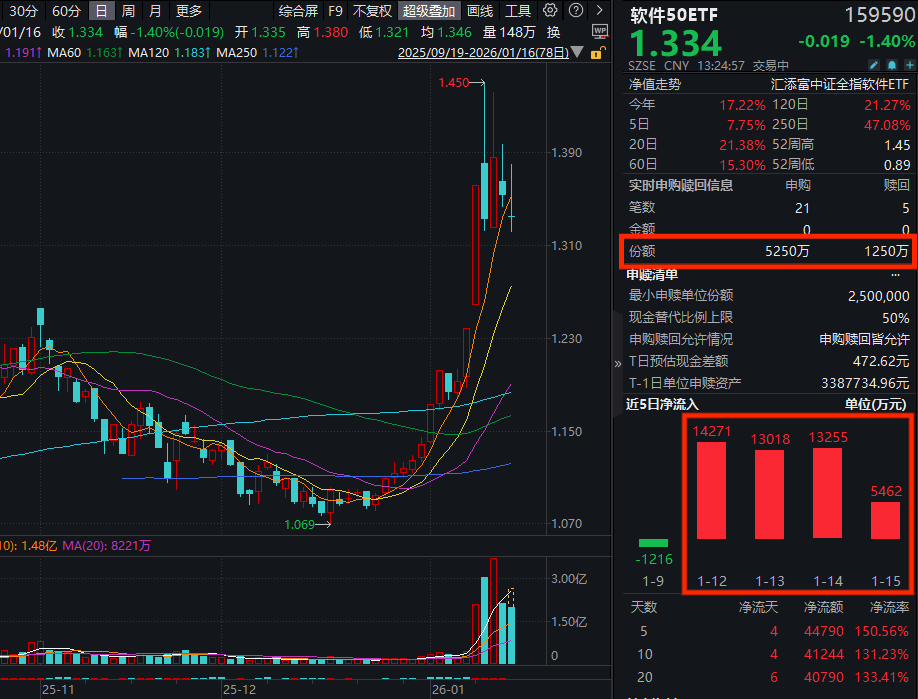
AI应用冲高回落!软件50ETF(159590)跌超1%,资金盘中逆势净流入超5300万元!阿里千问打造超级App,AI应用商业化快速落地!
Sou Hu Cai Jing· 2026-01-16 05:45
Group 1: Software Sector Performance - The software sector has experienced a second consecutive day of decline, with the Software 50 ETF (159590) dropping over 1% and a trading volume exceeding 1.8 billion yuan [1] - Despite the downturn, there was a net inflow of funds into the Software 50 ETF, with a net subscription of 40 million units, amounting to over 53 million yuan based on average trading prices [1] Group 2: Key Company Developments - Alibaba's Qianwen has launched a super app that integrates various services such as Taobao, Alipay, and Fliggy, marking a significant advancement in AI shopping capabilities [3] - Major component stocks in the software sector mostly retreated, with Youfu Network and Tuolisi dropping over 5%, while Zhongke Xingtou saw an increase of over 5% [4][5] Group 3: AI Market Insights - The global large model market is projected to reach $206.5 billion by 2029, driven by the growth of large model applications, which are expected to reach $151.5 billion during the same period [6] - The AI general assistant market is seeing consolidation among leading firms, with ByteDance, Tencent, and Alibaba expected to form a top tier in China [7] - AI companionship applications are anticipated to grow rapidly, with a projected market size of approximately $70 billion by 2030, reflecting a compound annual growth rate of 200% [8] Group 4: Industrial AI Integration - Policies are being implemented to enhance the integration of AI with industrial software, aiming for a high-quality development of industrial internet platforms by 2028 [10][11] - The industrial AI penetration rate is expected to rise significantly, with projections indicating that by 2025, 47.5% of industrial enterprises will adopt large models and intelligent agents [12]

人形机器人板块发力上攻,人工智能AIETF(515070)持仓股奥比中光大涨超6%
Mei Ri Jing Ji Xin Wen· 2026-01-16 05:24
Group 1 - The A-share technology sector is experiencing mixed performance, with storage and humanoid robot sectors seeing fluctuations and gains, while AI application sectors continue to decline [1] - The largest AI ETF in the Shanghai market (515070) has narrowed its decline to 0.23%, with significant gains in holdings such as Aobo Zhongguang-UW, which surged over 6% [1] - The robot leasing platform "Qingtian Rental" announced the completion of its seed round financing, achieving over 200,000 registered users and maintaining an average of over 200 daily orders within three weeks of launch [1] Group 2 - Qingtian Rental has partnered with major brands like Meiyijia, Haidilao, and Yuyuan Group to utilize robots for store traffic and brand activities, shifting from traditional equipment sales to a callable service model [1] - Dongfang Securities indicates that the investment logic in the humanoid robot industry is shifting from "hardware mass production" to "AGI (Artificial General Intelligence) development," emphasizing the importance of AGI capabilities as a key investment focus [1] - Despite Chinese companies leading in manufacturing, the marginal impact of simple robot mass production on investment is expected to diminish, with future value lying in AGI capabilities [1] Group 3 - The AI ETF (515070) tracks the CS AI theme index (930713), selecting component stocks that provide technology, basic resources, and application end stocks, focusing on the midstream and upstream of the AI industry chain [2] - The top ten weighted stocks in the ETF include leading domestic technology companies such as Zhongji Xuchuang, Xinyi Sheng, Hanwha Technology, and Hikvision [2]


科创ETF(588050)开盘涨0.85%,重仓股中芯国际涨2.46%,海光信息涨1.08%
Xin Lang Cai Jing· 2026-01-16 05:17
Group 1 - The core point of the article highlights the performance of the Sci-Tech ETF (588050), which opened with a gain of 0.85% at 1.548 yuan [1] - Major holdings in the Sci-Tech ETF include companies like SMIC, which rose by 2.46%, and other firms such as Haiguang Information, Cambrian, and Langqi Technology, which also saw positive gains [1] - The ETF's performance benchmark is the Shanghai Stock Exchange Sci-Tech Innovation Board 50 Index, managed by ICBC Credit Suisse Asset Management, with a return of 7.04% since its inception on September 28, 2020, and a recent one-month return of 13.25% [1]