三生制药

Search documents
医药行业2026年策略报告:坚定出海方向,把握结构性机遇-20251231
Huaxin Securities· 2025-12-31 11:05
Group 1 - The core investment theme for the pharmaceutical industry in 2025 is the overseas expansion of innovative drugs, which is expected to yield excess returns compared to the broader pharmaceutical sector and the CSI 300 index [2][21] - The innovative drug index has shown a significant increase, outperforming the pharmaceutical biological index by 37.48 percentage points, with a year-to-date increase of 65.99% [21] - Major transactions in the ADC and dual antibody fields are anticipated to continue, while there is a need to avoid repetitive competition in areas like small nucleic acids and focus on unmet clinical needs [3][4] Group 2 - The report emphasizes the importance of overseas markets for both innovative drugs and medical devices, suggesting that companies should seek growth opportunities beyond domestic market saturation [4][5] - The Chinese pharmaceutical industry is gradually becoming a global innovation center, with significant advancements in dual antibodies and ADCs, while also making strides in emerging fields like small nucleic acids and inhalation formulations [5][6] - The report highlights that the overseas authorization revenue has become a crucial funding source for innovative drug development, with a total upfront payment of $4.551 billion in the first three quarters of 2025 [29][32] Group 3 - The medical device sector is experiencing a shift towards overseas expansion, with a focus on high-value consumables and IVD products, as Chinese companies enhance their market share [7][55] - The export growth of high-value consumables is significant, with a recorded increase of 10.75% in the first half of 2025, particularly in the North American and European markets [57][66] - The report notes that the certification and market establishment processes for high-value consumables are long-term investments, requiring compliance with stringent regulations in the EU and the US [60][61] Group 4 - The recovery of financing in the domestic innovative drug sector has been robust, with a total of 324 financing events amounting to $5.51 billion in the first three quarters of 2025, marking a 67.6% increase year-on-year [70][72] - The CXO industry is experiencing varied recovery rhythms across different segments, with some areas like CDMO seeing order growth due to overseas financing recovery [74]



医药生物行业周报:创新药2026前瞻,出海从元年到大年,货与船并重:关注点从BD到CDP-20251231
Guohai Securities· 2025-12-31 10:33
Investment Rating - The report maintains a "Neutral" rating for the pharmaceutical and biotechnology industry [1]. Core Insights - The focus of the industry is shifting from "Business Development (BD)" to "Clinical Development Partnerships (CDP)" as companies aim to enhance their clinical development capabilities for overseas markets. The report emphasizes the importance of core assets and suggests that the industry is entering a strong alpha phase, with a continued positive fundamental outlook despite uncertainties in international expansion [2][12]. - The pharmaceutical sector has underperformed compared to the broader market, with a year-to-date return of 14.29% against the Shanghai Composite Index's 18.36%, indicating a 2.09 percentage point lag [2][3]. - The current valuation of the pharmaceutical sector is 32.9 times PE based on 2026 earnings forecasts, which represents a 37% premium over the overall A-share market (excluding financials). The TTM valuation stands at 29.1 times PE, below the historical average of 35.0 times PE [2][27]. Summary by Sections Recent Performance - For the week of December 22 to 26, 2025, the Shanghai Composite Index rose by 1.95%, while the pharmaceutical sector declined by 0.18%, ranking 25th among 31 sub-industries. The performance of various pharmaceutical sub-sectors was as follows: chemical pharmaceuticals (0.05%), biological products (-0.10%), medical devices (0.08%), pharmaceutical commerce (-1.66%), traditional Chinese medicine (-0.67%), and medical services (-0.25%) [2][8]. Market Dynamics - The report notes that the pharmaceutical sector's performance has been relatively weak, with a year-to-date return lagging behind the broader market. The report suggests that the recent adjustments in the pharmaceutical sector are seen as healthy and that the underlying logic for innovative drugs and devices remains unchanged [2][3]. Valuation Metrics - The report highlights that the pharmaceutical sector's current valuation is 32.9 times PE based on 2026 earnings forecasts, which is a 37% premium compared to the overall A-share market (excluding financials). The TTM valuation is 29.1 times PE, which is below the historical average of 35.0 times PE [2][27]. Key Companies and Developments - The report identifies key companies to watch, including Sanofi, Innovent Biologics, and others, indicating their significance in the ongoing developments within the industry [2][35].
共建共享 医药健康企业显担当
Bei Jing Wan Bao· 2025-12-31 08:00
Group 1 - The "Healthy China 2030" plan emphasizes the importance of national health and longevity as indicators of national strength and rejuvenation [1] - There is a growing demand for diversified and personalized healthcare services, including medical treatment, medication, chronic disease management, and healthy living [1] - Pharmaceutical companies are collaborating with national chain pharmacies to launch public welfare activities focused on specific disease segments to enhance public health literacy [1] Group 2 - Guangxi Jinsangzi Group launched a "Winter Clothing Donation" public welfare activity, providing 185 pieces of warm clothing and health products to students in a rural school, demonstrating a long-term commitment to public welfare and education [1] - SanSheng Mandi has established a network of 190,000 pharmacies to provide convenient services, including free hair follicle testing and professional consultations, aiming to address hair loss issues effectively [2] - Yiling Pharmaceutical focuses on public sleep health by conducting numerous educational activities to raise awareness about sleep disorders and provide medication guidance [3] - Yiling Pharmaceutical also addresses male prostate health through online and offline educational activities, reaching over 100,000 grassroots patients and promoting early prevention and screening [4]

中国癌症新药研发数量全球居首
3 6 Ke· 2025-12-31 03:52
Core Insights - Chinese companies are projected to conduct approximately 39% of global cancer clinical trials in 2024, surpassing the United States at about 32% [2][8] - The number of clinical trials in China has increased significantly, from around 2% in 2009 to approximately 35% in 2023, indicating a growing dominance in the cancer research field [2][8] - The Chinese government is providing strong support for new drug research, designating it as a key national focus and investing substantial resources [4][8] Clinical Trials and Market Dynamics - In 2024, Chinese enterprises are expected to conduct 896 cancer clinical trials, leading globally, while the U.S. will conduct 720 trials [2][8] - The total number of clinical trials globally is projected to be 5,318, with Chinese companies accounting for 1,669 trials, approximately 30% of the total [7][8] - The increase in patient numbers in China facilitates easier clinical trial execution and drug development [5] Collaborations and Partnerships - Japanese pharmaceutical companies are increasingly collaborating with Chinese firms, with notable agreements in cancer treatment and autoimmune disease therapies [6][7] - In 2023, Takeda Pharmaceutical signed an agreement with a Chinese company for cancer drug licensing, highlighting the advantages of conducting research in China [6][7] - By mid-2025, contracts between Chinese and global pharmaceutical companies are expected to exceed $48.5 billion, indicating a robust partnership trend [7] Intellectual Property and Globalization - China filed over 188,000 drug patents in 2024, significantly outpacing the U.S. with about 53,000 patents, reflecting a rapid enhancement in research capabilities [7][8] - For Chinese drugs to enter international markets, they must undergo rigorous clinical trials and secure regulatory approvals, emphasizing the importance of intellectual property protection [10] - The potential for innovative Chinese drugs to be utilized globally is increasing, necessitating careful management of economic and geopolitical risks [10]

ETF盘中资讯|续创阶段新低,港股通创新药ETF(520880)溢价逆向走高,千万资金逢跌揽筹!机构:2026年战略性布局创新药
Sou Hu Cai Jing· 2025-12-31 03:36
Core Viewpoint - The Hong Kong Stock Connect Innovative Drug ETF (520880) has experienced a continuous decline for four days, reaching a new low since July 10, indicating a strong buying interest despite the downturn [1][2]. Group 1: Market Performance - The Hong Kong Stock Connect Innovative Drug ETF (520880) has seen a price drop of 0.80%, currently priced at 0.499, with a trading volume of 124,339 shares [1]. - The ETF has been in a downward trend since September, with the current adjustment lasting over three months, leading to the ETF trading below its issuance price [2]. Group 2: Investment Strategy - Analysts suggest that 2026 will be a strategic year for investing in innovative drugs, as the current market conditions may present a favorable entry point for investors [2]. - The ETF tracks the Hang Seng Hong Kong Stock Connect Innovative Drug Select Index, which has three key advantages: it exclusively includes innovative drug companies, has a high concentration of leading firms (over 72% in the top ten), and offers better risk control by reducing the weight of less liquid stocks [2][3]. Group 3: Composition and Risk Management - The top ten holdings of the ETF account for 72.57% of its total weight, showcasing a significant concentration in leading innovative drug companies [3]. - The ETF is designed to mitigate risks associated with less liquid stocks by enforcing a forced reduction in their weight, thus controlling tail risks effectively [2][3].
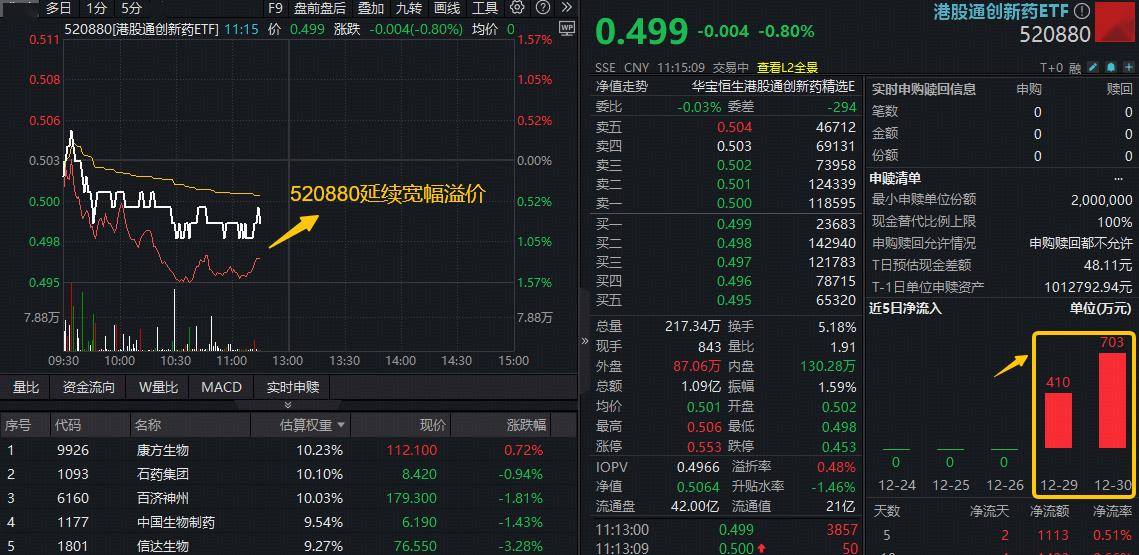
续创阶段新低,港股通创新药ETF(520880)溢价逆向走高,千万资金逢跌揽筹!机构:2026年战略性布局创新药
Xin Lang Cai Jing· 2025-12-31 03:25
Group 1 - The Hong Kong innovation drug sector continues to experience a downturn, with leading companies like BeiGene and China Biologic falling over 1%, and Innovent Biologics and 3SBio dropping more than 3% [1][7] - The Hong Kong Innovation Drug ETF (520880) has seen a decline for four consecutive days, reaching a new low since July 10, with a premium rising inversely, indicating strong buying interest [8][1] - Recent analysis from Zhongyou Securities indicates that the innovation drug sector is in a continuous correction phase, primarily driven by a retreat from previously optimistic business development (BD) expectations [3][10] Group 2 - Looking ahead to 2026, the maturity of clinical data is expected to be a key factor driving the innovation drug market, with BD being a necessary outcome of enhanced competitiveness of domestic new drugs [3][10] - Dongwu Securities suggests that the current period may represent a favorable configuration window for the Hong Kong innovation drug sector, which has been in adjustment since September, lasting over three months [10] - The Hong Kong Innovation Drug ETF (520880) and its associated funds track the Hang Seng Hong Kong Innovation Drug Select Index, which has three unique advantages: it is purely focused on innovation drugs, has a high concentration of leading companies, and offers better risk control [10][11] Group 3 - The top ten holdings in the Hong Kong Innovation Drug ETF account for over 72% of the index, highlighting the dominance of leading companies in the sector [4][10] - The total market capitalization of the top ten companies in the ETF is approximately HKD 12.87 billion, with BeiGene having a weight of 11.51% and a market cap of HKD 3.07 billion [4][10] - For investors looking to reduce volatility while still focusing on innovation drugs, the only drug ETF in the market (562050) is recommended, which emphasizes both innovation drugs and traditional Chinese medicine [12][13]
中国癌症新药研发数量全球居首
日经中文网· 2025-12-31 03:02
Core Viewpoint - Chinese companies are leading the world in cancer clinical trials, with a projected 39% share in 2024, surpassing the United States at 32% and indicating a significant shift in the global pharmaceutical landscape [1][3]. Group 1: Clinical Trials and Market Position - In 2024, Chinese enterprises are expected to conduct 896 cancer clinical trials, representing 39% of the global total, while the U.S. will account for approximately 32% [3]. - The number of clinical trials conducted by Chinese companies has increased from about 2% in 2009 to 35% in 2023, marking a substantial growth trajectory [3]. - The global market for pharmaceuticals is projected to see China’s drug expenditure reach $166 billion in 2024, constituting 10% of the global market [9]. Group 2: Government Support and R&D Investment - The Chinese government has prioritized new drug research as a key area, providing substantial funding and talent, particularly in the biopharmaceutical sector [7]. - The "Made in China 2025" initiative has identified biomedicine as a critical industry for national revitalization [7]. Group 3: Collaborations and Partnerships - Japanese pharmaceutical companies are increasingly collaborating with Chinese firms, with notable agreements for cancer treatments and other therapeutic areas [8]. - In the first half of 2025, contracts between Chinese and global pharmaceutical companies reached 61, totaling $48.5 billion, indicating a growing trend in international partnerships [9]. Group 4: Innovation and Patent Applications - China applied for over 188,000 drug patents in 2024, significantly outpacing the U.S. with approximately 53,000 applications, showcasing an increase in R&D capabilities [9]. - The quality of drug development in China is improving, with expectations for the emergence of blockbuster drugs and major pharmaceutical companies in the future [9]. Group 5: Global Market Challenges - Despite advancements, Chinese drugs primarily remain within the domestic market, with challenges in gaining approval for international sales [11]. - The need for transparent clinical trial data and intellectual property protection is crucial for Chinese companies aiming for global market entry [12].



年度行情收官 10家券商金股组合收益率亮眼超过50%
Zheng Quan Shi Bao· 2025-12-31 01:28
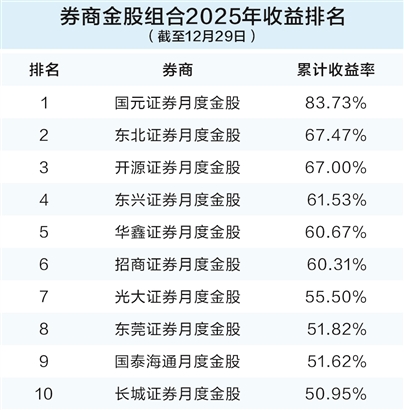
Core Insights - The report highlights the performance of stock recommendations from various brokerages, with 10 brokerages achieving over 50% returns in 2025, showcasing their ability to identify and recommend stocks early in the market cycle [2][3]. Group 1: Brokerage Performance - The highest cumulative return was achieved by Guoyuan Securities at 83.73%, followed by Northeast Securities and Kaiyuan Securities with returns of 67.47% and 67% respectively [2]. - Other brokerages such as Dongxing Securities, Huaxin Securities, and China Merchants Securities also reported returns exceeding 60%, while Everbright Securities, Dongguan Securities, Guotai Junan, and Changcheng Securities had returns above 50% [2]. Group 2: Stock Selection Strategy - The success of these brokerages is attributed to their strategy of identifying stocks at low points and consistently recommending them, which has led to significant gains [4][5]. - For instance, Kaiyuan Securities recommended Xinyisheng for four consecutive months, resulting in a total increase of 440% from May to August [6]. Group 3: Popular Stocks - Tencent Holdings emerged as the most recommended stock, being favored by around seven brokerages each month, making it the most popular stock of the year [7]. - The report indicates that the most popular stocks varied throughout the year, with technology stocks dominating in the first quarter, consumer stocks in the second, financial stocks in the third, and a return to technology stocks in the fourth quarter [7].





年度行情今日收官 十家券商金股组合收益率超百分之五十
Zheng Quan Shi Bao· 2025-12-30 18:19
Core Insights - The article highlights the performance of brokerage firms' recommended stocks, known as "golden stocks," which have achieved over 50% returns in 2025, with some firms excelling by identifying and recommending stocks early in their upward trends [1][3]. Group 1: Performance of Golden Stocks - As of December 29, 2025, 10 brokerage firms' golden stock portfolios recorded returns exceeding 50%, with the highest being 83.73% from Guoyuan Securities [3]. - Other notable performers include Northeast Securities and Kaiyuan Securities, with returns of 67.47% and 67%, respectively [3]. - The golden stock strategy has become a mature business for many brokerage firms, showcasing their research capabilities and market insights [3]. Group 2: Strategies for Success - Early identification of stocks at low prices and consistent recommendations have been key strategies for achieving high returns [4]. - For instance, Kaiyuan Securities recommended Xinyisheng for four consecutive months, resulting in a total increase of 440% from May to August [5]. - Guoyuan Securities focused on sectors like media, pharmaceuticals, and machinery, with significant monthly gains from stocks like Giant Network and JiBit [4]. Group 3: Popularity of Tencent - Tencent Holdings emerged as the most recommended stock, being favored by around seven brokerage firms monthly, making it the top "golden stock" of the year [2][6]. - The popularity of stocks varies by quarter, with technology stocks dominating in the first quarter, consumer stocks in the second, financial stocks in the third, and a return to technology stocks in the fourth quarter [6]. Group 4: Market Trends and Recommendations - The article notes that not all popular stocks achieve high success rates, with less than 40% of the most recommended A-share stocks showing gains in the same month they were recommended [7].


年内最大港股Biotech IPO!港股通创新药ETF(159570)跌超1%再创阶段新低,昨日净流入超1100万元!JPM大会有哪些值得关注?
Xin Lang Cai Jing· 2025-12-30 09:56
Core Viewpoint - The Hong Kong pharmaceutical market is experiencing a downturn, with the Hong Kong Stock Connect Innovation Drug ETF (159570) declining by 1.14% and over 25% from its previous high, despite a significant trading volume of over 1.44 billion yuan [1][4]. Group 1: Market Performance - The Hong Kong Stock Connect Innovation Drug ETF (159570) has seen a three-day decline, reaching a new low, with a total trading volume exceeding 14.4 billion yuan [1]. - As of December 29, the latest scale of the Hong Kong Stock Connect Innovation Drug ETF (159570) is over 21.9 billion yuan, leading among its peers [1]. - Major stocks within the ETF, such as King’s Bio and Kelun-Bio, have experienced declines, with King’s Bio dropping over 3% [4][5]. Group 2: IPO Activity - On December 30, Insilico Medicine, a generative AI-driven biopharmaceutical company, successfully listed on the Hong Kong Stock Exchange, marking it as the first AI biopharmaceutical company to do so under the main board listing rules [3]. - The IPO raised a total of 2.277 billion Hong Kong dollars, making it the highest fundraising biopharmaceutical IPO in Hong Kong for the year [3]. Group 3: Industry Trends - The upcoming J.P. Morgan Healthcare Conference in January 2026 is expected to attract over 8,000 global participants, featuring more than 500 listed companies and thousands of startups, focusing on "capital + strategy" discussions [6]. - Key trends highlighted for the industry include the continued rise of gene and cell therapies, deep integration of AI in pharmaceuticals, and the emergence of new market forces from China [7]. Group 4: Investment Insights - Multinational corporations (MNCs) are willing to pay higher prices for innovative drugs and technology platforms from China, with average total deals from China reaching 2.756 billion USD compared to 1.289 billion USD from overseas [8]. - The pressure from patent expirations, estimated at around 300 billion USD in sales, is driving MNCs to seek high-potential assets in China, particularly in advanced fields like ADCs and cell therapies [9]. - MNCs are shifting their focus from merely acquiring products to obtaining platforms and technologies that can yield new molecules, indicating a strategic evolution in their investment approach [10]. Group 5: Key Investment Areas - Key investment areas include ADCs, GLP-1 for metabolic diseases, bispecific antibodies, and neuroscience, with a focus on companies that can deliver competitive clinical data and innovative platforms [12][13].