
中国进出口银行

Search documents
电信网络诈骗手段花样翻新 银行加固防火墙构建反诈新格局
Zheng Quan Shi Bao· 2025-07-16 23:46
电信网络诈骗手段花样翻新 银行加固防火墙构建反诈新格局 记者 李颖超 一场由技术护航的金融安全变革,正在全国商业银行间悄然展开。 近期,随着中宣部、公安部联合部署的"全民反诈在行动"宣教工作全面铺开,银行、清算机构、消费金 融公司等机构积极响应,充分利用线上平台、社交媒体等渠道,结合线下互动,通过发布图文、短视 频、文字等包含金融知识和诈骗案例警示的多样化内容,广泛传播反诈知识。 证券时报记者深入业内观察发现,面对电信网络诈骗手段的持续升级,商业银行正通过引入人工智能、 大数据等前沿技术,结合线上线下反诈宣教活动,构建起"智能防控+生态共治"的反诈新格局。 主动防御 筑牢防线 在金融诈骗手段日益复杂多变的当下,主动防御、筑牢公众的金融安全意识防线已成为金融机构的重要 使命。 "近年来,随着《中华人民共和国反电信网络诈骗法》深入实施,金融机构正从事后处置向事前预防转 型。"华东地区某国有银行从业人士向证券时报记者表示,目前,无论是在意识层面还是在技术层面, 商业银行、支付平台等都主动开展反诈工作以保护用户资金安全。 7月以来,"全民反诈在行动"活动持续推进,各类金融机构积极响应。 7月上旬,中国人民银行深圳分行 ...
中国进出口银行董事长陈怀宇会见麦格理集团首席执行官
news flash· 2025-07-15 09:43
Group 1 - The core viewpoint of the meeting is to enhance cooperation between China Export-Import Bank and Macquarie Group in various sectors [1] - Both parties agreed to maintain communication on key countries and sectors, exploring business cooperation opportunities in infrastructure, commodities, peer collaboration, financial markets, and green development [1] - The meeting emphasized leveraging each other's strengths to promote practical cooperation [1]

消息称智谱同时推进香港和A股IPO;Manus总部迁至新加坡,清空国内多平台账号|36氪出海·要闻回顾
36氪· 2025-07-13 12:00
Group 1 - Zhihui is preparing for both Hong Kong and A-share IPOs, with a higher probability for A-share listing due to recent strategic financing of 1 billion yuan from state-owned enterprises [2][3] - AliExpress has launched a "same-day delivery" service in the UK, partnering with local delivery platform HungryPanda, and has expanded collaborations in Australia, Brazil, and the Middle East since last year [2][3] - Manus has relocated its headquarters to Singapore and has laid off some domestic staff, with its website indicating "not available in your region" [2][3] Group 2 - TikTok has denied reports of developing a separate app for the US market with different algorithms, stating that the information is inaccurate [4] - ByteDance refuted claims regarding the sale of TikTok's US operations to a consortium led by Oracle, emphasizing that the information is false [4] - Shanghai Zhiyuan Robotics has no immediate plans to change its main business or undergo significant asset restructuring in the next 12 months [4] Group 3 - Tea Yan Yue Se has officially announced its entry into the North American market through e-commerce, launching nearly 40 products across various platforms [5] - Pony.ai has started Robotaxi road tests in Luxembourg, collaborating with local transportation company EmileWeber [5] - US President Trump announced plans to impose a unified tariff of 15% or 20% on countries that have not yet received tariff notices [5] Group 4 - A-share companies have seen significant overseas orders and are expanding production bases abroad, with over 60 disclosed overseas investment and acquisition cases in the first half of the year [6] - Hong Kong's IPO market is thriving, with a 20% increase in the Hang Seng Index and 42 IPOs raising over 107 billion HKD in the first half of 2025 [7] - The Export-Import Bank of China has provided over 610 billion yuan in loans to foreign trade enterprises in the first half of the year, supporting small and micro foreign trade businesses [7] Group 5 - Star Epoch, a company focused on embodied intelligence, completed a 500 million yuan Series A financing round, with significant growth in overseas orders [8] - Itstone Technology raised 122 million USD in a financing round to enhance its technology ecosystem and expand its global talent recruitment [8] - Shuwen Biotech completed nearly 100 million yuan in financing to accelerate the market promotion of its innovative diagnostic products [8]



银行业为“全球南方”共谋高质量发展积蓄力量
Jin Rong Shi Bao· 2025-07-11 01:52
Group 1: Core Perspectives - The Chinese Premier Li Qiang emphasized the importance of strengthening strategic cooperation between China and Egypt as key members of the "Global South" to promote peace and prosperity [1] - The "Global South" now accounts for over 40% of the global economy and contributes 80% to global economic growth, becoming a crucial force in maintaining world peace and driving development [1] Group 2: Financial Cooperation and Infrastructure Development - Financial cooperation is a key area for win-win collaboration among "Global South" countries, with Chinese financial institutions optimizing services to support high-quality development [2][3] - The Belgrano freight railway in Argentina saw its capacity increase to 235% post-renovation, funded by the China Development Bank, showcasing successful infrastructure projects [2] - Ecuador's first national ultra-high voltage transmission line, financed by the Export-Import Bank of China, has significantly improved the country's power supply capacity [2] Group 3: Policy Support and Investment - The Chinese government has announced a $10 billion trade financing quota to support African exports and established financing windows totaling 350 billion RMB to support Belt and Road projects [3] - The establishment of a research center for the "Global South" and the continued use of a $20 billion funding window for developing countries highlight China's commitment to deepening practical cooperation [3] Group 4: Trade and Project Cooperation - The rise of the "Global South" has led to increased economic and trade exchanges, with China supporting its enterprises to invest abroad while welcoming foreign investments [4] - Chinese financial institutions are actively involved in major projects in Brazil, creating significant economic, social, and environmental value [5] Group 5: Financial Services and Cross-Border Transactions - Agricultural Bank of China plans to provide nearly $100 billion in financing services for trade between China and "Global South" countries in 2024, supporting over 100 Chinese enterprises [6] - The promotion of cross-border RMB loans and payment systems is enhancing trade facilitation and financial stability among "Global South" nations [7][8]



收评:沪指涨0.48%重回3500点 城镇化概念股集体爆发
Xin Hua Cai Jing· 2025-07-10 07:44
Market Performance - A-shares experienced a significant upward trend on July 10, with the Shanghai Composite Index rising by 0.48% to close above 3500 points for the first time since January 25, 2022 [1] - The Shenzhen Component Index increased by 0.47%, while the ChiNext Index rose by 0.22% [1] - Total trading volume reached 613.2 billion yuan for the Shanghai market and 881 billion yuan for the Shenzhen market [1] Sector Performance - Real estate, urbanization concept stocks, and silicon energy sectors saw substantial gains, with multiple stocks hitting the daily limit [1][2] - Major financial stocks, including the four largest banks, reached historical highs [1] - The PCB sector faced adjustments, with specific stocks experiencing significant declines [1] Institutional Insights - Market trends are expected to remain upward, with a focus on sectors such as semiconductors, consumer electronics, artificial intelligence, and low-altitude economy [3] - The cement industry is anticipated to see controlled supply and stable profitability due to recent policy changes [3] - Global capital flows are shifting, with increased investments in European stocks and outflows from U.S. equities [3] Policy Developments - The National Development and Reform Commission emphasized the importance of new urbanization, aiming for significant investments in key areas by 2035 [4] Financial Sector Updates - The China Export-Import Bank reported over 610 billion yuan in new loans to foreign trade sectors in the first half of the year, supporting small and micro foreign trade enterprises [6]
中国进出口银行:上半年新投放外贸领域贷款超6100亿元
news flash· 2025-07-10 04:12
Core Viewpoint - In the first half of the year, the Export-Import Bank of China significantly increased its support for foreign trade enterprises, with new loans exceeding 610 billion yuan [1] Group 1: Loan Support for Foreign Trade - The Export-Import Bank of China issued over 610 billion yuan in loans to the foreign trade sector in the first half of the year [1] - New loans for small and micro foreign trade enterprises reached over 17 billion yuan, marking a year-on-year growth of nearly 20% [1]
东方红货币市场基金2025年第2季度报告
Zheng Quan Zhi Xing· 2025-07-10 02:33
Core Viewpoint - The report provides an overview of the performance and management of the Dongfang Hong Money Market Fund for the second quarter of 2025, highlighting its investment strategy, financial indicators, and net asset value performance. Fund Product Overview - The Dongfang Hong Money Market Fund is managed by Shanghai Dongfang Securities Asset Management Co., Ltd. and is custodied by Industrial and Commercial Bank of China Limited. The fund aims to ensure high liquidity of assets while pursuing stable returns that exceed the performance benchmark [3][4]. Financial Indicators and Fund Net Value Performance - For the reporting period from April 1, 2025, to June 30, 2025, the fund's A class net value yield was 0.3307%, B class was 0.3908%, C class was 0.3308%, D class was 0.3683%, and E class was 0.3908%, all outperforming the benchmark yield of 0.0873% [15]. - The total fund assets at the end of the reporting period amounted to approximately 30.17 billion RMB [4]. Investment Strategy - The fund employs an active investment strategy based on predictions of short-term interest rate changes, utilizing both qualitative and quantitative analyses to achieve stable current returns while controlling risks and ensuring liquidity [5][14]. Management Report - The fund management team has adhered to relevant laws and regulations, ensuring fair treatment of all funds managed and maintaining a focus on maximizing the interests of fund shareholders [13][19]. Investment Portfolio Report - The fund's investment portfolio at the end of the reporting period included approximately 60.52% in bonds, with a focus on maintaining a balanced and liquid asset allocation [16][17]. - The average remaining maturity of the investment portfolio was 93 days, indicating a strategy focused on short-term investments [17]. Other Important Information - The fund did not experience any significant trading anomalies during the reporting period, and there were no instances of the fund's net asset value falling below the required thresholds [15][19].
上半年反洗钱罚单同比猛增近三倍!湘财证券“老鼠仓”被重罚
2 1 Shi Ji Jing Ji Bao Dao· 2025-07-07 12:07
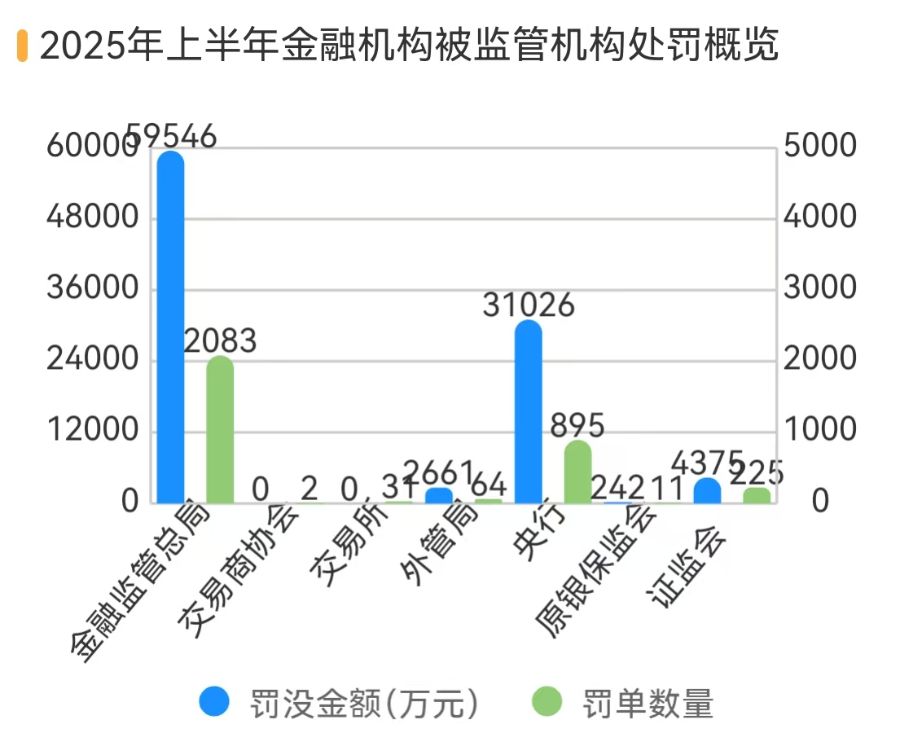
Summary of Key Points Core Viewpoint The financial institutions in China faced a significant reduction in penalties during the first half of the year, with a total of 3,311 fines amounting to 978 million yuan, representing a year-on-year decrease of 14.13% and 24.24% respectively [1][4]. Group 1: Penalty Overview - The National Financial Supervisory Administration issued the most fines, totaling 2,083, with penalties amounting to 595 million yuan, indicating a decrease in enforcement compared to the previous year [1][4]. - The People's Bank of China increased its enforcement, issuing 895 fines, a year-on-year increase of 202.36%, with penalties totaling 310 million yuan, up 179.28% [1][4]. Group 2: Monthly Distribution of Penalties - January saw the highest number of penalties, with 933 fines and 367 million yuan in penalties, accounting for 37.53% of the total penalties for the first half of the year [4]. - The penalty amounts rebounded in June to 158 million yuan, while the months from February to May showed relatively stable enforcement levels [4]. Group 3: Sector-Specific Penalties - The banking sector received the most penalties, with 2,181 instances and fines totaling 721 million yuan, representing 73.72% of the total penalties [7]. - Insurance institutions faced 825 penalties with fines of 151 million yuan, primarily for providing false reports and data [10]. - Securities firms received 93 penalties, totaling 36.08 million yuan, with a focus on violations in investment banking [10]. Group 4: Major Penalties - Notable fines included the Agricultural Bank of China, which was fined 516.05 million yuan for multiple violations, including failure to fulfill customer identity verification obligations [11]. - Other significant penalties involved China Minsheng Bank and China Everbright Bank, with fines of 180.46 million yuan and 187.88 million yuan respectively for similar violations [11]. Group 5: Compliance Trends - There was a dramatic increase in anti-money laundering penalties, with 610 fines issued, a year-on-year increase of 278.88% [15]. - Violations related to deposit management saw 55 penalties, a 44.74% increase from the previous year, focusing on issues like inflated deposits [16][17]. - Penalties related to financial statistics and data management increased by 67.8%, with 99 fines issued for violations in reporting and data accuracy [18][19]. Group 6: Penalty Rankings - The top ten penalties in the banking sector were predominantly from state-owned and joint-stock banks, with issues primarily in loan management and employee conduct [20][21]. - In the non-banking sector, insurance companies dominated the top ten penalties, with China People's Property Insurance leading at 20.04 million yuan [24].
金融活水精准滴灌 《智普惠 新金融(2024)》重磅发布
2 1 Shi Ji Jing Ji Bao Dao· 2025-07-07 12:01
Core Viewpoint - The development of inclusive finance in China has evolved from a policy initiative to a core driver for balanced economic and social development, with a goal to establish a high-quality comprehensive inclusive financial system within the next five years [1] Group 1: Development Goals and Achievements - The implementation plan released by the Financial Regulatory Administration and the People's Bank of China aims to enhance inclusive finance to promote common prosperity [1] - The inclusive finance system in China has made historic achievements over nearly a decade, addressing structural issues such as financing difficulties and high costs for small and micro enterprises and agricultural entities [1] Group 2: Technological Integration - The shift from "quantitative expansion" to "qualitative improvement" in the inclusive finance sector is a key challenge, with financial technology represented by big data and artificial intelligence being crucial for resolving structural contradictions [2] - Innovations like the "live biological digital" loan model by Industrial Bank utilize IoT and AI to convert hard-to-assess rural assets into quantifiable digital credit, addressing credit collateral issues in agriculture [2] Group 3: Expert Insights and Theoretical Framework - The book invites experts to analyze the future of inclusive finance, emphasizing the need for a dual-driven approach from both government and market to resolve structural contradictions [3] - The research team summarizes common issues from case studies, providing a practical and policy-oriented perspective alongside theoretical insights [3] Group 4: Case Studies and Innovations - The book features over 80 case studies showcasing diverse innovations in business collaboration, product design, and risk management within the inclusive finance sector [4] - Notable examples include the "water-saving loan" by Bank of China and the use of satellite technology by ICBC to optimize agricultural credit models, demonstrating how technology can enhance rural economic services [4] Group 5: Service to New Citizens and Consumer Protection - Institutions like the National Development Bank and China Postal Savings Bank are exploring financial services tailored to new citizens, including pension finance and community finance [5] - Innovations in product and service delivery, such as digital financial education by China Construction Bank and services for the hearing-impaired by Shenzhen Rural Commercial Bank, highlight the sector's commitment to improving customer experience and protecting consumer rights [5] Group 6: Future Directions - The publication of "Intelligent Inclusive New Finance" marks a pivotal moment as inclusive finance transitions from quantity to quality, providing insights and methodologies that may guide future reforms and innovations in the sector [5]
债市阿尔法:浮息债全解:利率变局中的攻守之道
Guoxin Securities· 2025-07-04 08:48
1. Report Industry Investment Rating No information about the report industry investment rating is provided in the given content. 2. Core Viewpoints of the Report - The scale of floating - rate bonds in China is still small. As of the end of 2024, the outstanding amount of floating - rate bonds was 52.01 billion yuan, accounting for 0.3% of the total bond balance [34]. - The valuation of floating - rate bonds is based on the discounted cash flow method (DCF), and the difficulty lies in predicting future coupon payments and selecting the discount rate [2][54]. - The change in the benchmark interest rate is inversely related to the bond value. The farther the valuation date is from the reset date, the greater the impact of interest rate changes on the bond value. The term spread is also inversely related to the bond value when the benchmark interest rate is constant, and the impact on the bond price needs to be observed in combination with the benchmark interest rate [2]. - Floating - rate bonds are more resistant to decline in a bear market and weaker in a bull market compared to fixed - rate bonds [2]. - The floating - rate bonds imply that the 1 - year LPR will first decline and then rise in the next three years, and the implied interest - rate cut expectation of floating - rate bonds of China Development Bank is stronger than that of Agricultural Development Bank bonds [3]. - Considering the expiration of US tariff exemptions and the appreciation of the RMB, an additional 10 - 20BP interest - rate cut is expected in the second half of the year, and the decline of 1YLPR in the second half of the year is likely to be higher than the implied value of floating - rate bonds [4][99]. 3. Summary According to the Directory 3.1 China's Floating - Rate Bond Historical Changes - The issuance scale of floating - rate bonds has fluctuated and increased, with significant shrinkage in the past three years. It has experienced three rounds of expansion and adjustment, with the peak issuance scale reaching 64.16 billion yuan in 2021, and the average issuance scale from 2022 - 2024 being only 16.34 billion yuan [14][17]. - The benchmark interest rate has changed from single to diversified, from the 1 - year fixed - deposit interest rate at the beginning to various types such as SHIBOR, LPR, and DR [20][21]. - Policy - bank bonds and asset - backed securities (ABS) have alternately dominated. Since 2022, policy - bank bonds have become the main type again [26]. - The issuance term has evolved from being highly concentrated (7 - 10 years) to gradually dispersed and then re - concentrated (2 - 3 years) [28][30]. 3.2 China's Floating - Rate Bond Current Situation - As of the end of 2024, the outstanding amount of floating - rate bonds was 52.01 billion yuan, accounting for 0.3% of the total bond balance. By bond type, the top three are policy - bank bonds, ABS, and non - financial corporate credit bonds. By benchmark interest rate, the top three are the 1 - year loan prime rate (LPR), the 7 - day inter - bank pledged repo rate, and the 5 - year loan prime rate (LPR). By issuance term, the top three are 2 - 3 years, over 10 years, and 7 - 10 years [34]. 3.3 Floating - Rate Bond Valuation Method - The valuation of floating - rate bonds is based on the DCF method, which discounts future coupon payments and principal to the current point in time. The difficulty lies in predicting future coupon payments and selecting the discount rate [54]. - The China Foreign Exchange Trade System simplifies the valuation formula by assuming that the benchmark interest rate remains unchanged after the valuation date, but this method does not reflect the market's expectation of future interest rates [56]. 3.4 Theoretical Analysis of Factors Affecting the Investment Value of Floating - Rate Bonds - The change in the benchmark interest rate is inversely related to the bond value. When the benchmark interest rate rises, the bond value falls, and vice versa. The farther the valuation date is from the reset date, the greater the impact of interest rate changes on the bond value [2][66]. - When the benchmark interest rate is constant, the term spread is inversely related to the bond value. The impact on the bond price needs to be observed in combination with the benchmark interest rate [72]. 3.5 Comparison between Floating - Rate Bonds and Fixed - Rate Bonds - In a rising - interest - rate environment, both floating - rate bonds and fixed - rate bonds will decline in price, but the decline of floating - rate bonds is smaller. In a falling - interest - rate environment, the price increase of fixed - rate bonds is greater than that of floating - rate bonds [78]. 3.6 Current Pricing Investigation of Floating - Rate Bonds - By studying the price changes of floating - rate bonds, the market's expectation of future monetary - policy trends can be inferred. The floating - rate bonds imply that the 1 - year LPR will first decline and then rise in the next three years, and the implied interest - rate cut expectation of floating - rate bonds of China Development Bank is stronger than that of Agricultural Development Bank bonds [3][83]. 3.7 Analysis of the Value of Floating - Rate Bonds from Future Interest - Rate Adjustment Range and Rhythm - Considering the expiration of US tariff exemptions and the appreciation of the RMB, an additional 10 - 20BP interest - rate cut is expected in the second half of the year, and the decline of 1YLPR in the second half of the year is likely to be higher than the implied value of floating - rate bonds. The allocation value of floating - rate bonds in the second half of the year may be lower than that of fixed - rate bonds [4][99]. - Four interest - rate cut scenarios are simulated, and the interest - rate increase rhythms at which the allocation values of floating - rate and fixed - rate bonds are in equilibrium are fitted for each scenario [100].