
珀莱雅

Search documents
——化妆品医美行业周报20251222:林清轩上市在即,高端护肤赛道再添看点-20251222
Shenwan Hongyuan Securities· 2025-12-22 06:33
Investment Rating - The report indicates a positive investment outlook for the cosmetics and medical beauty sector, highlighting strong performance relative to the market [2][3]. Core Insights - The cosmetics and medical beauty sector has shown resilience, with the Shenwan Beauty Care Index rising by 2.9% from December 12 to December 19, 2025, outperforming the market [2][3]. - Lin Qingxuan, a leading high-end plant skincare brand, is preparing for its IPO in Hong Kong, with a focus on its core product, camellia oil, which has sold over 30 million bottles [2][6]. - Minooxidil products from Mandi International dominate the hair growth market, with a market share of approximately 57% in the hair loss treatment sector [7][10]. Summary by Sections Industry Performance - The Shenwan Cosmetics Index increased by 2.2%, outperforming the Shenwan A Index by 2.4 percentage points, while the Shenwan Personal Care Index rose by 4.4%, exceeding the Shenwan A Index by 4.6 percentage points [2][3]. - Top-performing stocks included Hongmian Co. (+16.2%), Jiaheng Jiahua (+11.4%), and Baiya Co. (+9.1%) [3]. Company Highlights - Lin Qingxuan's product matrix includes 188 SKUs, with camellia oil accounting for 37% of revenue in 2024, while face creams and masks contribute 15.7% and 12.2%, respectively [6]. - Mandi International's revenue is projected to grow from 982 million yuan in 2022 to approximately 1.455 billion yuan in 2024, with a CAGR of 21.7% [8]. - The company has maintained a leading position in the minoxidil market for ten consecutive years, with a market share of 71% in 2024 [10]. Market Trends - The Chinese consumer healthcare market is expected to grow from 9.313 billion yuan in 2018 to 16.420 billion yuan in 2024, with a CAGR of 9.9% [9]. - The hair health management market is projected to grow at a CAGR of 17.7% from 2018 to 2024, while the weight management drug market is expected to grow at 20.7% during the same period [9]. E-commerce Insights - The report highlights significant growth in online sales channels, with Lin Qingxuan's online revenue increasing by 81.1%, contributing to 59.1% of total revenue [6]. - The overall cosmetics retail sales in China for the first 11 months of 2025 reached 428.5 billion yuan, with a year-on-year growth of 4.8% [14][15]. Strategic Developments - Proya has invested in the cosmetic raw material company Huaguan Biotechnology to enhance its capabilities in the whitening market, which is projected to exceed 150 billion yuan by 2027 [16][19]. - The report emphasizes the importance of product innovation and market positioning for domestic brands, which are gaining market share against international competitors [22].

化妆品医美行业周报:林清轩上市在即,高端护肤赛道再添看点-20251222
Shenwan Hongyuan Securities· 2025-12-22 03:46
Investment Rating - The report maintains a "Positive" outlook on the cosmetics and medical beauty industry, highlighting strong performance in the sector [2]. Core Insights - The cosmetics and medical beauty sector outperformed the market, with the Shenwan Beauty Care Index rising by 2.9% from December 12 to December 19, 2025, surpassing the Shenwan A Index by 2.4 percentage points [3][4]. - Lin Qingxuan, a leading high-end plant skincare brand, is set to launch its IPO in Hong Kong, with a focus on its core product, camellia oil, which has sold over 30 million bottles [9]. - Minooxidil products from Mandi International dominate the hair growth market, with a market share of approximately 57% in the hair loss treatment sector [10][13]. - Proya has invested in a cosmetic raw material company, Huaguan Biotechnology, to enhance its whitening product offerings, targeting a market expected to exceed 150 billion yuan by 2027 [19][22]. Summary by Sections Industry Performance - The cosmetics and medical beauty sector showed strong performance, with the Shenwan Beauty Care Index increasing by 2.9% during the specified period, outperforming the Shenwan A Index [3][4]. Company Highlights - Lin Qingxuan's product matrix includes 188 SKUs, with camellia oil contributing 37% to revenue in 2024, while offline channels are expected to generate 40.9% of revenue [9]. - Mandi International's revenue grew from 982 million yuan in 2022 to approximately 1.455 billion yuan in 2024, with a CAGR of 21.7% [11]. - Proya's strategic investment in Huaguan Biotechnology aims to capture a significant share of the whitening market, with new product launches and patent approvals [19][22]. Market Trends - The Chinese consumer healthcare market is projected to grow from 931.3 billion yuan in 2018 to 1.642 trillion yuan in 2024, driven by increased health awareness and digital transformation [12]. - The hair health management market is expected to grow at a CAGR of 17.7% from 2018 to 2024, indicating strong demand for hair loss treatments [12][13]. - The overall retail sales of cosmetics in China reached 428.5 billion yuan in the first eleven months of 2025, with a year-on-year growth of 4.8% [17][18].
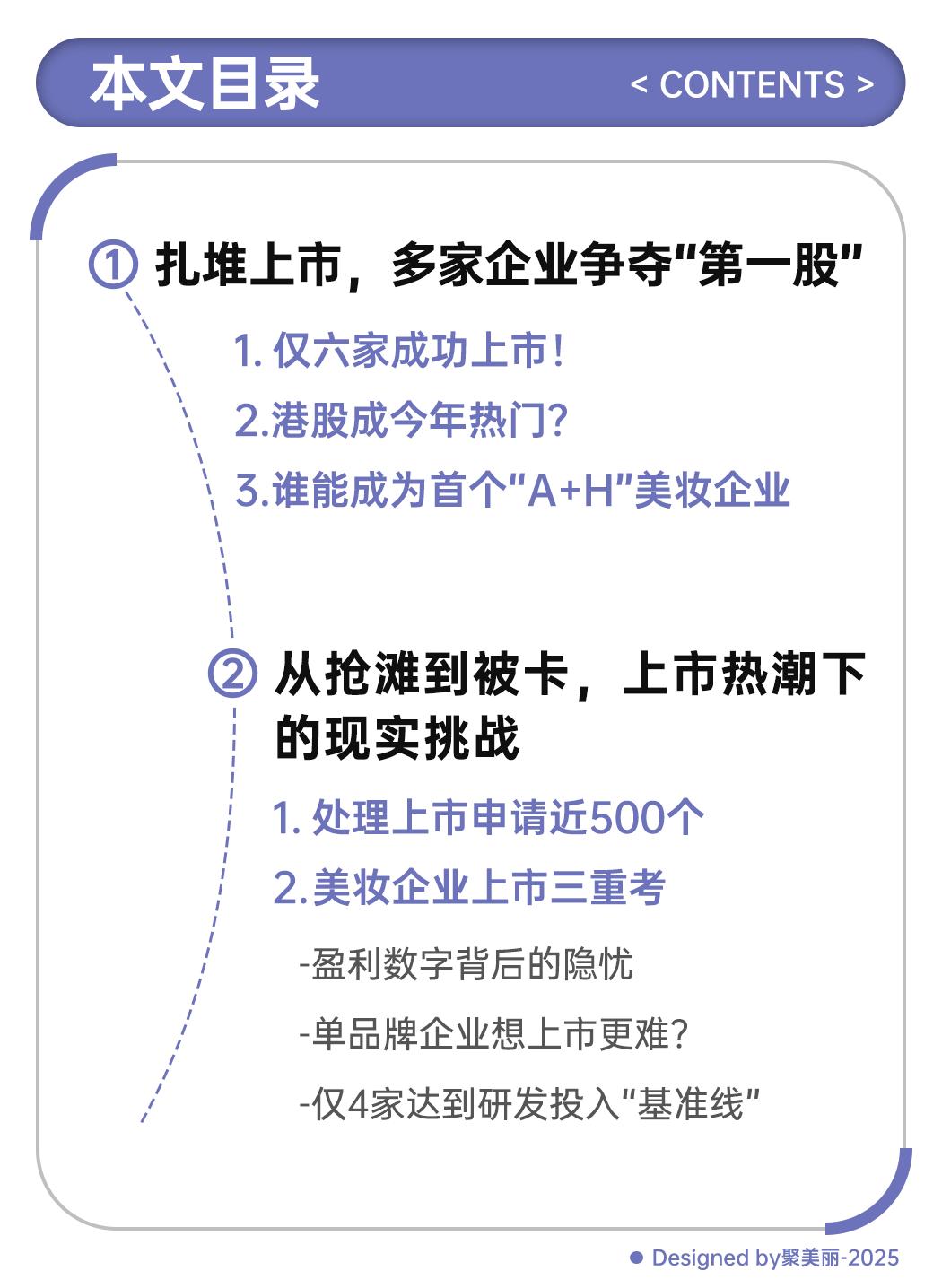
2025年,30+美妆企业冲击上市,仅6家成功
3 6 Ke· 2025-12-22 00:06
Core Insights - The beauty industry is experiencing a significant IPO wave, with over 30 companies attempting to enter capital markets, but only about 20% have successfully listed [3][4][7] - The focus of beauty companies has shifted from A-shares to Hong Kong stocks, driven by stricter regulations in the A-share market and more favorable conditions in Hong Kong [11][14][16] Group 1: IPO Landscape - Only six beauty companies have successfully gone public this year, including brands like Ying Tong Holdings and Pitanium Limited, with three listed on the Hong Kong Stock Exchange, two on NASDAQ, and one on the A-share market [4][6] - The majority of companies are still in the IPO process, with many facing delays due to regulatory scrutiny and the need for robust financial performance [7][21] - The current IPO environment is characterized by a high level of competition, with the capital market becoming increasingly selective about which companies to approve for listing [3][22] Group 2: Market Trends - The shift towards Hong Kong listings is evident, as the A-share market has seen a significant decline in successful IPOs since 2022, with a 69.69% drop in the number of listings [14] - Hong Kong has become a preferred destination for beauty companies due to its favorable market conditions and supportive regulatory environment, which includes recent reforms to the IPO process [16][20] - The trend of dual listings (A+H) is emerging, with several companies that are already listed in A-shares now seeking to enter the Hong Kong market [17][20] Group 3: Challenges and Opportunities - Companies face three main challenges in the IPO process: sustainable profitability, brand diversification, and research and development capabilities [24][25] - The ability to demonstrate consistent profitability is crucial, as evidenced by leading companies like Proya, which reported over 5 billion RMB in revenue, while others struggle to reach the 1 billion RMB mark [25][28] - R&D investment is critical for long-term success, with only a few companies meeting the industry benchmark for R&D spending, highlighting a gap in innovation among many players [39][42]

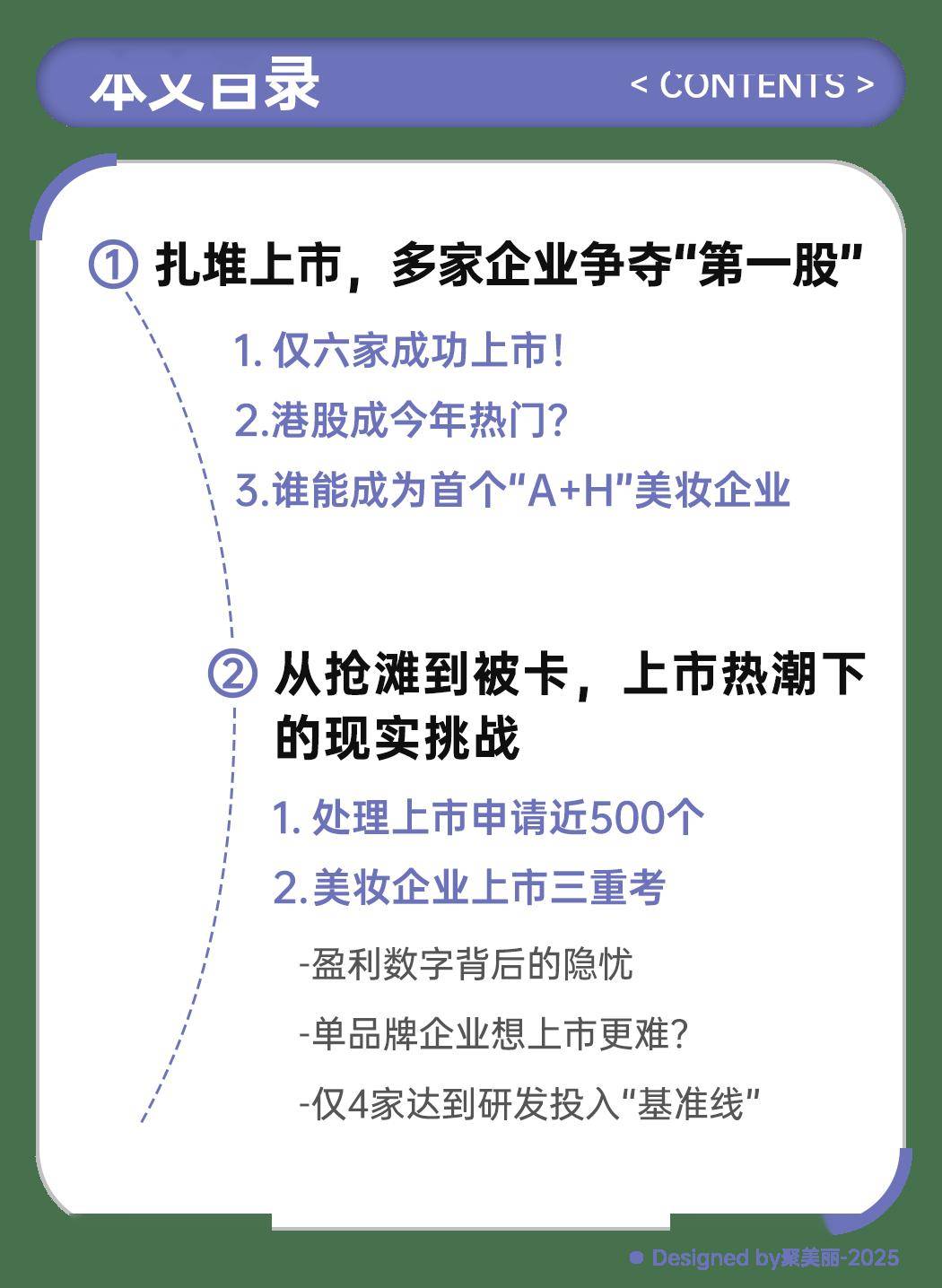
2025年,30+美妆企业冲击上市,仅6家成功!
Sou Hu Cai Jing· 2025-12-21 16:37
Core Viewpoint - The beauty industry is experiencing a surge in IPO activity, with over 30 companies attempting to go public, but only about 20% have succeeded, indicating a stringent selection process by capital markets [3][6][13]. Group 1: IPO Landscape - More than 30 beauty companies, including raw material suppliers and brand owners, are in the process of seeking IPOs in various markets, including A-shares, Hong Kong, and the US [1][3]. - Successful IPOs this year include six companies, with three listed on the Hong Kong Stock Exchange, two on NASDAQ, and one on the A-share market [4][5]. - The majority of companies are still in the preparatory stages, with some notable names like Naturals and Vicky Technology having revenue close to 2.5 billion [6][20]. Group 2: Market Trends - The focus of beauty companies' IPOs has shifted from A-shares to Hong Kong, especially after the tightening of IPO regulations in A-shares post-2022 [10][13]. - The Hong Kong market has become a preferred destination for beauty companies due to favorable policies and a more accommodating IPO environment [15][19]. - Recent regulatory changes in Hong Kong have made it easier for companies to list, enhancing the attractiveness of the market for beauty brands [15][19]. Group 3: Challenges and Opportunities - Companies face significant challenges in achieving sustainable profitability, building a diverse brand matrix, and enhancing research and development capabilities [22][23]. - The capital market is increasingly favoring companies with strong financial performance and a robust brand portfolio, as seen with leading firms like Proya and Up Beauty [23][27]. - Many companies still rely heavily on single brands, which poses risks and may hinder their ability to attract investment [32][34]. Group 4: Financial Performance - Leading beauty companies like Proya reported revenues exceeding 5 billion, while others like Plant Doctor and Lin Qingxuan are struggling with revenues around 1 billion [23][26]. - Profitability metrics show that only a few companies have net profits exceeding 500 million, highlighting the financial disparities within the industry [23][26]. - Research and development investment is critical, with only a few companies meeting the industry benchmark for R&D spending, which is essential for long-term competitiveness [36][39].
新消费行业周报(2025.12.15-2025.12.19):密集政策提振消费,海南自由贸易港封关运作正式启动-20251221
Hua Yuan Zheng Quan· 2025-12-21 11:21
Investment Rating - The industry investment rating is "Positive" (maintained) [1] Core Insights - The report emphasizes the importance of expanding domestic demand as a strategic initiative, with multiple policies aimed at boosting consumption being introduced. The central economic work conference highlighted the need for a strong domestic market and specific measures to stimulate consumption [4] - The official launch of the Hainan Free Trade Port marks a new phase in China's high-level opening-up, with significant increases in flight bookings to Hainan, indicating a positive trend in consumer behavior [4] - The report notes a robust growth in the beauty and skincare sector, with top brands maintaining their positions and new domestic brands showing significant growth, reflecting changing consumer preferences among younger generations [5][17] Summary by Sections Industry Performance - The new consumption sector saw a weekly increase of 6.66% in the retail index from December 15 to December 19, 2025 [8] - The beauty and personal care sector increased by 2.87% during the same period [8] Policy Developments - The central government has introduced various measures to enhance service consumption, including promotional activities and optimizing service availability to meet diverse consumer needs [4] - A joint notification from multiple government departments aims to strengthen collaboration between commerce and finance to boost consumption in key areas [4] Market Trends - In the beauty and skincare market, the top five brands include Proya, L'Oreal, Han Shu, Lancôme, and Estée Lauder, with domestic brands like Proya showing strong performance [5] - The report highlights a significant increase in sales for Hainan's duty-free shops, with a 90% year-on-year growth on the first day of the free trade port's operation [5] Investment Recommendations - The report suggests focusing on high-quality domestic brands in beauty and skincare, traditional gold jewelry brands favored by younger consumers, and strong tea beverage brands with extensive market coverage [17]



美护行业跟踪报告:美护触底,林清轩上市在即
国泰海通· 2025-12-21 08:37
Investment Rating - The report assigns an "Accumulate" rating for the beauty and personal care sector, indicating a positive outlook for the industry [6]. Core Insights - The beauty and personal care sector has experienced a significant pullback since August, with leading high-growth companies' valuations returning to 20-30x, and PEG ratios mostly below 1x, suggesting the sector is expected to bottom out [3][6]. - Lin Qingxuan is set to go public, focusing on the oil-based skincare segment, with a projected doubling of performance in the first half of 2025 [3][6]. Summary by Sections Market Performance - The beauty and personal care sector saw a decline of over 15% since August, with leading companies experiencing a valuation correction to 20-30x. The sector's maximum drawdown reached 17%, with top companies seeing declines of over 30% [6][8]. - The Shenyuan Beauty Care Index recorded a maximum increase of 19% in 2025, with key growth stocks like Ruoyuchen, Shangmei, and Maogeping achieving maximum gains of 239%, 198%, and 121% respectively [6][8]. Company Highlights - Lin Qingxuan, which is set to launch its IPO, plans to issue 13.97 million shares at an offering price of 77.77 HKD per share, corresponding to a market capitalization of 10.9 billion HKD. The company has secured cornerstone investors including Fidelity and others, with total subscriptions reaching 62 million USD [6][8]. - Lin Qingxuan's revenue for the first half of 2025 is projected at 1.05 billion CNY, reflecting a year-on-year increase of 98%, with a net profit of 182 million CNY, up 110%. The company's main product, a camellia oil essence, generated 480 million CNY in revenue, marking a 176% increase [6][8]. Investment Recommendations - The report suggests a bottom-up selection of stocks with product and channel innovations, highlighting strong growth potential in the beauty and personal care sector. Recommended stocks include: 1. High-growth brands: Ruoyuchen, Shangmei, Maogeping 2. Stable fundamentals with potential for improvement: Dengkang Oral, Shanghai Jahwa, Shuiyang, Jinbo Biological, Beitaini, Marubi, Qingsong 3. Stocks expected to bottom out: Pola, Juzibio, Lafang, Runben, Meilitiantian Medical Health, Furida, Huaxi Biological [6][7].


行业周报:海南自贸港封关正式启动,首日数据表现亮眼-20251221
KAIYUAN SECURITIES· 2025-12-21 03:41
Investment Rating - The investment rating for the retail industry is "Positive" (maintained) [1] Core Insights - The retail industry index rose by 6.66% in the week of December 15-19, 2025, outperforming the Shanghai Composite Index by 6.63 percentage points, ranking first among 31 primary industries [6][15] - The launch of the Hainan Free Trade Port has shown promising initial results, with duty-free sales reaching 118 million yuan on the first day and a significant increase in the number of zero-tariff goods [4][25][26] - The report emphasizes the importance of consumer sentiment and the potential for high-growth sectors within the retail space, particularly in jewelry, offline retail, cosmetics, and medical aesthetics [7][30][31] Summary by Sections Retail Market Review - The retail industry index closed at 2458.79 points, with a weekly increase of 6.66% [6][15] - The supermarket sector saw the highest weekly increase of 14.18%, while the commercial property sector led with a year-to-date increase of 22.51% [17][19] Industry Dynamics - The Hainan Free Trade Port officially commenced operations on December 18, 2025, with a focus on "one line open, two lines controlled, and free trade within the island" [4][25] - The proportion of zero-tariff goods increased from 21% to 74%, covering approximately 6,600 items, which is expected to reduce import tax burdens by about 20% for related enterprises [26][25] Investment Themes - Investment Theme 1: Focus on high-end jewelry brands with differentiated product offerings, recommending companies like Chow Tai Fook and Lao Pu Gold [7][30] - Investment Theme 2: Emphasize offline retail companies adapting to trends and AI-enabled cross-border e-commerce leaders, recommending Yonghui Supermarket and Aiying Room [7][30] - Investment Theme 3: Highlight domestic cosmetics brands that meet emotional value and safety ingredient innovations, recommending brands like Maogeping and Proya [7][31] - Investment Theme 4: Focus on differentiated medical aesthetics product manufacturers and leading chain medical institutions, recommending Aimeike and Kedi-B [7][31] Company-Specific Insights - Chow Tai Fook reported a revenue of 38.986 billion HKD for FY2026H1, with a slight decline of 1.1% year-on-year, while net profit increased by 0.1% [37] - Lao Pu Gold achieved a revenue of 12.354 billion HKD for FY2025H1, marking a significant increase of 250.9% year-on-year, with net profit rising by 285.8% [36] - Yonghui Supermarket's revenue for the first three quarters of 2025 was 42.434 billion yuan, down 22.2% year-on-year, with net profit showing a significant loss [44]
研判2025!中国A醇护肤品行业发展背景、市场规模、渗透率、重点品牌及未来趋势分析:市场迅速崛起,预计到2030年市场规模将突破90亿元[图]
Chan Ye Xin Xi Wang· 2025-12-21 01:18
内容概要:A醇,化学名视黄醇,是维生素A家族的一员,分子式为C₂₀H₃₀O。从化学结构上看,它由 一个β-紫罗兰酮环和一个不饱和侧链组成,这种特殊结构赋予它强大的生物活性。作为护肤品中的"明 星"成分,A醇一直以来都因其强大的抗衰、控油等功效而备受推崇。随着抗衰理念的持续渗透,以及 银发经济的崛起,抗衰老成为消费者选择护肤品的首要考虑因素。在2024年中国消费者使用护肤品的最 主要诉求调查中,抗皱抗衰老位居第一,占比接近六成。其次,美白祛斑、保湿锁水等功效也是日常所 需。对于需求明确的消费者来说,具有抗皱抗衰老这一类功效型护肤品更受消费者喜爱。受益于抗衰老 需求的持续增长及功效护肤理念的深化,近年来中国A醇护肤品市场迅速崛起,成为功效护肤赛道中的 高关注细分领域。A醇护肤品正从专业小众市场向大众消费领域加速渗透,行业呈现技术迭代加速、产 品矩阵多元化及市场集中度提升的显著特征。2020-2024年期间,中国A醇护肤品行业规模从38.8亿元增 长至57.2亿元,年复合增长率达10.2%。未来行业规模将继续保持增长态势,预计到2030年中国A醇护 肤品市场规模将超90亿元。在中国市场,A醇护肤品的商业化应用起步较 ...

欧莱雅加仓高德美股权至20%,这场跨界融合玩得多大?
Sou Hu Cai Jing· 2025-12-19 07:42
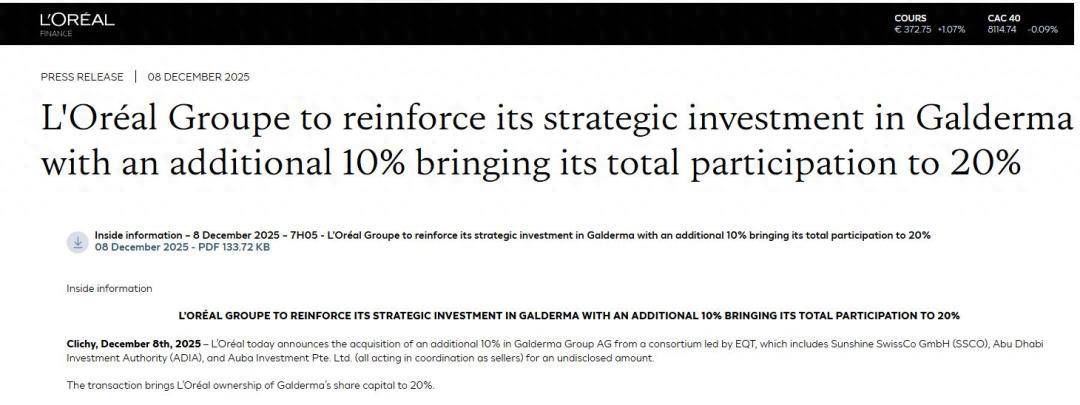
Core Viewpoint - The boundary between beauty and medical aesthetics is increasingly blurred, with major beauty companies like L'Oréal investing in medical aesthetics firms, reflecting a strategic shift in the industry towards a more integrated approach to consumer beauty needs [1][5]. Group 1: Company Actions - L'Oréal announced the acquisition of an additional 10% stake in Galderma, increasing its ownership from 10% to 20%, marking a significant move into the medical aesthetics sector [1][3]. - The transaction involves Sunshine SwissCo GmbH, backed by EQT, Abu Dhabi Investment Authority (ADIA), and Auba Investment Pte. Ltd., and is expected to finalize in Q1 2026 [3]. - L'Oréal plans to nominate two non-independent directors with L'Oréal backgrounds to Galderma's board, enhancing its influence over strategic decisions [4]. Group 2: Industry Trends - The integration of beauty and medical aesthetics is becoming a necessity, with companies like Estée Lauder and Shiseido also making moves into the medical aesthetics space, indicating a broader industry trend [7]. - The driving force behind this trend is the demand for a comprehensive ecosystem that combines daily skincare, medical devices, and professional medical aesthetics [7]. - The Chinese medical aesthetics market is seen as a key growth area for beauty companies, as consumer demand for "scientific beauty" continues to rise [7]. Group 3: Challenges and Opportunities - The fusion of beauty and medical aesthetics presents challenges due to differing business models and channel logic, with beauty companies focusing on mass production and marketing, while medical aesthetics emphasize personalized services and compliance [9]. - The entry of beauty companies into the medical aesthetics field is expected to enhance consumer education and push for safer, more convenient medical technologies [9]. - Successful integration of technology transfer, channel adaptation, and compliance operations will be crucial for capturing opportunities in the rapidly growing medical aesthetics market [10].

珀莱雅涨2.01%,成交额2.99亿元,主力资金净流入343.24万元
Xin Lang Cai Jing· 2025-12-19 06:53
Core Viewpoint - The stock of Proya Cosmetics has shown a mixed performance, with a year-to-date decline of 17.12% but a recent uptick in trading activity, indicating potential investor interest amidst fluctuating market conditions [1][2]. Financial Performance - For the period from January to September 2025, Proya achieved a revenue of 7.098 billion yuan, reflecting a year-on-year growth of 1.89%, while the net profit attributable to shareholders was 1.026 billion yuan, up by 2.65% [2]. - Cumulatively, Proya has distributed 2.125 billion yuan in dividends since its A-share listing, with 1.540 billion yuan distributed over the past three years [3]. Shareholder Structure - As of September 30, 2025, Proya had 84,100 shareholders, an increase of 39.53% from the previous period, with an average of 4,708 circulating shares per shareholder, down by 28.23% [2]. - The top ten circulating shareholders include significant institutional investors, with Hong Kong Central Clearing Limited holding 27.1106 million shares, a decrease of 20.4089 million shares from the previous period [3].