杭州银行

Search documents
混合类产品收益强势,近1月年化收益率最高超76%!
2 1 Shi Ji Jing Ji Bao Dao· 2026-01-12 01:10
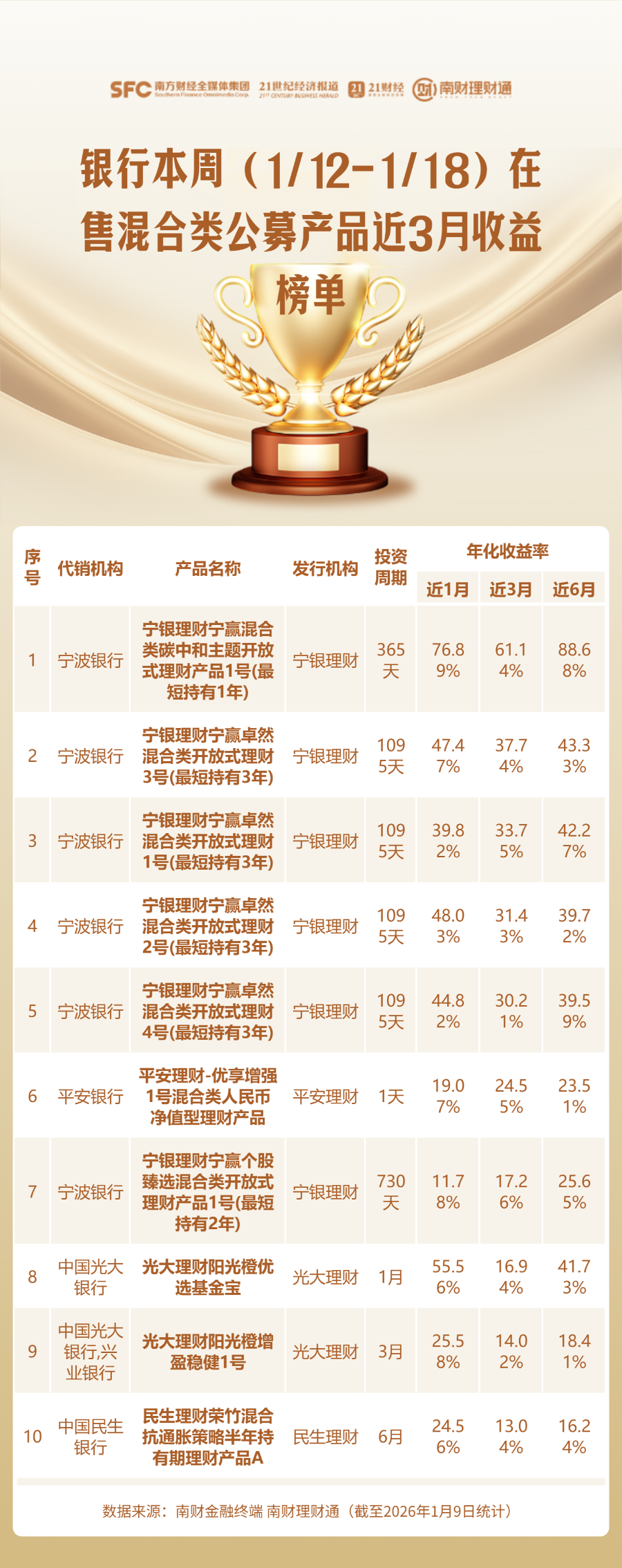
此外,南财理财通虽力求客观公正,但不对本评价榜信息的真实性、完整性和准确性作任何保证,排名信息仅供参考。 | 2 | 宁波银行 | 宁银理财宁赢卓然 混合类开放式理财 | 宁银理财 | 109 | 47.4 | 37.7 | 43.3 | | --- | --- | --- | --- | --- | --- | --- | --- | | | | | | ਦੇ ਦੇ | 7% | 4% | 3% | | | | 3号(最短持有3年) | | | | | | | 3 | 宁波银行 | 宁银理财宁赢卓然 混合类开放式理财 | 宁银理财 | 109 | 39.8 | 33.7 | 42.2 | | | | | | 55 | 2% | 5% | 7% | | | | 1号(最短持有3年) | | | | | | | ব | 宁波银行 | 量根理财产赢卓然 混合类开放式理财 | 宁银理财 | 109 | 48.0 | 31.4 | 39.7 | | | | | | ਦੇਵ | 3% | 3% | 2% | | | | 2号(最短持有3年) | | | | | | | 5 | 宁波银行 | 宁银理财宁赢卓然 混合类开放 ...


浙商银行管理层变阵 深耕战略驶入深水区
Hua Er Jie Jian Wen· 2026-01-12 00:57
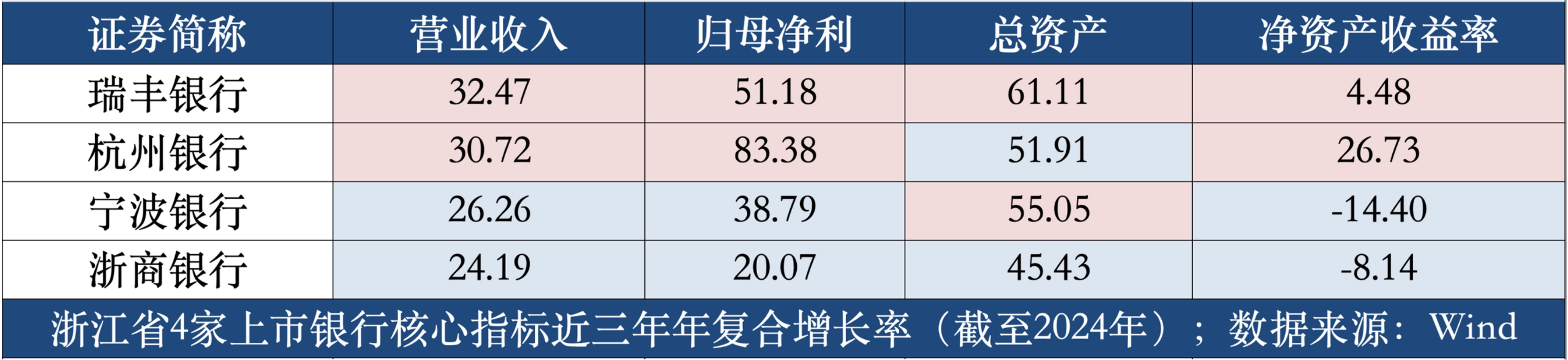
Core Viewpoint - Zhejiang Zheshang Bank has undergone a significant executive reshuffle, marking a strategic transition as it prepares for the next phase of its "Deepening Zhejiang" strategy, which is crucial for maintaining its competitive edge in the local banking market [1][3][5]. Executive Changes - The bank's chairman Chen Haiqiang has officially stepped down as president, with Lu Linhua appointed as the new president and nominated as an executive director candidate [1]. - Several other executives, including vice president Lin Jingran and assistant presidents Wang Chaoming and Hou Bo, have also resigned, while Zhou Weixin and Pan Huafeng have been promoted to vice presidents [1][2]. Strategic Context - The timing of these changes suggests a conclusion to the previous "three leaders" adjustment, as the bank prepares for a new strategic cycle starting in 2025 [2][5]. - The restructuring aims to align the executive team with the bank's strategic upgrades, focusing on efficiency and effectiveness by reducing redundant positions [6][7]. Talent Selection - The new leadership team is characterized by a younger demographic, with an average age below 50, reflecting a shift towards a more dynamic management style [11]. - Chen Haiqiang's background in the bank's core management and Lu Linhua's experience in financial regulation and local operations are seen as assets for the bank's strategic continuity and local market penetration [7][10]. Competitive Landscape - Zhejiang Zheshang Bank faces increasing competition from city commercial banks and rural commercial banks in its home market, which is impacting its market share [13][15]. - Financial data indicates that while the bank has shown strong growth in several metrics, it is still lagging behind competitors like Ningbo Bank and Hangzhou Bank in profitability and market performance [16][17]. Strategic Initiatives - The bank's new strategy emphasizes "deepening" its presence in Zhejiang, with initiatives aimed at enhancing local financial services and supporting regional economic development [18]. - The bank has reported significant growth in its inclusive loan balance and has exceeded its annual targets for serving individual businesses, indicating early success from the strategic adjustments [18]. Future Challenges - The new leadership, particularly Lu Linhua, will need to effectively integrate the flexible, localized approaches of the rural banking system with the standardized practices of a national bank to avoid internal friction [19].

最高增长28倍 投资者回报“浙江样本”这样炼成
Zheng Quan Shi Bao· 2026-01-11 16:55
Core Viewpoint - The capital market serves as a "barometer" for the real economy, with listed companies in Zhejiang actively fulfilling social responsibilities and enhancing investor returns, thereby contributing to a healthy capital market ecosystem [1] Investor Return Initiatives - During the 14th Five-Year Plan (2021-2025), listed companies in Zhejiang achieved significant growth in investor return measures, with total dividends reaching 443.901 billion yuan, a 115.29% increase compared to the previous five-year period [1] - Share buybacks increased dramatically, with 396 companies repurchasing shares worth 74.819 billion yuan, a 28-fold increase from the previous period [1] - Important shareholders in 343 companies increased their holdings by nearly 34.5 billion yuan, a 16.73% rise compared to the previous five-year period [1] Dividend and Buyback Trends - Cash dividends and share buybacks are the most direct ways for listed companies to return value to investors, with Zhejiang companies distributing a total of 443.901 billion yuan in dividends during the 14th Five-Year Plan [2] - The average dividend payout ratio has been increasing annually, reaching 46.71% in 2024, surpassing the national average [2] - By the end of the 14th Five-Year Plan, 111 listed companies had cumulatively paid dividends exceeding their total capital market financing, accounting for nearly one-fifth of the total number of companies in the region [1] Leading Companies and Their Contributions - Notable companies such as Hikvision, Zheshang Bank, and Hangzhou Bank have cumulatively distributed over 100 billion yuan in dividends during the 14th Five-Year Plan [2] - In 2025, the total cash dividends from listed companies in Zhejiang are expected to exceed 1 trillion yuan, nearly doubling from 2020 [2] - Companies like Hikvision have maintained a high actual dividend payout rate of over 50%, with cumulative cash dividends reaching 68.5 billion yuan since its IPO [3] Shareholder Confidence and Buyback Strategies - Important shareholders in 343 companies executed 2,849 buyback transactions, totaling nearly 34.5 billion yuan, indicating strong market confidence [5] - Companies like Rongsheng Petrochemical have initiated significant buyback plans, with total investments nearing 10 billion yuan [5] - Hikvision's share buyback efforts have been complemented by shareholder increases, with significant purchases made by its controlling shareholder [6] Investor Relations Management - Effective investor relations management is crucial for maintaining communication between listed companies and investors, enhancing transparency and governance [8] - Companies in Zhejiang have improved their investor relations frameworks, with the number of companies receiving investor research increasing from 197 to 519 during the 14th Five-Year Plan [8] - Innovative communication methods, such as cloud tours and online meetings, have been adopted to enhance investor engagement [9]
息差稳定预期加强
Xiangcai Securities· 2026-01-11 13:46
Investment Rating - The industry rating is maintained at "Overweight" [10][37] Core Insights - The central bank's 2026 work meeting emphasized a stable interest margin expectation, indicating a shift in focus from reducing financing costs to maintaining them at low levels [7][34] - The meeting highlighted the importance of enhancing financial services for high-quality economic development, directing funds towards key areas such as technological innovation and small and medium enterprises [7][34] - The credit market is showing signs of stabilization, with a shift from quantity to quality in credit issuance, and a reduction in the pace of loan rate declines [8][34] Summary by Sections Market Review - The banking index fell by 1.90%, underperforming the CSI 300 index by 4.69 percentage points [12] - The performance of various banking sectors showed declines, with large banks down by 2.94% and regional banks performing relatively better [12] Monetary Policy - The central bank's monetary policy will remain moderately accommodative, focusing on both counter-cyclical and cross-cyclical adjustments [7][34] - The emphasis will be on stabilizing corporate financing cost expectations and preventing significant interest rate fluctuations [7][34] Investment Recommendations - The report suggests focusing on state-owned banks with stable asset deployment and regional banks with growth potential, recommending specific banks such as ICBC, Bank of China, and others [10][37]




金融行业周报(2026、01、11):开门红催化保险板块,看好配置策略下银行股中长线收益-20260111
Western Securities· 2026-01-11 13:11
Group 1: Core Conclusions - The financial industry saw a weekly increase of +2.60% in the non-bank financial index, underperforming the CSI 300 index by 0.19 percentage points [1] - The insurance sector outperformed with a weekly increase of +3.58%, benefiting from strong performance in listed insurance companies [1][9] - The banking sector experienced a decline of -1.90%, underperforming the CSI 300 index by 4.69 percentage points, with all types of banks showing negative performance [1][9] Group 2: Insurance Sector Insights - The insurance sector's strong performance is driven by high growth in "opening red" earnings, indicating a solid investment logic with improving fundamentals [1][13] - The sector benefits from a dual drive of asset under management (AUM) expansion and interest rate spread recovery, with a clear trend of increasing industry concentration [1][17] - Recommended companies in the insurance sector include China Pacific Insurance, China Ping An, China Life (H), and New China Life [3] Group 3: Brokerage Sector Insights - The brokerage sector saw a weekly increase of +1.90%, with a PB valuation of 1.41x, indicating potential for valuation recovery [2][18] - Notable developments include GF Securities' plan to raise funds through H-share placement to support international business expansion [2][18] - Recommended brokerages include Guotai Junan, Huatai Securities, and CITIC Securities, focusing on those with strong fundamentals and low valuations [3][19] Group 4: Banking Sector Insights - The banking sector's PB valuation stands at 0.53x, with expectations for interest margin recovery in 2026, driven by reduced re-pricing pressure on loans [2][21] - The People's Bank of China indicated a continuation of a moderately loose monetary policy, which is expected to support the banking sector's performance [2][21] - Recommended banks include Hangzhou Bank, with additional focus on Qingdao Bank and Ningbo Bank for potential recovery opportunities [3][22]
中国上市公司“第一大省”:拥有889家,总市值超过浙江+江苏
Sou Hu Cai Jing· 2026-01-11 06:08
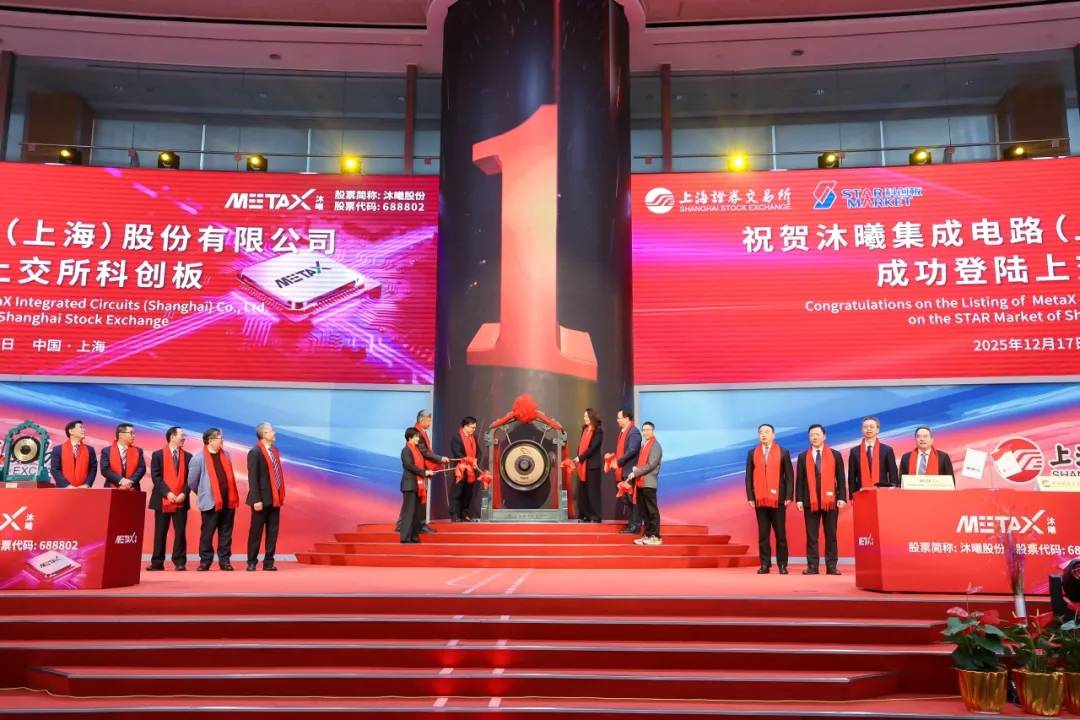
Group 1 - The capital market serves as a "barometer" for China's economy, with listed companies acting as the "locomotive" for economic development. By the end of 2025, there will be 5,469 listed companies in China, with a total market capitalization of 123 trillion yuan. In 2025, 116 new companies are expected to be listed, representing a 16% increase compared to 2024, raising a total of 131.77 billion yuan, primarily in sectors like computer, communication, and electronic equipment manufacturing [1] Group 2 - Shanghai ranks fifth with 452 listed companies, adding 8 new companies last year. Notably, the company Muxi Co., which specializes in high-performance GPU chips, has sold over 25,000 units by the end of March 2025 [3] - Beijing holds the fourth position with 481 listed companies and a total market capitalization of 30.6 trillion yuan, the highest in the country. It has 48 companies with a market value exceeding 100 billion yuan, primarily consisting of state-owned enterprises and large tech and financial firms [3] Group 3 - Jiangsu ranks third with 721 listed companies and a total market capitalization of 8.95 trillion yuan. It added 29 new companies last year, the highest in the country, with a focus on manufacturing and strategic emerging industries [5] - Suzhou has become the leading city for new listings, with 12 new companies, supported by a robust industrial ecosystem and a systematic service mechanism for companies preparing to go public [5] Group 4 - Zhejiang is in second place with 731 listed companies and a total market capitalization of 9.18 trillion yuan. The capital city, Hangzhou, has 231 listed companies, followed by Ningbo with 124 [5] - By the end of last year, Zhejiang had 10 companies with a market value exceeding 100 billion yuan, with four located in Hangzhou [6] Group 5 - Guangdong remains the top province with 889 listed companies and a total market capitalization of 19.32 trillion yuan, reflecting a 29% year-on-year growth. It added 21 new companies last year, including notable firms like Marco Polo and Stone Innovation [8] - Guangdong has 30 companies with a market value exceeding 100 billion yuan, with Industrial Fulian leading at 1.2322 trillion yuan [8] Group 6 - The distribution of listed companies across various exchanges shows Guangdong leading with 32 on the Beijing Stock Exchange, 92 on the Shanghai Stock Exchange's Sci-Tech Innovation Board, and 324 on the Shenzhen Stock Exchange's Growth Enterprise Market [9] - Jiangsu follows with 56 on the Beijing Stock Exchange and 222 on the Shanghai Stock Exchange's main board [9]
中小银行开年存款大降息:最高下调55基点,中长期产品加速调整
Hua Xia Shi Bao· 2026-01-09 12:13
本报(chinatimes.net.cn)记者卢梦雪 北京报道 "抓紧这几天锁定当前利率,错过就只能按新利率了。"近日,有多家中小银行客户经理向记者表示,该 行即将开始新一轮存款利率调降。 其中,从1月4日起,振兴银行整存整取两年期、三年期存款利率均下降到1.8%,5年期存款利率下调到 1.7%。1月16日起,新安银行两年期存款利率从2.35%下调到2.25%,下调10个基点。庆安农村商业银行 单位、个人整存整取的三个月、六个月存款产品利率相比此前分别下调了20个基点、25个基点,一年 期、两年期、三年期、五年期存款利率亦有所下调,七天存款利率较此前下调了30个基点,降幅最大。 记者注意到,2026年开年以来,中小银行降息节奏明显加快,调整力度不减。1月份已有多家中小银行 公告将下调或已下调存款利率,中长期产品存款利率降幅相对更大,部分期限存款产品利率降幅最高达 55个基点。 不过,在普遍降息的同时,仍有部分中小银行推出"开门红"活动,选择阶段性上浮存款利率。多家村镇 银行、农商行、城商行近期推出活动,不仅存款利率上浮,部分还赠送精美礼品。 开年即降息,中长期产品受冲击 1月9日,贵阳花溪建设村镇银行公告,调 ...

金融行业双周报(2025/12/26-2026/1/8):2025年证券行业多项核心指标创历史新高-20260109
Dongguan Securities· 2026-01-09 12:03
Investment Ratings - Banking: Overweight (Maintain) [1] - Securities: Market Weight (Maintain) [1] - Insurance: Overweight (Maintain) [1] Core Insights - The banking sector shows a continued growth trend in social financing, with a marginal decrease in the contribution of government bonds. Corporate bonds increased by 178.8 billion yuan year-on-year, becoming the main increment in social financing. However, the demand for loans remains weak, with a year-on-year decrease of 190 billion yuan in new RMB loans in November [5][44]. - The securities industry has seen multiple core indicators reach historical highs in 2025, with total stock fund transaction volume exceeding 500 trillion yuan, a year-on-year increase of over 70%. The primary market has rebounded, with IPO and refinancing scales increasing by 95.64% and 326.17% respectively, indicating improved market liquidity and financing conditions [3][46]. - The insurance sector reported a total original premium income of 57,629 billion yuan in the first 11 months of 2025, a year-on-year growth of 7.6%. Life insurance companies saw a 9.1% increase in premium income, while property insurance companies grew by 3.9% [4][47]. Summary by Sections Market Review - As of January 8, 2026, the banking, securities, and insurance indices changed by -0.87%, +0.91%, and +1.95% respectively, while the CSI 300 index increased by +2.05%. Among 31 industries, the banking and non-banking sectors ranked 29th and 21st in performance [5][13]. Valuation Situation - As of January 8, 2026, the PB ratio for the banking sector is 0.74, with state-owned banks, joint-stock banks, city commercial banks, and rural commercial banks having PB ratios of 0.79, 0.61, 0.71, and 0.63 respectively. Notably, China Merchants Bank, Agricultural Bank of China, and Ningbo Bank have the highest valuations at 0.96, 0.95, and 0.87 [22][24]. Recent Market Indicators - The one-year MLF operation rate is 2.0%, with LPR rates at 3.0% for one year and 3.50% for five years. The average interbank borrowing rates for one day, seven days, and fourteen days are 1.33%, 1.50%, and 1.60% respectively [29][30]. Industry News - The China Banking and Insurance Regulatory Commission has released guidelines for data classification and grading in the insurance asset management industry, effective January 1, 2026, aimed at enhancing data security management standards [39][40].






金融行业双周报(2025、12、26-2026、1、8)-20260109
Dongguan Securities· 2026-01-09 10:32
Investment Ratings - Banking: Overweight (Maintain) [1] - Securities: Market Weight (Maintain) [1] - Insurance: Overweight (Maintain) [1] Core Insights - The banking sector shows a continued growth trend in social financing, with a marginal decrease in the contribution of government bonds. Corporate bonds increased by 178.8 billion yuan year-on-year, becoming the main increment in social financing. However, the demand for loans remains weak, with a year-on-year decrease of 190 billion yuan in new RMB loans in November [5][44]. - The securities industry has seen multiple core indicators reach historical highs in 2025, with total stock fund transaction volume exceeding 500 trillion yuan, a year-on-year increase of over 70%. The primary market has rebounded, with IPO and refinancing scales increasing by 95.64% and 326.17% respectively, indicating improved market liquidity and a favorable financing environment [3][46]. - The insurance sector reported a total original premium income of 57,629 billion yuan in the first 11 months of 2025, a year-on-year growth of 7.6%. Life insurance companies contributed 41,472 billion yuan, up 9.1%, while property insurance companies reported 16,157 billion yuan, up 3.9% [4][47]. Summary by Sections Market Review - As of January 8, 2026, the banking, securities, and insurance indices had respective changes of -0.87%, +0.91%, and +1.95%, while the CSI 300 index increased by 2.05%. Among 31 industries, the banking and non-banking sectors ranked 29th and 21st respectively [5][13]. Valuation Situation - As of January 8, 2026, the PB ratio for the banking sector was 0.74, with state-owned banks, joint-stock banks, city commercial banks, and rural commercial banks having PB ratios of 0.79, 0.61, 0.71, and 0.63 respectively. Notably, China Merchants Bank, Agricultural Bank of China, and Ningbo Bank had the highest valuations at 0.96, 0.95, and 0.87 [22][24]. Recent Market Indicators - The one-year MLF operation rate was 2.0%, with the one-year and five-year LPR at 3.0% and 3.50% respectively. The weighted average interbank borrowing rates for one day, seven days, and fourteen days were 1.33%, 1.50%, and 1.60% respectively [29][32]. Industry News - The China Banking and Insurance Regulatory Commission reported that insurance companies issued bonds totaling 104.2 billion yuan in 2025, driven by high capital replenishment needs and favorable regulatory support [39][40].

指数上涨多空分歧加大!各凭本事赚钱,还有哪些投资机会?
Sou Hu Cai Jing· 2026-01-09 07:48
Group 1 - The market adjustment is attributed to the fragile market structure, macro disturbances, and industry divergences, suggesting that investors should avoid single attribution and linear extrapolation [1] - The current liquidity environment is expected to remain loose until the first quarter of next year, with a trend of "deposit migration" likely to continue under a low-interest-rate backdrop [1] - Key sectors for net inflow include domestic software, military industry, new energy vehicles, non-ferrous metals, and gaming [1] Group 2 - The brokerage sector has underperformed compared to the Shanghai Composite Index despite showing growth in Q3 reports, raising questions about its future prospects [3] - The year 2026 is anticipated to open up opportunities for the securities industry, supported by favorable policies and a reasonable liquidity environment [3] - Key investment focuses include leading securities firms aiming for international competitiveness, mid-sized firms with potential, and companies benefiting from improved industry competition and wealth management recovery [3] Group 3 - A wave of state-owned enterprises is entering the capital market, focusing on core business and strategic new layouts, indicating a clear path for high-quality development of state capital [4] - The next phase is expected to emphasize capital operations in advanced fields such as new materials, biopharmaceuticals, and digital economy, with spin-off listings becoming a significant trend [4] Group 4 - The demand for the energy storage industry is projected to remain high in 2026 due to ongoing global energy transition trends and significant project plans in major markets [6] - The strong demand for household and industrial storage persists, driven by ongoing electricity shortages in emerging markets [6] Group 5 - The short-term market trend is strong, with significant inflow of incremental capital and a strong profit-making effect [8] - The number of stocks rising outnumbers those falling, indicating a positive market sentiment [9] Group 6 - The Shanghai Composite Index is experiencing a strong rally, with expectations that even during high-level corrections, capital will continue to enter the market [10] - The AI glasses industry is expected to transition from exploration to scaled growth, benefiting from technological innovation and product iteration [10] - The banking sector is seeing increased research interest, particularly among city and rural commercial banks, with a focus on net interest margin trends and asset quality changes for 2025 and 2026 [10]