饿了么

Search documents
即时零售火力全开、同城配送机会增多,押注“一对一专送”的闪送中期业绩差强人意
Xin Lang Cai Jing· 2025-08-21 02:55
Core Insights - The company Flash Express (Nasdaq: FLX) remains committed to its "one-to-one delivery" model despite increasing competition in the same-city delivery market, focusing on finding more stable business flows [1][2] Financial Performance - In Q2 2025, Flash Express reported a revenue increase of 60 million yuan to 1.02 billion yuan compared to Q1 2025, with a gross profit of 120 million yuan and a gross margin of 12%, up 1.2 percentage points year-on-year [1] - The net profit attributable to ordinary shareholders rose from 22.3 million yuan in the same period last year to 53.5 million yuan, marking a 140% year-on-year increase [1] Market Dynamics - The instant retail market has seen significant growth in demand, driven by fierce competition among major players like Ele.me, JD.com, and Meituan, leading to increased order volumes [2] - The instant delivery market in China is projected to reach an order volume of 48.28 billion by 2024, with a year-on-year growth of 17.6%, and is expected to exceed 100 billion orders by 2030 [3] Service Differentiation - Flash Express emphasizes its one-to-one delivery model, which allows for faster and safer delivery of items, particularly in scenarios involving electronic products [3][4] - The company has developed a specialized team of "digital delivery riders" based on strict selection criteria, ensuring a higher fulfillment rate than the industry average [4] Strategic Initiatives - Flash Express is expanding its service offerings into various scenarios, including tourism and events, while enhancing partnerships with multiple e-commerce platforms [2][3] - The integration of AI and big data analytics is being utilized to improve order matching efficiency and optimize delivery routes, thereby enhancing overall operational performance [6] User Base and Coverage - As of June 30, 2025, Flash Express operates in 297 cities across China, with a workforce of 2.92 million delivery personnel and over 100 million registered users [6]

餐饮“回收人”,默默“送”走无数小店
Hu Xiu· 2025-08-20 23:36
Core Viewpoint - The article discusses the severe impact of the ongoing subsidy war in the food delivery industry on small and medium-sized restaurant businesses, highlighting the struggle for survival amidst aggressive competition and changing consumer behavior. Group 1: Industry Overview - The food delivery market has seen a massive influx of over 800 billion in subsidies from e-commerce platforms, leading to a "subsidy war" that has intensified competition in the industry [3][49]. - Many small restaurant owners are facing a "prisoner's dilemma," where they must choose between participating in the subsidy programs, which erode profits, or opting out and risking a significant drop in orders [18][20]. Group 2: Financial Impact on Restaurants - A notable example includes a tea shop that saw its daily orders increase from 200 to 800, but its profit margin plummeted from 15% to 6% due to the high costs associated with subsidies [5][25]. - In another case, a noodle shop that refused to participate in subsidies experienced a 40% drop in orders over three months, leading to potential closure [28]. Group 3: Consumer Behavior Changes - The subsidy war has altered consumer expectations, with 75% of consumers preferring cheaper delivery options over dining in, and 86% indicating they would choose delivery if it was cheaper than in-store prices [49]. - This shift in consumer behavior has resulted in a significant decline in dine-in orders, with many customers opting to order delivery even while sitting in restaurants [32]. Group 4: Survival Strategies for Restaurants - Some restaurants are adapting by focusing on unique offerings or enhancing their operational efficiency, such as a dessert shop that improved its profit margin to 12% by abandoning low-price subsidies and focusing on in-store sales [44]. - Others are leveraging technology to reduce costs, with one restaurant implementing an AI inventory system that decreased food waste and improved turnover rates [46]. Group 5: Long-term Industry Outlook - The article suggests that while many small restaurants are struggling, there are also success stories among those who have adapted their business models to thrive in the new environment [39][41]. - The ongoing changes in the industry may lead to a natural selection process, where only those businesses that can innovate and adjust to the new market conditions will survive [50][52].
多行业代表致敬城市骑士 饿了么推出职业保障升级计划
Zhong Guo Jing Ji Wang· 2025-08-20 14:23
Group 1 - The core idea of the articles revolves around the recognition and support for the delivery riders, now referred to as "urban knights," highlighting their contributions and the new identity associated with their profession [1][2] - On August 17, Ele.me's Taobao Flash Purchase announced the upgrade of all delivery riders to "urban knights," introducing new uniforms and a series of welfare measures to enhance their professional identity and recognition [1] - The "Urban Knights·Orange Initiative" was launched on August 18 by Alibaba and Ant Group, aimed at providing additional rewards and support for delivery riders, including special assistance for those in crisis and educational funding [2] Group 2 - A number of notable individuals from various professions participated in wearing the new urban knight uniforms to honor the delivery riders and advocate for their recognition [1] - The initiative includes honoring riders who have performed acts of bravery, with several riders already receiving the first batch of honorary knight uniforms [2] - The CEO of Ele.me emphasized the importance of treating riders with respect and dignity, reflecting on the challenges they face in their work [2]
致敬马路天使侠义精神!淘宝闪购“城市骑士·橙意计划”向跳水救人骑士颁出全国首个奖励
Bei Jing Shang Bao· 2025-08-20 07:38
Core Viewpoint - The article highlights the heroic act of a delivery rider, Lü Weiquan, who jumped from a height of over 10 meters to save a drowning person, earning him the first national award under the "Orange Intent Program" initiated by Taobao Flash Purchase [1][10]. Group 1: Heroic Act and Recognition - Lü Weiquan, a 50-year-old delivery rider from Guangdong, performed a courageous act by jumping off a bridge to save a person in distress, which he considered a normal response to a situation requiring help [4][6]. - Following the incident, Lü received a cash reward of 100,000 RMB and a special honor uniform as part of the "Orange Intent Program," which aims to recognize and reward acts of kindness among delivery riders [10][11]. - The local government also awarded Lü the title of "Brave Act" and nominated him for the "Chinese Good Person List" in 2025 [7][10]. Group 2: Personal Background and Impact - Lü Weiquan had recently undergone surgery prior to the rescue, highlighting his bravery despite health concerns, including a history of lumbar disc herniation [7][10]. - His family was initially unaware of his heroic act, and his wife expressed concern for his safety after seeing the rescue video [6][11]. - The incident has increased Lü's recognition in his community, with many residents acknowledging him as a hero during his delivery rounds [9][10]. Group 3: Industry Context and Future Outlook - The "Orange Intent Program" was launched to enhance the welfare and recognition of delivery riders, reflecting a growing trend in the industry to appreciate the contributions of these workers [10]. - Lü believes that the delivery industry will continue to thrive as more people opt for convenience over cooking, indicating a positive outlook for the sector [10].


9月起“不缴社保”约定一律无效,2亿零工社保问题从骑手开始破局
3 6 Ke· 2025-08-19 11:05
Core Points - The article discusses the recent developments in social security for delivery riders in China, particularly focusing on JD.com's initiative to provide social insurance for its riders, which has prompted other platforms like Meituan and Ele.me to follow suit [1][6][11] - The implementation of social security for delivery riders is seen as a significant step towards improving labor rights and protections for the growing gig economy in China, where over 200 million flexible workers exist [1][21] Group 1: JD.com's Initiative - JD.com has become the first platform in China to provide full social insurance coverage for its full-time delivery riders, with over 150,000 riders benefiting from this initiative [1][6] - The average monthly social insurance contribution per rider is approximately 2,000 yuan, with JD.com covering both the employer and employee portions [1][6] - Despite the significant costs, JD.com reported a 199% year-on-year revenue growth in its new business segment, including delivery services, although it also faced increased operating losses [6][7] Group 2: Industry Trends - Other major platforms like Meituan and Ele.me are also beginning to implement social security measures for their riders, with Meituan planning to cover all full-time and stable part-time riders by mid-2025 [11][12] - The social security issue for delivery riders is part of a broader trend in China, where the government is tightening regulations to ensure that employers cannot evade social insurance obligations [2][3][22] - The new judicial interpretation emphasizes that any agreement to not pay social insurance is invalid, reinforcing the need for platforms to comply with social security laws [2][22] Group 3: Challenges and Considerations - The transition to providing social security for over 10 million delivery riders is complex, involving rider willingness, platform costs, and potential cost transfers to merchants and consumers [11][20] - Many riders express a lack of interest in social security due to high personal contributions and bureaucratic hurdles, with a significant percentage unwilling to pay the current rates [16][19] - The article highlights the need for reforms in the social security system to accommodate the unique circumstances of gig economy workers, such as flexible contribution levels and portability of benefits [22]

李勇坚:外卖市场需要新玩家 更需找到可持续发展路径
Zhong Guo Jing Ying Bao· 2025-08-19 07:40
中经记者张靖超北京报道 对于今年的餐饮与互联网行业而言,外卖大战无疑是一个热点话题。这也引起了国家有关部门的注意, 主管单位分别于今年5月和7月约谈外卖平台,要求理性竞争。近期平台企业也对外发声,表达了"反内 卷""低质低价竞争不会给行业带来长期价值"等核心观点。 但从近几周的情况来看,外卖大战仍未彻底停歇。对此,中国社会科学院财经战略研究院研究员李勇坚 近日在《中国经营报》在线视频访谈栏目"零观科技"近期举办的主题为"呼吁良性竞争:外卖'卷低价'不 利于多方共赢"的节目中表示,此前的外卖市场在骑手劳动权益保障、商家利益等方面暴露出诸多问 题,新竞争者的加入或能促使行业在更激烈的竞争中向着健康发展的方向前进。 外卖大战的另一面 但从长远来看,这种依靠平台与商家补贴消费者的营销模式,终究难以维持。因此,李勇坚认为,一方 面,平台需要在规则、技术、生态等方面加大投入力度;另一方面,有关部门需要在补贴大战中加强对 服务质量、食品安全等方面的监管。 外卖市场需要新玩家 外卖行业连接了亿万消费者、千万商家、百万骑手,可以说是一个影响非常广泛的行业。而在今年2 月,京东的入局打破了原有的市场格局。京东为骑手提供的五险一金 ...
黄阳华:适度竞争有利于破解外卖行业“积弊”
Zhong Guo Jing Ying Bao· 2025-08-19 07:40
Core Viewpoint - The entry of JD into the food delivery market has intensified competition, leading to significant growth in order volume and raising concerns about industry structure, merchant survival, and rider rights [1][4]. Group 1: Industry Issues - The food delivery market has historically been dominated by a duopoly, resulting in various industry practices that require reform [2]. - Merchants, especially small and medium-sized ones, lack sufficient pricing autonomy and face high commissions, which affects their competitive rights and interests [2][3]. - Consumers may suffer from a lack of choice due to algorithmic and data monopolies created by large platforms, impacting their transaction rights and potential earnings [2][3]. Group 2: Rider Rights and Market Dynamics - Riders are in a passive position with insufficient protection of their labor rights, including social security and work autonomy, which is a consequence of inadequate competition [3][4]. - The introduction of new competitors is essential for providing merchants with more options and improving their rights, as well as enhancing consumer and rider protections [3][4]. Group 3: Impact of Subsidies - The recent subsidy wars have highlighted the need for addressing long-standing issues in the industry, with platforms beginning to offer subsidies to both consumers and merchants [4]. - Despite the subsidies, many small merchants may still face financial difficulties due to fixed costs like rent and wages, leading to a situation where increased orders do not necessarily translate to higher profits [5]. - The disparity in benefits from subsidies means larger merchants may see gains, while smaller ones could struggle, creating a dilemma for them regarding participation in subsidy programs [5]. Group 4: Future of the Industry - The future health of the food delivery industry hinges on how platforms define their "social function," balancing the needs of consumers, merchants, and riders [6]. - A focus solely on technical optimization may lead to negative outcomes, as more precise algorithms could limit riders' operational space [6]. - The core issue lies in the platforms' understanding of their role, which should prioritize long-term sustainability over short-term gains by exploiting one party's interests to benefit another [6].

a2以12亿元收购蒙牛海外工厂:光明或受影响丨消费参考
2 1 Shi Ji Jing Ji Bao Dao· 2025-08-19 00:45
Group 1 - A2 Milk Company plans to increase investment in China by acquiring a milk powder factory in Pokeno, New Zealand for approximately NZD 282 million (around RMB 1.2 billion) from Yashili International, a subsidiary of Mengniu Dairy [1] - The factory has the capacity to produce up to 52,000 tons of infant formula annually and will allow A2 to register two Chinese label infant formula products [1] - A2 Milk's revenue in China and other Asian regions grew by 13.9% to NZD 1.302 billion for the fiscal year ending June 30, 2025, with its market share in China increasing from 7.1% to 8.0% [2][3] Group 2 - The acquisition may impact the contract manufacturing business of Bright Dairy, which previously produced A2's Chinese label milk powder through its subsidiary New Light [4] - New Light reported a loss of NZD 450 million in 2024, and Bright Dairy holds a 65.3% stake in New Light [4] - A2 Milk is optimistic about its expansion in the Chinese market, indicating a strong confidence in future growth [6]
京东为什么“死磕”外卖?
虎嗅APP· 2025-08-19 00:13
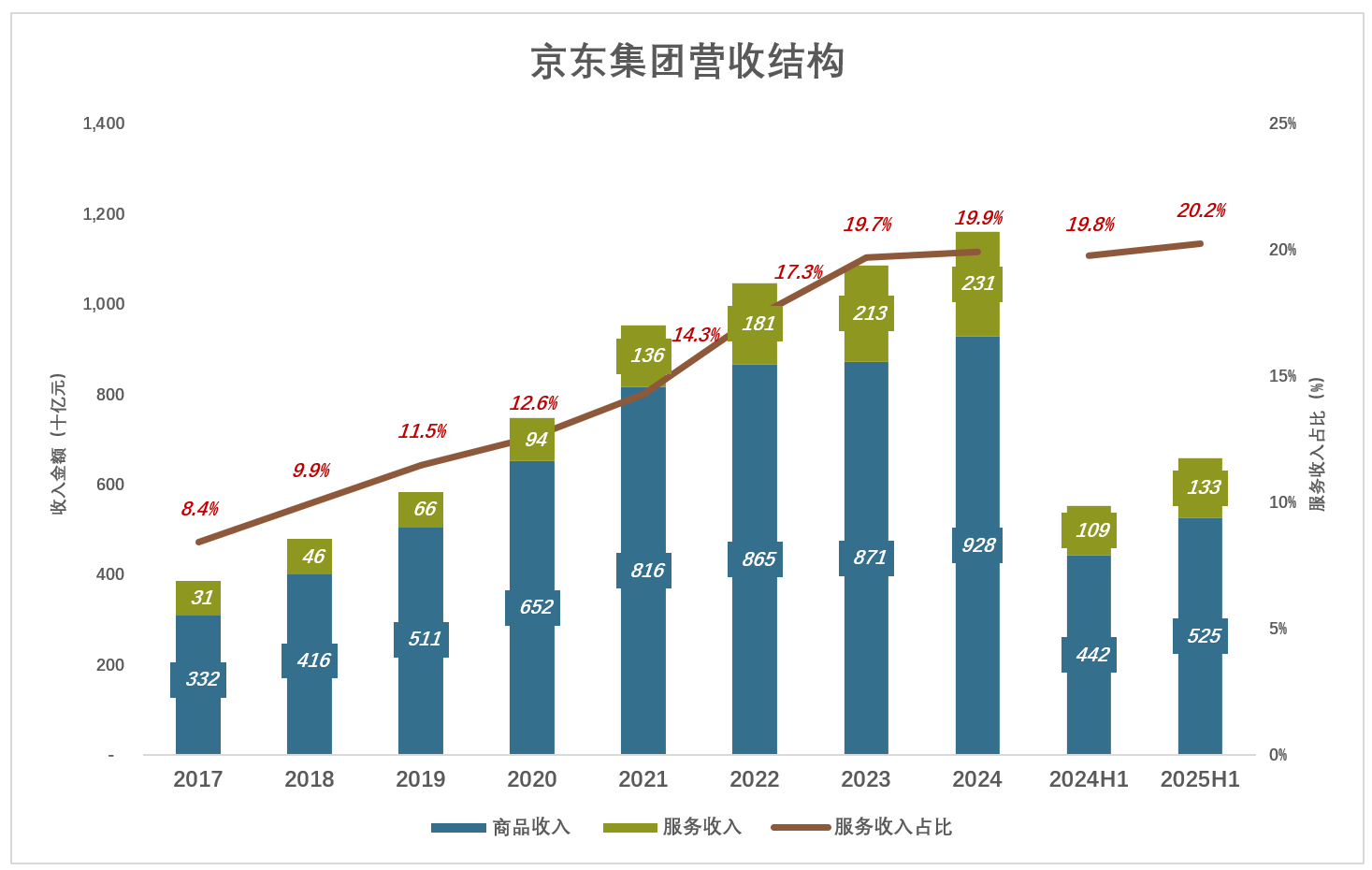
Core Viewpoint - JD Group's second quarter and mid-year performance shows strong revenue growth driven by retail and service income, despite significant losses in new business ventures like food delivery [4][23]. Group 1: Financial Performance - In Q2 2025, JD Group reported revenue of 356.7 billion, a year-on-year increase of 22.4%, with product revenue growing by 20.7% and service revenue by 29.1% [4]. - JD Retail's operating profit reached 13.94 billion, up 37.9% year-on-year, with a profit margin of 4.5% [4]. - The total revenue for H1 2025 was 657.74 billion, reflecting a 19.3% year-on-year growth, with JD Retail contributing 84.7% to the total revenue increase [23]. Group 2: Service Revenue Growth - Service revenue's share of total revenue surpassed 20% for the first time, indicating a significant shift in JD's revenue structure [8][12]. - The service revenue has consistently increased from 8.4% in 2017 to 20.2% in H1 2025, highlighting its importance in improving JD's overall profitability [10][12]. Group 3: New Business Ventures - JD's new business segment, primarily driven by food delivery, saw a staggering revenue increase of 199% in Q2 2025, reaching 13.85 billion, but also incurred a substantial operating loss of 14.78 billion [21][33]. - The company is strategically investing in the food delivery sector despite the losses, aiming for long-term growth and market positioning [50][51]. Group 4: Market Dynamics - The online retail market in China is approaching saturation, with e-commerce growth rates aligning closely with GDP growth, indicating limited future expansion potential [40][44]. - The shift towards "E-commerce 3.0" is necessary to break through existing market ceilings, focusing on integrating online and offline supply chains [46][48]. Group 5: Competitive Landscape - JD's food delivery service, while currently third in daily order volume, is positioned for growth through strategic investments and leveraging existing customer data [51][52]. - The competitive landscape in the food delivery market is intense, with JD aiming to enhance its operational capabilities to improve efficiency and profitability [50].

京东为什么“死磕”外卖?
Hu Xiu· 2025-08-18 23:12
Core Insights - JD Group reported Q2 2025 revenue of 356.7 billion, a year-on-year increase of 22.4%, with product revenue growing by 20.7% and service revenue by 29.1% [1][2] Segment Performance - JD Retail operating profit reached 13.94 billion, up 37.9% year-on-year, with a profit margin of 4.5% [2] - JD Logistics operating profit was 2.1 billion, down 10.3% year-on-year, with a profit margin of 3.8% [2] - New business revenue, primarily from food delivery, surged by 199%, but incurred an operating loss of 14.78 billion [2] Business Expansion and Strategy - JD's food delivery service achieved over 25 million daily orders, covering 350 cities with over 1.5 million merchants, contributing to a significant decline in overall operating profit for the first half of the year [3][5] - The company is strategically expanding into the food delivery sector despite the associated losses, indicating a long-term vision [5][58] Revenue Composition - Service revenue has surpassed 20% of total revenue, indicating a shift in JD's business model [7][11] - Historical data shows a steady increase in service revenue from 8.4% in 2017 to 20.2% in H1 2025, highlighting the importance of service revenue for profit improvement [8][12] Retail and Logistics Growth - JD Retail revenue grew from 694 billion in 2020 to 1.02 trillion in 2024, with a notable increase in growth rate in 2025 [18] - JD Logistics revenue increased from 73.4 billion in 2020 to 182.8 billion in 2024, with continued growth in 2025 [19] New Business Insights - New business revenue reached 13.85 billion in Q2 2025, driven primarily by food delivery, marking a significant increase [21] - The new business segment has been characterized by high operating losses, with Q2 2025 losses reaching 14.78 billion [31][33] Market Context - The online retail market in China is approaching saturation, with growth rates slowing and online sales as a percentage of total retail sales declining [38][42] - The company is exploring new strategies to enhance its market position, including the integration of online and offline supply chains [49][50] Future Outlook - JD's management emphasizes the importance of food delivery and instant retail as key strategic directions for sustainable growth over the next several years [58][61]