
光大证券

Search documents
A股行情带火分析师招聘,AI应用、新兴科技等多赛道“抢人大战”同步打响
Xin Lang Cai Jing· 2026-01-20 02:48
Group 1 - The A-share media sector has experienced a significant surge since the beginning of 2026, driven by the strong catalyst of Generative Engine Optimization (GEO), with the Shenwan Media Industry Index rising over 15% from January 1 to 16, outperforming the CSI 300 Index during the same period [1] - The rapid increase in market interest has led to a surge in demand for analysts in the media sector, prompting several brokerages to initiate recruitment drives for media industry analysts due to previous reductions in research team sizes [1][2] - Major brokerages, including Guosheng Securities and Dongwu Securities, have publicly announced recruitment for chief analysts and analysts specializing in media and internet sectors, indicating a competitive talent acquisition landscape [2] Group 2 - The turnover of high-end talent in the media industry has accelerated, with notable cases of core analysts switching firms, reflecting the industry's recovery and renewed interest from investors [2] - The resurgence of the media sector began in 2023, fueled by the AI technology wave, which has revitalized the industry and created new investment opportunities, leading to a significant increase in the media sector's performance [2] - Brokerages are not only focusing on the media sector but are also actively recruiting analysts in emerging fields such as AI applications, advanced manufacturing, and other high-growth areas, indicating a broader trend in talent acquisition across various sectors [3][4] Group 3 - Guojin Securities has established a chief analyst position specifically for the embodied intelligence sector, focusing on humanoid robots and intelligent equipment, showcasing a targeted approach to emerging technologies [3] - Traditional sectors like pharmaceuticals and cyclical industries are also seeing high demand for talent, with brokerages seeking to balance their recruitment efforts between new and established fields [3] - The urgency for high-end talent acquisition is reflected in the increasing trend of brokerages "poaching" analysts from competitors, highlighting the competitive nature of the current job market in the financial services industry [3][4]
光大证券晨会速递-20260120
EBSCN· 2026-01-20 01:48
Group 1: Macroeconomic Insights - The economic structure is shifting towards improvement, with expectations for a strong start in Q1 2026 due to preemptive investment policies, strong export and infrastructure indicators, and early disbursement of funds for "trade-in" programs [1] - Economic data is anticipated to rebound, contributing to a positive economic outlook for the beginning of 2026 [1] Group 2: Bond Market Analysis - As of the end of December 2025, the total bond custody amount reached 178.55 trillion yuan, with a net increase of 0.30 trillion yuan, although this was a decrease compared to the previous month [2] - The bond market shows a trend where commercial banks are increasing their holdings in interest rate bonds, while credit cooperatives are reducing their positions [2] - The economic characteristics of 2025 indicate a "high before low" pattern, with supply outpacing demand and external demand stronger than internal demand [3] - In December 2025, industrial production growth rates increased year-on-year and month-on-month, while fixed asset investment saw a larger decline [3] - The current liquidity in the bond market is relatively loose, and investors are becoming increasingly optimistic, with expectations for the 10Y government bond yield to stabilize around 1.75% in 2026 [3] Group 3: Real Estate Market Trends - As of January 18, 2026, the cumulative transaction volume for new homes in 20 cities was 23,000 units, reflecting a year-on-year decrease of 45.3% [4] - In major cities, Beijing saw 1,398 units sold (-25%), Shanghai 3,534 units (-35%), and Shenzhen 765 units (-75%) [4] - The second-hand housing market also experienced a decline, with a total of 44,000 units sold across 10 cities, down 17.8% year-on-year [4] - In Beijing, 7,033 second-hand homes were sold (-23%), in Shanghai 12,849 units (-8%), and in Shenzhen 2,844 units (-25%) [4]

光大证券:地缘政治不确定性为油价提供景气基础 关注26年供需边际变化
智通财经网· 2026-01-19 23:25
Core Viewpoint - The current geopolitical tensions in Iran are driving oil price volatility, with the geopolitical risk premium on oil prices increasing, leading to a rise in oil prices. OPEC+ has decided to pause production increases in Q1 2026, which is expected to alleviate concerns regarding oil supply [1][2][3]. Group 1: Geopolitical Impact on Oil Prices - The escalation of tensions in Iran has resulted in significant fluctuations in oil prices, providing a favorable backdrop for oil price increases due to geopolitical uncertainties [2]. - As of January 16, 2026, Brent and WTI crude oil futures closed at $64.20 and $59.22 per barrel, reflecting increases of 1.9% and 0.7% respectively from the previous week [2]. - The U.S. has opted for economic sanctions against Iranian officials rather than military action, which may lead to a potential end to the current oil price surge, although risks of escalation remain [2]. Group 2: OPEC+ Production Decisions - OPEC+ increased production by 2.21 million barrels per day in 2025, but has decided to adopt a cautious approach to production increases in 2026, which is expected to improve the balance of oil supply and demand [3]. - OPEC forecasts a demand growth of 1.38 million barrels per day for 2026, with a first-time prediction of 1.34 million barrels per day growth for 2027 [3]. Group 3: Demand and Supply Outlook - The IEA has revised its forecast for global oil demand growth in 2026 to 860,000 barrels per day, an increase of 90,000 barrels per day from previous estimates, driven by improvements in macroeconomic and trade conditions [4]. - The IEA expects that the demand for chemical feedstocks will dominate oil demand growth, with its share of the incremental demand rising from 40% in 2025 to 60% in 2026 [4]. - Global oil supply is projected to grow by 2.4 million barrels per day in 2026, with a downward adjustment of 20,000 barrels per day due to OPEC+ production pauses and intensified sanctions on Russian and Venezuelan oil [4]. Group 4: Resilience of Major Oil Companies - The "Big Three" Chinese oil companies have demonstrated resilience during the current oil price volatility, benefiting from increased production and effective cost control, with performance levels surpassing historical oil price periods [5]. - Looking ahead to 2026, these companies are expected to maintain high capital expenditures and continue expanding in the natural gas market, as well as accelerate the transformation of their downstream refining businesses, positioning them for long-term growth through oil price cycles [5].
【光大研究每日速递】20260120
光大证券研究· 2026-01-19 23:06
Economic Policy and Market Outlook - Recent economic policies, including structural interest rate cuts, are expected to support economic growth, potentially leading to a "good start" in the first quarter of 2026, although final performance will depend on forthcoming data [5] - The financial market policies have moderated previously overheated sectors, indicating that the market may not sustain its rapid upward trend and could transition into a more volatile phase [5] Fund Market Trends - The Hong Kong stock market saw an overall increase, while domestic equity markets experienced fluctuations; TMT-themed funds performed well, whereas defense and military-themed funds faced net value declines [5] - There was a notable reduction in passive fund holdings across various broad-based ETFs, with over 130 billion yuan flowing out of large-cap ETFs, while TMT and cyclical theme ETFs attracted over 60 billion yuan in net inflows [5] Economic Data Insights - The economic landscape in 2025 is characterized by a "high before low" trend, with supply outpacing demand and external demand exceeding internal demand [6] - In December 2025, industrial production growth rates increased year-on-year and month-on-month, while fixed asset investment saw a widening decline, and retail sales growth continued to decrease [6] Oil and Geopolitical Factors - Heightened geopolitical tensions in Iran have increased the geopolitical risk premium on oil, contributing to rising oil prices; as of January 16, 2026, Brent and WTI crude oil prices were reported at $64.20 and $59.22 per barrel, reflecting increases of 1.9% and 0.7% respectively [7] - The ongoing international instability is likely to provide a favorable foundation for oil price trends in the long term [7] Infrastructure Investment - The State Grid has announced a planned fixed asset investment of 4 trillion yuan during the 14th Five-Year Plan period, marking a 40% increase compared to the previous plan, focusing on power grid and energy storage sectors [8] - Key projects for 2026 will concentrate on ultra-high voltage and pumped storage, indicating potential opportunities in power infrastructure orders and renewable energy consumption [8] Power Consumption and Digitalization - In 2025, the total electricity consumption in society increased by 5.0% year-on-year [9] - The State Grid's investment in new power systems is expected to enhance capacity pricing, with projected capacity prices for 2026 estimated at 6.3 cents per kilowatt-hour, a 4-cent increase from the previous year [9] Pharmaceutical Sector Innovations - The pharmaceutical and biotechnology sectors are experiencing a surge driven by innovation, including overseas expansion, AI applications, and new technologies, alongside policy support and seasonal market dynamics [9] - Key focus areas include innovative drugs, CXO services, AI healthcare, brain-computer interfaces, and small nucleic acid drugs, with ongoing attention required on post-JPM conference collaborations and clinical data outcomes [9]

【固收】2025年经济前高后低特点显著——2025年四季度和12月经济数据点评兼债市观点(张旭/李枢川)
光大证券研究· 2026-01-19 23:06
Core Viewpoint - The economic data for Q4 2025 indicates a significant "high first, low later" trend, with supply outpacing demand and external demand stronger than internal demand [4][5]. Economic Data Summary - In Q4 2025, the GDP grew by 4.5% year-on-year, aligning with market expectations, while the annual growth rate for 2025 was 5% [4][5]. - The industrial added value for December 2025 increased by 5.2% year-on-year, up from 4.8% in November [4][5]. - Fixed asset investment for the entire year of 2025 saw a cumulative year-on-year decline of 3.8%, worsening from a previous decline of 2.6% [4][6]. - Retail sales of consumer goods in December 2025 grew by 0.9% year-on-year, down from 1.3% in November, marking a continuous decline over seven months [4][6]. Investment Market Insights - In the bond market, from August 2025 to the present, government bond yields have shown a clear divergence, with short-term yields stable and declining, while long-term yields, especially the 30-year yield, are on an upward trend [7]. - The current loose liquidity and diverging fundamentals suggest a gradually optimistic outlook for the bond market, with the 10-year government bond yield expected to stabilize around 1.75% in 2026 [7]. - In the convertible bond market, as of January 16, 2026, the China Securities Convertible Bond Index has risen by 5.6%, mirroring the 5.5% increase in the overall index, indicating a strong demand for convertible bonds amid a bullish equity market [7].

独家!穆启国卸任,去向已定!
Zhong Guo Ji Jin Bao· 2026-01-19 16:34
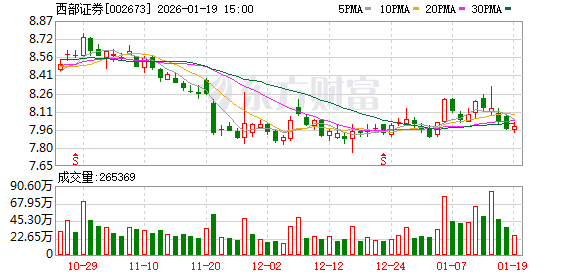
Group 1 - Mu Qiguo has resigned as the head of the Research Institute of Western Securities, with Zhao Yinghua, the deputy general manager in charge of the research institute, taking over the role [2] - The company stated that the new development phase requires updated and higher capabilities for the research center's business development, market expansion, business innovation, and internal collaboration [2] - Mu Qiguo will focus on the company's intelligent investment research and the establishment of research operations for its Hong Kong subsidiary [3] Group 2 - During Mu Qiguo's tenure, his team won the New Fortune Most Potential Research Institution Award for three consecutive years from 2019 to 2021 and was recognized as the Most Characteristic Research Institution by Sina Golden Unicorn in 2020 and 2021 [3] - Mu Qiguo emphasized that smaller brokerages can focus on niche areas with significant Beta changes and upstream industry research to provide unique insights, which can yield higher Alpha value for investors [6] - The research development center's revenue and operating profit have significantly increased year-on-year since 2025, with insurance client revenue surpassing public funds to become the main source of income [7]


独家!穆启国卸任 去向已定!
Zhong Guo Ji Jin Bao· 2026-01-19 16:25
Group 1 - The core point of the article is the resignation of Mu Qiguo as the head of the Research Institute of Western Securities, with Zhao Yinghua taking over the role. This change aligns with the company's updated strategic planning for its research center, emphasizing higher demands for business development and innovation [2][3]. - Mu Qiguo will focus on the company's intelligent investment research and the establishment of its Hong Kong subsidiary's research operations [3]. - Western Securities aims to enhance its research capabilities by strengthening sell-side research, expanding overseas business, and fostering technological innovation to better serve investors [3][5]. Group 2 - During Mu Qiguo's tenure, his team received multiple awards, including the New Fortune Most Promising Research Institution Award for three consecutive years from 2019 to 2021 and the Most Distinctive Research Institution Award from Sina Jin Qilin in 2020 and 2021 [3]. - Mu Qiguo emphasized the potential for smaller brokerages to focus on niche markets with significant beta changes and upstream industry research to provide unique insights, which can yield higher alpha value for investors [4]. - Under Mu Qiguo's leadership, the research development center saw significant growth in revenue and profit, with insurance clients becoming the primary revenue source by surpassing public funds in 2025 [5].
——2025年12月份债券托管量数据点评:商业银行持续增持利率债
EBSCN· 2026-01-19 09:27
1. Report Industry Investment Rating No relevant content provided. 2. Core Viewpoints of the Report - The total bond custody increased less on a month - on - month basis. In December 2025, the total bond custody of China Central Depository & Clearing Co., Ltd. (CCDC) and Shanghai Clearing House was 178.55 trillion yuan, with a net increase of 0.30 trillion yuan compared to the previous month, and 1.18 trillion yuan less than the month - on - month increase in November [1][11]. - In terms of the bond holder structure, among the allocation portfolios, except for credit cooperatives, all institutions increased their bond holdings; trading portfolios and overseas institutions decreased their bond holdings. Different institutions showed different trends in holding various types of bonds [2][26]. - The balance of bonds to be repurchased increased seasonally, and the bond market leverage ratio rose on a month - on - month basis. As of the end of December 2025, the estimated balance of repurchase - style repurchase of bonds to be repurchased was 11.91 trillion yuan, an increase of 859.04 billion yuan compared to the previous month. The leverage ratio was 107.14%, up 0.54 percentage points month - on - month and down 1.10 percentage points year - on - year [4][47]. 3. Summary by Related Catalogs 3.1 Bond Custody Total and Structure - The total bond custody increased less on a month - on - month basis. As of the end of December 2025, the total bond custody of CCDC and Shanghai Clearing House was 178.55 trillion yuan, with a net increase of 0.30 trillion yuan compared to the previous month, and 1.18 trillion yuan less than the month - on - month increase in November [1][11]. - By variety, interest - rate bonds, credit bonds, and financial bonds increased on a net basis month - on - month, while negotiable certificates of deposit (NCDs) decreased on a net basis. In December 2025, the custody of interest - rate bonds was 124.63 trillion yuan, accounting for 69.80% of the inter - bank bond market custody, with a net increase of 0.69 trillion yuan; the custody of credit bonds was 19.15 trillion yuan, accounting for 10.73%, with a net increase of 0.02 trillion yuan; the custody of non - policy financial bonds was 12.93 trillion yuan, accounting for 7.24%, with a net increase of 0.13 trillion yuan; the custody of NCDs was 19.69 trillion yuan, accounting for 11.03%, with a net decrease of 0.62 trillion yuan [1][11]. 3.2 Bond Holder Structure and Changes 3.2.1 Month - on - Month Changes in Custody by Institution - Among the allocation portfolios, except for credit cooperatives, all institutions increased their bond holdings; trading portfolios and overseas institutions decreased their bond holdings. Specifically, policy banks increased their holdings of interest - rate bonds, NCDs, and credit bonds across the board; commercial banks and securities companies increased their holdings of interest - rate bonds but decreased their holdings of NCDs and credit bonds; non - legal person products increased their holdings of interest - rate bonds and credit bonds but decreased their holdings of NCDs; credit cooperatives and overseas institutions decreased their holdings of interest - rate bonds, NCDs, and credit bonds across the board [2][26]. 3.2.2 Month - on - Month Changes in Custody by Bond Type - The custody of treasury bonds continued to increase on a month - on - month basis. Policy banks and commercial banks continued to increase their holdings, while non - legal person products continued to decrease their holdings. - The custody of local government bonds continued to increase on a month - on - month basis, and all major institutions in the bond market increased their holdings. - The custody of policy - based financial bonds continued to increase on a month - on - month basis. Commercial banks continued to increase their holdings, while policy banks changed to significantly decrease their holdings. - The custody of NCDs continued to decrease on a month - on - month basis. Policy banks changed to increase their holdings, while non - legal person products significantly decreased their holdings. - The custody of enterprise bonds continued to decrease on a month - on - month basis, and all major institutions in the bond market decreased their holdings. - The custody of medium - term notes continued to increase on a month - on - month basis. Commercial banks and non - legal person products were the main institutions increasing their holdings. - The custody of short - term financing bills and super - short - term financing bills continued to decrease on a month - on - month basis, and commercial banks were the main institutions decreasing their holdings. - The custody of privately - placed debt instruments changed to a decrease, and commercial banks were the main institutions decreasing their holdings [3][28]. 3.2.3 Holder Structure of Major Bond Types - As of the end of December 2025, the holder structure of treasury bonds: commercial banks accounted for 69.21%, overseas institutions 5.25%, policy banks 11.61%, non - legal person products 7.72%, securities companies 2.50%, insurance institutions 2.57%, and credit cooperatives 1.13% [33]. - The holder structure of policy - based financial bonds: commercial banks accounted for 56.73%, non - legal person products 31.54%, overseas institutions 2.82%, credit cooperatives 3.15%, insurance institutions 1.89%, securities companies 0.93%, and policy banks 2.94% [35]. - The holder structure of local government bonds: commercial banks accounted for 71.83%, non - legal person products 9.83%, policy banks 11.81%, insurance institutions 4.92%, securities companies 1.02%, credit cooperatives 0.57%, and overseas institutions 0.02% [37]. - The holder structure of enterprise bonds: non - legal person products accounted for 55.48%, commercial banks 31.29%, securities companies 9.09%, insurance institutions 3.23%, policy banks 0.54%, credit cooperatives 0.28%, and overseas institutions 0.08% [39]. - The holder structure of medium - term notes: non - legal person products accounted for 60.33%, commercial banks 24.90%, securities companies 4.56%, nominal holder accounts (domestic) 3.67%, policy banks 3.24%, insurance institutions 2.26%, overseas institutions 0.21%, other 0.57%, and credit cooperatives 0.25% [41]. - The holder structure of short - term financing bills and super - short - term financing bills: non - legal person products accounted for 66.21%, commercial banks 26.47%, nominal holder accounts (domestic) 2.97%, securities companies 1.01%, policy banks 2.73%, other 0.29%, insurance institutions 0.14%, credit cooperatives 0.02%, and overseas institutions 0.15% [46]. - The holder structure of NCDs: non - legal person products accounted for 63.66%, commercial banks 22.09%, policy banks 2.22%, credit cooperatives 1.90%, other 4.15%, nominal holder accounts (domestic) 2.09%, securities companies 0.81%, overseas institutions 2.92%, and insurance institutions 0.16% [45]. 3.3 Bond Market Leverage Ratio Observation - The balance of bonds to be repurchased increased seasonally, and the bond market leverage ratio rose on a month - on - month basis. As of the end of December 2025, the estimated balance of repurchase - style repurchase of bonds to be repurchased was 11.91 trillion yuan, an increase of 859.04 billion yuan compared to the previous month. The leverage ratio was 107.14%, up 0.54 percentage points month - on - month and down 1.10 percentage points year - on - year [4][47].
证券板块1月19日跌0.22%,华林证券领跌,主力资金净流出18.66亿元
Zheng Xing Xing Ye Ri Bao· 2026-01-19 08:58
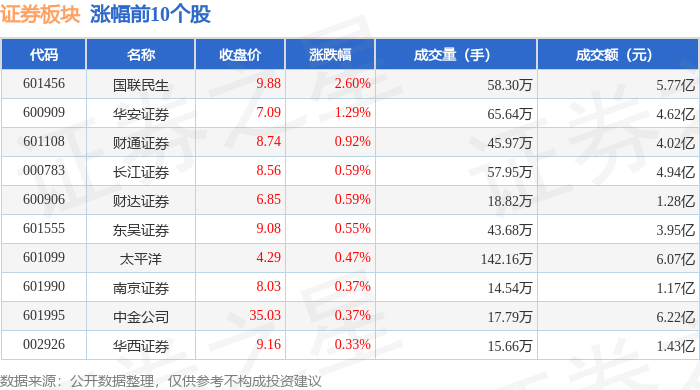
Market Overview - On January 19, the securities sector declined by 0.22%, with Huayin Securities leading the drop [1] - The Shanghai Composite Index closed at 4114.0, up 0.29%, while the Shenzhen Component Index closed at 14294.05, up 0.09% [1] Individual Stock Performance - Guolian Minsheng (601456) closed at 9.88, up 2.60% with a trading volume of 583,000 shares and a turnover of 577 million yuan [1] - Huayin Securities (002945) closed at 17.47, down 1.74% with a trading volume of 339,700 shares and a turnover of 594 million yuan [2] - Dongfang Caifu (300059) closed at 23.50, down 1.63% with a trading volume of 2,997,400 shares and a turnover of 7.065 billion yuan [2] Capital Flow Analysis - The securities sector experienced a net outflow of 1.866 billion yuan from institutional investors, while retail investors saw a net inflow of 1.136 billion yuan [2] - Major stocks like Guotai Junan (601211) had a net inflow of 118 million yuan from institutional investors, while retail investors had a net outflow of 66.72 million yuan [3] - The overall trend indicates a mixed sentiment among different investor types, with institutional investors pulling back while retail investors are more active [2][3]






——2025年四季度和12月经济数据点评兼债市观点:2025年经济前高后低特点显著-20260119
EBSCN· 2026-01-19 08:47
1. Report Industry Investment Rating No relevant content provided. 2. Core Viewpoints of the Report - The economy in 2025 showed a significant "high in the front, low in the back" characteristic, with supply stronger than demand and external demand stronger than domestic demand. The GDP growth rate in Q1 was the highest at 5.4%, while that in Q4 dropped to the lowest at 4.5%. The main economic indicators were significantly differentiated, with the GDP deflator remaining negative and the inflation environment showing no obvious improvement [2][8]. - In December 2025, the year - on - year and month - on - month growth rates of the added value of large - scale industries both increased. However, the month - on - month decline of fixed - asset investment widened, and the growth rates of its three major sub - items continued to decline. The year - on - year growth rate of social consumer goods continued to fall, and the month - on - month growth rate was significantly weaker than the seasonal level [2][3]. - In the bond market, for interest - rate bonds, since August 2025, the yield curve of treasury bonds has steepened significantly. The short - end yield has been stable with a slight decline, while the long - end yield, especially the 30 - year yield, has been on the rise. For convertible bonds, since the beginning of 2026, the convertible bond market has moved in tandem with the equity market. In the long run, convertible bonds are still relatively high - quality assets [4][34]. 3. Summary by Relevant Catalogs 3.1 Event - On January 19, 2026, the National Bureau of Statistics released the economic data for Q4 and December 2025. The real year - on - year growth rate of GDP in Q4 2025 was 4.5%, and the real year - on - year growth rate for the whole year was 5%. In December 2025, the year - on - year growth rate of the added value of large - scale industries was 5.2%, the cumulative year - on - year decline of fixed - asset investment from January to December was 3.8%, and the year - on - year growth rate of the total retail sales of social consumer goods was 0.9% [1][7][10]. 3.2 Comment 3.2.1 Overall Economic Situation in 2025 - The economy showed a "high in the front, low in the back" trend. The industrial production growth rate continued to decline but remained at a relatively high level. In terms of demand, external demand was strong (export growth rate was 6.1% in 2025), while domestic demand was relatively weak (fixed - asset investment growth rate was - 3.8% and social consumer goods retail sales growth rate was 3.7%). The GDP deflator was negative, and the inflation environment did not improve significantly. The year - on - year growth rate of per - capita disposable income of residents also continued to decline [8][9]. 3.2.2 Added Value of Large - scale Industries in December 2025 - The year - on - year growth rate was 5.2%, 0.4 percentage points higher than that in November. The month - on - month growth rate was + 0.49%, up from + 0.44% in the previous month. Among the three major sectors, the year - on - year growth rate of the manufacturing industry increased significantly, while those of the mining industry and the production and supply of electricity, heat, gas, and water decreased [15]. 3.2.3 Fixed - Asset Investment in December 2025 - The cumulative year - on - year growth rate of fixed - asset investment was - 3.8%, with the decline expanding. The month - on - month growth rate was - 1.13%, also with an expanding decline. The cumulative year - on - year growth rates of real estate, manufacturing, and general infrastructure investment all decreased, and the single - month year - on - year growth rates were all weak [20][22]. 3.2.4 Social Consumer Goods in December 2025 - The year - on - year growth rate was 0.9%, falling for 7 consecutive months. The month - on - month growth rate was - 0.12%, significantly lower than the same period in 2023 and 2024. The growth rate of optional consumption slightly stabilized, while the growth rates of necessities and catering services continued to decline [28]. 3.3 Bond Market Viewpoint - Interest - rate bonds: Since August 2025, the yield curve of treasury bonds has steepened. The short - end yield has been stable with a slight decline, and the long - end yield has been rising. Given the current loose capital situation and the differentiated fundamental trends, investors should be more optimistic about the bond market. It is expected that the fluctuation center of the 10Y treasury bond yield in 2026 will be 1.75%. - Convertible bonds: Since the beginning of 2026 (as of January 16), the convertible bond market has moved in tandem with the equity market. In the long run, convertible bonds are still relatively high - quality assets, but more attention should be paid to the structure [4][34].