
天弘基金

Search documents
“上架秒空”!i茅台批发价跌破1499元,食品饮料ETF天弘(159736)最新单日净申购1400万份,位居深市同类第一
Sou Hu Cai Jing· 2026-01-05 01:49
Group 1 - The food and beverage ETF Tianhong (159736) recorded a transaction volume of 18.7153 million yuan as of December 31, 2025, with a net subscription of 14 million units on the latest trading day, ranking first among similar products in the Shenzhen market [1] - The underlying index, the CSI Food and Beverage Index (930653), showed mixed performance among its constituent stocks, with Baba Foods (605338) leading with a 10.01% increase, followed by Yangyuan Beverage (603156) at 9.98%, and Yuegui Co. (000833) at 4.91% [1] - Over the past 20 trading days, the ETF has attracted a total of 38.4279 million yuan in investments, indicating strong market interest [1] Group 2 - The launch of the 53% vol 500ml Flying Moutai liquor on the iMoutai APP sold out within seconds, with over 100,000 users purchasing the product within three days [2] - The wholesale price of the 2025 Flying Moutai fell below 1499 yuan per bottle, decreasing by approximately 100 yuan from the previous week, reflecting market demand dynamics [2] - Guizhou Moutai's strategy for 2026 focuses on consumer-centric market transformation and marketing system reform, aiming to strengthen its product hierarchy and enhance brand competitiveness [2]


基金双周报:ETF市场跟踪报告-20260104
Ping An Securities· 2026-01-04 14:25
Report Industry Investment Rating No information provided regarding the report's industry investment rating Core Viewpoints of the Report - As of December 31, recent two - week ETF products showed good performance, with the Science and Technology Innovation 100 having the largest increase among domestic major broad - based ETFs, and the military - themed ETF having the largest increase among industry and theme products [3][4][11] - In the recent two weeks, the CSI A500 ETF had a significant inflow of funds among domestic major broad - based ETFs, and the CSI 1000, CSI 500, and Science and Technology Innovation 100 ETFs also ranked high in net inflows [4][11] - In the recent two weeks, funds in cycle and large - manufacturing other ETFs accelerated their inflow, while the inflow of funds in dividend and pharmaceutical ETFs slowed down. Consumption, new - energy, and technology ETFs turned to net outflows, and the net outflow of financial - real - estate ETFs slowed down, while the military ETF's funds accelerated their outflow [4][18] - In the bond ETF sector, the funds of the policy - financial bond ETF turned from net inflow to net outflow, the national bond ETF's funds turned to net inflow, the net inflow of local - government bond ETFs slowed down, the credit - bond ETF's funds accelerated their net inflow, the net outflow of the short - term financing ETF slowed down, and the convertible - bond ETF's funds accelerated their net outflow [4] - As of December 31, 15 new ETFs were established in the market in the recent two weeks, with a total issuance of 3.982 billion shares, all being stock ETFs. Compared with the end of 2024, the scale of various types of ETFs increased, with the bond ETF, commodity ETF, industry + dividend ETF, QDII - ETF, and broad - based ETF increasing by 376.52%, 230.98%, 111.47%, 61.13%, and 18.62% respectively [4][26] Summary by Relevant Catalog ETF Market Review 1.1 Main Types of ETF Fund Flows Overview - In terms of returns, as of December 31, the Science and Technology Innovation 100 had the largest increase among domestic major broad - based ETFs in the recent two weeks, and the military - themed ETF had the largest increase among industry and theme products [4][11] - In terms of fund flows, in the recent two weeks, the CSI A500 ETF had a significant inflow of funds among domestic major broad - based ETFs, and the CSI 1000, CSI 500, and Science and Technology Innovation 100 ETFs also ranked high in net inflows [4][11] 1.2 Main Types of ETF Cumulative Fund Flows - **Broad - based ETFs**: In 2025, the funds of major broad - based ETFs changed from outflow to inflow and then to outflow, with a significant inflow at the end of the year. In April, there was a large inflow of funds into broad - based ETFs such as the CSI 300 ETF, and then all types of broad - based ETFs had continuous outflows. In mid - to late December, there was a large inflow of funds into the CSI A500 ETF. In 2025, the CSI 1000/CSI 2000 had the highest cumulative net inflow of funds, followed by the CSI 300 and CSI 500 ETFs, while the Science/Innovation ETFs and A - series ETFs had cumulative net outflows. In the recent two weeks, the funds of major broad - based ETFs continued to have a net inflow as a whole, with the A - series and CSI 1000/CSI 2000 accelerating their net inflow, the net - inflow speed of the CSI 500 ETF slowing down, the CSI 300 and Science/Innovation ETFs turning to net outflows, and the Shanghai Composite 50 ETF accelerating its net outflow [12] - **Industry and Theme ETFs**: In 2025, the technology - themed ETF had the highest cumulative net inflow of funds, followed by the financial - real - estate ETF. Except for the military - themed ETF, all other industry - theme ETFs had cumulative net inflows. After a large outflow at the beginning of the year, the technology ETF turned to inflow since March, and in the recent two weeks, the funds turned to a large net outflow. In the recent two weeks, funds in cycle and large - manufacturing other ETFs accelerated their inflow, while the inflow of funds in dividend and pharmaceutical ETFs slowed down. Consumption and new - energy ETFs turned to net outflows, and the net outflow of financial - real - estate ETFs slowed down, while the military ETF's funds accelerated their outflow [18] - **Bond ETFs**: Since 2025, the credit - bond ETF had the highest net inflow of funds, followed by the national bond ETF. In the recent two weeks, the funds of the policy - financial bond ETF turned from net inflow to net outflow, the national bond ETF's funds turned to net inflow, the net inflow of local - government bond ETFs slowed down, the credit - bond ETF's funds accelerated their net inflow, the net outflow of the short - term financing ETF slowed down, and the convertible - bond ETF's funds accelerated their net outflow [18] 1.3 ETF Product Structure Distribution - **Newly Issued Products**: As of December 31, 15 new ETFs were established in the market in the recent two weeks, with a total issuance of 3.982 billion shares, all being stock ETFs [4][26] - **Product Scale**: Compared with the end of 2024, the scale of various types of ETFs increased, with the bond ETF, commodity ETF, industry + dividend ETF, QDII - ETF, and broad - based ETF increasing by 376.52%, 230.98%, 111.47%, 61.13%, and 18.62% respectively [4][26] 1.4 Manager Scale Distribution - As of December 31, Huaxia Fund had the largest on - exchange ETF scale of 95.6917 billion yuan, and the ETF management scale of Huaxia and E Fund expanded by more than 29 billion yuan compared with one year ago [27] Sub - type ETF Tracking - **Technology Theme ETF**: In the recent two weeks, products tracking satellite communications had the highest net inflow of funds, while products tracking the Guozheng Chip had a net outflow [31] - **Dividend Theme ETF**: In the recent two weeks, products tracking low - volatility dividends had the highest net inflow of funds, while products tracking the Hang Seng Hong Kong Stock Connect High - Dividend - Yield Index had a net outflow [34] - **Consumption Theme ETF**: Products tracking the S&P 500 Consumer Select Index had a relatively high premium rate; ETFs tracking the CSI Tourism Index had the highest net inflow of funds in the recent two weeks, while products tracking the CSI Animal Husbandry Index had a net outflow [37] - **Pharmaceutical Theme ETF**: ETFs tracking the CSI Medical Index had the highest net inflow of funds in the recent two weeks, while products tracking medical devices had a net outflow [40] - **Large - manufacturing Theme ETF**: Products tracking the robot industry had the highest net inflow of funds in the recent two weeks, while products tracking the CSI Military Industry Index had a net outflow [43] - **QDII ETF**: Products tracking the Hang Seng Technology Index had the highest net inflow of funds in the recent two weeks, while ETF products tracking the Hang Seng Index had a net outflow [46] Popular Theme ETF Tracking 3.1 AI Theme ETF Tracking - **Return Performance**: Most AI - themed products rose in the recent two weeks, with an average return of 3.10%. The products tracking the Science and Technology Innovation and Entrepreneurship AI had the largest increase [57] - **Fund Flows**: Since 2025, the funds had an overall net inflow. There was a large inflow from mid - February to April, a continuous outflow from May to August, and a large inflow since mid - August. In the recent two weeks, there was a net outflow of 2.878 billion yuan [57] 3.2 Robot Theme ETF Tracking - **Return Performance**: Robot - themed products performed well in the recent two weeks, with an average return of 9.85%. The products tracking the robot industry had the largest increase [61] - **Fund Flows**: After February 2025, the funds showed a rapid inflow trend as a whole. In the recent two weeks, there was a net inflow of 1.83 billion yuan [61] 3.3 New - energy Theme ETF Tracking - **Return Performance**: Most new - energy - themed products rose in the recent two weeks, with an average return of 3.14%. The products tracking new - energy vehicles had the largest increase [67] - **Fund Flows**: There was a continuous outflow before August 2025, a large inflow from August to October, and a large outflow since late October. In the recent two weeks, there was a net outflow of 1.118 billion yuan [67] 3.4 Central Huijin, Guoxin, and Chengtong Holdings ETF Tracking - **Holding Scale**: As of June 30, 2025, the scale of ETFs held by Central Huijin, Guoxin, and Chengtong totaled 391.336 billion shares [72] - **Fund Flows**: In the recent two weeks, there was a net inflow of 4.992 billion yuan. In the recent two weeks, the Southern CSI 500 ETF, Huaxia CSI 1000 ETF, and Southern CSI 1000 ETF ranked high in terms of fund inflow [72]
周观:公募基金销售新规正式稿落地,债市修复可期(2025年第51期)
Soochow Securities· 2026-01-04 14:03
Group 1: Report Industry Investment Rating - Not provided in the content Group 2: Core Viewpoints of the Report - The bond market at the end of 2025 was volatile and weak, mainly affected by year - end institutional behavior changes and strong December PMI data. The official draft of the new regulations on public fund sales is expected to have a positive impact on the bond market, and the bond market at the beginning of 2026 is likely to recover [13][16]. - In 2026 Q1, the bond market has both risks and opportunities. At the beginning of 2026, the possibility of a significant tightening of funds similar to that in early 2025 is small. Higher interest rates are beneficial for allocation - type institutions, while trading - type institutions can focus on capital interest rates and potential reserve requirement ratio and interest rate cuts [17]. - The "grand narrative" pricing and cyclical factors of gold are positive in 2026, and gold is expected to play an important role in different asset portfolios. The long - term value of the RMB is underestimated, but in the medium - term, the supporting role of macro - policies during the transformation from exogenous to endogenous growth needs to be considered [20]. - The latest PMI and EIA data in the US show increased inflationary pressure and slowed economic expansion momentum. The market's expectation of the Fed's interest rate cut has become more cautious. There are significant policy differences within the Fed, and the monetary policy path requires more data for confirmation [21]. Group 3: Summary According to Relevant Catalogs 3.1 One - Week Viewpoints - **Impact of PMI and New Fund Sales Regulations on the Bond Market**: From December 26 to 31, 2025, the yield of the 10 - year Treasury active bond rose 1.45bp from 1.8355% to 1.85%. On December 31, the release of PMI data initially suppressed the bond market sentiment, and the official draft of the new regulations on public fund sales had limited impact on the bond market that day [11][12]. - **Analysis of US Economic Data and Bond Yields**: The US December PMI initial values were all lower than expected, EIA inventory data changed, and the housing and labor markets showed mixed signals. The Fed's policy differences were significant, and the short - term interest - rate cut faced resistance [21][22][32]. 3.2 Domestic and Foreign Data Summaries - **Liquidity Tracking**: From December 29 to 31, 2025, the net investment in the open market was 117.1 billion yuan. The money market interest rates and bond yields showed certain changes [36][41]. - **Domestic and Foreign Macroeconomic Data Tracking**: Steel prices generally rose, LME non - ferrous metal futures official prices increased across the board. Overseas, the US stock and bond markets, and commodity prices also had corresponding fluctuations [59]. 3.3 Local Bond One - Week Review - **Primary Market Issuance Overview**: From December 29, 2025, to January 2, 2026, 9 local bonds were issued, with a total issuance amount of 26 billion yuan, including 11.5 billion yuan in refinancing bonds and 14.5 billion yuan in new special bonds. The net financing amount was 17.449 billion yuan, mainly invested in comprehensive projects [84]. - **Secondary Market Overview**: The local bond stock was 54.61 trillion yuan, with a trading volume of 133.992 billion yuan and a turnover rate of 0.25%. The top three provinces in terms of trading activity were Guangdong, Sichuan, and Zhejiang, and the top three active terms were 30Y, 10Y, and 20Y [97]. - **This Month's Local Bond Issuance Plan**: The issuance plans for Shandong and Zhejiang provinces from January 5 to 9, 2026, were provided [103]. 3.4 Credit Bond Market One - Week Review - **Primary Market Issuance Overview**: A total of 81 credit bonds were issued, with a total issuance of 74.42 billion yuan, a total repayment of 136.119 billion yuan, and a net financing of - 61.7 billion yuan. The net financing of urban investment bonds was - 8.818 billion yuan, and that of industrial bonds was - 52.882 billion yuan [104][105]. - **Issuance Interest Rates**: The issuance interest rates of short - term financing bonds, medium - term notes, and corporate bonds showed different degrees of change [118]. - **Secondary Market Transaction Overview**: The total trading volume of credit bonds was 242.219 billion yuan, with short - term financing bonds and medium - term notes having relatively large trading volumes [119]. - **Yield to Maturity**: The yields of short - term financing bonds, medium - term notes, corporate bonds, and urban investment bonds showed a differentiated trend [121][123][125]. - **Credit Spreads**: The credit spreads of short - term financing bonds, medium - term notes, corporate bonds, and urban investment bonds showed different degrees of change, with the credit spreads of urban investment bonds generally widening [128][131][134]. - **Grade Spreads**: The grade spreads of short - term financing bonds, medium - term notes, and corporate bonds generally widened, while those of urban investment bonds showed a differentiated trend [135][141][142]. - **Trading Activity**: The industrial sector had the largest trading volume of bonds, reaching 152.732 billion yuan. The top five most actively traded bonds in each category were listed [147]. - **Subject Rating Changes**: The subject ratings of several companies were upgraded, including Yichun Development Investment Group Co., Ltd., and Suining Tianyi Investment Group Co., Ltd. [149].
科创综指年涨逾46%,超260亿资金借道布局硬科技
Di Yi Cai Jing· 2026-01-04 09:49
Core Insights - The Sci-Tech Innovation Board (STAR Market) has become a central battleground for technological innovation in China, with the STAR Composite Index (Sci-Tech Composite Index) launched in early 2025, showcasing a significant annual increase of 46.3% and a cumulative rise of nearly 115% since the "9·24" market rally, outperforming major indices like the Shanghai Composite Index and CSI 300 [1][2]. Market Performance - The STAR Composite Index has demonstrated strong market performance, ranking among the top of major broad-based indices, with a 46.3% increase in 2025 and a cumulative increase of 114.97% since the "9·24" rally [2]. - The number of products linked to the STAR Composite Index has expanded from 12 to 58, with a total scale exceeding 26.6 billion yuan, reflecting increased investor interest and product diversity [2][3]. Product Performance - Most products linked to the STAR Composite Index have achieved positive returns, with over 60% of products yielding more than 20% cumulative returns. Notably, the Jiashi STAR Composite Enhanced Strategy ETF has a cumulative return of 43.19%, leading the pack [3][4]. Index Differentiation - The STAR Composite Index provides comprehensive coverage of both industry leaders and growth potential companies, filling a gap in the representation of the STAR Market's overall ecosystem, unlike the more focused Sci-Tech 50 and Sci-Tech 100 indices [4][5]. - The STAR Composite Index serves as a core allocation anchor for investors looking to gain exposure to the entire STAR Market, while the Sci-Tech 50 and Sci-Tech 100 indices cater to different investment strategies [5][6]. Institutional Interest - The STAR Composite Index is increasingly viewed as a long-term allocation option for institutional investors, such as insurance and pension funds, due to its strategic alignment, long-term return potential, and risk diversification capabilities [6][7]. - The average daily trading volume of leading STAR Composite Index ETFs has reached a significant scale, enhancing liquidity and reducing concerns for institutional investors [6][8]. Future Directions - The future of the STAR Composite Index may involve product innovation and the introduction of derivatives, which could activate the market and attract diverse investor preferences [7][8]. - Suggestions for future developments include creating cross-market ETFs, thematic ETFs based on technology sectors, and implementing systematic investment plans to lower barriers for ordinary investors [7][8].
见证历史,6万亿之上
Zhong Guo Ji Jin Bao· 2026-01-03 07:08
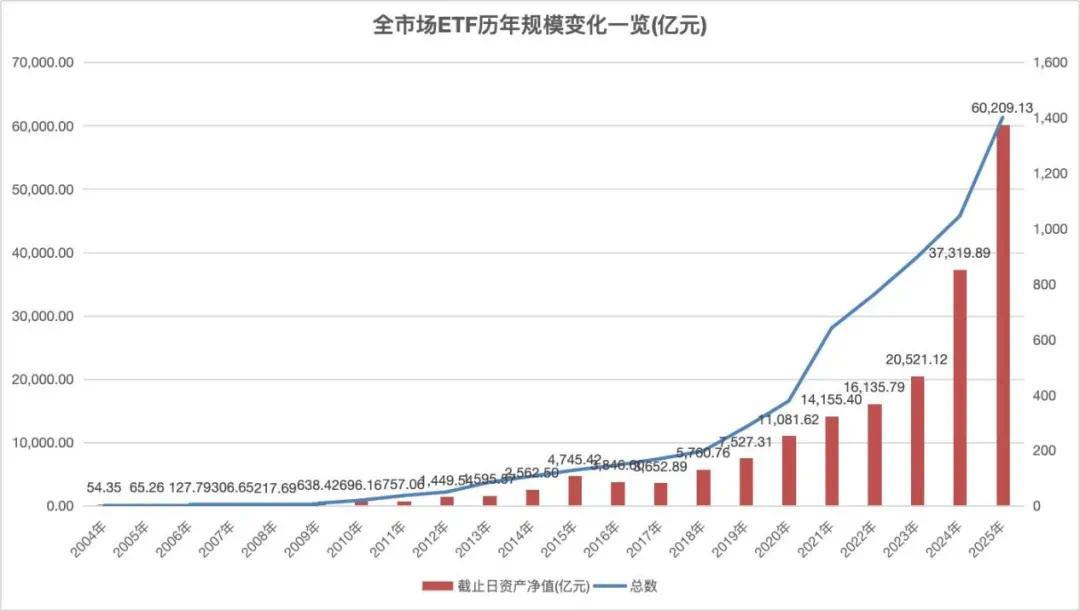
Group 1 - The total scale of the ETF market in China surpassed 6 trillion yuan for the first time, reaching 6.02 trillion yuan by the end of 2025, with a growth rate of 61.33% [2][4] - The number of ETF products increased from 1,046 at the end of 2024 to 1,401 by the end of 2025, marking a growth of 33.93% [2][4] - The market saw significant growth in various ETF categories, including bond ETFs, commodity ETFs, and cross-border ETFs, with the Hong Kong Stock Connect Internet ETF leading in net inflows [2][4][12] Group 2 - Six ETFs experienced a doubling in unit net value growth, particularly in sectors like communication, artificial intelligence, and non-ferrous metals, with the top ten performing ETFs averaging over 105% growth [4][6] - Conversely, some ETFs tracking food and beverage indices showed poor performance, with declines ranging from 7% to nearly 13% [4][6] Group 3 - Major fund companies such as Huaxia, E Fund, and Huatai-PB maintained the top three positions in ETF management scale, with Huaxia leading at 957.16 billion yuan [17][18] - In terms of net inflows, Huaxia and E Fund also led, with several other companies like Guotai and Fortune seeing net inflows exceeding 100 billion yuan [17][18] Group 4 - The bond ETF market saw explosive growth, with the total scale surpassing 800 billion yuan, driven by the popularity of the Sci-Tech Bond ETF [24][26] - The total number of newly established ETFs in 2025 reached a record high of 362, with a total issuance of 2.664 billion units, significantly exceeding previous years [22][23] Group 5 - The ETF custody market also experienced concentration, with major banks like Industrial and Commercial Bank of China and China Construction Bank leading in custody scale, collectively holding over 4.5 trillion yuan [29][30] - A trend of standardization in ETF naming emerged, with major institutions like E Fund completing the renaming of their ETFs to align with new guidelines [31]
这个板块火了!成立不足一年,ETF规模突破110亿元
Zheng Quan Shi Bao Wang· 2026-01-03 06:37
Core Insights - The satellite sector has shown remarkable investment performance, with several satellite ETFs experiencing over 40% growth in December alone, leading to a total market size exceeding 11 billion yuan by the end of December 2025, a significant increase of over 140% from the end of November 2025 [1][2] Group 1: Market Performance - By December 31, 2025, the total scale of satellite-related ETFs and linked products surpassed 11 billion yuan, with a notable increase from 4.491 billion yuan at the end of November [1][2] - The first satellite ETF tracking the National Commercial Satellite Communication Industry Index was launched by Yongying Fund, achieving a scale of 6.66 billion yuan and a return of 71.15% since its inception [1][2] - The largest product tracking the CSI Satellite Industry Index is the ZhaoShang CSI Satellite Industry ETF, with a scale of 1.531 billion yuan, contributing to a total of 4.397 billion yuan for all products linked to this index [1][2] Group 2: Industry Development - The satellite industry is recognized as a core component of the aerospace economy, with national strategies emphasizing its role in fostering new productive forces [3] - The "14th Five-Year Plan" includes the satellite industry as a strategic emerging industry, aligning with national security and technological advancement [3][4] - The industry has transitioned from a "follower" to a "leader" in global satellite technology, driven by advancements in low-orbit satellite internet and commercial remote sensing [4] Group 3: Investment Opportunities - Fund managers highlight that the commercial space sector is on the brink of a significant breakthrough, driven by policy support, technological advancements, and expanding application scenarios [5][6] - The successful business model of SpaceX and the potential of low-orbit satellite internet are seen as key drivers for industry growth [6] - Investment opportunities are identified in satellite launch schedules, breakthroughs in heavy-lift rockets, and cost reductions in rocket and satellite manufacturing [7]
2025年千亿管理人增至16家 这十只ETF规模正狂飙
Xin Lang Cai Jing· 2026-01-03 04:51
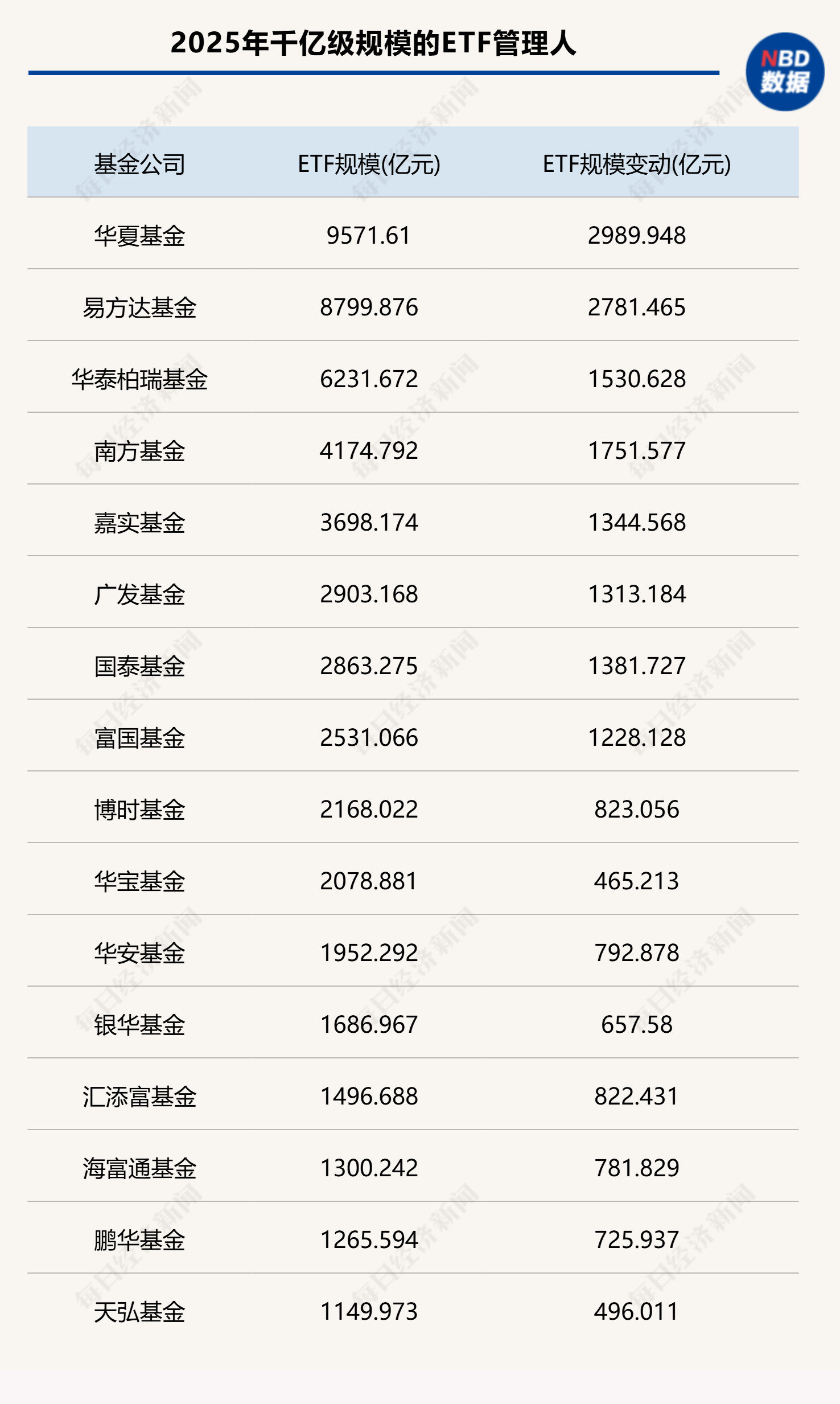
格隆汇1月3日|据每经,Wind数据显示,2025年有16家基金公司ETF管理规模超千亿元,相比2024年的12家增加了4家。另外,2025年ETF管理规模排名前 十位的基金公司位次出现了变化,富国基金规模排名提升2个位次,广发基金、国泰基金提升1个位次。 | 基金公司 | ETF规模(亿元) | ETF规模 | | --- | --- | --- | | 华夏基金 | 9571.61 | 298 | | 易方达基金 | 8799.876 | 278 | | 华泰柏瑞基金 | 6231.672 | 153 | | 南方基金 | 4174.792 | 175 | | 嘉实基金 | 3698.174 | 134 | | "发基金 | 2903.168 | 131 | | 国泰基金 | 2863.275 | 138 | | 富国基金 | 2531.066 | 122 | | 博时基金 | 2168.022 | 82. | | 花毛蜜等 | 2078.881 | 46! | | --- | --- | --- | | 华安基金 | 1952.292 | 79: | | 银华基金 | 1686.967 | ୧୮ | | ...
见证历史!6万亿之上
Xin Lang Cai Jing· 2026-01-03 04:50
Group 1 - The core theme of the article is the significant growth of the ETF market in China, with the total market size reaching 6.02 trillion yuan by the end of 2025, marking a 61.33% increase from the previous year [4][6][33] - The number of ETF products increased to 1,401, reflecting a growth of 33.93% from the end of 2024, indicating a robust expansion in the market [4][27] - Major players in the ETF market include Huaxia, E Fund, and Huatai-PB, which dominate the management scale, with Huaxia leading at 957.16 billion yuan [23][24] Group 2 - The performance of ETFs showed structural differentiation, with six ETFs achieving a unit net value growth rate exceeding 100%, particularly in sectors like communication, artificial intelligence, and non-ferrous metals [6][7] - Conversely, some ETFs tracking food and beverage indices experienced declines, with the wine ETF dropping by 12.96% [9][6] - The top ten ETFs by net inflow included the Hong Kong Stock Connect Internet ETF, which attracted over 566 billion yuan, highlighting the strong demand for cross-border investment products [17][10] Group 3 - The bond ETF market also saw explosive growth, with the total size surpassing 800 billion yuan, driven by the popularity of the Sci-Tech Bond ETF, which accounted for over 50% of the annual growth in this segment [29][28] - The A500 ETF segment became a focal point of competition, with total assets exceeding 300 billion yuan and significant net inflows recorded in December 2025 [31][32] - The ETF issuance market experienced a historic surge, with 362 new ETFs launched in 2025, surpassing the total from the previous two years combined [27][28] Group 4 - The ETF custody market also expanded, with the top five custodians holding approximately 75% of the total ETF market size, indicating a concentration of assets among leading institutions [33] - A trend towards standardization in ETF naming was observed, with major firms like E Fund completing the renaming of their products to align with new regulatory guidelines [34]





上证180指数ETF今日合计成交额1.53亿元,环比增加66.18%
Zheng Quan Shi Bao Wang· 2025-12-31 10:58
Core Viewpoint - The trading volume of the Shanghai Stock Exchange 180 Index ETFs increased significantly today, with a total trading amount of 153 million yuan, representing a week-on-week increase of 60.86 million yuan, or 66.18% [1] Trading Volume Summary - The Huazhong Shanghai 180 ETF (510180) had a trading volume of 94.61 million yuan, an increase of 50.34 million yuan from the previous trading day, with a week-on-week growth of 113.74% [1] - The Shang 180 ETF (530800) recorded a trading volume of 4.96 million yuan, up by 4.72 million yuan from the previous day, marking a week-on-week increase of 1927.86% [1] - The Southern Shanghai 180 ETF (530580) had a trading volume of 18.31 million yuan, an increase of 3.92 million yuan, with a week-on-week growth of 27.23% [1] Market Performance Summary - As of market close, the Shanghai 180 Index (000010) fell by 0.16%, while the average decline of related ETFs tracking the index was 0.12% [1] - The ETFs with the largest declines included the Ping An Shanghai 180 ETF (530280) and the Industrial Bank Shanghai 180 ETF (530680), which fell by 0.33% and 0.17%, respectively [1]
跨境ETF扩容持续,港股科技股ETF放量增长
Zheng Quan Shi Bao· 2025-12-31 09:21
Core Viewpoint - The expansion of cross-border ETFs has accelerated significantly this year, with both the scale and number of related products increasing, making it an important observation window for changes in capital allocation [1][2]. Group 1: Cross-Border ETF Expansion - As of December 26, the total scale of cross-border ETFs has increased by 514.7 billion, with the number of products rising by 63 since the beginning of the year [2]. - Hong Kong stock-related ETFs have become the main source of this expansion, particularly those focused on technology stocks, which have seen significant growth [2][3]. - Several ETFs focusing on Hong Kong technology assets have achieved substantial scale increases, indicating that some funds are still participating in the Hong Kong technology sector through cross-border ETF tools despite global market volatility [1][2]. Group 2: Market Dynamics and Fund Flows - In the fourth quarter, the performance of Hong Kong technology stocks has shown phase volatility, but there has not been a consistent withdrawal of funds [1][3]. - Despite the decline in net value of related technology indices, some ETFs have continued to see growth, indicating ongoing structural investment [3]. - Specific ETFs such as Tianhong Hang Seng Technology ETF, Huaxia Hang Seng Technology ETF, and E Fund Hang Seng Technology ETF have reported scale increases of 10.257 billion, 5.502 billion, and 5.330 billion respectively over the past three months [3]. Group 3: Institutional Outlook - Institutions remain optimistic about the future, citing multiple narratives such as AI development, potential Federal Reserve interest rate cuts, and accelerated inflows from the south as factors attracting market attention [4]. - The liquidity environment is expected to become more accommodative, which may support risk assets like Hong Kong technology stocks [4]. - The recent market corrections have released some risk factors, providing opportunities for long-term investors to position themselves in quality technology assets [4]. Group 4: Industry Trends - The development of AI is heavily supported by capital expenditures in cloud and computing power, with global cloud giants increasing investments in data centers to meet rising AI inference demands [5]. - Hong Kong technology companies are expanding their market boundaries and entering new phases of internationalization [5][6].