
宇通客车

Search documents
大行评级|花旗:以旧换新补贴新政或令入门级车型市场加快整合 比亚迪、吉利等更具规模优势
Ge Long Hui· 2026-01-02 04:55
Core Viewpoint - Citigroup's report indicates that the mainland has updated its vehicle trade-in subsidy policy for 2023, shifting from fixed amounts to percentage-based calculations based on vehicle prices [1] Summary by Category Subsidy Policy Changes - The subsidy cap remains unchanged from last year, but eligibility is now based on vehicle price percentages rather than fixed amounts [1] - For scrapping and updating policies, only new energy vehicles priced above 166,700 yuan and fuel vehicles above 150,000 yuan qualify for the maximum subsidy [1] - Under the trade-in policy, only new energy vehicles priced above 187,500 yuan and fuel vehicles above 216,700 yuan are eligible for the maximum subsidy [1] Market Implications - The new subsidy structure may accelerate market consolidation for entry-level models (average price below 160,000 yuan) [1] - Companies like BYD, Geely, and Changan, which have advantages in cost control and higher profit margins from export businesses, may gain a competitive edge in the domestic market compared to smaller, loss-making car manufacturers [1] Commercial Vehicle Subsidies - The subsidies for commercial trucks and urban buses will remain unchanged from last year, which is expected to benefit companies like Yutong Bus and China National Heavy Duty Truck Group [1]



汽车行业2026年度投资策略
2025-12-31 16:02
Summary of Key Points from the Conference Call Industry Overview - The conference call focuses on the **automotive industry** and its investment strategies for **2026**. The discussion includes various segments such as passenger vehicles, commercial vehicles, and motorcycles, along with the impact of macroeconomic factors and technological advancements. Core Insights and Arguments - **Passenger Vehicle Market**: The domestic demand for passenger vehicles is expected to decline by **2.5%** in 2026 due to policy exhaustion and the reduction of purchase tax. However, the penetration rate of new energy vehicles (NEVs) is anticipated to partially offset this decline, leading to a slight increase in registration numbers for NEVs [3][4]. - **Export Growth**: The export growth rate for the automotive sector is projected to remain above **15%** due to domestic manufacturers' overseas expansion and the competitive pricing of NEVs [5][9]. The expected export volume for NEVs in 2026 is close to **2.4 million units**, representing a year-on-year increase of **100%** [9]. - **Heavy-Duty Trucks**: The heavy-duty truck market is expected to benefit from the "old-for-new" policy, with sales projected at **1.06 million units** in 2026. However, the growth momentum may weaken as the policy's effects diminish [6][15]. - **Commercial Vehicles**: The bus market is expected to grow by approximately **5%** in 2026, primarily driven by the increasing penetration of NEVs in overseas markets [6]. - **Motorcycle Market**: The motorcycle export market is projected to maintain a high growth rate of around **15%**, with domestic brands like Longxin and Chunfeng capitalizing on overseas channel expansions [7]. - **Investment Opportunities**: Key investment themes for the automotive sector include expanding overseas markets, high-end passenger vehicle segments, the domestic replacement of components, and embracing AI technologies for transformation [2][20]. Additional Important Insights - **AI and Technology**: The development of AI technologies is expected to significantly impact the automotive sector, particularly in areas such as autonomous driving and robotics. The liquid cooling market is projected to reach over **150 billion** in 2026, indicating exponential growth [4][18]. - **Domestic Component Replacement**: The domestic replacement rate for components in the heavy-duty truck segment has reached **40%** for vehicles priced above **200,000**. This trend is expected to accelerate with new models from brands like Geely and Huawei [13]. - **Global Market Potential**: There remains a substantial potential market of over **30 million** vehicles outside of major markets like the US, Japan, and Europe, indicating significant opportunities for domestic brands [8]. - **Challenges and Risks**: The automotive sector faces challenges such as policy changes affecting domestic demand and potential trade tensions impacting component exports. However, the established advantages of Chinese automotive parts manufacturers in terms of cost and technology position them well for growth in international markets [10]. - **Future Outlook**: The overall outlook for the automotive sector in 2026 is cautiously optimistic, with opportunities arising from high-end domestic replacements, overseas expansions, and the integration of AI technologies across various segments [20].
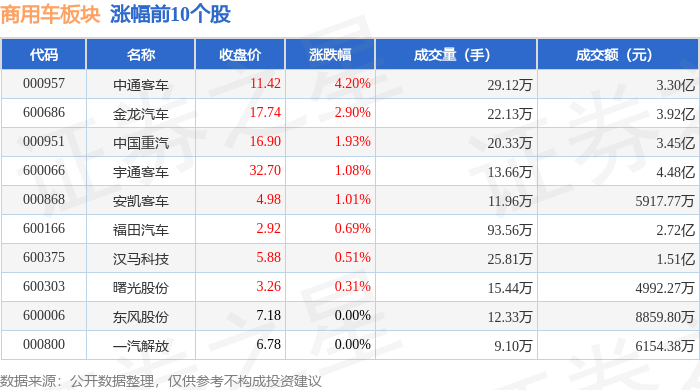
商用车板块12月31日涨0.25%,中通客车领涨,主力资金净流出8846.28万元
Zheng Xing Xing Ye Ri Bao· 2025-12-31 08:59
Group 1 - The commercial vehicle sector increased by 0.25% on December 31, with Zhongtong Bus leading the gains [1] - The Shanghai Composite Index closed at 3968.84, up 0.09%, while the Shenzhen Component Index closed at 13525.02, down 0.58% [1] - Key stocks in the commercial vehicle sector showed varied performance, with Zhongtong Bus closing at 11.42, up 4.20%, and Jinlong Automobile at 17.74, up 2.90% [1] Group 2 - The commercial vehicle sector experienced a net outflow of 88.46 million yuan from institutional investors, while retail investors saw a net inflow of 57.80 million yuan [2] - The trading volume and turnover for key stocks varied, with Jinlong Automobile having a turnover of 3.92 billion yuan and Zhongtong Bus at 3.30 billion yuan [2] - The net inflow from retail investors for several stocks, including Yutong Bus and Ankai Bus, indicated mixed investor sentiment [3]


宇通集团|写入《2025 汽车行业影响力年鉴》
Jing Ji Guan Cha Bao· 2025-12-31 07:06
Core Insights - The Chinese automotive industry is entering a new development phase as the "14th Five-Year Plan" concludes, with a focus on the impact of technology and market dynamics on the sector [1] - Yutong Group is positioned as a leading enterprise in the new energy commercial vehicle sector, showcasing a model for industry leadership through significant breakthroughs planned for 2025 [1][4] Group 1: Yutong's Technological Advancements - Yutong's innovation strategy is systematic, focusing on platform construction and strategic layout, achieving over 10% improvement in product range and a 20% reduction in operational costs [2] - The self-developed electric platform "Rui Control E Platform" integrates hardware and software, enhancing product competitiveness in the commercial vehicle sector [2] - Yutong's heavy-duty truck "Yuanjie T800" features an 800 kWh battery, extending its range to over 550 kilometers, facilitating entry into the medium and long-distance logistics market [2] Group 2: Globalization and Customization - Yutong is expanding its growth boundaries through globalization and customization, developing unique competitive advantages tailored to different market demands [3] - The company is not merely exporting products but extending its core technology capabilities through localized services, achieving bulk operations in various countries [3] - Continuous investment in R&D and participation in industry standards solidify Yutong's leadership position, driving product performance optimization and industry technology upgrades [3] Group 3: Industry Leadership and Recognition - Yutong's capabilities in core technology autonomy, global customization, and industry standard leadership position it as one of the few companies in the domestic new energy commercial vehicle sector with depth in technology and breadth in market reach [4] - The company has been recognized in the "2025 Automotive Industry Influence Yearbook" as a pioneering leader in the new energy commercial vehicle sector, reflecting its sustained industry impact [4]
2025年商用车行业开启价值竞争新周期
Xin Lang Cai Jing· 2025-12-30 11:09
Group 1 - The commercial vehicle market in China is experiencing moderate growth, with production and sales reaching 3.843 million and 3.87 million units respectively from January to November, representing year-on-year increases of 11.6% and 10.4% [3][5] - Heavy-duty and light-duty trucks are the main contributors to growth, with heavy-duty truck sales increasing by 27.5% year-on-year to 1.042 million units, while light-duty trucks saw a 5.8% increase to 1.824 million units [3][5] - The bus market also shows strong recovery, with production and sales reaching 508,000 and 510,000 units respectively, marking year-on-year growth of 12.8% and 13.2% [4][5] Group 2 - The sales of new energy commercial vehicles reached 750,000 units from January to November, a year-on-year increase of 62.4%, accounting for 25.7% of total commercial vehicle sales [7][27] - The heavy-duty new energy truck segment is growing rapidly, with sales in November reaching approximately 28,000 units, a significant year-on-year increase of 178% [7][27] - The market penetration rate for new energy heavy-duty trucks has surpassed 30%, indicating a shift towards market-driven growth [7][27] Group 3 - The trend towards intelligent technology in commercial vehicles is accelerating, with advancements in smart driving assistance, smart cockpits, and high-level autonomous driving [10][30] - Domestic high-end commercial vehicles are now equipped with smart maintenance features, significantly reducing repair time and operational costs [11][30] - The integration of intelligent technology into operational scenarios is becoming a key competitive advantage for companies in the commercial vehicle sector [12][30] Group 4 - The export of commercial vehicles from China reached 947,000 units from January to November, reflecting a year-on-year increase of 14.6% [14][34] - New energy vehicle exports have shown remarkable growth, with 77,000 units exported, representing a year-on-year increase of 120% [14][34] - Chinese commercial vehicle companies are shifting from simple product exports to a more integrated global strategy, focusing on local production and service networks [15][35] Group 5 - The commercial vehicle industry in China is transitioning from high-speed growth to a phase characterized by stable fluctuations and a focus on quality improvement and structural optimization [17][37] - The competitive landscape is shifting from scale expansion to value competition, emphasizing core technology development, brand value, and service quality [17][37] - Companies are increasingly focusing on the entire lifecycle value of transportation tools and ecosystem integration capabilities [17][37]

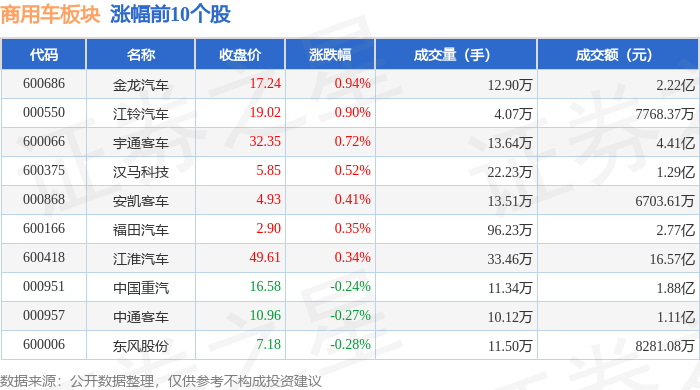
商用车板块12月30日涨0.27%,金龙汽车领涨,主力资金净流出9307.09万元
Zheng Xing Xing Ye Ri Bao· 2025-12-30 09:00
证券之星消息,12月30日商用车板块较上一交易日上涨0.27%,金龙汽车领涨。当日上证指数报收于 3965.12,下跌0.0%。深证成指报收于13604.07,上涨0.49%。商用车板块个股涨跌见下表: 从资金流向上来看,当日商用车板块主力资金净流出9307.09万元,游资资金净流入6316.26万元,散户资 金净流入2990.83万元。商用车板块个股资金流向见下表: | 代码 | 名称 | 主力净流入(元) | 主力净占比 游资净流入 (元) | | 游资净占比 散户净流入 (元) | | 散户净占比 | | --- | --- | --- | --- | --- | --- | --- | --- | | 000951 | 中国車汽 | 2942.02万 | 15.66% | -126.24万 | -0.67% | -2815.78万 | -14.98% | | 600686 | 金龙汽车 | 1813.28万 | 8.16% | 2706.60万 | 12.17% | -4519.88万 | -20.33% | | 000957 | 中通客车 | 946.80万 | 8.54% | 631.50万 | ...



中国巴士风靡东南亚,“曾经我们用日本和欧洲品牌,现在情况已大不相同”
Guan Cha Zhe Wang· 2025-12-30 08:28
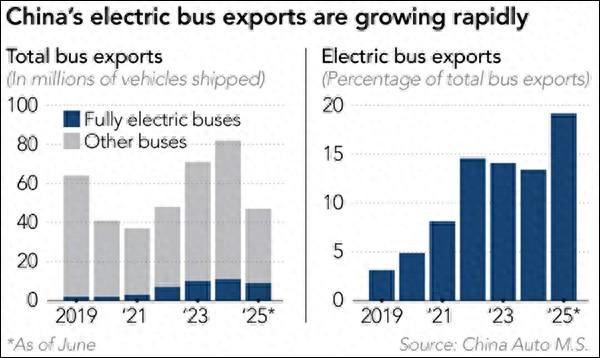
Core Insights - Indonesian public transport company has successfully integrated electric buses into its fleet, with a significant shift from traditional fuel sources to electric vehicles, highlighting the growing acceptance and preference for electric buses among drivers and operators [1] - Chinese electric vehicle manufacturers, particularly BYD, are rapidly expanding their presence in Southeast Asia, capitalizing on the region's increasing demand for electric buses as part of broader decarbonization strategies [1][2] Group 1: Market Trends - In 2024, China is expected to export over 15,000 new energy buses, marking a 25% year-on-year increase, with BYD, Yutong, and Suzhou Jinlong leading the market [2] - By the first half of 2025, China is projected to export approximately 9,000 pure electric buses, a staggering 124% increase compared to the previous year, indicating a robust growth trajectory in the electric bus sector [4] Group 2: Regional Developments - In Indonesia, BYD is collaborating with local company VKTR to establish an electric bus and truck assembly plant, aiming to deliver 50 buses by the end of December and an additional 30 by early 2026 [4] - Malaysia has already deployed at least 146 electric buses, with plans to significantly increase this number in the coming years, reflecting a strong commitment to electric vehicle adoption [5] - Singapore has awarded contracts for electric buses to Chinese manufacturers, with plans to procure over 2,000 electric buses by 2030, further demonstrating the region's shift towards electric public transport [6] Group 3: Local Manufacturing and Policy - VKTR has achieved 40% localization of bus components, qualifying for government incentives aimed at promoting electric vehicle production [4] - The Philippines has enacted legislation requiring government agencies to ensure that at least 5% of their vehicles are electric, which is expected to boost the adoption of electric buses in the country [6] Group 4: Challenges and Perceptions - Despite the positive outlook for Chinese electric buses in Southeast Asia, concerns have been raised regarding cybersecurity risks associated with these vehicles, as highlighted by accusations from European countries [8] - Yutong has denied allegations of remote control risks, emphasizing the technical safeguards in place to protect critical safety systems [9]

东风特商新一届领导班子就位!明确十五五发展目标和战略任务 | 头条
第一商用车网· 2025-12-30 04:15
Core Viewpoint - The article discusses the second party representative conference of Dongfeng Special Commercial Vehicle Co., Ltd., outlining the election of the new party committee and disciplinary committee, as well as the strategic goals and tasks for the next five years [1][3]. Group 1: Conference Overview - The conference was guided by Xi Jinping's thoughts on socialism with Chinese characteristics for a new era, focusing on the implementation of Dongfeng's "three leaps and one renewal" strategy [3]. - The conference emphasized the importance of transformation and breakthroughs in the "14th Five-Year Plan" period, aiming to strengthen Dongfeng's position as a strategic support in the commercial vehicle sector [3]. Group 2: Leadership and Responsibilities - Wang Jun highlighted the critical phase of transformation for Dongfeng Special Commercial Vehicle, urging the new party committee and all members to enhance their sense of mission and responsibility [5]. - The new leadership is tasked with focusing on core business areas, accelerating the implementation of the "14th Five-Year Plan," and building a sustainable competitive development system [5]. Group 3: Future Goals - The company aims to implement major decisions from the central government and enhance core competitiveness, with a goal of turning losses into profits and achieving high-quality development [5]. - The new leadership will also prioritize deepening party building and integrating it with business operations to foster a cohesive workforce dedicated to the company's goals [5].

200辆氢能重卡交付西北 谁家车?
第一商用车网· 2025-12-30 04:15
Core Viewpoint - The article highlights the significant delivery of 200 hydrogen-powered heavy trucks by XCMG to a major client in Northwest China, aimed at facilitating the green transition of traditional energy transportation [1][3]. Group 1: Hydrogen Energy Development - The large-scale delivery coincides with a critical phase in the local hydrogen energy industry, marked by the launch of a high-power hydrogen fuel cell production line and the establishment of several hydrogen production and refueling stations [3]. - XCMG is collaborating with clients to build a zero-carbon transportation solution that integrates green energy, high-end equipment, and operational scenarios, establishing a leading modern hydrogen energy transportation system [3]. Group 2: Performance in Extreme Conditions - The harsh conditions in Northwest China, including temperatures exceeding 65°C in summer and dropping to -35°C in winter, present significant challenges for coal transportation [5]. - The client chose XCMG's hydrogen-powered heavy trucks due to their stable performance in extreme environments and lower total lifecycle operating costs [5]. Group 3: Safety and Technology Features - XCMG's hydrogen-powered heavy trucks are designed with a cage structure and collision mitigation technology, providing a "mobile safety fortress" for drivers and passengers [8]. - The trucks are equipped with intelligent assistance systems for collision and lane departure warnings, enhancing safety during operations [8]. Group 4: Power and Efficiency - The vehicles feature a powerful fuel cell engine, high-performance battery, and efficient permanent magnet motor, capable of operating stably in a wide temperature range from -35°C to 65°C [9]. - With a large capacity of 6×410L gas cylinders and high energy density batteries, the trucks achieve a comprehensive energy consumption reduction of 5%-10% compared to similar products in the industry [10]. Group 5: Future Commitment - XCMG is committed to continuing its research and development philosophy of "innovation collaboration and intelligent user demand," working alongside clients to promote zero-carbon transportation solutions [12].


宇通客车:公司坚持“以员工为中心”的经营管理理念
Zheng Quan Ri Bao Zhi Sheng· 2025-12-29 11:39
(编辑 楚丽君) 证券日报网讯 12月29日,宇通客车在互动平台回答投资者提问时表示,公司坚持"以员工为中心"的经 营管理理念,在员工生育和育儿方面有多项福利政策,例如公司员工可享有婚假、产前检查假、产假、 哺乳假、生育护理假、产假补充事假、育儿假等;公司每年组织暑期托管班,为员工子女提供托管服 务;公司每年暑期面向全体员工子女举办主题夏令营,搭建亲子互动、成长学习的平台等。具体情况可 详见公司发布的《2024年度社会责任暨可持续发展(ESG)报告》。 ...