
顺鑫农业

Search documents
白酒公司高管集体降薪,有人一年少了四百万
21世纪经济报道· 2025-05-08 03:52
Core Viewpoint - The article discusses the contrasting employment trends in the beer and liquor industries during the current adjustment period, highlighting that while beer companies have reduced their workforce significantly, liquor companies, particularly leading brands, have increased their employee numbers despite facing revenue declines [2][11]. Employment Trends in Beer Industry - Over the past year, the beer industry has seen a reduction of over 6,000 employees across 10 listed companies, with major players like Budweiser APAC and China Resources Beer each reducing their workforce by over 1,000 [5][8]. - The overall employment in the beer sector has decreased to below 300,000, primarily due to declining sales and revenue in the industry [2][5]. - The reduction in workforce is attributed to decreased demand for production and sales roles, particularly for temporary workers during peak seasons [8][9]. Employment Trends in Liquor Industry - In contrast, the liquor industry has experienced an increase of over 3,900 employees, with only 7 out of 22 listed liquor companies reporting reductions [9][12]. - Leading liquor companies such as Kweichow Moutai and Yanghe Brewery have added over 1,000 employees each, indicating a robust demand for production roles [9][12]. - The increase in employment is partly driven by the need to meet production demands and the social responsibility of state-owned enterprises to maintain employment levels [12][13]. Salary Adjustments - While the overall employment levels in liquor companies have increased, there has been a notable reduction in executive compensation, with many high-ranking officials seeing salary cuts of hundreds of thousands [16][17]. - In contrast, the average salary for non-executive employees has remained stable or even increased in some companies, such as Water Well and Kweichow Moutai, which reported a rise in average non-executive salaries [20][21]. Future Outlook - The article suggests that the current adjustment period for the liquor industry is not yet over, and further developments in cost-cutting measures and employee compensation will need to be monitored [21].






白酒行业熬出头了吗?
格隆汇APP· 2025-05-03 08:37
Core Viewpoint - The A-share liquor industry has experienced a significant decline of over 40% since its peak in February 2021, with the white liquor sector particularly struggling, contrasting sharply with its previous popularity before 2021 [1][2]. Group 1: Industry Performance - From 2022 to 2024, the net profit growth rate of A-share listed liquor companies is projected to decline, with figures of 20.3%, 18.9%, and 7.4% respectively, marking a significant drop from the double-digit growth seen in previous years [2]. - In Q1 2025, total revenue for listed liquor companies reached 153.4 billion yuan, a year-on-year increase of 1.7%, while net profit was 63.39 billion yuan, up 2.3% [4]. - Despite some companies like Moutai and Wuliangye showing positive growth, nearly half of the A-share liquor companies reported declining performance, with some experiencing revenue drops of up to 80% [7]. Group 2: Market Dynamics - The overall profitability of the liquor sector remains high, with a gross profit margin of 81.53% and a net profit margin of 42.54% in Q1 2025, largely supported by leading companies [8]. - The market is currently facing a "volume and price decline" scenario, contrasting with the consumption upgrade seen in the previous five years [9][10]. - The current price-to-earnings ratio of the liquor index is 19.9 times, a significant drop from 70 times in February 2021, aligning with valuation levels from 2015 and 2018 [10][12]. Group 3: Economic Influences - The liquor industry is undergoing a cyclical downturn, influenced by broader economic factors such as the real estate market's decline, which has seen a drop in sales area from 1.79 billion square meters in 2021 to 970 million square meters in 2024, a decrease of over 45% [14]. - The decline in real estate prices and the shrinking asset base of middle-class families are expected to negatively impact personal liquor consumption [15]. - The demographic trends indicate a potential decline in the drinking population starting in 2028, which could further pressure demand [17]. Group 4: Future Outlook - The current cycle presents greater challenges for the liquor industry compared to previous downturns, with no clear new growth engines to drive recovery [20]. - While exploring international markets could provide growth opportunities, the cultural differences in drinking habits pose significant challenges [21]. - The liquor industry is transitioning from a high-growth phase to a more mature and potentially declining phase, with long-term growth rates likely to settle in the single digits [22].

像素级复刻“汾老大”,汾阳王想成“清香第二”
3 6 Ke· 2025-04-30 01:24
Core Viewpoint - The article discusses the challenges and strategies of Fen Yang Wang in its pursuit to become the "second in clear fragrance" in the Chinese liquor market, emphasizing the need for differentiation and market expansion beyond Shanxi province [1][11]. Company Strategy - Fen Yang Wang aims to learn from the leading brand, Shanxi Fenjiu, by adopting a "copying" strategy in product development, marketing, and geographical positioning [3][4]. - The company has launched various marketing initiatives, including the "Great National Clear Fragrance" strategy and a series of promotional events to enhance brand visibility [2][3]. - Fen Yang Wang's ambition to become "clear fragrance second" is evident in its product offerings, which closely resemble those of Shanxi Fenjiu, particularly in packaging and branding [3][4]. Market Positioning - The clear fragrance liquor market is projected to grow, with an expected market size of 120 billion yuan by 2025, leading to increased competition among brands vying for the "second bottle" position [5]. - Fen Yang Wang's sales have shown growth, with a reported 20% increase in 2024 and a 40% increase in high-end product sales [7]. Challenges - Despite some brand recognition, Fen Yang Wang faces significant challenges, including low brand awareness among consumers and the struggle to establish a high-end product presence in a market dominated by Shanxi Fenjiu [10][11]. - The company has set ambitious sales targets, aiming for 30 billion yuan by 2025 and 100 billion yuan by 2028, but achieving these goals will require overcoming substantial market barriers [6][9]. Industry Dynamics - The competition in the clear fragrance liquor sector is intensifying, with numerous brands emerging both within and outside Shanxi province, each attempting to capitalize on the growing market [5][6]. - Analysts suggest that Fen Yang Wang's strategy of closely following Shanxi Fenjiu could yield high returns, but it must also innovate and differentiate to avoid being overshadowed [4][6].
白酒周期巨变:汾酒跻身行业前三,一季度半数酒企业绩倒退
2 1 Shi Ji Jing Ji Bao Dao· 2025-04-29 15:09
Core Viewpoint - The white liquor industry is experiencing a significant slowdown in growth, with many companies reporting declining revenues and profits, indicating a challenging market environment [1][12][18]. Group 1: Industry Performance - As of April 29, nearly all listed white liquor companies reported a slowdown in performance for 2024, with six companies experiencing a year-on-year revenue decline [1][4]. - In the first quarter of 2025, nearly half of the white liquor companies reported negative performance, with some experiencing revenue declines of 20% to 30% [1][12]. - The total revenue of all white liquor companies in 2024 exceeded 440 billion yuan, primarily driven by growth from leading companies like Moutai [4][7]. Group 2: Market Dynamics - The competitive landscape of the white liquor industry has shifted, with Shanxi Fenjiu rising to the third position among leading brands, indicating a consolidation of market power among top players [2][8]. - Over the past five years, the rankings of the top ten white liquor companies have changed significantly, with new entrants and established brands experiencing shifts in their market positions [10][11]. - The performance of mid-sized and smaller liquor companies has generally been poor, with some facing delisting risks [2][12]. Group 3: Future Outlook - Analysts suggest that the white liquor industry is currently in a "bottoming out" phase, with expectations of continued low performance in the second quarter of 2025 [2][17]. - The core issue facing the industry is weak consumer demand, with a need for companies to connect with younger consumers and explore new market segments [18].


白酒准百亿梯队生变,增长失速且有人掉队,达成目标要延后?
Nan Fang Du Shi Bao· 2025-04-29 13:21
Core Viewpoint - The white liquor industry is experiencing significant changes among the "quasi-100 billion" enterprises, with increased competition and varying growth rates among companies aiming to reach the 100 billion revenue threshold [2][3][7]. Group 1: Industry Overview - The 100 billion revenue mark is considered a threshold for white liquor companies to enter the top tier of the industry, with those earning between 50 billion and 100 billion classified as "backup troops" [3][7]. - The industry is currently in a deep adjustment phase, with a general slowdown in growth and a focus on reducing channel inventory [2][8]. Group 2: Company Performance - Among the quasi-100 billion companies, Yingjia Gongjiu achieved a record revenue of 73.44 billion yuan, marking an 8.46% increase [4]. - Baiyunbian reported revenue of 78.3 billion yuan, a 1% increase, while other companies like Zhenjiu Lidu and Kouzi Jiao maintained revenue levels from the previous year [4][6]. - Shede Liquor experienced a significant decline, with revenue dropping to 53.57 billion yuan, a decrease of 24.41% compared to the previous year [4][5]. Group 3: Market Dynamics - The overall market environment is characterized by high inventory levels, price inversions, and intensified competition, leading to a challenging landscape for quasi-100 billion enterprises [8][9]. - The production of white liquor in 2024 is projected to decline by 1.8%, indicating a shift towards "volume reduction competition" [8]. - Analysts suggest that achieving the 100 billion revenue goal may take several more years for many companies due to the current market conditions [9][10]. Group 4: Future Outlook - The industry is expected to see a normalization of growth around 10%, with companies needing to adjust their growth expectations and strategies to navigate the current environment [9][10]. - Some analysts remain optimistic about a potential recovery in the industry, suggesting that the supply-side adjustments are nearing completion and that market conditions may improve by 2025 [9][10].
食品饮料周报:政治局会议定调积极,看好饮料旺季催化
Tianfeng Securities· 2025-04-29 12:23
行业报告 | 行业研究周报 食品饮料 证券研究报告 食品饮料周报:政治局会议定调积极,看好饮料旺季催化 市场表现复盘 本周(4 月 21 日-4 月 25 日)食品饮料板块/沪深 300 涨跌幅分别-1.36%/+0.38%。具体板块来 看,本周零食(+4.50%)、软饮料(+2.21%)、其他酒类(+0.06%)、调味发酵品(-0.33%)、肉 制品(-0.53%)、啤酒(-0.72%)、保健品(-1.28%)、白酒 III(-1.75%)。 周观点更新 白酒:五一临近关注宴席场景拉动,Q1 板块释压预计总体持平微增。本周白酒板块-1.75%, 表现弱于食品饮料整体以及沪深 300,我们认为主要系:①当前处白酒消费淡季,需求端总体 仍偏弱;②25Q1 行业主动调整去库存&高基数背景下报表端预计承压。本周舍得酒业、华致 酒行发布一季报,天佑德酒、顺鑫农业、五粮液、老白干酒发布年报&一季报,总体表现符合 预期(五粮液25Q1略超预期),从目前发布的酒企财报来看预计降速释压仍是酒企24Q4&25Q1 主旋律。五一旺季来临各头部品牌纷纷加码婚宴投入力度,从多地酒店宴席预订量增长情况来 看,五一期间白酒宴席场景预计有 ...





食品饮料周报:政治局会议定调积极,看好饮料旺季催化-20250429
Tianfeng Securities· 2025-04-29 08:46
Investment Rating - The industry rating is "Outperform" (maintained rating) [5] Core Viewpoints - The report highlights a positive outlook for the beverage sector, driven by the upcoming peak season and supportive macroeconomic policies from the central government [2][12] - The report emphasizes the potential for valuation recovery in the liquor sector, particularly in light of the recent political bureau meeting that indicated a more proactive fiscal and monetary policy [2][12] Summary by Sections Market Performance Review - For the week of April 21 to April 25, the food and beverage sector declined by 1.36%, while the Shanghai Composite Index rose by 0.38%. Notable performances included snacks (+4.50%) and soft drinks (+2.21%), while categories like beer (-0.72%) and health products (-1.28%) saw declines [1][19] Weekly Perspective Updates - **Liquor Sector**: The liquor sector saw a decline of 1.75%, attributed to the off-peak consumption period and inventory adjustments. However, the upcoming May Day holiday is expected to boost demand for banquet scenarios, aiding in inventory reduction [2][12] - **Beer and Beverage Sector**: The beer sector decreased by 0.72%, but companies like Zhujiang Brewery saw a 5.7% increase in stock price due to better-than-expected Q1 performance. The report anticipates improved demand as the weather warms and consumption policies are implemented [3][13] - **Consumer Goods Sector**: The report identifies opportunities in the snack sector, with a focus on companies that have shown resilience and potential for growth. The upcoming sales season for soft drinks is also highlighted as a catalyst for growth [3][14] Investment Recommendations - **Liquor Sector**: Recommended stocks include strong alpha leaders like Moutai and Shanxi Fenjiu, as well as cyclical stocks like Luzhou Laojiao and Jiugui Liquor [4][18] - **Consumer Goods**: The report recommends focusing on snacks and dairy products, with specific mentions of companies like Ganyuan Foods and Yuyuan Foods, which are expected to benefit from low base effects in Q2 [4][18] Sector and Individual Stock Performance - The report provides detailed performance metrics for various sectors, indicating that the snack and soft drink sectors are currently outperforming others, while the liquor sector is under pressure [19][22]

顺鑫农业(000860) - 关于全资子公司内蒙古顺鑫农业小店种猪育种有限公司完成工商注销登记的公告
2025-04-28 10:06
关于全资子公司内蒙古顺鑫农业小店种猪育种有限公司 完成工商注销登记的公告 本公司及董事会全体成员保证信息披露内容的真实、准确和完整,没有虚假记载、 误导性陈述或重大遗漏。 证券代码:000860 证券简称:顺鑫农业 公告编号:2025-017 北京顺鑫农业股份有限公司(以下简称"公司")于 2025 年 1 月 7 日召开 第九届董事会第十九次会议,审议通过了《关于拟注销全资子公司内蒙古顺鑫农 业小店种猪育种有限公司的议案》,具体情况详见公司于 2025 年 1 月 8 日披露 的《北京顺鑫农业股份有限公司关于拟注销子公司及孙公司的公告》(公告编号 2025-002)。 北京顺鑫农业股份有限公司 近日,公司收到化德县行政审批政务服务与数据管理局核发的《登记通知书》, 准予注销登记内蒙古顺鑫农业小店种猪育种有限公司。 一、注销全资子公司的基本情况 公司名称:内蒙古顺鑫农业小店种猪育种有限公司 股东持股情况:北京顺鑫农业股份有限公司持有其股权比例为 100%。 二、注销该全资子公司对公司的影响 内蒙古顺鑫农业小店种猪育种有限公司注销完成后,将不再纳入公司合并财 成立时间:2018 年 01 月 29 日 注册地址 ...
白酒板块持续调整,“问题”酒企股价大幅下跌 | 酒市周报
Mei Ri Jing Ji Xin Wen· 2025-04-28 08:13
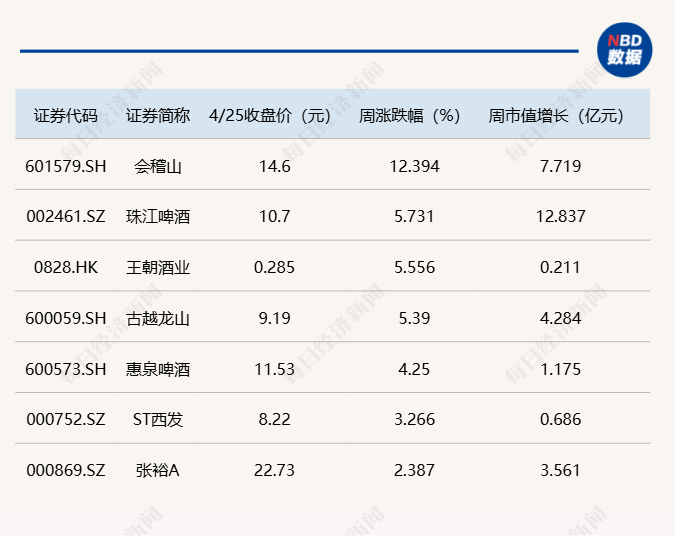
Group 1 - The overall performance of liquor companies was weak, with stock prices declining, particularly for major liquor brands, as their 2024 annual reports and 2025 Q1 reports were released, which were generally in line with or slightly below market expectations [1] - Public funds have significantly reduced their holdings in Yanghe and Yingjia Gongjiu, indicating concerns about the competitive strength of these companies in their respective regions [1][5] - The liquor sector saw a notable divergence in stock performance, with yellow wine companies like Kuaijishan and Guyue Longshan showing significant weekly gains of 12.39% and 5.39%, respectively, while the white liquor sector continued to decline [2][3] Group 2 - The white liquor index experienced a weekly decline of 1.61%, marking three consecutive weeks of losses, with major brands like Luzhou Laojiao and Shanxi Fenjiu seeing declines exceeding 3% [3] - Companies facing operational difficulties, such as ST Yanshi, saw substantial weekly declines, with ST Yanshi down 14.95% and Mogao Co. and Hainan Yedao down 7.65% and 8.11%, respectively [4] - As of March 31, 2025, public funds held a total market value of 257.1 billion yuan in the white liquor sector, a decrease of 0.23 percentage points from the previous quarter, continuing a downward trend since 2022 [5]

食品饮料行业深度报告:政策预期强化,关注景气细分
Dongguan Securities· 2025-04-28 07:39
Investment Rating - The report maintains an "Overweight" rating for the food and beverage industry [1] Core Insights - The food and beverage industry is gaining attention due to increased external uncertainties and positive domestic policy signals, with a focus on boosting domestic demand as a key driver for economic growth [12][16] - The liquor sector is expected to show a "front low, back high" performance trend for the year, with a focus on inventory digestion in the first half and gradual demand recovery in the second half [17][32] - The consumer goods sector, particularly those related to the catering supply chain and benefiting from fertility policy catalysts, is highlighted for potential investment opportunities [39] Summary by Sections 1. Policy Expectations and Industry Focus - Increased external uncertainties have led to a heightened focus on domestic demand as a crucial element for economic growth [12] - Recent government policies aimed at boosting consumption have positively influenced market confidence, with a comprehensive action plan to enhance consumer spending [13][16] 2. Liquor Sector - Liquor sales during the Spring Festival saw a year-on-year decline of approximately 10%, with a focus on inventory management during the off-peak season [17] - High-end liquor demand remains stable, while mid-range and regional brands are experiencing varied performance based on market conditions [19] - Major liquor companies are engaging in share buybacks and increasing shareholdings to bolster market confidence [24][30] 3. Consumer Goods Sector - The report emphasizes the importance of sectors related to the catering supply chain, with specific attention to the seasoning, beer, dairy, and snack segments [39] - The seasoning sector is expected to benefit from a recovery in restaurant consumption, while the beer sector is poised for growth due to the resurgence of dining scenarios [40] - Dairy demand is anticipated to rise following the introduction of fertility subsidies in various regions, which could positively impact dairy company performance [39]


