
圣农发展

Search documents
从粒粒良种,到仓廪充盈(“十四五”,我们见证这些硬核突破⑦)
Ren Min Ri Bao Hai Wai Ban· 2025-11-03 22:46
Core Insights - The article highlights China's significant advancements in agricultural seed breeding during the "14th Five-Year Plan" period, focusing on the development of high-yield and disease-resistant crop varieties, which have led to increased food security and market competitiveness [6][7][10]. Group 1: Crop Breeding Innovations - China has implemented a seed industry revitalization action plan, resulting in over 95% of crop varieties being independently bred, including high-yield rice, drought-resistant wheat, and high-oil soybeans [6][7]. - In Sichuan Province, the introduction of high-yield rice varieties has led to a combined yield of over 1300 kg per mu (approximately 0.067 hectares), showcasing the effectiveness of new breeding techniques [7][8]. - The development of disease-resistant wheat varieties, such as "Yangmai 53," has resulted in a yield increase of 10.13% compared to traditional varieties, marking a significant achievement in wheat breeding [8][9]. Group 2: Livestock and Aquaculture Breeding - The successful breeding of domestic white-feather broilers, which previously relied entirely on imports, has now achieved a market share exceeding 25%, ensuring a stable supply of poultry [10][11]. - The introduction of the Huaxi cattle breed has broken the dependency on imported beef cattle, with a market share surpassing 20% and an average daily weight gain of 1.36 kg [11]. - The development of 12 new varieties of South American white shrimp has led to a market share of over 30%, significantly reducing the reliance on imported shrimp [11]. Group 3: Genetic Resource Survey - A comprehensive national agricultural germplasm resource survey has been conducted, collecting 139,000 new germplasm resources, which are crucial for breeding high-quality crop varieties [13][14]. - The survey has identified and protected traditional local varieties and wild relatives, enhancing the genetic diversity available for future breeding efforts [14]. - Over 6000 germplasm resources have already been applied in breeding innovation and industrial development, supporting the goal of enhancing China's seed industry [14].


市场情绪监控周报(20251027-20251031):深度学习因子10月超额-0.07%,本周热度变化最大行业为有石油石化、综合-20251103
Huachuang Securities· 2025-11-03 12:54
Quantitative Models and Construction - **Model Name**: DecompGRU **Model Construction Idea**: The model improves information interaction between time-series and cross-sectional data by introducing two simple de-mean modules on the GRU baseline model[18] **Model Construction Process**: 1. The DecompGRU model architecture is based on GRU as the baseline 2. Two de-mean modules are added to enhance the interaction between time-series and cross-sectional data 3. The model is trained using IC and weighted MSE loss functions[18] **Model Evaluation**: The model demonstrates improved interaction between time-series and cross-sectional data, enhancing prediction accuracy[18] Model Backtesting Results - **DecompGRU TOP200 Portfolio**: - Cumulative absolute return: 41.11% - Excess return relative to WIND All A equal-weight index: 13.98% - Maximum drawdown: 10.08% - Weekly win rate: 64.52% - Monthly win rate: 100% - October absolute return: 1.78%, excess return: -0.07%[11] - **ETF Rotation Portfolio**: - Cumulative absolute return: 19.06% - Excess return relative to benchmark: -2.00% - Maximum drawdown: 7.82% - Weekly win rate: 62.50% - Monthly win rate: 57.14% - October absolute return: -2.04%, excess return: -1.18%[14][15] Quantitative Factors and Construction - **Factor Name**: Sentiment Heat Factor **Factor Construction Idea**: The factor aggregates stock-level sentiment heat metrics (e.g., browsing, self-selection, and clicks) to represent broader market sentiment[19] **Factor Construction Process**: 1. Individual stock sentiment heat is calculated as the sum of browsing, self-selection, and click counts 2. The sentiment heat is normalized by dividing by the total market sentiment on the same day and multiplying by 10,000 3. Aggregated sentiment heat is used as a proxy for market sentiment at the index, industry, and concept levels[19] **Factor Evaluation**: The factor effectively captures market sentiment and its impact on pricing errors[19] Factor Backtesting Results - **Broad-based Index Sentiment Heat Rotation Strategy**: - Annualized return since 2017: 8.74% - Maximum drawdown: 23.5% - 2025 portfolio return: 38.5% - Benchmark return: 32.9%[28] - **Concept Sentiment Heat BOTTOM Portfolio**: - Annualized return: 15.71% - Maximum drawdown: 28.89% - 2025 portfolio return: 42.1%[41][44]



中小盘周报:国有“三资”改革大幕拉开,国资并购重组未来已来-20251102
KAIYUAN SECURITIES· 2025-11-02 13:44
Policy Insights - The "Three Assets" reform of state-owned enterprises (SOEs) is expected to initiate a new wave of mergers and acquisitions (M&A) in the state sector, with a focus on asset securitization[3] - Hubei and Anhui provinces are leading the reform efforts, with specific actions planned from September to December 2025 to enhance asset management and debt linkage[3][17] - The core principles of the reform include maximizing the assetization of state resources, securitization of state assets, and leveraging state funds[15] Investment Opportunities - Potential M&A targets include central state-owned enterprises (SOEs) with low asset securitization rates and strong restructuring intentions, particularly in sectors like defense, utilities, and transportation[4][24] - Local SOEs with recent changes in ownership, capital operations, or urgent M&A intentions are also recommended for investment consideration[4][24] Market Performance - The A-share market saw a general increase, with mid-cap indices like the CSI 500 and CSI 1000 outperforming large-cap indices such as the SSE 50 and CSI 300, with respective increases of +1.00% and +1.18%[30] - The lithium battery electrolyte index recorded the highest weekly increase of 17.12%, with top performers including Tianji Co. (+41.86%) and Haike New Source (+39.42%)[30][34] Key Recommendations - Focus on sectors such as smart vehicles and high-end manufacturing, with specific stocks like Hu Guang Co., Rui Hu Mould, and Ao Lai De recommended for their growth potential[6][36] - The report highlights the importance of identifying companies with significant restructuring potential and those that can benefit from the upcoming M&A wave in the state sector[4][24] Risk Factors - Potential risks include changes in macroeconomic conditions, IPO policies, refinancing policies, and M&A regulations that could impact the market dynamics[7]
生猪养殖持续亏损,产能去化或加速
CAITONG SECURITIES· 2025-11-02 13:13
Core Insights - The report maintains a positive outlook on the agricultural sector, particularly in pig farming, despite ongoing losses in the industry [1][3] - The report highlights a potential acceleration in capacity reduction due to supply pressures and policy guidance [6][19] Group 1: Pig Farming - The number of breeding sows decreased by 0.20% month-on-month in September, with a total of 40.35 million sows reported [20][21] - Pig prices have been on the rise, with the average price for market pigs reaching 12.22 CNY/kg on October 30, reflecting a week-on-week increase of 7.10% [29][30] - The profitability of pig farming remains negative, with losses of 89.33 CNY per head for self-bred pigs and 179.72 CNY per head for purchased piglets as of October 31 [35][37] Group 2: Poultry Farming - The average price for white feather broilers increased to 7.09 CNY/kg on October 31, marking a week-on-week rise of 3.05% [39][42] - The report notes a significant increase in the number of breeding stock, with a 143.18% month-on-month rise in the number of grandparent stock updated in October [39][40] Group 3: Animal Health - The demand for animal health products is expected to rebound, driven by a recovery in breeding cycles and an increase in livestock numbers [48] - The report mentions that several companies are actively developing new products, which may enhance growth prospects for the sector [48] Group 4: Seed Industry - The average prices for wheat, soybean meal, and corn have increased, with wheat and soybean meal rising by 0.9% and 1.3% respectively as of October 31 [52][53] - The report emphasizes the importance of food security and the promotion of biotechnology in the seed industry [52][56] Group 5: Pet Industry - Pet food exports amounted to 823 million CNY in September, showing a year-on-year decline of 6.8% [57][60] - Domestic sales of pet food have continued to grow, with a combined growth rate of 3% across major e-commerce platforms in September [60]


预见2025:《2025年中国轻食行业全景图谱》
Sou Hu Cai Jing· 2025-11-01 21:14
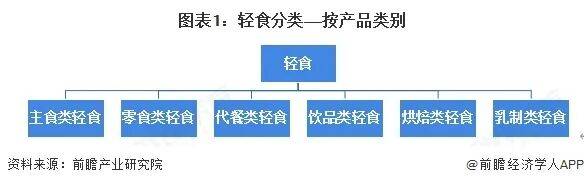
Core Insights - The light food industry in China is experiencing significant growth, with the market size projected to reach approximately 1.76 trillion yuan in 2024, up from over 1.6 trillion yuan in 2023 [12][15][29] - The industry has evolved from a niche concept to a broader category encompassing various healthy food options, driven by changing consumer preferences towards healthier eating habits [12][29] Industry Overview - Light food is defined as low in sugar, fat, and salt, while being high in fiber and nutrient density, categorized into six types: staple foods, snacks, meal replacements, beverages, baked goods, and dairy products [1][2] - The supply chain consists of upstream suppliers (packaging, equipment, and raw materials), midstream product suppliers (various light food categories), and downstream sales channels (e-commerce, delivery platforms, own stores, and supermarkets) [4][6] Industry Development History - The light food concept entered the Chinese market in 2013, gaining traction from 2015 to 2017 due to significant capital investment, followed by a period of consolidation from 2018 to 2019 due to market challenges [9] - Post-2020, the industry saw a resurgence driven by increased consumer demand for healthy eating, influenced by the COVID-19 pandemic [9] Policy Environment - Since the introduction of the "Healthy China 2030" initiative in 2016, the government has implemented various policies to promote healthy eating, including guidelines on food pairing, calorie control, and nutritional intake [11][12] - The Chinese Culinary Association has established standards for light food and is supporting businesses in the sector, with further initiatives planned for 2025 [11][13] Market Dynamics - The number of light food-related restaurants peaked in 2021 at 4,905, with a more rational growth phase expected, projecting 3,738 new establishments in 2024 [15] - Zero-sugar diets are particularly popular, accounting for nearly 50% of the product consumption structure in the light food sector by 2024, followed by low-sugar diets at approximately 35% [17] Competitive Landscape - The top five brands in the light food sector by store count as of 2025 include Jinshi Fitness Nutrition Meal, Shaye Light Food, Manwei Light Food, Chaoneng Deer Battle Team, and Shiye SAYYEAH Creative Light Food [22][24] - The distribution of light food enterprises is concentrated in economically developed regions with active consumer markets and well-established supply chains [26] Future Outlook - The light food market is expected to exceed 3 trillion yuan by 2030, driven by policy support and increasing consumer health awareness [29] - Trends indicate a diversification of product offerings, with innovations in flavors and ingredients, as well as a growing emphasis on functional light food products tailored to specific nutritional needs [33]
养殖业板块10月31日涨1%,天域生物领涨,主力资金净流入2.9亿元
Zheng Xing Xing Ye Ri Bao· 2025-10-31 08:36
Core Insights - The aquaculture sector experienced a 1.0% increase on October 31, with Tianyu Biological leading the gains [1] - The Shanghai Composite Index closed at 3954.79, down 0.81%, while the Shenzhen Component Index closed at 13378.21, down 1.14% [1] Aquaculture Sector Performance - Tianyu Biological (603717) closed at 9.16, up 4.93% with a trading volume of 254,000 shares and a transaction value of 234 million [1] - Huaying Agriculture (002321) closed at 2.90, up 4.69% with a trading volume of 654,900 shares and a transaction value of 188 million [1] - Other notable performers include *ST Tianshan (300313) up 3.34%, Luoniushan (000735) up 2.37%, and Xiaoming Co. (300967) up 1.65% [1] Capital Flow Analysis - The aquaculture sector saw a net inflow of 290 million from institutional investors, while retail investors experienced a net outflow of 190 million [2] - Major stocks like Muyuan Foods (002714) had a net inflow of 203 million, while Wens Foodstuffs (300498) had a net inflow of 61 million [3] - The overall trend indicates a shift in capital, with institutional investors showing confidence in the sector while retail investors are withdrawing [2][3]


农林牧渔行业双周报(2025、10、17-2025、10、30):三季报业绩表现分化-20251031
Dongguan Securities· 2025-10-31 08:29
Investment Rating - The report maintains an "Overweight" rating for the agriculture, forestry, animal husbandry, and fishery industry [5][44]. Core Insights - The SW agriculture, forestry, animal husbandry, and fishery industry slightly underperformed the CSI 300 index, declining by 1.1% from October 17 to October 30, 2025, lagging behind the index by approximately 3.08 percentage points [11]. - Among the sub-sectors, only planting and agricultural product processing recorded positive returns, increasing by 1.47% and 0.44% respectively, while fisheries, animal health, breeding, and feed sectors experienced negative returns, declining by 1.22%, 1.63%, 2.56%, and 4.24% respectively [14]. - The overall price of live pigs has rebounded, with the average price rising from 11.17 CNY/kg to 12.56 CNY/kg during the reporting period [23]. - The number of breeding sows as of the end of September 2025 was 40.35 million, a slight decrease of 0.07% from the previous month, indicating a potential for further capacity reduction [23]. - The report highlights the narrowing of losses in pig farming, with self-breeding losses at -89.33 CNY per head and purchased piglet losses at -179.72 CNY per head, showing improvement compared to the previous week [27]. - The average price of broiler chicks increased to 3.58 CNY per chick, while the average price of white feather broilers rose to 7.09 CNY/kg, indicating a slight recovery in poultry prices [29][32]. - The report emphasizes the potential for investment opportunities in leading companies within the industry, particularly in pig farming, poultry farming, feed production, animal health, and pet food sectors [44]. Summary by Sections Market Review - The SW agriculture, forestry, animal husbandry, and fishery industry slightly underperformed the CSI 300 index, with a decline of 1.1% from October 17 to October 30, 2025 [11]. - Only a few sub-sectors recorded positive returns, with planting and agricultural product processing increasing by 1.47% and 0.44% respectively [14]. - Over half of the stocks in the industry recorded positive returns during the same period [15]. Industry Key Data - The average price of live pigs increased from 11.17 CNY/kg to 12.56 CNY/kg [23]. - The breeding sow inventory was 40.35 million, slightly down by 0.07% [23]. - The average prices for corn and soybean meal showed slight declines, with corn at 2242.16 CNY/ton and soybean meal at 3028 CNY/ton [25]. - Losses in pig farming narrowed, with self-breeding losses at -89.33 CNY per head [27]. Company Insights - The Q3 performance of pig and chicken farming companies showed a year-on-year decline in profitability due to lower prices compared to the previous year [35]. - Leading companies such as Muyuan Foods and Wens Foodstuffs are highlighted for their market positions and potential for recovery [44].


鸡肉板块业绩分化 业内看好四季度
Zheng Quan Shi Bao Wang· 2025-10-30 11:30
Core Insights - The chicken industry is experiencing significant performance divergence among listed companies in Q3, with some achieving remarkable profit growth while others face substantial declines [1][2]. Group 1: Company Performance - Shengnong Development (002299) reported a net profit increase of 202.82% year-on-year, reaching 1.159 billion yuan, despite a 11.4% decline in Q3 net profit [1]. - Chunxue Food (605567) saw a staggering 1320.44% increase in net profit for the first three quarters, totaling 33.87 million yuan, with Q3 net profit growth of 190.90% driven by cost optimization and export growth [1]. - Lihua Co. (300761) experienced a 75.27% decline in net profit for the first three quarters, with Q3 decline further expanding to 76.40% due to downward pressure on yellow feather chicken prices [1]. - Yisheng Co. (002458) faced an 89.42% drop in net profit for the first three quarters, with negative growth in both revenue and net profit in Q3, although showing improvement on a quarter-on-quarter basis [1]. - Minhe Co. (002234) continued to incur losses, reporting a net loss of 230 million yuan for the first three quarters [1]. Group 2: Industry Trends - The fluctuations in the chicken industry are attributed to a combination of price cycles and cost disturbances, with yellow feather chicken selling at an average price of 13.53 yuan/kg in Q3 [2]. - The average price of white feather chicken products in September was 8,663 yuan/ton, reflecting a 0.8% decrease month-on-month and a 6.4% year-on-year decline, primarily due to high inventory levels and weaker-than-expected consumer demand [2]. - The industry anticipates a potential recovery in both volume and price in Q4, driven by upcoming holidays and limited supply growth, which may support price increases for yellow feather chicken [2]. Group 3: Market Dynamics - The rapid decline in pork prices since October may lead to lower-than-expected demand for chicken as a substitute [3]. - Leading companies are focusing on full industry chain integration and channel structure upgrades to build competitive advantages, making them attractive to investors [3].
养殖业板块10月30日跌1.31%,天域生物领跌,主力资金净流出1.88亿元
Zheng Xing Xing Ye Ri Bao· 2025-10-30 08:28
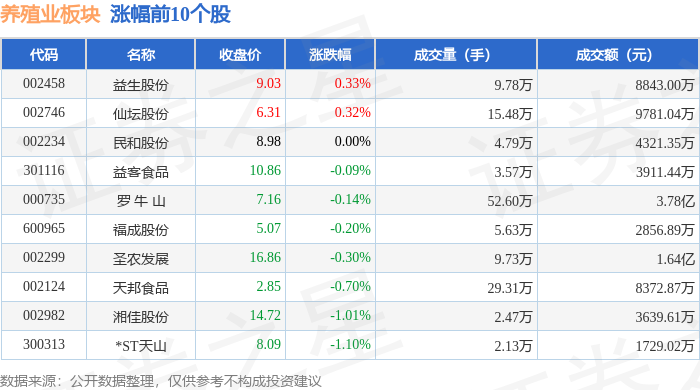
Core Points - The aquaculture sector experienced a decline of 1.31% on October 30, with Tianyu Biology leading the drop [1] - The Shanghai Composite Index closed at 3986.9, down 0.73%, while the Shenzhen Component Index closed at 13532.13, down 1.16% [1] Stock Performance - Yisheng Co. (002458) closed at 9.03, up 0.33% with a trading volume of 97,800 shares and a turnover of 88.43 million yuan [1] - Xiantan Co. (002746) closed at 6.31, up 0.32% with a trading volume of 154,800 shares and a turnover of 97.81 million yuan [1] - Tianyu Biology (603717) closed at 8.73, down 3.64% with a trading volume of 155,200 shares and a turnover of 137 million yuan [2] - Huaying Agriculture (002321) closed at 2.77, down 3.15% with a trading volume of 424,400 shares and a turnover of 119 million yuan [2] Capital Flow - The aquaculture sector saw a net outflow of 188 million yuan from institutional investors, while retail investors had a net inflow of 141 million yuan [2] - The main capital inflow and outflow for specific stocks included: - Jingji Zhinnong (000048) had a net inflow of 19.99 million yuan from main capital [3] - Wens Foodstuff Group (300498) had a net inflow of 7.96 million yuan from main capital [3] - Yisheng Co. (002458) had a net inflow of 3.79 million yuan from main capital [3]


农业农村部推进渔业现代化!农牧渔ETF(159275)下挫1.2%!机构:养殖业产能去化加速
Xin Lang Ji Jin· 2025-10-30 01:57
Group 1 - The agricultural and fishery ETF (159275) showed weak performance with a price drop of 1.2% and a trading volume of 1.748 million yuan, while the fund's latest scale is 205 million yuan [1] - Key stocks such as Yike Food, Meihua Biological, and Luoniushan performed well with increases of 1.01%, 0.64%, and 0.56% respectively, while Jinhe Biological, Tiankang Biological, and Weilan Biological saw declines of 4.46%, 3.59%, and 3.29% [1] - The Ministry of Agriculture and Rural Affairs emphasized the importance of solidifying key work during the 14th Five-Year Plan period to support the modernization of the fishery sector, highlighting the successful construction of the "Haiwei 2" breeding platform in Zhanjiang, Guangdong [1] Group 2 - According to data from Tianfeng Securities, the supply of yellow chickens may contract, with demand being a core variable and production capacity at its lowest since 2018, suggesting that average prices in the second half of the year may outperform the first half [2] - The pig farming sector continues to experience losses, with policy guidance aimed at reducing production leading to ongoing capacity reduction [2] - The poultry industry faces challenges due to avian influenza, with a 21.78% year-on-year decline in the number of breeding stock, but a potential recovery in industry conditions is anticipated after three years of downturn [2]