科华数据

Search documents
巨头加速布局,AI领域持续高景气 | 投研报告
Zhong Guo Neng Yuan Wang· 2025-10-24 06:17
Core Viewpoint - The computer industry index has underperformed compared to major indices, indicating a challenging market environment for the sector [1][2]. Market Review - During the week of October 13-17, the Shanghai Composite Index fell by 1.47%, the ChiNext Index dropped by 5.71%, and the CSI 300 Index decreased by 2.22%. The computer (Shenwan) index declined by 5.61%, underperforming the Shanghai Composite by 4.14 percentage points, outperforming the ChiNext by 0.11 percentage points, and underperforming the CSI 300 by 3.38 percentage points, ranking 25th among all industries [1][2]. Weekly Insights - Continuous iterations of overseas large models are noted, including: - OpenAI's Sora2 updates, increasing video length for free users from 10 seconds to 15 seconds and for Pro users from 15 seconds to 25 seconds, along with a new storyboard feature for Pro users [3]. - Google's release of video generation model Veo3.1, which integrates multiple reference images into a single video and generates corresponding sound effects and music [3]. - Anthropic's launch of Claude Haiku4.5, a smaller model with performance comparable to Sonnet4 at a third of the cost, designed for multi-agent systems [3]. Domestic AI Product Upgrades - ByteDance's launch of four upgraded models, including Doubao Model 1.6, which supports four thinking lengths, enhancing efficiency and catering to different enterprise needs [4][5]. - Alibaba's introduction of Qwen Chat Memory, enabling long-term memory capabilities in AI interactions, and the launch of Qoder CLI, an AI programming tool that improves code generation and efficiency [5]. - Baidu's comprehensive upgrade of its Wenxin Assistant, now supporting eight modes of AI content creation, including images, videos, and music [5]. Investment Recommendations - Suggested focus areas include: - Computing power: Huafeng Technology, Shenling Environment, Cambrian, Haiguang Information, and Anbotong [6]. - AIDC: Kehua Data, Yunsai Zhili, Hongxin Electronics, Runjian Shares, Runze Technology, and Dataport [6]. - AI applications: Kingsoft Office, iFlytek, Dingjie Zhizhi, Hand Information, Zhuoyi Information, and Puyuan Information [6].
固态电池概念股走强,储能电池ETF(159566)标的指数涨近2%
Mei Ri Jing Ji Xin Wen· 2025-10-24 04:54
Core Insights - The renewable energy sector, including solar, wind, and battery industries, continues to see upward momentum, with the National Renewable Battery Index rising by 1.8% as of 10:30 AM [1] - The Ministry of Industry and Information Technology reported that Chinese companies hold six out of the top ten global battery manufacturers, accounting for 69% of total shipment volume [1] - CITIC Securities highlights solid-state batteries as the next-generation high-performance battery technology, moving from laboratory research to commercialization [1] Industry Developments - The National Renewable Battery Index consists of stocks related to the renewable energy generation and storage battery industry, with solid-state battery companies making up over 35% of the index [1] - The solid-state battery sector is expected to benefit from the commercialization of new technologies, driven by policy incentives, market demand upgrades, and ongoing technological advancements [1] - The Storage Battery ETF (159566) is the largest among ETFs tracking this index, providing investors with opportunities in the solid-state battery sector [1]
固态又推新!欣旺达新一代全固态电池上线,电池ETF(561910)涨超2%!
2 1 Shi Ji Jing Ji Bao Dao· 2025-10-24 03:24
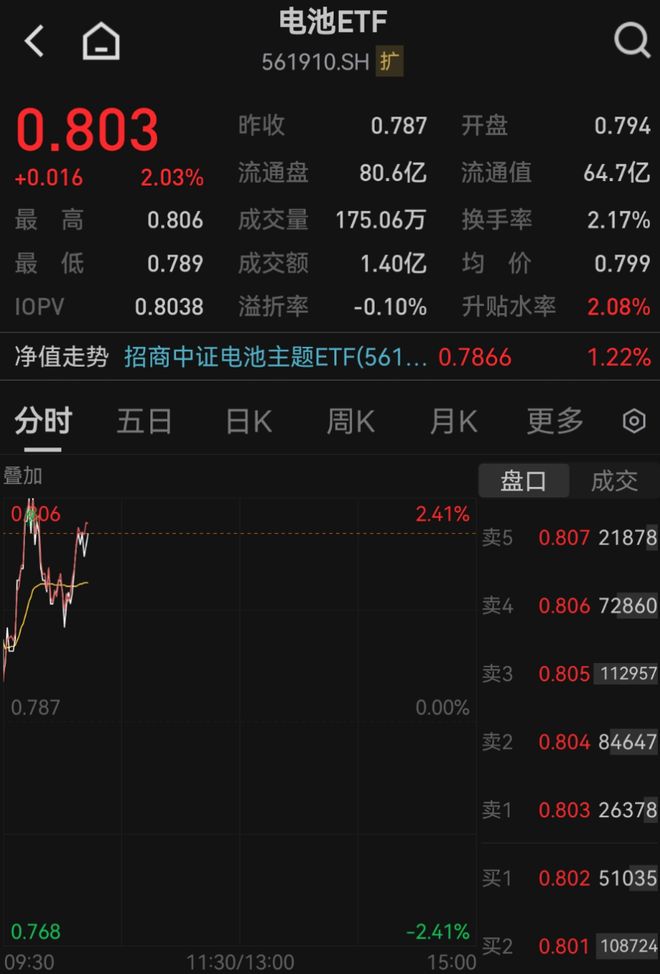
Core Insights - The 2025 New Energy Battery Industry Development Conference concluded, leading to a significant rise in the battery sector, with notable stock increases for companies like Penghui Energy and Ningde Times [1][3]. Group 1: Market Performance - As of 9:51 AM, Penghui Energy surged over 12%, while Sunshine Power rose by 4.46%. Other companies such as Kehua Data, Tiannai Technology, and Xinnengda saw increases of over 3% [1]. - The battery ETF (561910) increased by over 2%, tracking the CS battery index, which has over 40% solid-state battery content and has risen more than 58% this year [2][5]. Group 2: Technological Advancements - Xinnengda launched a new generation polymer solid-state battery, "Xinn·Bixiao," with an energy density of 400Wh/kg and a cycle life of 1200 weeks under ultra-low external pressure [3]. - The company plans to establish a 0.2GWh polymer solid-state cell pilot line by the end of this year and has developed a laboratory sample of a lithium metal super battery with an energy density of 520Wh/kg [3]. Group 3: Industry Trends - According to the Ministry of Industry and Information Technology, Chinese companies occupy six of the top ten global battery manufacturers, accounting for 69% of total shipment volume [3]. - Recommendations were made for the development of new battery technologies, including solid-state batteries and metal-air batteries [3]. Group 4: Company Performance - Yiwei Lithium Energy reported a significant increase in both revenue and profit for Q3, achieving a revenue of 16.832 billion yuan, a year-on-year increase of 35.85%, and a net profit of 1.457 billion yuan, up 50.70% year-on-year [4]. - The company’s battery shipments for the first three quarters included 34.59 GWh of power batteries and 48.41 GWh of energy storage batteries, marking increases of 66.98% and 35.51% respectively [4]. Group 5: Investment Outlook - Zhongyin International highlighted the accelerating progress in solid-state battery technology and the increasing demand for specialized equipment in the production process, indicating a high growth potential [5]. - Dongguan Securities noted strong domestic demand for energy storage cells and the ongoing production ramp-up in the electric vehicle market, suggesting a positive outlook for companies involved in solid-state battery equipment [5].



十五五将“加快高水平科技自立自强”摆在首要位置,AI主线行业地位进一步确立,人工智能ETF(515980)盘中上涨2.70%
Xin Lang Cai Jing· 2025-10-24 03:24
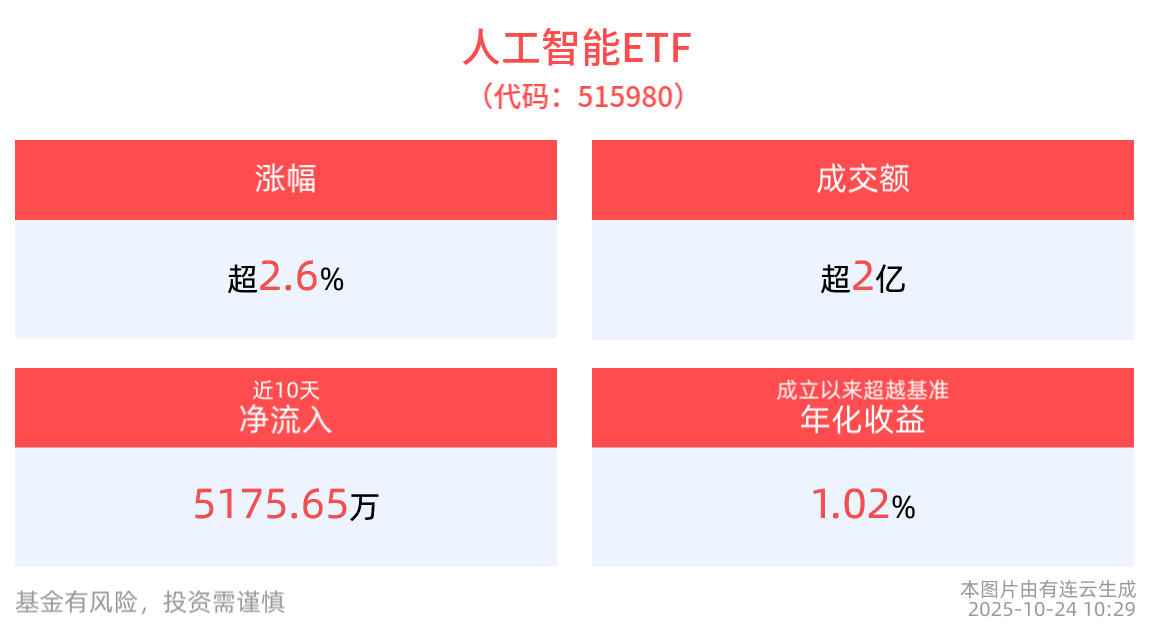
Core Insights - The recent high-level meeting has outlined a five-year plan emphasizing high-quality development and technological self-reliance, with a focus on new productive forces as a priority for all policies [1][3] - The AI sector is expected to benefit significantly from policy incentives under the 14th Five-Year Plan, particularly in areas like foundational models, AI chips, algorithms, and computing power [3][4] - The artificial intelligence industry is positioned as a strategic priority for national development, enhancing growth certainty and establishing its status in the mainline industry [3] Market Performance - As of October 24, 2025, the CSI Artificial Intelligence Industry Index (931071) rose by 2.80%, with notable gains in constituent stocks such as Beijing Junzheng (300223) up 6.66% and Lanke Technology (688008) up 5.84% [1] - The artificial intelligence ETF (515980) also saw an increase of 2.70%, with a trading volume of 2.06 billion yuan and a turnover rate of 2.61% [3] Investment Opportunities - The Huafu Artificial Intelligence ETF (515980) provides balanced exposure across various segments of the AI industry, covering both computing power and applications [4] - Investors without stock accounts can consider the Huafu Artificial Intelligence ETF linked funds (Class A 008020, Class C 008021) for AI investment [4]
算力概念牛股辈出,14股上涨空间获机构看好
Zheng Quan Shi Bao Wang· 2025-10-23 01:06
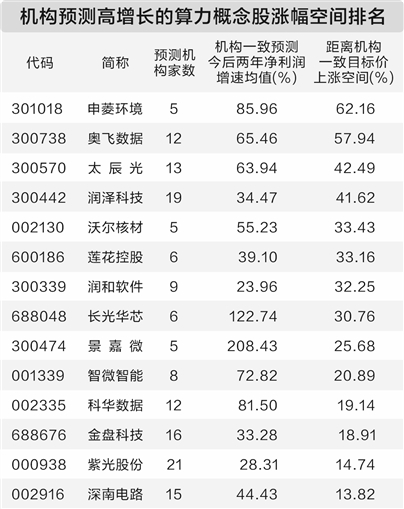
Group 1: Market Trends and Predictions - The Ministry of Industry and Information Technology of China is soliciting opinions on the "Guidelines for the Construction of Computing Power Standard System (2025 Edition)" to accelerate the establishment of a national integrated computing power network [2] - By 2027, over 50 standards will be revised to support the construction of the computing power standard system, focusing on various aspects such as infrastructure, equipment, and applications [2] - China's computing power industry has a total scale growth rate of approximately 30% annually, with intelligent computing demand rapidly increasing due to advancements in artificial intelligence [3] Group 2: Company Performance and Opportunities - Nine concept stocks reported significant profit growth in the first three quarters, including companies like Shijia Photon and Cambricon, with Shijia Photon achieving a net profit of 300 million yuan, a year-on-year increase of 727.74% [4] - The computing power sector has seen multiple stocks with over 100% cumulative growth this year, with Shenghong Technology leading at a 564.6% increase [5] - Companies like Shenling Environment are predicted to have substantial growth potential, with a projected net profit growth rate of 62.16% over the next two years [5]
20+数据中心液冷技术厂家盘点,建议收藏!
DT新材料· 2025-10-22 16:05
Core Viewpoint - The article emphasizes the critical role of liquid cooling technology in addressing the increasing thermal management challenges faced by data centers due to the rapid advancement of technologies like artificial intelligence and the Internet of Things. Traditional air cooling methods are becoming inadequate, making liquid cooling a key focus for sustainable development in data centers [5]. Summary by Sections Overview of Liquid Cooling Technology - Data centers are evolving towards "high performance, high density, and high energy consumption," with cooling systems accounting for approximately 40% of total energy consumption. Efficient heat dissipation is essential for sustainable development [5]. Company Profiles - **Shenzhen Envicool Technology Co., Ltd.**: Established in 2005, it specializes in precision cooling solutions for data centers and has a diverse product matrix including liquid cooling technologies widely used in high-power density servers [6][7]. - **Guangzhou Gaolan Energy-saving Technology Co., Ltd.**: Founded in 2001, it offers advanced cooling solutions with a focus on liquid cooling technologies, achieving a PUE as low as 1.08 in applications [10][12]. - **Sugon Information Industry Co., Ltd.**: With a comprehensive product system in liquid cooling, it has developed technologies that enhance heat exchange efficiency by over 15% [13][14]. - **Inspur Information**: A global leader in IT infrastructure, it holds a 5.5% market share in the global liquid cooling infrastructure market and has been the top provider in China for four consecutive years [16][17]. - **Ningchang Information Industry (Beijing) Co., Ltd.**: Focused on liquid cooling servers, it has developed a comprehensive system covering all scenarios of liquid cooling [20][22]. - **Sanhua Tongfei Refrigeration Co., Ltd.**: Established in 2001, it specializes in industrial temperature control technology and has developed solutions that significantly reduce energy consumption [24][26]. - **Jiangsu Likang Puting Precision Technology Co., Ltd.**: Founded in 2024, it focuses on efficient and energy-saving cooling solutions for data centers [27][28]. - **Nanjing Jialitu Room Environment Technology Co., Ltd.**: Established in 2003, it provides a full chain of services in environmental control, including liquid cooling solutions [31][33]. - **Kehua Data Co., Ltd.**: With a history dating back to 1988, it has developed liquid cooling solutions that achieve a PUE as low as 1.2 [36][37]. - **Shenzhen Keda Technology Co., Ltd.**: Founded in 1993, it offers comprehensive solutions for data centers, focusing on high-density liquid cooling products [39][40]. - **Guangdong Shenling Environment System Co., Ltd.**: Established in 2000, it provides integrated solutions for environmental control, including innovative liquid cooling systems [42][43]. - **Guangdong Haiwu Technology Co., Ltd.**: Focused on low-carbon solutions, it has developed a full-stack liquid cooling system adaptable to various power densities [46][47]. - **Shenzhen Green Cloud Technology Co., Ltd.**: A subsidiary of Wangsu Technology, it specializes in green data center solutions based on immersion cooling technology [50][51]. - **Yimikang Technology Group Co., Ltd.**: Established in 2002, it aims to lead in zero-carbon data center solutions, with a focus on various liquid cooling technologies [53][54]. - **Yuan Di (Guangzhou) Digital Technology Co., Ltd.**: Founded in 2021, it focuses on innovative liquid cooling products and solutions, achieving significant milestones in various industries [57][58]. - **Sichuan Chuanrun Co., Ltd.**: Established in 1992, it has developed dual technology routes in liquid cooling, achieving a PUE below 1.05 [61][62]. - **Changzhou Hester Technology Co., Ltd.**: With 25 years of experience, it has become a leader in liquid cooling technology, providing solutions for high-performance computing [64][65]. - **Beehe Electric (Taicang) Co., Ltd.**: Founded in 2006, it offers comprehensive thermal management solutions, including liquid cooling products [68][69]. - **Guangzhou Hashi Temperature Control Technology Co., Ltd.**: Established in 2023, it focuses on liquid cooling solutions and has developed a complete technical system for various applications [71][72]. - **Lanyang (Ningbo) Technology Co., Ltd.**: Founded in 2019, it provides comprehensive liquid cooling solutions for various industries, focusing on immersion cooling technology [73][74]. - **Zhejiang Yunchuang Zhida Technology Co., Ltd.**: A subsidiary of Zhejiang Kangsong, it offers customized liquid cooling solutions based on extensive experience in thermal management [77][78]. - **Henan Jingrui Cooling Technology Co., Ltd.**: Established in 2008, it provides solutions for various fields, including data centers [80][81]. - **H3C Group**: Offers high-density liquid cooling solutions to meet the growing performance demands of data centers [84]. Upcoming Events - The sixth Thermal Management Industry Conference and Expo will be held in 2025, focusing on thermal management technologies in data centers and consumer electronics, inviting industry professionals and researchers to participate [88].


大模型APP,AI时代第一个爆款
China Post Securities· 2025-10-22 09:50
Investment Rating - The industry investment rating is "Outperform" [1] Core Insights - OpenAI has initiated a "technology-hit product-user" growth flywheel, transitioning to a platform-based business model [2] - The domestic internet sector is accelerating the implementation of AI platforms, competing for user entry points and ecological dominance [3] - OpenAI represents a closed-source ecosystem centered on technology, achieving user growth through "technology-hit products," with MAU surpassing 1 billion [4] Summary by Sections OpenAI: Initiating the "Technology-Hit Product-User" Growth Flywheel - OpenAI is evolving into a platform company, with user accumulation forming a strong competitive moat [7] - The company anticipates revenue growth, projecting $200 billion by 2030, with a CAGR of 92% from 2024 to 2030 [4][48] - The launch of products like GPT-4o and GPT-5 has significantly boosted user engagement, with message volume increasing over 7 times since launch [33] Domestic Internet: Accelerating AI Platform Implementation - ByteDance's Doubao and Tencent's Yuanbao are competing aggressively for user acquisition [49] - Doubao's MAU reached 1.5 million and 860,000 on app and web platforms respectively, showing strong growth [57] - Tencent's Yuanbao is leveraging the popularity of AI applications to enhance its user base [58] Breaking the "Disruption Theory" - The core value of large models has shifted from being disruptors to enablers, fostering a new industrial cycle [6] - OpenAI and other leading firms are collaborating with application companies to expand the AI market [4] - The competitive focus is shifting towards user accumulation and platform transformation capabilities [4] Investment Recommendations - The dual strategy of "ToC for branding and ToB for business" is seen as a consensus in the industry [4] - Companies with entry value in the Hong Kong internet sector and those with potential collaboration with large model firms are recommended for investment [4]

云计算50ETF(516630)小幅下跌,算力板块短期调整,但高景气有望持续
Mei Ri Jing Ji Xin Wen· 2025-10-22 07:09
Core Viewpoint - The A-share market experienced a slight decline, with major indices such as the Value Index, Sci-Tech 100, and ChiNext Index leading the drop, while sectors like oil and banking showed gains. The AI industry is expected to thrive due to domestic substitution policies and technological advancements, with a focus on the AI industry chain including chips, servers, and applications [1][2]. Group 1: Market Performance - A-share indices fell slightly, with the Value Index, Sci-Tech 100, and ChiNext Index among the worst performers [1] - Sectors such as non-ferrous metals, electric equipment, and defense led the decline, while oil, petrochemicals, and banking sectors saw gains [1] - The cloud computing 50 ETF (516630) experienced a minor drop, with key holdings like Tax Friend Co., Deep Technology, and others declining [1] Group 2: AI Industry Insights - Major AI companies like Nvidia, OpenAI, Google, and Alibaba are investing in data centers, indicating a robust growth trajectory for the AI industry [1] - The Ministry of Industry and Information Technology announced a special action for "millisecond computing" on October 16, 2025, further supporting the AI sector [1] - First Shanghai highlights the high growth potential of AI-driven computing demand, with a breakthrough expected in domestic computing capacity by 2026 [2] Group 3: Investment Recommendations - Investors are advised to select high-quality stocks with strong performance capabilities as the third-quarter reports approach, while being mindful of short-term volatility risks due to capital expenditure changes and technological shifts [2] - The cloud computing 50 ETF (516630) tracks an index with a high AI computing content, covering popular concepts like optical modules, computing leasing, and AI servers [2] - The ongoing US-China tensions do not alter the positive trend in the AI industry, suggesting a focus on core companies within the domestic computing industry chain [2]
AI电源行业专家交流
2025-10-21 15:00
Summary of SST System Industry Conference Call Industry Overview - The conference focused on the SST (Solid State Transformer) system industry, discussing its cost structure, market trends, and competitive landscape in both domestic and overseas markets [1][2][3]. Key Points and Arguments Cost Structure of SST Systems - The cost composition of SST systems includes rectifier modules (40%-50%), high-frequency transformers (approximately 25%), control and distribution (15%), energy storage (11%), and structural cooling (8%) [1][2]. - Current single watt cost of SST systems is around 5 RMB, with total system costs reaching 8-10 million RMB. By 2028, costs are expected to drop to below 1 RMB per watt, with total system costs around 2 million RMB, but large-scale application is anticipated only by 2030 [1][4]. Price Trends and Market Dynamics - There is a significant price disparity between domestic and overseas SST systems, particularly in North America, where prices are expected to remain around 4-5 RMB per watt until 2027-2028, with limited reduction [5]. - Domestic market competition is intense, with expectations that prices could fall below 1 RMB per watt by 2030 [5]. Technical Standards and Design Differences - North America tends to adopt higher input voltage SST systems (35 kV or 20 kV), which enhances renewable energy integration efficiency but also increases costs. Differences in design standards between North America and China contribute to cost variations [6][8]. - Domestic companies can enter the SST supply chain by exporting components like high-frequency transformers and rectifier modules, capturing growth opportunities despite slower rack power increases compared to North America [9]. Market Opportunities and Challenges - Companies like Jinpan and Sungrow, which have comprehensive system integration capabilities, are better positioned to enter the SST supply chain [3][16]. - The domestic market's ability to reduce SST product prices significantly is attributed to lower value differences compared to overseas products, reflecting market maturity and demand [23]. Future Prospects - The SMT (Solid State Transformer) AC-DC hybrid system market is expected to grow faster than the data center market due to lower energy continuity and stability requirements, making it more cost-sensitive [24]. - The demand for silicon carbide (SiC) in charging stations and data centers is increasing, but the complex production process may lead to supply constraints and price increases [26]. Additional Important Insights - The integration capabilities of domestic companies lag behind those of leading overseas firms like Delta, Schneider, and Eaton, which have dedicated departments for each segment of the SST system [22]. - The competitive landscape in the HVDC (High Voltage Direct Current) sector shows that traditional power distribution companies in China have advantages, but emerging electronic companies are rapidly advancing [18]. This summary encapsulates the critical insights from the SST system industry conference call, highlighting the cost structures, market dynamics, technical standards, and future prospects within the industry.
AIDC爆火,储能企业跨界抢滩AI能源“新战场”
3 6 Ke· 2025-10-21 12:11
Core Insights - The establishment of AIDC (Artificial Intelligence Data Centers) is driven by the increasing demand for computing power, with a projected global data center electricity consumption exceeding 800 TWh by 2026, a 75% increase over four years [2][3] - Major cloud service providers are engaged in a capital expenditure arms race, with the top four overseas cloud companies collectively spending over $300 billion, a year-on-year increase of over 30% [3][4] - The investment scale for AIDC in China is expected to surge from 187.5 billion yuan in 2024 to 482.6 billion yuan by 2027 [4] Investment and Growth - The rapid iteration of large model technologies has led to a dual explosion in computing power demand for both training and inference, with AI computing needs projected to reach 16 times the 2025 levels by 2030 [3][4] - Companies like Tencent and ByteDance are significantly increasing their investments in AIDC, with Alibaba's CEO stating that investments in cloud and AI infrastructure will surpass the total of the past decade [4] Energy Challenges - The new generation of AI chips shows a dramatic increase in power consumption, with NVIDIA's H200 power board consuming approximately 1700W and the new B200 board rising to 3300W, nearly doubling [4] - The total electricity consumption of data centers and 5G base stations in China is projected to reach 250 billion kWh in 2024, equivalent to the annual electricity consumption of Beijing and Shanghai combined [5] Storage Market Opportunities - The unique power consumption characteristics of AIDC, described as "power roller coasters," have transformed energy storage from an optional component to a necessity, creating unprecedented market opportunities [6] - CATL predicts that the shipment volume of data center energy storage batteries will reach 30 times that of 2024 by 2030, corresponding to a market size of approximately 150 billion yuan [6] Technical Challenges and Solutions - AIDC faces significant technical challenges in cooling, power supply, and space, necessitating innovations in cooling technologies and power supply systems [7] - The transition from traditional UPS systems to new architectures like HVDC and SST is driven by the need for stable and uninterrupted power supply [7] Competitive Landscape - Energy storage companies are leveraging their long-term expertise in the energy sector to gain a competitive edge in the AIDC market, focusing on efficient conversion, stable storage, and intelligent scheduling [7][8] - Companies like Sungrow and Nandu Power are developing integrated solutions that combine renewable energy sources with energy storage to meet AIDC's demands [8][9] Market Performance - Companies such as Double登股份 and Nandu Power have reported significant revenue growth in their AIDC-related businesses, with Double登股份 achieving a 113.1% year-on-year increase in sales [10] - Sungrow has established a dedicated AIDC division, positioning itself as an energy system service provider rather than just an equipment supplier [10] Industry Collaboration - The establishment of the AIDC Industry Ecosystem Alliance aims to promote collaboration across the supply chain, focusing on technology standards and innovation [14] - Successful examples of ecosystem collaboration include the launch of the Lingang AIDC collaborative platform, which enhances energy demand forecasting accuracy [13] Global Competition - The global AIDC construction trend is intensifying, with countries increasing their investments, highlighting the need for Chinese energy storage companies to accelerate technological innovation and global expansion [15][16] Conclusion - The AIDC sector is at the beginning of a transformative phase, where balancing efficiency and sustainability will determine the leaders in this critical future competition [17]