高鑫零售

Search documents
阿里年报的9个细节
海豚投研· 2025-06-29 06:36
Core Views - The past year has been a pivotal one for Alibaba, marked by significant reforms led by executives Cai Chongxin and Wu Yongming, focusing on strategic clarity and business focus [2][3] - Alibaba's 2025 fiscal year was characterized by solid progress under the "user-first, AI-driven" strategy, with notable growth in core businesses [3][4] Group 1: Financial Performance - Alibaba reported a total revenue of 996.347 billion RMB for the fiscal year, with a net profit increase of 77% to 125.976 billion RMB, marking a four-year high [4] - E-commerce revenue grew by 3%, CMR increased by 6%, and international e-commerce revenue surged by 29% [4] - Cloud revenue achieved double-digit growth, leading the AI technology wave since the beginning of the year [4] Group 2: Strategic Focus - The company is concentrating on two core businesses: e-commerce and "AI + Cloud," which are seen as the engines for long-term growth [4][7] - Alibaba's mission remains unchanged: to make it easier for businesses to operate, with an updated emphasis on AI to support small enterprises [5][6] Group 3: Market Position - Alibaba is the world's largest e-commerce platform with an annual GMV of approximately 8 trillion RMB, while Amazon ranks second with around 500 billion USD (approximately 5 trillion RMB) [13] - In cloud services, Alibaba ranks fourth globally and first in the Asia-Pacific region, following Amazon, Microsoft, and Google [13] Group 4: Investment and Growth - The company plans to invest over 380 billion RMB in cloud and AI infrastructure over the next three years, with a capital expenditure of 86 billion RMB in the past year, a 168% increase year-on-year [20] - As of March 2025, Alibaba had signed but unrecognized capital expenditures amounting to 45.3 billion RMB, a 146% increase [20] Group 5: Organizational Changes - The partner team has been reduced to 17 members, focusing on a more streamlined and effective leadership structure [22][23] - The total number of full-time employees decreased significantly to 124,320 by March 2025, following the divestment of non-core businesses [25] Group 6: Shareholder Returns - Alibaba's cash reserves stood at 374.3 billion RMB, with a net cash position of 143.6 billion RMB after accounting for interest-bearing liabilities [27] - The company returned 117 billion RMB to shareholders through dividends and stock buybacks, reducing the total share count by 5.1% [27]


阿里合伙人“瘦身”幕后:核心变阵 聚焦赛道完成切换
Zhong Guo Jing Ying Bao· 2025-06-27 07:12
Core Insights - Alibaba's 2025 fiscal year report indicates a significant restructuring of its partnership system, reducing the number of partners from 26 to 17, signaling the end of an era led by the founding team [1][5] - The company is focusing on core businesses, particularly e-commerce and AI, with a planned investment of 380 billion yuan over the next three years [1][6] - The shift in partnership reflects a transition to younger leadership, emphasizing frontline business decision-makers [5][6] Financial Performance - For the 2025 fiscal year, Alibaba reported total revenue of 996.347 billion yuan, with a net profit increase of 77% to 125.976 billion yuan [6] - The AI-related products revenue has shown triple-digit year-on-year growth for seven consecutive quarters, indicating strong demand in this sector [6] Business Strategy - Alibaba has exited non-core assets such as Gao Xin Retail and Intime Department Store, focusing on its core business and increasing strategic investments in AI [6][8] - The company has seen a 6% year-on-year increase in customer management revenue (CMR) for its Taotian business, with the 88VIP membership base exceeding 50 million [6][8][7] - Recent organizational changes, including the merger of Ele.me and Fliggy into Alibaba's China e-commerce division, aim to enhance competitiveness against rivals like Meituan and JD.com [6]
谷歌发布本地具身智能模型!AI人工智能ETF(512930)、消费电子ETF(561600)盘中双双涨近1%
Sou Hu Cai Jing· 2025-06-25 02:39
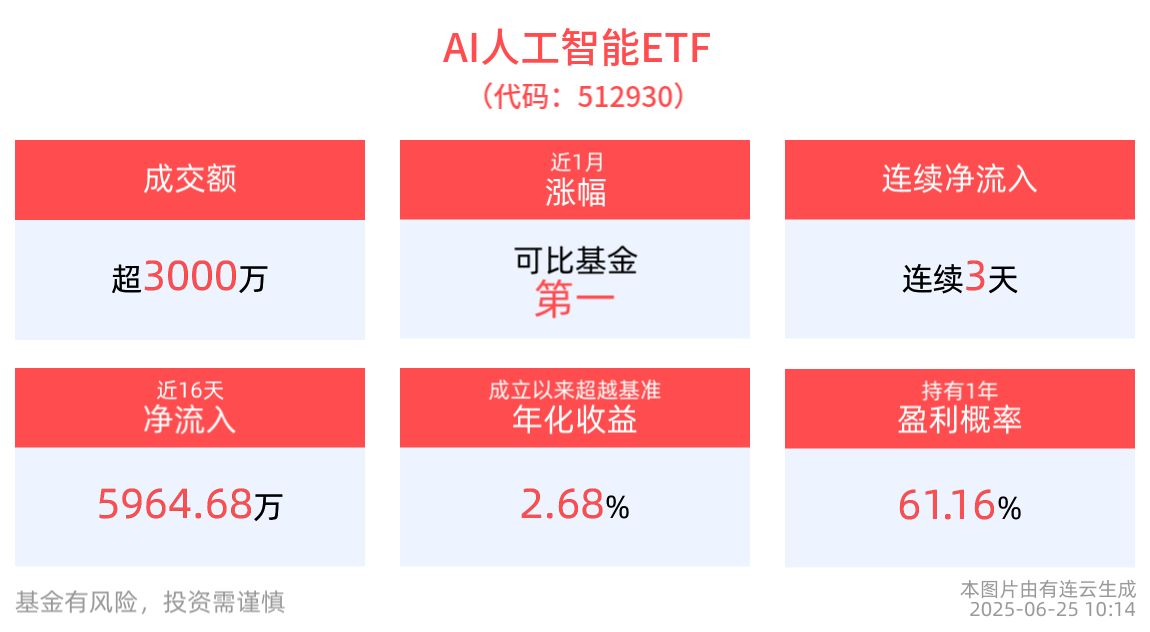
Group 1: AI Industry Developments - The AI Artificial Intelligence ETF (512930) has reached a latest scale of 2.034 billion yuan [2] - Google's DeepMind team has released the Gemini Robotics On-Device model, which can operate entirely offline and has strong operational capabilities, addressing issues of network latency and instability [2] - The AI Agent is seen as a solution to the limitations of generative AI models, driving AI technology towards practical and intelligent applications, with global tech giants focusing on both consumer and business sectors [3] Group 2: Stock Performance and Indices - As of June 25, 2025, the CSI Artificial Intelligence Theme Index (930713) increased by 0.76%, with notable gains from companies like Runze Technology (5.15%) and Stone Technology (4.84%) [1] - The top ten weighted stocks in the CSI Artificial Intelligence Theme Index account for 51.56% of the index, with Cambricon (688256) holding the highest weight at 7.00% [7][9] - The CSI Consumer Electronics Theme Index (931494) rose by 0.32%, with significant increases from companies such as Xingsen Technology (3.82%) and Industrial Fulian (3.30%) [6] Group 3: ETF Performance - The Consumer Electronics ETF (561600) has seen a net value increase of 19.07% over the past year, with a significant growth of 29 million shares this year [6] - The Online Consumption ETF closely tracks the CSI Hong Kong-Shenzhen Online Consumption Theme Index, which includes major companies like Alibaba and Tencent, with the top ten stocks accounting for 56.98% of the index [13]
恒生消费ETF(513970)涨近1%,冲击三连阳!六部门联合印发,促消费政策持续发力
Sou Hu Cai Jing· 2025-06-25 02:21
Group 1 - The core viewpoint of the articles highlights the positive market sentiment in Hong Kong, driven by easing geopolitical tensions and supportive financial policies aimed at boosting consumer spending [1][2] - The Hang Seng Consumption ETF (513970) has shown significant performance, with a recent closing increase of 2.18% and a continued rise of nearly 1% in early trading, indicating strong investor interest [1] - The ETF has reached a scale of 1.668 billion yuan, with net inflows exceeding 310 million yuan in the past three months and over 1.162 billion yuan year-to-date, reflecting robust demand for consumer-related investments [1] Group 2 - Guotai Junan Securities notes that Hong Kong stocks have outperformed global indices in the first half of the year due to strong earnings and reasonable valuations, with expectations for continued excess returns in the second half [2] - The Hang Seng Consumption ETF closely tracks the Hang Seng Consumption Index, focusing on essential consumer sectors while excluding liquor stocks, aligning with the preferences of a new generation that values emotional consumption and service experiences [2] - Investors without stock accounts can access the consumption sector through the Hang Seng Consumption ETF linked funds, providing additional avenues for investment in this growing market [2]
星巴克中国要卖了,估值超350亿
投资界· 2025-06-24 03:12
Core Viewpoint - The article discusses the intense interest from private equity firms in acquiring Starbucks' China operations, highlighting the competitive landscape and the challenges faced by Starbucks in the Chinese market [1][2][5]. Group 1: Acquisition Interest - Hillhouse Capital has shown interest in acquiring Starbucks' China business, participating in a management roadshow [1][5]. - Other notable investment firms, including Carlyle Group and Xincheng Capital, are also involved in the bidding process for Starbucks China, with the business valued at approximately $5 to $6 billion (around 350 to 430 billion RMB) [2][5]. - The competitive bidding landscape includes major players like KKR, PAG, and potential domestic buyers such as China Resources Group and Meituan [5]. Group 2: Market Challenges - Starbucks has been operating in China for 26 years, with over 7,700 stores, but faces fierce competition from local brands like Luckin Coffee and Mixue Ice Cream [3][7]. - The emergence of Luckin Coffee has significantly impacted Starbucks' market position, with Luckin achieving a store count of 24,097 by Q1 2025, nearly three times that of Starbucks China [8][9]. - Starbucks reported a 6% decline in same-store sales in Q1 2025 and announced its first price reduction in 25 years, indicating the pressure from competitors [9]. Group 3: Strategic Shifts - Starbucks is exploring various strategies to enhance its growth in China, including seeking external strategic investors [9]. - The article draws parallels with McDonald's China, which successfully navigated a similar acquisition and localization process, suggesting that Starbucks could benefit from a similar approach [11]. - The current environment in the consumer market is characterized by significant mergers and acquisitions, with many brands being targeted for acquisition due to favorable pricing and cash reserves among buyers [12][14].

2.13 万亿规模,2024 中国连锁 TOP100 发布,沃尔玛稳坐头把交椅,胖东来凭啥成行业白月光?
3 6 Ke· 2025-06-20 03:14
Core Insights - The 2024 China Chain TOP100 report indicates a sales scale of 2.13 trillion yuan and a total of 257,200 stores, representing a year-on-year growth of 4.9% and 13.5% respectively [1][4][12] Group 1: Sales Performance - Walmart (China) leads the sales ranking with 158.84 billion yuan, showing a year-on-year growth of 19.6% [2][8] - Hunan Mingming Hen Mang, a new entrant in the top ten, achieved a remarkable sales growth of 132.7% and a store count increase of 105.6% [8][10] - The top ten companies in sales include traditional giants like Suning and Gome, indicating the resilience of established brands [8][10] Group 2: Store Count - Meiyijia holds the highest number of stores at 37,943, leveraging the convenience store model for rapid expansion [9][10] - The increase in store count is primarily driven by convenience and specialty stores, reflecting a shift towards meeting immediate consumer needs [9][12] Group 3: Growth Dynamics - Companies like Hema and Mingming Hen Mang reported double-digit growth in both sales and store numbers, highlighting their effective market strategies [10][12] - Costco, despite having only seven stores, achieved a sales growth of 58.2%, showcasing the potential of high-end warehouse retail [10][12] Group 4: Industry Trends - The report indicates a structural adjustment within the industry, with a notable increase in the number of companies achieving over 30 billion yuan in sales, from 21 to 24 [14] - The industry is experiencing a shift towards specialization, with professional stores and convenience stores leading growth, while traditional retail faces pressure to adapt [12][15]


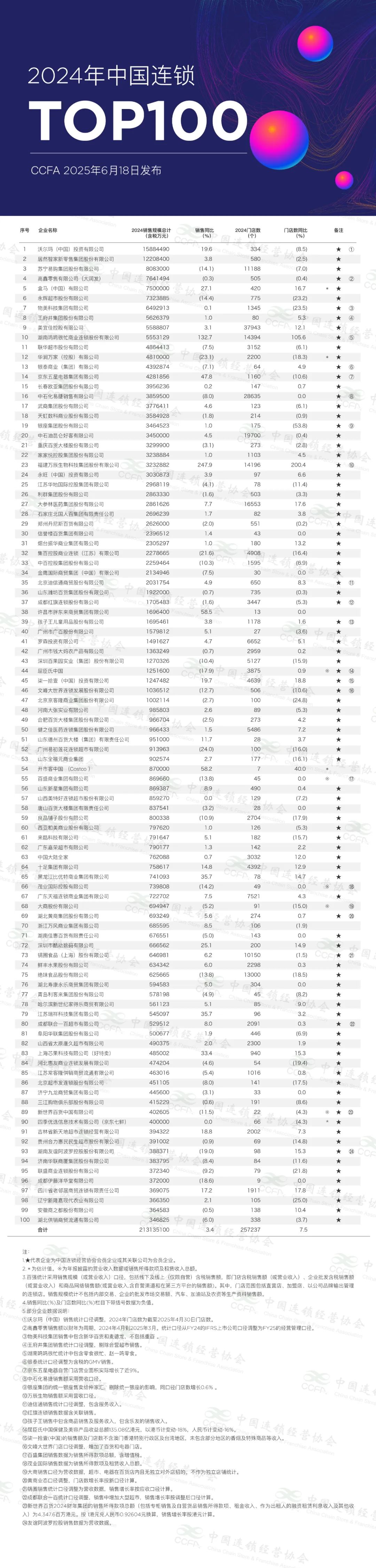
规模突破2万亿!中国连锁百强排名出炉
21世纪经济报道· 2025-06-20 00:40
Core Viewpoint - The 2024 China Chain Top 100 report indicates a mixed performance across various retail sectors, with significant challenges for comprehensive retail while supermarkets and specialty stores show growth potential [1][3][11]. Group 1: Overall Performance - The overall sales scale of the top 100 chain enterprises in China for 2024 is 2.13 trillion yuan, with a total of 257,200 stores, representing a growth of 4.9% and 13.5% respectively compared to 2023 [1]. - Notable companies such as Walmart (China), Suining Yigou, and Hema maintain their leading positions, with Walmart (China) achieving sales of 158.845 billion yuan [2]. Group 2: Comprehensive Retail Sector - The comprehensive retail sector faces significant growth pressure, with only 19 out of 46 companies showing year-on-year sales growth, and just 9 achieving both sales and store number growth [4]. - Companies like Suning Yigou and CR Vanguard experienced substantial declines in sales, with decreases of 14.1% and 23.1% respectively, alongside reductions in store numbers [5]. - The challenges faced by comprehensive retail are not new, as evidenced by declines in 2023, indicating a trend of stagnation due to rising costs and increased online sales penetration [5]. Group 3: Supermarkets and Convenience Stores - The supermarket sector shows signs of improvement, with 12 out of 23 companies reporting sales growth, including Hema and Jiajiayue, which achieved significant increases in both sales and store numbers [7]. - Hema's sales exceeded 75 billion yuan, growing by 27.1%, while Pang Donglai reported a remarkable 58.5% increase in sales [7][8]. - Convenience stores continue to grow, but the growth rate has slowed significantly for major players like Meiyijia and 7-Eleven, indicating a potential saturation in the market [9][10]. Group 4: Specialty Stores - Specialty stores are emerging as a new growth driver, with strong performance across various segments such as pharmaceuticals and beauty products, showing double-digit growth in both sales and store numbers [11]. - Companies like Dazhenglin and Kidswant are expanding rapidly, with Dazhenglin's store count increasing by 17.6% [12]. - The snack industry is witnessing the rise of new discount brands, with Hunan Mingming Hen Mang entering the top 10 with a staggering 132.7% sales growth [13]. Group 5: Future Trends - The competition among chain enterprises will increasingly depend on user engagement, service experience, product precision, and technological support [13]. - As the retail market evolves, specialty stores must enhance their competitiveness to address pressures from other retail formats and e-commerce platforms [13].

连锁百强格局新变:规模突破2万亿,专业店抢眼
2 1 Shi Ji Jing Ji Bao Dao· 2025-06-19 12:50
Group 1: Overall Performance of Top 100 Retailers - The overall sales scale of China's Top 100 chain enterprises in 2024 is 2.13 trillion yuan, with a total of 257,200 stores, representing a growth of 4.9% and 13.5% respectively compared to 2023 [1] - Walmart (China) leads the list with a sales revenue of 158.845 billion yuan, maintaining its top position [1] - New entrants to the list include five companies, with Hunan Mingming Hen Mang breaking into the top ten with sales exceeding 55 billion yuan [1] Group 2: Challenges in Comprehensive Retail - Comprehensive retail faces significant growth pressure, with only 19 out of 46 companies showing year-on-year sales growth, and only 9 achieving both sales and store number growth [2] - Notable declines in sales were observed for Suning.com and CR Vanguard, with sales dropping by 14.1% and 23.1% respectively, alongside reductions in store numbers [2] - The challenges faced by comprehensive retail are not new, as evidenced by declines in 2023 sales figures for major players [2] Group 3: Supermarkets and Convenience Stores - Among the 23 supermarkets listed, 12 achieved year-on-year sales growth, with notable performers like Hema and Pang Dong Lai showing significant increases [4] - Hema's sales exceeded 75 billion yuan, growing by 27.1%, while Pang Dong Lai's sales reached 16.9 billion yuan, marking a 58.5% increase [4] - Convenience stores continue to show growth in sales and store numbers, but growth rates have slowed significantly for major brands like Meiyijia and 7-Eleven [6][7] Group 4: Professional Stores as New Growth Drivers - Professional stores have shown the best performance, with double-digit growth in sales and store numbers across various sectors, indicating strong demand in niche markets [8] - Dazhenglin in the pharmaceutical sector and Kidswant in the mother and baby category have demonstrated robust growth, with Dazhenglin expanding by 17.6% [8] - The snack industry is witnessing the rise of new discount brands, with Hunan Mingming Hen Mang achieving a remarkable 132.7% sales growth [8] Group 5: Future Trends in Retail Competition - Future competition among chain enterprises will increasingly depend on user operation capabilities, service experience, product precision, and technological support [9] - The intersection of consumption upgrades and rational return will determine which companies can understand users and continue to innovate [9]
消失的巨头LP又回来了
FOFWEEKLY· 2025-06-19 09:59
互联网巨头以LP身份出手了。 作者丨FOFWEEKLY 本期推荐阅读5分钟 本期导读: 这两年,一级 市场上围绕 "找钱难" 的讨论层出不穷。尤其是那些不带招商诉求的市场化资金,更是成 为GP争相追逐的稀缺资源。 从上市公司出资数据来看,整体作为LP的出资数据未见太多起色,曾经活跃的互联网巨头们,近两年在 LP领域近乎销声匿迹。 而值得关注的是, 近日,一则工商信息,打破了这份沉寂, 一家互联网巨头又一次现身了,且是作 为LP的身份出手 。 阿里巴巴又做LP 这一看似普通的新基金成立事件, 实则暗藏深意。 有外界人士猜测:此举或是阿里巴巴在新环境下的核心应对逻辑,被视为其战略调整的 关键落子 。 回顾2025年初至今,阿里巴巴进行了一系列引人瞩目的资产处置:以131亿港元出售高鑫零售(大 润发母公司)控股权予德弘资本,以约74亿元转让银泰商业股权…… 这些动作,在外界看来,正是展现出了阿里巴巴逐步退出非核心资产,聚焦核心业务的战略决心。 而大刀阔斧的"瘦身"为其回笼了超过200亿人民币的资金。 沉寂多年的互联网巨头回来了。 曾几何时,互联网与产业巨头的战略投资部收缩、战投基金解散、非核心资产剥离的消息不绝于 ...

奇瑞旗下CVC,买了一家上市公司!
证券时报· 2025-06-12 15:33
Core Viewpoint - The article discusses the recent acquisition of 25% of Honghe Technology by Ruicheng Fund for 1.575 billion yuan, marking a significant move in the rising trend of mergers and acquisitions (M&A) initiated by corporate venture capital (CVC) firms in the Chinese market [1][3]. Group 1: Acquisition Details - Honghe Technology focuses on the education technology sector, providing digital and smart education solutions, with a reported revenue of 3.525 billion yuan in 2024, a decrease of 10.29% year-on-year, and a net profit of 222 million yuan, down 31.20% year-on-year [2]. - Ruicheng Fund, backed by Chery Holding Group and Chery Automobile, aims to leverage its resources to enhance Honghe Technology's operational governance and competitive strength [2][3]. - The acquisition is part of a broader trend where CVCs are increasingly engaging in M&A activities, with six such transactions reported since the introduction of the "M&A Six Guidelines" policy [1][5]. Group 2: Market Trends and Motivations - The article highlights a growing trend of CVCs entering the M&A space, driven by policy support and the need for diversified exit strategies beyond traditional IPOs [5][6]. - The current market environment is characterized by a "project dam" phenomenon, where many mature projects face IPO exit challenges, prompting CVCs to explore M&A as a viable option [5][6]. - The shift from early-stage investments to mature project acquisitions reflects a changing investment logic, with a focus on industry chain integration to enhance efficiency and reduce costs [5][6]. Group 3: Advantages of CVCs in M&A - CVCs possess distinct advantages in M&A, including strong industry resource integration capabilities, professional transaction expertise, and strategic insights that can help listed companies expand their business [6][7]. - The integration of acquired companies is often seen as the most challenging aspect of M&A, but CVCs, with their extensive industry experience, are better positioned to manage this process effectively [7][8]. - The article emphasizes the need for CVCs to evolve from an "investment mindset" to an "industry mindset" to enhance their integration management capabilities in the face of competition from state-owned and industrial capital [8].