
养元饮品

Search documents
饮料乳品板块1月20日跌0.01%,均瑶健康领跌,主力资金净流出7003.17万元
Zheng Xing Xing Ye Ri Bao· 2026-01-20 08:51
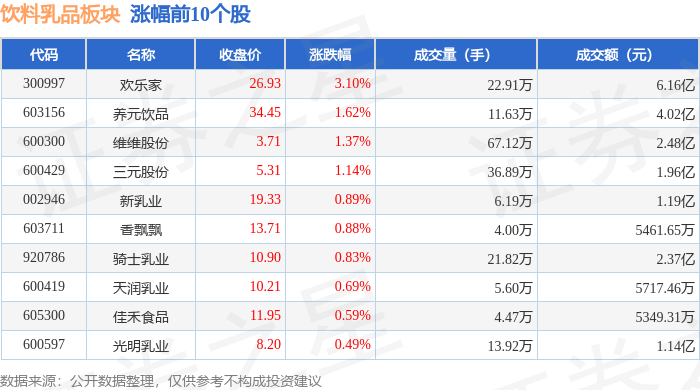
Market Overview - The beverage and dairy sector experienced a slight decline of 0.01% on January 20, with Junyao Health leading the drop [1] - The Shanghai Composite Index closed at 4113.65, down 0.01%, while the Shenzhen Component Index closed at 14155.63, down 0.97% [1] Stock Performance - Notable gainers in the beverage and dairy sector included: - Huanlejia (300997) with a closing price of 26.93, up 3.10% and a trading volume of 229,100 shares, totaling 616 million yuan [1] - Yangyuan Beverage (603156) closed at 34.45, up 1.62% with a trading volume of 116,300 shares, totaling 402 million yuan [1] - Weiwei Co. (600300) closed at 3.71, up 1.37% with a trading volume of 671,200 shares, totaling 248 million yuan [1] - Conversely, Junyao Health (605388) saw a decline of 2.57%, closing at 7.20 with a trading volume of 147,800 shares, totaling 106 million yuan [2] - Other notable decliners included: - Bei Yin Mei (002570) down 2.46% to 6.34 with a trading volume of 679,500 shares, totaling 432 million yuan [2] - Xibu Muye (300106) down 2.38% to 11.09 with a trading volume of 105,800 shares, totaling 118 million yuan [2] Capital Flow - The beverage and dairy sector saw a net outflow of 70.03 million yuan from institutional investors, while retail investors contributed a net inflow of 104 million yuan [2] - The capital flow for specific stocks indicated: - Yili Group (600887) had a net inflow of 91.01 million yuan from institutional investors, while retail investors experienced a net outflow of 61.14 million yuan [3] - Huanlejia (300997) had a net inflow of 60.50 million yuan from institutional investors, but a significant net outflow of 79.94 million yuan from retail investors [3] - Knight Dairy (920786) had a net inflow of 11.97 million yuan from institutional investors, with minimal impact from retail investors [3]


未知机构:东吴食饮苏铖团队0120Q1消费看大众旺季零食闪亮餐饮餐供季节性饮-20260120
未知机构· 2026-01-20 02:25
Summary of Conference Call Notes Industry Overview - The focus is on the consumer sector, particularly in the food and beverage industry, highlighting a seasonal uptick in demand during spring [1][2]. - The report emphasizes the recovery of service consumption, particularly in the restaurant and food supply sectors, supported by government initiatives to boost consumer spending [2]. Key Companies and Recommendations - **Snack Food Companies**: - Recommended leading snack brands include Wanchen Group, Yanjinpuzi, Weilong, Youyou, and Ganyuan [1][2]. - **Restaurant Supply Chain**: - Key players include Babi, Anjins, Guoquan, and Yihai International, along with Baoli Foods and Lihai Foods [1][2]. - **Beverage Companies**: - Notable recommendations are Yangyuan Beverage and Dongpeng Beverage [1][2]. Company-Specific Insights - **Babi**: Focused on diversified growth strategies to recreate its business model [2]. - **Anjins**: Confirming a bottoming out phase and restarting growth initiatives [2]. - **Guoquan**: Demonstrating a resilient business model with accelerated store openings [2]. Market Trends and Predictions - Historical data indicates that Q1 typically shows positive performance for many restaurant companies, with factors such as market profitability, delayed corporate events, and favorable seasonal reporting expected to drive growth in Q1 2026 [3]. - The report anticipates a multi-factor resonance effect in Q1 2026, which may positively impact metrics like customer spending, same-store sales, and table turnover rates [3]. Government Initiatives - The government has implemented a series of fiscal and financial policies aimed at stimulating domestic demand, which includes measures to clear overdue payments to businesses and ensure wage payments to migrant workers [2]. Additional Insights - The report highlights the cyclical nature of the consumer sector and its role as a leader in consumption recovery, with key companies showing continued improvement [4]. - Emphasis on valuation switching as a strategy to recommend high-quality stocks such as Ximai, Babi, Guoquan, and Yanjinpuzi [4].




饮料市场加速分化 接班潮涌能否讲出新故事?
Zhong Guo Jing Ying Bao· 2026-01-19 08:41
Core Insights - The beverage industry is shifting from merely quenching thirst to emphasizing health attributes, with this trend expected to be more pronounced by 2025 [1] - Reports indicate that low-sugar and no-sugar options will become standard in the beverage market by 2025, reflecting a clear trend towards health-conscious consumption [1] - The industry is experiencing a bifurcation, with some companies capitalizing on market trends for growth while others face declining performance [1] Industry Performance - In November 2025, China's beverage production reached 10.46 million tons, a year-on-year increase of 0.4%, with a cumulative production of 165.61 million tons from January to November, reflecting a 3.3% growth [2] - Eastroc Beverage reported impressive performance with a revenue of 16.844 billion yuan in the first three quarters of 2025, a 34.13% increase year-on-year, while Nongfu Spring achieved a revenue of 25.622 billion yuan, up 15.6% [2] - Conversely, traditional giants like Master Kong faced challenges, with a revenue decline of 2.7% in the first half of 2025 [2] Segment Analysis - Sales of tea beverages fell by 6.3% to 10.67 billion yuan, fruit juice sales dropped by 13.0% to 2.956 billion yuan, and packaged water sales decreased by 6.0% to 2.377 billion yuan [3] - Carbonated and other beverages saw a growth of 6.3%, reaching 10.256 billion yuan [3] - The plant-based protein drink segment struggled, with leading brands like Yangyuan and Chengde Lulux experiencing revenue declines of 7.64% and 9.42%, respectively [3] Competitive Landscape - Companies are adjusting to revenue declines, with some experiencing double-digit drops; for instance, China Resources Beverage's revenue fell by 18.5% to 6.206 billion yuan [4] - The competitive landscape is marked by price wars, particularly in the packaged water segment, leading to significant revenue drops for brands like "Yibao" [4] - Analysts suggest that the success of Nongfu Spring's tea segment indicates a shift from basic hydration to quality tea beverages, while traditional companies must innovate to escape the price war trap [4] Emerging Trends - The rise of functional beverages is evident, with products tailored for specific scenarios, such as sports and fitness, gaining traction [7] - Brands are focusing on packaging innovations and marketing strategies that align with health and fitness trends, such as electrolyte water and convenient single-use formats [7][8] - The health and wellness segment is seeing explosive growth, with numerous new brands entering the market, particularly in traditional Chinese health drinks [6] Leadership Transition - The beverage industry is witnessing a generational shift, with new leaders taking over established companies, such as Wei Hongcheng at Master Kong and Xu Yangyang at Dali Foods [9][10] - These new leaders bring fresh perspectives and experiences, which may help navigate the challenges of a saturated market [11] - However, not all transitions are smooth, as seen in the ongoing succession issues at Wahaha, highlighting the complexities of generational change in the industry [11]

“i茅台”15天上线近20款产品,食品饮料ETF天弘(159736)上周五成交额超3500万元,机构:食品饮料板块的复苏信号正逐步显现
2 1 Shi Ji Jing Ji Bao Dao· 2026-01-19 01:33
Group 1 - The three major indices collectively declined on January 16, with the Shanghai Composite Index down 0.26%, the Shenzhen Component Index down 0.18%, and the ChiNext Index down 0.2% [1] - The CSI Food and Beverage Index fell by 0.71%, with notable increases in stocks such as Yangyuan Beverage and New Dairy, both rising over 5%, and Guotou Zhonglu rising over 4% [1] - The Tianhong Food and Beverage ETF (159736.SZ) decreased by 0.58% on the same day, with a trading volume exceeding 35 million yuan, and its latest circulating scale was 5.443 billion yuan as of January 15 [1] Group 2 - On January 15, the launch of the main products of Guizhou Moutai on the "i Moutai" platform saw significant demand, with over 2.7 million new users and 400,000 transaction users within the first nine days [2] - The Consumer Price Index (CPI) showed a month-on-month increase of 0.2% and a year-on-year increase of 0.8%, with the rise primarily driven by increased food prices [2] - After a prolonged adjustment period, signs of recovery in the food and beverage sector are emerging, with macro indicators stabilizing and the restaurant industry showing a rebound in operational flow [2]
养元饮品股价涨5.76%,银河基金旗下1只基金重仓,持有4200股浮盈赚取7770元
Xin Lang Cai Jing· 2026-01-16 06:09
Group 1 - The core point of the news is that Yangyuan Beverage has seen a stock price increase of 5.76%, reaching 33.95 CNY per share, with a trading volume of 256 million CNY and a turnover rate of 0.62%, resulting in a total market capitalization of 42.786 billion CNY [1] - Yangyuan Beverage, established on September 24, 1997, and listed on February 12, 2018, specializes in the research, production, and sales of plant protein beverages made from walnut kernels [1] Group 2 - From the perspective of major fund holdings, Yangyuan Beverage is a significant holding in the Galaxy Fund, specifically in the Galaxy CSI Dividend Low Volatility 100 Index A (021388), which held 4,200 shares, accounting for 2.05% of the fund's net value, making it the second-largest holding [2] - The Galaxy CSI Dividend Low Volatility 100 Index A (021388) has a current scale of 1.35 million CNY and has experienced a year-to-date loss of 0.42%, ranking 5,330 out of 5,531 in its category, while achieving a one-year return of 6.14%, ranking 4,052 out of 4,215 [2]
翻倍“牛股”,拟提前赎回可转债
Zhong Guo Zheng Quan Bao· 2026-01-15 14:38
Core Viewpoint - The company has decided to exercise the early redemption rights of its convertible bonds due to the stock price exceeding 130% of the conversion price for 15 out of 30 trading days, indicating a significant market reaction and potential investor risks [1][2]. Group 1: Convertible Bond Redemption - The company announced on January 15 that it will redeem all unconverted "Jia Mei Convertible Bonds" at a price of 100.893 yuan per bond, effective after the close of trading on February 5, 2026 [1][2]. - The "Jia Mei Convertible Bonds" were issued on August 9, 2021, with a total issuance of 7.5 billion yuan, consisting of 7.5 million bonds with a face value of 100 yuan each [2]. Group 2: Stock Performance and Market Conditions - As of January 15, the latest conversion price for the "Jia Mei Convertible Bonds" is 4.55 yuan per share, while the stock price closed at 17.38 yuan per share, reflecting a 9.99% decline [3]. - The stock price has experienced a significant increase of 323.46% from December 17, 2025, to January 14, 2026, leading to concerns about market overheating and irrational speculation [3]. Group 3: Financial Performance Outlook - The company expects a decline in net profit for the year 2025, projecting a range of 85.4371 million to 104.4231 million yuan, representing a year-on-year decrease of 43.02% to 53.38% [4].

2025年1-11月其他制造业企业有2343个,同比增长5.02%
Chan Ye Xin Xi Wang· 2026-01-15 03:56
数据来源:国家统计局,智研咨询整理 知前沿,问智研。智研咨询是中国一流产业咨询机构,十数年持续深耕产业研究领域,提供深度产业研 究报告、商业计划书、可行性研究报告及定制服务等一站式产业咨询服务。专业的角度、品质化的服 务、敏锐的市场洞察力,专注于提供完善的产业解决方案,为您的投资决策赋能。 相关报告:智研咨询发布的《2026-2032年中国制造业市场竞争格局分析及投资发展研究报告》 2025年1-11月,其他制造业企业数(以下数据涉及的企业,均为规模以上工业企业,从2011年起,规模 以上工业企业起点标准由原来的年主营业务收入500万元提高到年主营业务收入2000万元)为2343个, 和上年同期相比,增加了112个,同比增长5.02%,占工业总企业的比重为0.45%。 2016-2025年1-11月其他制造业企业数统计图 上市公司:华纺股份(600448),凤竹纺织(600493),江南高纤(600527),浙文影业(601599), 千禾味业(603027),广州酒家(603043),台华新材(603055),百合股份(603102),养元饮品 (603156),一鸣食品(605179),华生科技(6051 ...

ETF盘中资讯|茅台打出市场化“组合拳”!吃喝板块震荡拉升,行业迎周期底部机遇?
Sou Hu Cai Jing· 2026-01-14 03:16
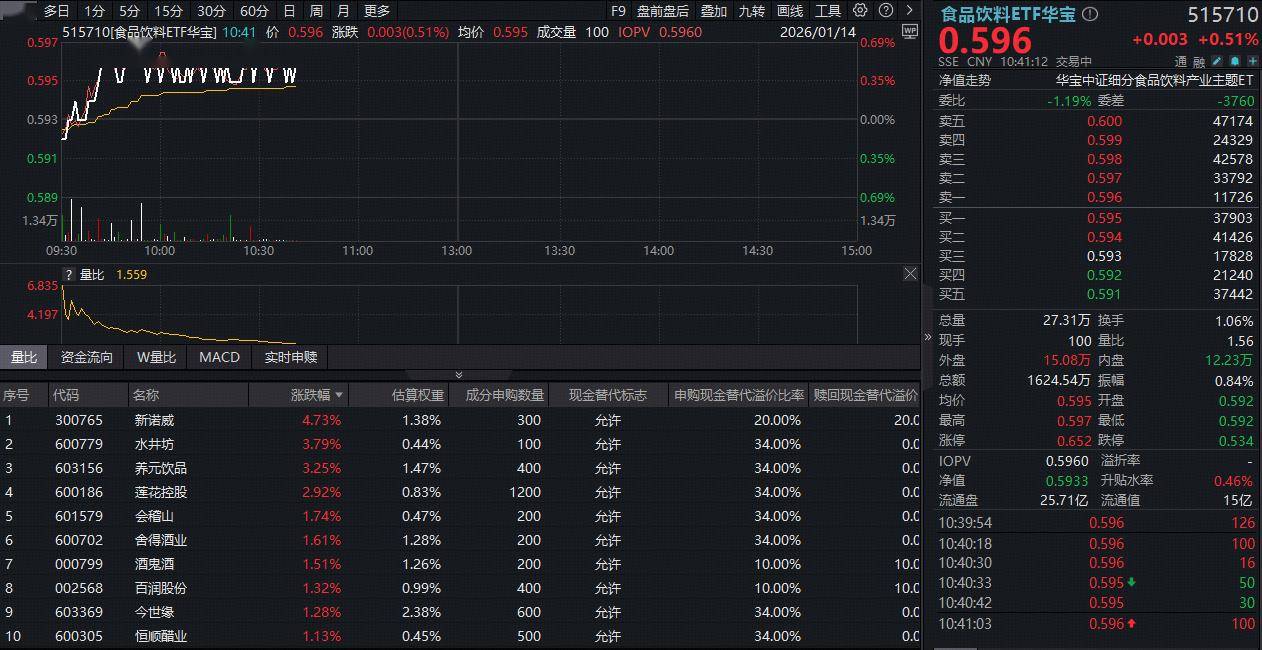
Group 1 - The food and beverage sector experienced a positive trend on January 14, with the Huabao Food and Beverage ETF (515710) rising by 0.51% during trading [1] - Notable gains were observed in several stocks, including XinNuoWei, which surged over 4%, and ShuiJingFang and YangYuan beverages, both increasing by over 3% [1] - The overall valuation of the food and beverage sector is currently at a historical low, with the food index's price-to-earnings ratio at 20.23, indicating a favorable long-term investment opportunity [3][4] Group 2 - Kweichow Moutai announced a new market-oriented operational plan, restructuring its product lineup to enhance market competitiveness [3] - The operational model will shift to a multi-channel approach, including self-sale, distribution, consignment, and online retail, aiming for a more dynamic pricing mechanism [3] - Analysts suggest that this transformation is crucial for Moutai to address supply-demand mismatches and channel issues, emphasizing the essence of the product [3] Group 3 - The white liquor industry is expected to reach a turning point, with potential opportunities for capital market investments as the Spring Festival approaches [4] - The Huabao Food and Beverage ETF is recommended for investors looking to gain exposure to core assets in the food and beverage sector, with significant allocations to leading high-end liquor stocks [4]

茅台打出市场化“组合拳”!吃喝板块震荡拉升,行业迎周期底部机遇?
Xin Lang Cai Jing· 2026-01-14 02:50
Core Viewpoint - The food and beverage sector is experiencing an upward trend, with the Huabao Food and Beverage ETF (515710) showing a price increase of 0.51% as of the latest report [1][8]. Group 1: Market Performance - The food and beverage ETF Huabao (515710) opened positively and has been fluctuating in the red, with a current price increase of 0.51% [1][8]. - Notable gains were observed in several stocks, including Xin Nuo Wei, which surged over 4%, and Shui Jing Fang and Yang Yuan Beverage, both rising over 3% [1][8]. Group 2: Company Announcements - Kweichow Moutai announced on January 13 that its board approved the 2026 market-oriented operation plan, which aims to return to a "pyramid" product structure [10]. - The new operational model will shift from "self-sale + distribution" to a multi-faceted approach including "self-sale + distribution + agency + consignment" [10]. Group 3: Pricing and Market Strategy - The pricing mechanism will be market-oriented, establishing a dynamic adjustment system for retail prices, with the self-sale price for the flagship product, Moutai 53% vol 500ml, set at 1499 yuan per bottle [10]. - Analysts suggest that this move is a critical step in Moutai's market-oriented transformation, focusing on product, model, channel, and price restructuring to address supply-demand mismatches [10]. Group 4: Valuation Insights - The food and beverage sector is currently at a historical low in terms of valuation, with the food index's price-to-earnings ratio at 20.23 times, placing it in the 6.85% percentile of the last decade [11]. - This presents a potential opportunity for left-side positioning in the sector, particularly as the Chinese New Year approaches, which may signal a turning point for the liquor market [11]. Group 5: Investment Opportunities - The Huabao Food and Beverage ETF (515710) tracks the sub-index of the food and beverage industry, with approximately 60% of its holdings in leading high-end and mid-range liquor stocks, and nearly 40% in beverage, dairy, seasoning, and beer sectors [11]. - Investors can also consider the Huabao Food and Beverage ETF linked funds (Class A 012548/Class C 012549) for exposure to core assets in the food and beverage sector [11].
东海证券晨会纪要-20260114
Donghai Securities· 2026-01-14 02:21
Group 1: Non-Banking Financial Sector - The non-banking financial index rose by 2.6%, with brokerage and insurance indices increasing by 1.9% and 3.6% respectively, indicating a synchronized upward trend [6][7] - Daily average A-share trading volume reached 2.85 trillion yuan, a significant increase of 137% year-on-year and 51.6% month-on-month, reflecting heightened market trading enthusiasm [7] - The two financing balance stood at 2.63 trillion yuan, maintaining above the 2 trillion yuan mark for 106 consecutive trading days, suggesting sustained market vitality [7] Group 2: Insurance Sector - The "deposit migration effect" is driving sales in the insurance sector, as banks lower deposit rates and long-term deposits become scarce, leading to increased demand for insurance products [8] - The A-share market is performing well, benefiting from policy support and economic recovery, which has improved the investment returns for insurance funds [8] - Major insurance companies have proactively increased their allocations in high-dividend blue-chip stocks and cyclical sectors, enhancing their profit potential in the current market [8] Group 3: Currency and Exchange Rate - The People's Bank of China has implemented counter-cyclical measures to stabilize the RMB exchange rate, aiming to prevent excessive appreciation [11][12] - The estimated waiting settlement amount for foreign trade is approximately 480 billion USD, indicating potential for RMB appreciation if it surpasses the critical threshold of 6.80 [12] - The swap market reflects a shift in RMB appreciation expectations, with state-owned banks becoming net buyers in the swap market, indicating a bullish sentiment towards the RMB [13] Group 4: Food and Beverage Sector - The Consumer Price Index (CPI) for December showed a year-on-year increase of 0.8%, with food prices improving, particularly fresh vegetables and fruits, which rose by 18.2% and 4.4% respectively [16][17] - The food and beverage sector saw a 2.12% increase, with pre-processed food leading the gains at 6.72% [18] - Major retail players like Sam's Club and Alibaba are expanding aggressively, with Sam's Club sales expected to exceed 200 billion yuan in 2026 [19] Group 5: Machinery and Equipment Sector - The "Artificial Intelligence + Manufacturing" initiative aims to enhance the application of AI in manufacturing, with goals set for 2027 to establish a leading global position in AI technology [23] - Numerous Chinese companies showcased their innovations at the CES exhibition, highlighting advancements in robotics and AI applications in manufacturing [24][25]