
滨江集团

Search documents
地产行业点评:“沪七条”促进需求释放,上海楼市政策底或已现
Guolian Minsheng Securities· 2026-02-25 12:15
地产行业点评 "沪七条"促进需求释放,上海楼市政策底或已现 [Table_Author] 邮箱:hmdu@glms.com.cn 邮箱:fangpeng@glms.com.cn 邮箱:xudezun@glms.com.cn 分析师:杜昊旻 分析师:方鹏 分析师:徐得尊 执业证书:S0590524070006 执业证书:S0590524100003 执业证书:S0590525110054 事件 2026 年 2 月 25 日,上海市住房城乡建设管理委、市房屋管理局、市财政局、市 税务局、市公积金管理中心等五部门联合印发《关于进一步优化调整本市房地产 政策的通知》(以下简称《通知》),以更好满足居民刚性和改善性住房需求,促进 房地产市场平稳健康发展,《通知》涉及调减限购、优化公积金、完善房产税三大 方面七条内容,又称"沪七条"。 调减住房限购政策,满足居民合理住房需求。 《通知》对上海的购房限制进行了调减,主要针对非沪籍家庭或成年单身人士, 社保满 1 年(原为 3 年)可在外环内购买 1 套住房,在外环外购房不限套数;社 保满 3 年(与沪籍购房待遇一致)可在外环内购买 2 套住房;持《上海市居住证》 满 5 ...
行业点评报告:新七条、松限购、促改善
ZHESHANG SECURITIES· 2026-02-25 11:25
Investment Rating - The industry investment rating is "Positive" (maintained) [4] Core Insights - The new "Hushiqiao" policy issued on February 25, 2026, represents a significant enhancement over the previous 2024 policy, aiming to systematically lower the barriers to home purchasing, enhance purchasing power, and reduce replacement costs to better meet rigid and improvement housing demands [1][2] - The policy is expected to stimulate short-term demand release, boost market confidence, and increase activity, particularly through the relaxation of purchasing qualifications in the outer ring, which may lead to a resurgence in both second-hand and new home transactions during the "small spring" period [1][2] - Structural impacts are anticipated, with core areas and improvement products benefiting the most, as the relaxation of purchase restrictions is likely to support price stability and liquidity in central urban areas and mature suburban districts [2] - The policy will facilitate market circulation and repair the "sell one buy one" replacement chain, targeting improvement customers through relaxed public housing loan recognition and property tax exemptions, thus promoting a healthy linkage between the first and second-hand housing markets [2] Summary by Sections Policy Comparison - The 2026 policy significantly reduces the social security duration required for non-local buyers in the outer ring from "5 years" to "1 year" and allows eligible non-local buyers to purchase an additional property [5] - The new policy introduces a housing purchase channel for holders of residence permits who have held them for over 5 years, allowing them to buy one property citywide without needing social security or tax proof [5] Credit and Public Fund Policies - The new policy raises the maximum public fund loan limit for first-time buyers from 1.6 million to 2.4 million, with potential increases up to 3.24 million for families with multiple children [6] - It optimizes the recognition of loan counts, allowing families with settled public fund loans and owning one or fewer properties to apply for public fund loans again [6] Investment Recommendations - The report suggests focusing on three main investment lines: 1. **Elasticity Priority** - Local state-owned enterprises and real estate companies that will directly benefit from the recovery of regional market activity, with high business concentration and maximum performance and valuation elasticity [3] 2. **Stable Leaders** - Resource-based real estate companies with a strong brand presence and quality land reserves in Shanghai, expected to benefit from overall market recovery and accelerated new home sales [3] 3. **Valuation Recovery** - National real estate companies with strong operations, as the policy is expected to improve overall industry expectations and drive valuation recovery for quality firms [3]
多重利好叠加,A股、港股地产股双双大涨
Guan Cha Zhe Wang· 2026-02-25 10:25
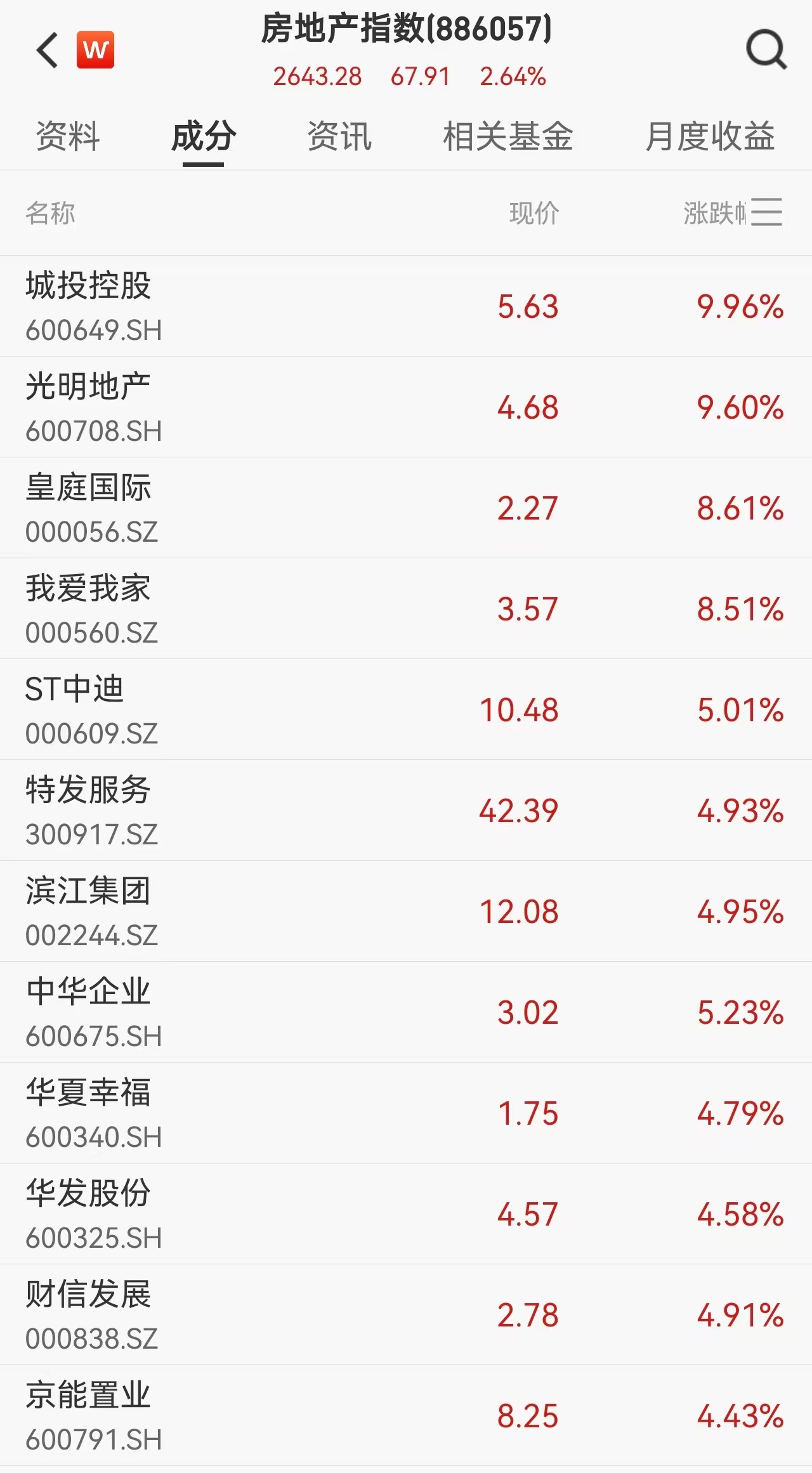
Core Viewpoint - The recent introduction of the "Shanghai Seven Measures" has significantly boosted the stock prices of real estate companies in both Hong Kong and A-shares, indicating a positive market reaction to the new policies aimed at easing property purchase restrictions [1][2]. Group 1: Market Reaction - On February 25, real estate stocks in Hong Kong saw substantial gains, with notable increases such as 7.41% for Heung Kong Holdings and 6.45% for Country Garden [1]. - A-shares also performed well, with the real estate sector rising by 2.11%, highlighted by a 9.96% increase for Chengdu Investment Holdings [1]. - The market's early response to the "Shanghai Seven Measures" was influenced by prior speculation and a recovery in the second-hand housing market in January [1]. Group 2: Policy Impact - The "Shanghai Seven Measures" are seen as a significant step in promoting demand and consumption in the real estate sector, aligning with broader economic goals for 2026 [2]. - The recent land auction in Guangzhou set a new record for land prices, indicating strong competition among major developers and reflecting positive sentiment in the real estate market [2]. Group 3: Market Trends - The emergence of a new land price record in Guangzhou is expected to positively influence market expectations and stimulate demand for luxury properties [3]. - Recent data shows a slight recovery in both new and second-hand housing transactions, with a notable increase in online property searches during the Spring Festival [4]. - The overall housing price decline has slowed, with January data indicating a 0.5% decrease, the smallest since August 2025, suggesting a potential stabilization in the market [4].


上海发布“沪七条”点评:上海再出新政,住房限购放松
Yin He Zheng Quan· 2026-02-25 09:24
Investment Rating - The report maintains a "Recommended" rating for the real estate industry [1] Core Insights - The Shanghai government has introduced new policies to relax housing purchase restrictions, aiming to promote a stable and healthy development of the real estate market [3] - The policies include lowering the threshold for non-local residents to purchase homes, increasing the maximum housing provident fund loan amount, and improving property tax policies to support housing demand [3] - The report suggests that these measures will likely release pent-up housing demand, leading to a gradual recovery in the real estate market [3] Summary by Sections Policy Changes - The Shanghai government has relaxed housing purchase restrictions for non-local residents, including: - Reducing the minimum social security or individual income tax payment period to 1 year for purchasing homes in the outer ring [3] - Allowing non-local residents who have paid individual income tax for 3 years or more to purchase an additional home in the outer ring [3] - Permitting non-local residents with a Shanghai residence permit for over 5 years to buy one home without proof of social security or tax payments [3] Loan Policy Adjustments - The maximum housing provident fund loan amount for first-time homebuyers has been increased from 1.6 million to 2.4 million, with potential increases for families with multiple children or those purchasing green buildings [3] - The loan policy has been optimized to allow individuals who have previously used provident fund loans to apply again under certain conditions [3] Tax Policy Enhancements - Starting January 1, 2026, property tax exemptions will be granted to local residents' children when purchasing their first home, aimed at stimulating housing demand [3] Investment Recommendations - The report highlights potential investment opportunities in leading real estate companies such as China Merchants Shekou, Poly Developments, and China Resources Land, among others [3] - It also suggests focusing on quality developers, property management firms, and commercial real estate [3]
房地产行业点评:上海优化房地产政策,持续关注行业积极变化
Ping An Securities· 2026-02-25 07:45
Investment Rating - The industry investment rating is "Outperform the Market" which indicates an expected performance that exceeds the market by more than 5% over the next six months [7]. Core Insights - The report highlights the recent optimization of real estate policies in Shanghai, which is expected to positively impact the market. Key changes include adjustments to purchasing conditions for non-local residents, an increase in the maximum public housing loan amount, and tax exemptions for certain families [6][3]. - The report emphasizes the importance of monitoring the market trends post-holiday, suggesting that quality real estate companies may present investment opportunities due to their strong inventory structure and product capabilities [6][5]. Summary by Sections Policy Changes - Shanghai has implemented several policy optimizations, including: 1. Non-local residents can purchase additional properties under certain conditions, such as having a social security or tax payment history of one year for properties within the outer ring [6]. 2. Public housing loan policies have been adjusted, with the maximum loan amount increased from 1.6 million yuan to 2.4 million yuan, and additional benefits for families with multiple children [6]. 3. A temporary exemption from personal property tax for families with only one home starting January 1, 2026 [6]. Market Performance - The report notes that the number of second-hand home transactions in Shanghai has remained stable, with monthly sales exceeding 22,000 units from November 2025 to January 2026. This stability is expected to improve short-term market conditions [6]. - The report also mentions that the average daily transaction volume for new homes in 12 comparable cities decreased by 9.1% during the Spring Festival compared to the previous year, while the transaction volume for second-hand homes in major cities like Beijing, Shanghai, and Shenzhen increased by 39.1% [6]. Investment Recommendations - The report suggests that the market may have already priced in concerns regarding sales and performance, indicating that certain quality companies may have long-term investment value. Companies such as China Resources Land and Jianfa are highlighted for their strong land acquisition and product capabilities [6][5].
2026W7:春节期间港股地产板块整体上涨
GOLDEN SUN SECURITIES· 2026-02-25 02:40
Investment Rating - The report maintains an "Overweight" rating for the real estate industry [2][18]. Core Views - The current policy environment is expected to be more forceful than in 2008 and 2014, driven by fundamental pressures [2][18]. - Real estate serves as an early-cycle indicator, making it a barometer for economic trends [2][18]. - The competitive landscape in the industry is improving, with leading state-owned enterprises and select mixed-ownership and private firms performing well in land acquisition and sales [2][18]. - The focus remains on first-tier cities, two-thirds of second-tier cities, and a very limited number of third-tier cities, which have shown better performance during sales rebounds [2][18]. - Supply-side policies, including land storage and the proper handling of idle land, are crucial areas to monitor, with first and second-tier cities expected to benefit more [2][18]. Summary by Sections New Home and Second-Hand Home Transaction Data - During the 2026 Spring Festival, new home transactions reached 112,000 square meters (up 7.4% year-on-year), while second-hand home transactions were 22,000 square meters (up 96.8% year-on-year) [8][10]. Hong Kong Stock Market Review - The Hong Kong real estate sector saw an overall increase during the Spring Festival, with the real estate HK (CITIC) index rising by 2.34% [10][11]. - Among 80 Hong Kong real estate development stocks, 50 increased, 10 remained flat, and 20 decreased during the festival [10][11]. Investment Recommendations - Recommended stocks include: - Real estate development: Greentown China, Jianfa International Group, China Resources Land, Yuexiu Property, China Overseas Development, and China Jinmao in H-shares; and Binjiang Group, China Merchants Shekou, Jianfa Co., Poly Developments, and Huafa Group in A-shares [2][18]. - Local state-owned enterprises and city investment companies: Chengdu Investment Holdings, Urban Construction Development [2][18]. - Real estate intermediaries: Beike-W [2][18]. - Property management companies: China Resources Vientiane Life, China Merchants Jiyu, Greentown Services, Poly Property, and China Overseas Property [2][18].
滨江集团股价涨5.04%,富国基金旗下1只基金位居十大流通股东,持有5000万股浮盈赚取2900万元
Xin Lang Cai Jing· 2026-02-25 02:04
Group 1 - The core viewpoint of the news is that Binhai Group's stock price increased by 5.04%, reaching 12.09 yuan per share, with a trading volume of 165 million yuan and a turnover rate of 0.51%, resulting in a total market capitalization of 37.617 billion yuan [1] - Binhai Group, established on August 22, 1996, and listed on May 29, 2008, primarily engages in real estate development and sales, with 98.93% of its revenue coming from property sales [1] - The company's revenue composition includes property sales (98.93%), property leasing (0.44%), property project management services (0.34%), hotel management services (0.27%), and other services (0.02%) [1] Group 2 - Among the top ten circulating shareholders of Binhai Group, a fund under the Fortune Fund ranks first, having reduced its holdings by 3 million shares to 50 million shares, representing 1.86% of the circulating shares [2] - The Fortune Tianhui Growth Mixed Fund (LOF) A/B (161005) has a current scale of 21.102 billion yuan and has achieved a year-to-date return of 7.2%, ranking 3115 out of 8889 in its category [2] - The fund manager, Zhu Shaoxing, has a tenure of 20 years and 107 days, with the fund's total asset scale at 22.483 billion yuan, achieving a best return of 1810.53% during his tenure [3]

房地产板块大涨超2%!城投控股涨停,光明地产涨超9%,多地购房补贴密集出台楼市回暖
Jin Rong Jie· 2026-02-25 02:00
Group 1: Market Overview - The A-share real estate sector is active, with the Wind Real Estate Index rising by 2.24%, and several companies experiencing significant stock price increases, including Chengdu Investment Holdings reaching the daily limit, and Guangming Real Estate rising over 9% [1][2] - The current market enthusiasm is driven by a rebound in the spring real estate market, supported by favorable policies from various regions, including home purchase subsidies and talent housing tickets, which are expected to stabilize and warm up the real estate industry [3][4] Group 2: Policy Impact - Multiple cities have introduced measures to stimulate the real estate market, such as Guangzhou offering promotional packages for over 140 properties and Jiangsu's Huai'an providing tiered subsidies of 2% to 6% on home purchases, along with increased loan limits for families with multiple children [4] - A two-month special action has been launched in Guangzhou to address issues in real estate self-media, aiming to purify the industry environment and reduce false advertising and malicious speculation [4] Group 3: Industry Segments - Real estate development companies are expected to benefit directly from the recovery in transactions and policy incentives, with a focus on core cities leading to faster sales and shorter de-stocking cycles [5] - The recovery in the real estate market will also boost demand in real estate services, including property management and intermediary services, as transaction volumes for new and second-hand homes increase [5] - The rebound in the real estate market is anticipated to positively impact the home furnishings and appliances sector, with rising demand for home customization and smart appliances as a result of improved purchasing conditions [5] Group 4: Key Companies - Guangming Real Estate, a well-established company in Shanghai, has seen a significant increase in visitor and transaction volumes due to multiple promotional activities during the spring [6] - Chengdu Investment Holdings benefits from its state-owned background, focusing on urban renewal and affordable housing projects, positioning itself well to take advantage of local policy benefits [6] - Wo Ai Wo Jia, a leading real estate intermediary, has experienced a substantial increase in store inquiries and contract signings due to the resurgence in the spring real estate market, indicating strong performance recovery expectations [6]


城投控股涨停,南方基金旗下房地产ETF(512200)强势拉升涨超2%,机构研判政策宽松下布局时点已至
Xin Lang Cai Jing· 2026-02-25 01:53
Core Viewpoint - The real estate ETF (512200) has shown a positive trend, with a 2.15% increase as of February 25, 2026, indicating a potential recovery in the real estate market following the Chinese New Year holiday [1]. Group 1: Market Performance - The real estate ETF (512200) recorded a trading volume of 69.0258 million yuan, with significant gains in constituent stocks such as Guangming Real Estate (up 10.07%), Chengdu Investment Holdings (up 9.96%), and I Love My Home (up 4.56%) [1]. - The market experienced a decline in overall trading volume during the previous week due to the Spring Festival holiday, but there was a rebound in market transactions compared to the same period in the previous year [1]. Group 2: Industry Outlook - Guotai Junan Securities suggests that the overall market transaction volume has shown signs of stabilization since the beginning of 2026, indicating a positive outlook for high-quality enterprises in the future [1]. - Huayuan Securities believes that the length and depth of the real estate adjustment in China have reached a relatively sufficient level, with current adjustments nearing historical averages in terms of both magnitude and duration [1]. - The central government's emphasis on "good housing" construction, accelerated REITs pilot programs, and expanded financial support for affordable housing are expected to contribute to the industry nearing the end of its adjustment phase [1]. Group 3: Investment Strategy - Bank of China Securities highlights the importance of early positioning for "policy turning points," while the "fundamental turning point" opportunities may last longer, requiring price stabilization for sustained recovery [2]. - The "policy turning point" may manifest through increased policy enthusiasm on both the supply and demand sides of the real estate market, while the "fundamental turning point" is indicated by a narrowing decline in second-hand housing prices [2]. - Some real estate companies have adequately accounted for impairments in 2025, which may reduce impairment pressure in 2026 and 2027, presenting potential for reversal [2]. - Companies holding commercial real estate have proactively adapted to new business models and consumption trends, positioning themselves to capitalize on opportunities in the new consumption era [2]. Group 4: ETF Composition - The real estate ETF (512200) closely tracks the CSI All Share Real Estate Index, which categorizes sample securities into various industry classifications, providing a comprehensive analysis tool for investors [2]. - The top ten weighted stocks in the index include Poly Developments, China Merchants Shekou, Vanke A, Zhangjiang Hi-Tech, Hainan Airport, Wantong Development, New City Holdings, Quzhou Development, Binhai Group, and Xianlead [2].


朝闻国盛:年报预告景气行业的个股指引
GOLDEN SUN SECURITIES· 2026-02-25 01:06
Core Insights - The report identifies key sectors with positive earnings forecasts for 2025, focusing on companies that are expected to outperform based on growth metrics and other indicators [2] - The report highlights the performance of various industries, with construction materials and oil & petrochemicals showing significant growth in the past year [2][3] Industry Performance - The top-performing industries in January, March, and over the past year include: - Comprehensive: 13.2%, 33.4%, 83.9% - Construction Materials: 8.9%, 28.6%, 49.5% - Oil & Petrochemicals: 7.1%, 28.0%, 41.1% - Coal: 5.9%, 9.1%, 21.8% - Communication: 4.1%, 27.6%, 73.0% [2] - The bottom-performing industries include: - Retail: -5.6%, 3.4%, 10.1% - Non-ferrous Metals: -5.0%, 39.2%, 115.5% - Pharmaceutical Biology: -4.1%, -0.2%, 11.5% - Computer: -3.7%, 6.4%, 1.9% - Non-bank Financials: -2.4%, 3.8%, 9.1% [2] Company-Specific Insights - Yingke Medical (300677.SZ) is identified as a core beneficiary in the nitrile glove industry recovery, with expectations of a price increase and improved supply-demand dynamics [4] - The company is projected to achieve net profits of 1.71 billion and 2.19 billion in 2026 and 2027, respectively, with corresponding P/E ratios of 15.0 and 11.8 [5] Real Estate Sector Analysis - The report notes that the Hong Kong real estate sector saw an overall increase during the Spring Festival, with specific stocks showing varied performance [6] - Investment recommendations for the real estate sector include a focus on companies with strong land acquisition and sales performance, particularly in first and second-tier cities [6]