联合健康

Search documents
3Q25全球医药晴雨表:A股走势稳健、港股大涨、美股回暖,后市机会在哪?
Sou Hu Cai Jing· 2025-10-02 11:45
Core Insights - The global pharmaceutical market in Q3 2025 is experiencing significant volatility, with some sectors performing exceptionally well while others struggle. The focus is on identifying promising investment directions amidst this uncertainty [1]. Group 1: Key Investment Directions - The pharmaceutical research outsourcing (CXO) sector is highlighted as a key area for investment, benefiting from strong demand from global pharmaceutical companies for new drug development [1][7]. - In the U.S. market, two biotechnology funds (IBB and XBI) and major companies like UnitedHealth and Novo Nordisk are recommended for attention due to favorable conditions stemming from anticipated Federal Reserve interest rate cuts [1][12][13]. Group 2: Market Performance Overview - In Q3 2025, the A-share biopharmaceutical index rose by 14%, with significant gains in specific sectors such as pharmaceutical research outsourcing (up 48%) and medical consumables (up 22%) [2][3]. - The Hong Kong stock market saw even more substantial gains, with the healthcare sector increasing by 41%, driven by biotechnology and life sciences services [2][4]. Group 3: Historical Context and Trends - Over the past year, the A-share biopharmaceutical sector has increased by 48%, while the Hong Kong market has seen a 116% rise, significantly outperforming their respective indices [5]. - The U.S. pharmaceutical sector has lagged behind, with a historical performance decline post-2023, attributed to a shift in investor focus towards technology stocks [5]. Group 4: Sector Disparities - A clear trend of divergence is noted within the A-share pharmaceutical sector, where only pharmaceutical research outsourcing and innovative drugs are showing positive growth, while overall revenue growth has turned negative for the first time [6][7]. - Specific sectors such as vaccines and offline pharmacies are identified as areas to avoid due to intense competition and market saturation [8]. Group 5: External Influences - The ongoing U.S. policy changes pose potential risks, particularly regarding tariffs on innovative drugs, but the impact on the CXO sector is expected to be minimal [9]. - The anticipated Federal Reserve interest rate cuts are seen as a critical factor that could positively influence the U.S. pharmaceutical market, particularly for biotechnology funds [11][12]. Group 6: Summary of Opportunities - The current landscape suggests a need for selective investment strategies, focusing on the innovative drug and CXO sectors in A/Hong Kong markets, and biotechnology funds and leading companies in the U.S. market [14].
3Q25全球医药晴雨表:A股走势稳健、港股大涨、美股回暖,后市机会在哪?
格隆汇APP· 2025-10-02 11:12
Core Viewpoint - The global pharmaceutical market in Q3 2025 is experiencing significant volatility, with some sectors performing exceptionally well while others struggle. The focus is on identifying promising investment opportunities in the pharmaceutical industry, particularly in the areas of drug research and development outsourcing (CXO) and biotechnology funds in the US [2][3]. Summary by Sections 1. Key Directions to Watch - The pharmaceutical sector in A-shares and Hong Kong is primarily driven by companies providing research and production services to drug manufacturers, known as CXO. These companies are benefiting from a resurgence in demand for new drug development, leading to strong order volumes and stable profitability [3][4]. 2. Market Performance Overview - In Q3 2025, the A-share biotechnology index rose by 14%, matching the performance of the Shanghai Composite Index. Notably, the pharmaceutical research outsourcing sector surged by 48%, driven by robust order volumes and solid earnings [5][6]. - The Hong Kong pharmaceutical sector outperformed the broader market, with healthcare stocks rising by 41%, led by biotechnology and life sciences services, which saw increases of 54% and 51%, respectively [6][8]. - In contrast, US pharmaceutical stocks lagged, with the S&P 500 healthcare index only increasing by 2%, attributed to a decline in post-pandemic earnings and ongoing policy uncertainties [6][7]. 3. Long-term Market Trends - Over the past year, the Hong Kong pharmaceutical sector has seen a remarkable increase of over 100%, while A-shares have also experienced significant gains, particularly in the pharmaceutical research outsourcing segment, which rose by 111% [8][9]. - The A-share pharmaceutical market is showing a clear trend of divergence, with strong performers like CXO and innovative drugs thriving, while other sectors face challenges, including a projected revenue decline of 2% for 2024 [10][11]. 4. Investment Opportunities and Risks - The two resilient sectors in the A-share market are pharmaceutical research outsourcing and innovative drugs, both of which are experiencing improved revenue and profit margins due to increased demand from global pharmaceutical companies [12]. - Conversely, sectors such as vaccines, offline pharmacies, blood products, and medical devices are facing significant challenges, including intense competition and regulatory pressures [13][14]. 5. US Market Dynamics - The key driver for the US pharmaceutical market is the anticipated interest rate cuts by the Federal Reserve, which historically lead to positive performance in the biotechnology sector. Funds like IBB and XBI have already begun to outperform the broader market following these developments [17][18]. - Two leading companies in the US market, UnitedHealth and Novo Nordisk, are highlighted for their strong fundamentals and growth potential, particularly in the obesity treatment market [19][20]. 6. Conclusion - The current landscape of the global pharmaceutical market is characterized by a need for selective investment strategies, focusing on high-certainty opportunities in specific sectors such as CXO and biotechnology funds. External factors like Federal Reserve policies and US pharmaceutical regulations will significantly influence market dynamics [20].


美国关税政策又有变数!白宫最新发声!
Zheng Quan Shi Bao Wang· 2025-09-27 06:07
Group 1 - The U.S. White House announced that the new tariff measures on pharmaceuticals will not apply to countries that have trade agreements with the U.S. [2][4] - The new tariffs include a 100% tariff on imported brand-name or patented drugs starting October 1, 2025, unless companies establish pharmaceutical manufacturing in the U.S. [4] - Pharmaceutical stocks showed mixed performance in the U.S. market, with Novavax rising by 2.52% and Moderna falling by 0.49% on the day of the announcement [1][2] Group 2 - The U.S. will maintain a 15% tariff cap on pharmaceuticals from trade partners like the EU and Japan, as per existing agreements [2][4] - The U.K. will face a 100% tariff on pharmaceuticals due to ongoing negotiations regarding their trade agreement with the U.S. [2][3] - Canadian steel and related manufacturing industries have seen significant declines in output and exports due to U.S. tariffs, with a 24.8% drop in production since March [5][6]
关税突变!白宫最新发声!
天天基金网· 2025-09-27 02:44
Group 1 - The article discusses the recent changes in the U.S. tariff policy regarding pharmaceuticals, stating that the new tariffs will not apply to countries that have trade agreements with the U.S. [3][4] - On September 26, U.S. pharmaceutical stocks showed mixed performance, with Novavax rising by 2.52% and Pfizer increasing by 0.68%, while Moderna and UnitedHealth saw declines of 0.49% and 0.43%, respectively [3]. - The U.S. will impose a 100% tariff on imported brand-name or patented drugs starting October 1, unless companies establish manufacturing facilities in the U.S. [6]. Group 2 - The White House confirmed that the new tariffs on pharmaceuticals will adhere to existing agreements, maintaining a 15% tariff cap for the EU and Japan [4]. - British officials indicated that the UK is willing to negotiate higher prices for certain pharmaceuticals to protect exports to the U.S. [5]. - The Canadian steel industry has faced significant declines in production and exports due to U.S. tariffs, with a 24.8% drop in output since March and a 25.5% decrease in exports of non-alloy steel by July [7][8].

关税,突变!白宫最新发声!
券商中国· 2025-09-27 02:29
Group 1: Core Views - The recent U.S. tariff policy changes will not apply to countries that have trade agreements with the U.S., such as the EU and Japan, which will maintain a 15% tariff cap on pharmaceuticals [2][4] - President Trump announced a 100% tariff on all brand-name and patented drugs starting October 1, 2025, unless companies establish manufacturing in the U.S. [4][5] - The U.S. Chamber of Commerce has urged the government to reconsider new tariffs on heavy trucks, emphasizing that major import sources are allies and do not pose a security threat [6] Group 2: Market Reactions - Following the announcement of the new tariffs, pharmaceutical stocks showed mixed performance in the U.S. market, with Novavax rising by 2.52% and Moderna falling by 0.49% [1] - Japanese and South Korean pharmaceutical stocks mostly declined, with notable drops including Sumitomo Pharma down over 3% and Samsung Biologics down over 2% [1] Group 3: Impact on Other Industries - The Canadian steel industry has faced significant declines due to U.S. tariffs, with production down 24.8% and exports down 25.5% since March [7] - The U.S. Labor Statistics Bureau reported a 4.7% year-over-year increase in furniture prices due to tariff impacts [5]
金十数据全球财经早餐 | 2025年8月18日
Jin Shi Shu Ju· 2025-08-17 23:03
Group 1: International Developments - Trump claims significant progress on Russia issues, giving the meeting a score of 10 and indicating a future meeting with Putin is likely [10] - U.S. envoy states Putin has agreed to provide Ukraine with "NATO-like Article 5" security guarantees [10] - Trump plans to determine tariffs on steel and chips within two weeks, with semiconductor tariffs potentially reaching 300% [10] Group 2: Economic Indicators - The Federal Reserve's Daly suggests that two rate cuts this year remain a good prediction, while Goolsbee expresses concerns over recent inflation data [11] - The U.S. dollar index fell 0.36% to 97.82, while the 10-year Treasury yield closed at 4.321% [3][7] - WTI crude oil dropped 1.22% to $62.26 per barrel, and Brent crude fell 1.04% to $65.60 per barrel [4][7] Group 3: Stock Market Performance - U.S. stock indices showed mixed results, with the Dow Jones up 0.08% and the S&P 500 down 0.29% [4] - Hong Kong's Hang Seng Index fell 0.98%, while the technology index decreased by 0.59% [5] - A-shares saw gains, with the Shanghai Composite Index rising 0.83% and the Shenzhen Component up 1.6% [6]

机构美股调仓动态曝光 抄底科技黄金坑 中概股投资有亮点
Zhong Guo Zheng Quan Bao· 2025-08-17 21:51
□本报记者 王雪青 有观点认为,上述新买入标的属于防御性配置,具备低估值修复空间,并且6家公司均为细分行业龙 头,符合巴菲特"护城河"投资理念。 资料显示,伯克希尔在增持阶段对持仓保密是其一贯的策略。当连续多个季度买入某只股票时,公司通 常会申请保密,以避免过早暴露投资标的,增加自身建仓成本。 其中,医疗保险巨头联合健康目前属于困境阶段。从今年4月1日至8月14日,公司股价已下跌超45%。 值得注意的是,二季度出手联合健康的不止伯克希尔,买家还包括多家知名对冲基金,例如大卫·泰珀 旗下Appaloosa、"大空头"原型迈克尔·伯瑞旗下Scion以及被称为"量化之王"的文艺复兴科技,还有索罗 斯基金等。相关机构买入的消息披露后,联合健康8月15日涨超10%。 截至北京时间8月15日,美股机构投资者2025年二季度持仓报告基本披露完毕。 中国证券报记者梳理了包括巴菲特旗下伯克希尔·哈撒韦、李录旗下喜马拉雅资本、高瓴旗下HHLR、高 毅、景林、桥水、橡树资本、老虎环球基金、柏基投资、著名对冲基金经理大卫·泰珀旗下的 Appaloosa、"大空头"原型迈克尔·伯瑞的Scion,以及先锋领航、贝莱德、摩根大通等知名投资 ...
抄底科技黄金坑 中概股投资有亮点
Zhong Guo Zheng Quan Bao· 2025-08-17 20:07
Group 1: Berkshire Hathaway's Holdings - Berkshire Hathaway revealed its "mysterious holdings" for Q2 2025, with significant investments in healthcare, steel, and real estate sectors [1][2] - In Q2, Berkshire purchased six new stocks, including over 5 million shares of UnitedHealth valued at approximately $1.57 billion, over 6.6 million shares of Nucor Steel valued at about $860 million, and over 700,000 shares of Lennar valued at around $780 million, totaling over $3.6 billion in new positions [2][3] - Berkshire reduced its stake in Apple by 20 million shares, a decrease of about 6.67%, while also cutting its holdings in Bank of America by over 26.3 million shares, a reduction of approximately 4.17% [3] Group 2: Li Lu and Pinduoduo - Li Lu's Himalaya Capital bought over 4.6 million shares of Pinduoduo, making it the second-largest holding with a market value of $480 million, representing 17.93% of the portfolio [3][4] - Himalaya Capital previously held Pinduoduo but sold its position in Q4 2021, indicating a renewed confidence in the Chinese e-commerce sector [4] Group 3: Institutional Investment in Technology Stocks - Major institutions like Hillhouse, Bridgewater, JPMorgan, Vanguard, BlackRock, and Tiger Global increased their positions in technology stocks, capitalizing on the market downturn [5] - Notably, JPMorgan's top five holdings are all technology companies, and Vanguard's holdings reached $6.18 trillion, with significant investments in Nvidia, Microsoft, Apple, Amazon, and META [5] - Renaissance Technologies and Tiger Global also made substantial investments in Nvidia and other tech stocks, reflecting a bullish outlook on the technology sector's future [5]
空翻多!“大空头”做多中国
中国基金报· 2025-08-16 14:38
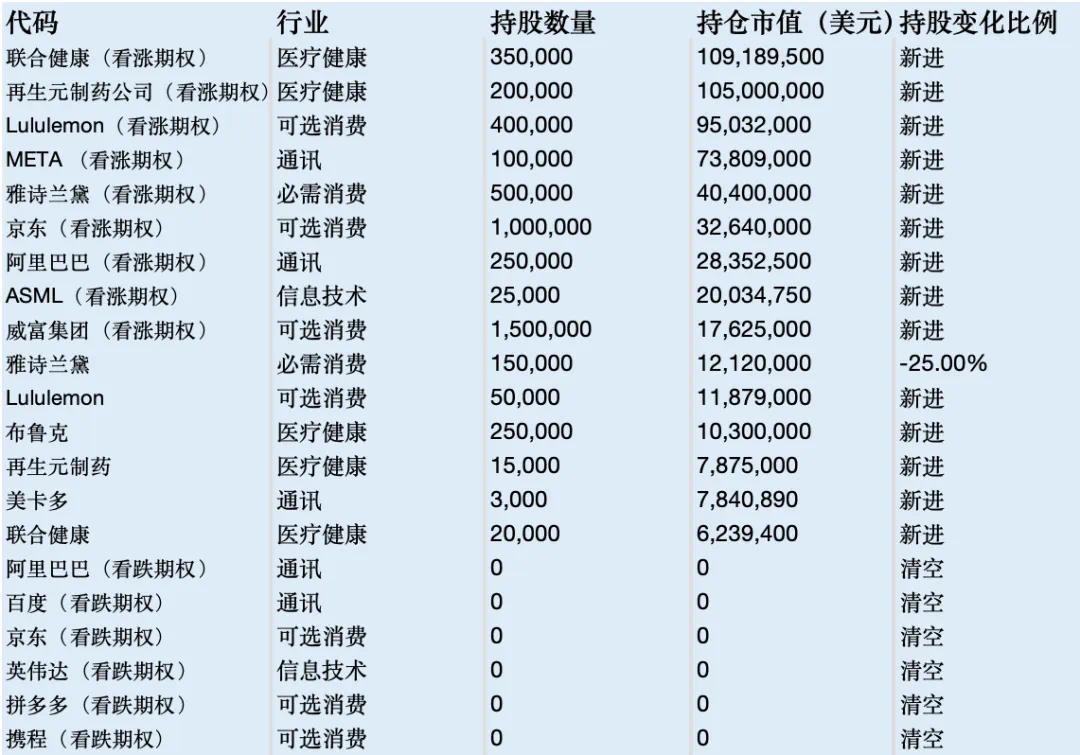
Core Viewpoint - Michael Burry has made a significant shift in his investment strategy, moving from bearish to bullish on Chinese stocks, particularly by selling put options and buying call options on companies like Alibaba and JD.com [2][5][9]. Summary by Sections Investment Strategy Changes - In Q2 2025, Michael Burry's Scion Asset Management cleared its put options on Alibaba, Baidu, JD.com, Pinduoduo, and Ctrip, and instead purchased call options on Alibaba and JD.com, indicating a complete turnaround in his stance on Chinese stocks [5][9]. - As of the end of Q2, Burry's portfolio was heavily concentrated, with a market value of $578 million, where the top ten holdings accounted for 92.37% of the total [2]. Key Holdings - The largest positions in Burry's portfolio included call options on UnitedHealth and Regeneron Pharmaceuticals, with respective values of $109.19 million and $105 million, both newly initiated [3]. - Other notable new positions included call options on Lululemon ($95.03 million), Meta ($73.81 million), Estée Lauder ($40.4 million), JD.com ($32.64 million), and Alibaba ($28.35 million) [3]. Historical Context - Michael Burry gained fame for predicting the U.S. housing market crash and profiting significantly from it, which was depicted in the film "The Big Short" [6]. - In Q1 2024, Burry had already increased his stakes in JD.com and Alibaba by 80% and 66.67%, respectively, indicating a growing confidence in these companies [7]. Market Reactions - Following the "9·24" policy announcement, which positively impacted the stock market, Burry's aggressive accumulation of Chinese stocks yielded substantial returns [7]. - In Q2 2025, while some investors like David Tepper took profits from their Chinese stock holdings, Burry's renewed bullishness on Alibaba and JD.com suggests a divergence in market sentiment [12].

空翻多,“大空头”做多中国
Zhong Guo Ji Jin Bao· 2025-08-16 13:24
Group 1 - Michael Burry has made a significant shift in his investment strategy, moving from bearish to bullish on Chinese stocks, clearing his put options and buying call options instead [1][3][6] - As of the end of Q2, Burry's Scion Asset Management held a total market value of $578 million in U.S. stocks, with the top ten holdings accounting for 92.37% of the portfolio [1] - The largest positions in Burry's portfolio include call options on UnitedHealth and Regeneron Pharmaceuticals, indicating a focus on healthcare [2][3] Group 2 - Burry's recent investments include new positions in companies such as Lululemon, Meta, and Alibaba, reflecting a diversified approach across various sectors [2][3] - In Q1 2024, Burry significantly increased his holdings in JD.com and Alibaba by 80% and 66.67% respectively, demonstrating confidence in these Chinese tech stocks [6][9] - The overall sentiment towards Chinese stocks has been mixed among global institutions, with some choosing to take profits while others continue to invest [8][9]