赛力斯

Search documents
重庆时隔九年重回王座,汽车产业却已变天
3 6 Ke· 2026-01-28 02:14
Core Insights - Chongqing's automotive production is projected to reach 2.788 million units by 2025, marking a 9.7% increase and positioning it as the top city in automotive production, reclaiming its title after nine years [1][4] - The competition for the title of "China's Automotive Capital" has intensified, with cities like Guangzhou, Shenzhen, and others vying for dominance, reflecting a significant shift in the automotive industry landscape over the past decade [1][5] Group 1: Title Competition Dynamics - The title of "China's Automotive Capital" has seen unprecedented turnover in the last five years, with cities frequently changing positions due to industry restructuring [1][5] - The competition is not just about production numbers but also reflects broader economic shifts and the evolution of the automotive industry in China [1][5] - The change in statistical criteria for production reporting from "enterprise location" to "production location" has significantly impacted city rankings, allowing Chongqing to reclaim its title [4][5] Group 2: New Energy Vehicle (NEV) Impact - The penetration rate of new energy vehicles in China has dramatically increased from 5.4% in 2020 to 54% by 2025, with total NEV production rising from 1.37 million to over 16 million units [6][9] - Chongqing's automotive industry is now driven by a NEV penetration rate exceeding 46%, showcasing a shift from traditional vehicles to electric and intelligent models [5][6] - The rapid growth of NEV production has led to a reshuffling of city rankings, with cities that lag in NEV adoption facing declines in their automotive standings [10][11] Group 3: Industry Shifts and Brand Dynamics - The transition to new energy has catalyzed a significant reshuffling among the top automotive groups in China, with domestic brands gaining market share at the expense of joint ventures [14][15] - By 2025, domestic brands are expected to account for over 65% of the market, with BYD emerging as the leading player, surpassing traditional joint venture brands [15][17] - The competitive landscape has shifted, with companies like Geely and Chery rising in rankings due to their focus on new energy vehicles, while traditional giants like SAIC and FAW have seen declines [16][17] Group 4: Export Growth and Globalization - The export of Chinese automobiles has surged, with 2025 projections indicating that exports will exceed 1.22 million units, making Anhui the first province to achieve this milestone [21][22] - The average export price of Chinese vehicles has increased significantly, driven by a higher proportion of high-end electric and hybrid models, indicating a shift in market strategy [22][23] - The profitability of overseas markets is becoming increasingly important for Chinese automakers, with companies like BYD reporting higher margins from international sales compared to domestic markets [22][23]


未知机构:天风电新安培龙再再推荐海内外订单落地在即0127-20260128
未知机构· 2026-01-28 02:00
【天风电新】安培龙再再推荐:海内外订单落地在即-0127 力传感是难得的格局优高价值量高壁垒赛道。 格局好(真正对接上T的不到3家),高价值量(按照2万美金售价下单机ASP1.5W+),传感器类一般净利率 20%,芯片自制甚至能到30%,有望成长出大市值公司。 特斯拉早期力传感器多采用海外公司,因本身传感器龙头在海外,对中国供应链信任度一般 【天风电新】安培龙再再推荐:海内外订单落地在即-0127 T链: 按照短期有望落地的扭矩450*16+拉压力100*14= 8600元 100W台,40%份额 20%净利率 40X,值275亿。 国内链:XP落地在即,此外亦卡位ZY、赛力斯等,对标T链,给100亿。 特斯拉早期力传感器多采用海外公司,因本身传感器龙头在海外,对中国供应链信任度一般。 近些年汽车、储能端采购安培龙,对公司信任度不断加强,叠加量产在即,降本诉求大,我们认为国内公司突破T 链击球点已至。 公司温度、压力传感器起家,客户面向家电、汽车,配套基础使得公司具备力传感大批量量产能力。 此外,公司向上一步自研芯片,形成全产业链竞争力。 公司已做进特斯拉汽车、Robotaxi、储能项目,因产品佳,T逐步将海 ...
2026年中国新能源汽车融资租赁行业政策、产业链、市场规模、重点企业及趋势研判:新能源汽车产销持续高速增长,带动融资租赁市场规模跃升至千亿元[图]
Chan Ye Xin Xi Wang· 2026-01-28 01:25
Core Insights - The rapid growth of the new energy vehicle (NEV) financing leasing market is driven by policy support and technological advancements, making it a crucial financial solution to lower ownership barriers and mitigate technology iteration risks [1][6][7]. Group 1: Market Overview - The NEV financing leasing market in China is projected to grow from 449 million yuan in 2015 to 112.72 billion yuan in 2024, with a compound annual growth rate (CAGR) of 84.78% [1][7]. - By 2025, the market size is expected to reach approximately 165.58 billion yuan, indicating robust growth potential [1][7]. Group 2: Policy Support - The Chinese government has extended the NEV purchase tax exemption policy until 2025 and is exploring innovative models like battery-vehicle separation [1][4][7]. - Local governments are also providing targeted financing leasing subsidies to stimulate procurement and consumption [1][4][7]. Group 3: Technological Advancements - Continuous improvements in NEV technology and performance are enhancing user experience and increasing market acceptance, particularly among the younger generation [1][7]. - The Z generation shows a strong preference for environmentally friendly, intelligent, and connected NEVs, promoting the "rent-to-buy" consumption model [1][7]. Group 4: Industry Structure - The NEV financing leasing industry comprises various players, including traditional automotive finance companies, specialized leasing firms, and financial institutions [6][8]. - Major companies in the sector include SAIC General Motors Automotive Finance Co., Ltd., Volkswagen Financial Services (China) Co., Ltd., and Mercedes-Benz Automotive Finance Co., Ltd. [2][8][10]. Group 5: Industry Trends - Digital transformation in the NEV financing leasing sector is expected to evolve towards intelligent risk control and asset management based on big data [11]. - The integration of NEV financing leasing with green finance will create unique competitive advantages, allowing for lower-cost funding through green bonds and innovative financial products linked to carbon reduction [12]. - International expansion will focus on local operations and global asset circulation, particularly in emerging markets with rising electric vehicle penetration [13].


十王争霸,谁是“中国汽车第一城”
汽车商业评论· 2026-01-27 23:08
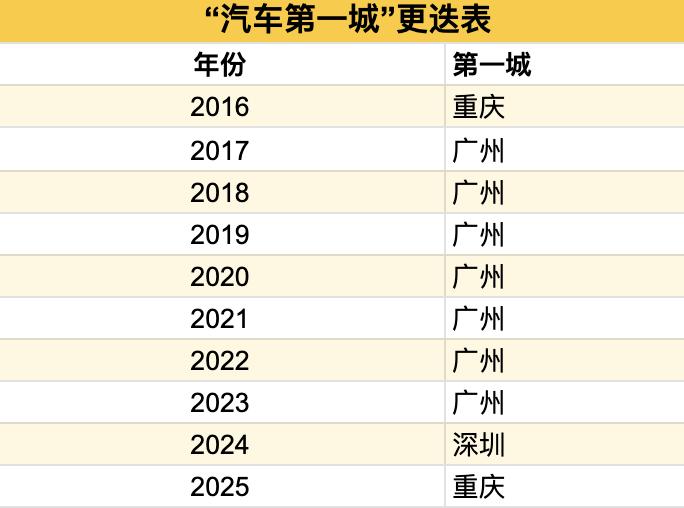
Core Viewpoint - The title of "China's Automobile Capital" has shifted back to Chongqing in 2025, reflecting the city's strong automotive production capabilities and the rise of local manufacturers [8][19]. Group 1: Automotive Production Overview - In 2025, Chongqing's total automobile production reached 2.788 million units, a 9.7% increase year-on-year, with 1.296 million units being new energy vehicles (NEVs), marking a 36% growth [8]. - Other cities with significant production include Hefei with approximately 2.5 million units (NEVs: 1.38 million, 55.2% share), Guangzhou estimated at 2.1-2.15 million units (NEVs: 700-750 thousand, 33%-35% share), and Changchun at around 2.1 million units (NEVs: 588 thousand, 28% share) [10][11][12]. Group 2: Key Players and Developments - Chongqing's automotive landscape is dominated by Changan and Seres, both achieving significant milestones in 2025, including Changan's establishment of its first overseas NEV manufacturing base [20][21]. - The local automotive supply chain has expanded to include 19 vehicle manufacturers and 1,200 parts suppliers, with a local supply rate exceeding 45% [28]. Group 3: Government Policies and Strategic Plans - The Chongqing government has prioritized the automotive industry, implementing policies such as the "2022-2030 Intelligent Connected New Energy Vehicle Cluster Plan" to guide development [30]. - The "33618" plan aims to establish Chongqing as a national advanced manufacturing center, with a focus on NEVs as a key growth area [31]. Group 4: Competitive Landscape and Future Outlook - The competition among cities for automotive production is intensifying, with cities like Hefei emerging as a leader in NEVs, while traditional automotive hubs like Changchun face challenges in transitioning to new energy [36][55]. - The automotive industry is undergoing a dynamic restructuring, with ongoing developments indicating that the title of "China's Automobile Capital" may continue to evolve [58].



智能电动汽车行业点评报告:国产豪华智能车崛起
ZHESHANG SECURITIES· 2026-01-27 13:29
证券研究报告 | 行业点评 | 计算机 国产豪华智能车崛起 ——智能电动汽车行业点评报告 投资要点 ❑ 打造尊界战略转型成效初现 江淮汽车 2025 年全力投入尊界品牌打造,在研发、生产、营销端与华为全力配合, 自 2025Q3 开始实现批量交付,Q4 时押注尊界带来的战略转型财务成效已初步体 现。根据公司业绩公告,2025 全年归母净利润-16.8 亿元,较去年同期减亏 10.4 亿 元。单 Q4 扣非后归母净利润剔除大众安徽 10.8 亿投资亏损后,已达 3.7 亿元。 ❑ 尊界交付表现亮眼,超豪华市场一骑绝尘 尊界 S800 2025 年累计交付达到 11,930 辆。自 2025 Q3 批量交付以来,迅速跃 居 70 万元以上超豪华轿车交付量榜首。12 月尊界 S800 轿车交付 4,376 辆,月 度环比增加 104%,超过帕拉梅拉(1593 辆)+宝马 7 系(1429 辆)+迈巴赫 S 级 (1118 辆)总和。截至 2025 年末,尊界 S800 累计大定订单已突破 1.8 万辆, 深厚的订单池为后续持续放量提供了坚实保障。细分市场登顶的"尊界速度",验 证了尊界在超豪华市场品牌的成功。 ❑ ...

赛力斯张正萍:AI深度融入汽车产业 汽车未来将是移动智能体
Quan Jing Wang· 2026-01-27 10:44
面对地缘政治与合规挑战,张正萍表示全球化绝不是简单地将国内模式复制到海外,而是要在市场差 异、文化差异与法规差异中,找到价值融合的最佳方案。 张正萍表示,中国新能源汽车产业在过去五年实现了"质"与"量"的双重跨越。国内市场渗透率从5%提 升至50%以上,2025年全球超过60%的新能源汽车销量来自中国。他强调,中国车企已在电池、电机、 电控等核心领域形成先发优势,当前产业竞争正从电动化向智能化与高端化转移。 "高端化与智能化已成为中国新能源汽车品牌的差异化优势,"张正萍表示,"赛力斯早在十年前就已布 局智能化研发,我们不仅聚焦技术落地,更关注用户体验。"5年前,赛力斯和华为共同推出问界品牌, 面对"智能车不豪华、豪华车不智能"的市场痛点,提出 "智慧重塑豪华" 的品牌理念,仅用46个月实现 百万辆下线,改变了中国豪华车市场格局。 目前,问界用户累计使用智能辅助驾驶里程已超50亿公里,节假日使用率占比达40%,其中问界M9稳 居50万元以上中国豪华市场销量榜首,充分印证了中国新能源汽车品牌在高端市场的竞争力。 推进 "深度本地化" 战略融入全球市场 第19届亚洲金融论坛1月26-27日在香港举行,本届论坛以"变 ...

集邦咨询:欧盟放宽燃油车禁令 预估2030年全球增程式电动车年销量将可达300万台
智通财经网· 2026-01-27 10:40
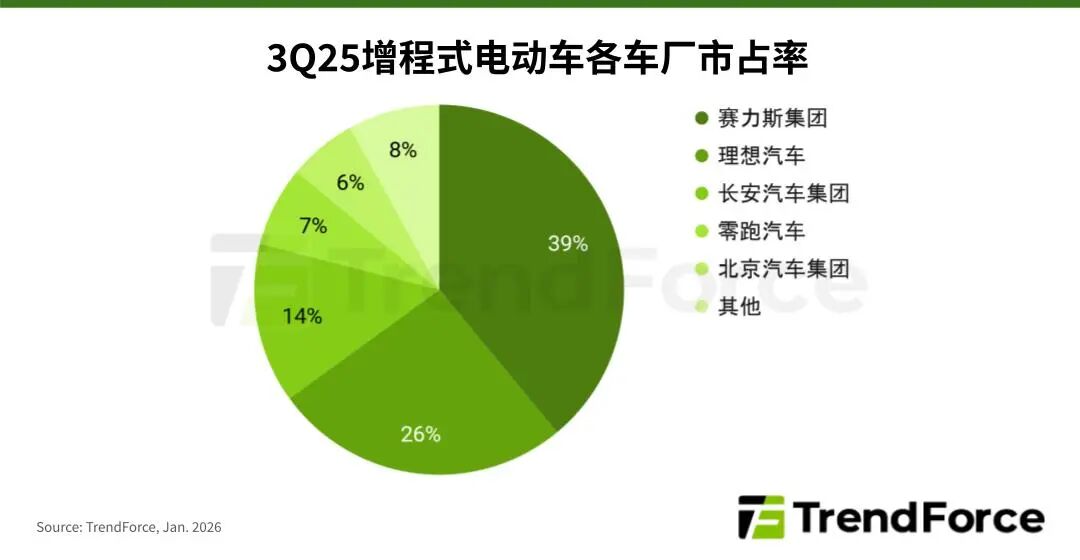
智通财经APP获悉,根据TrendForce集邦咨询最新电动车产业研究,增程式电动车(Range-Extended Electric Vehicle, REEV)近年逐渐成为车厂转向纯电化的 过渡选项,日前欧盟宣布调整2035年禁售燃油车政策,更为REEV提供了重要法规弹性和发展空间。TrendForce集邦咨询预估,在政策弹性、技术成熟 度、市场接受度的支撑下,2030年全球REEV年销量将可达300万台,较2025年实现翻倍成长。 欧盟于2025年末宣布,计划将原本"新车100%零排放"的规定,放宽为"整体新车平均减排90%",其余可通过使用低碳钢、合成燃料等方式抵销,此提案尚 待欧盟成员国和欧洲议会审议通过。 TrendForce集邦咨询表示,REEV的架构与插电式混合动力车(PHEV)相似,但其内燃机仅负责发电,不直接驱动车轮,所以更能提供近似纯电车(BEV)的 体验,实际碳排量也较PHEV低。更重要的是,REEV可通过内燃机及电池包双重供电,能大幅降低驾驶者里程焦虑。 REEV在全球新车市场的渗透率已从原本不到3%,至2025年第三季稳定维持在4%左右。中国车厂凭借相对较低车价、电池成本优势主导市场 ...
汽车行业周报:2026年首月政策过渡期,新能源渗透率短暂承压-20260127
CHINA DRAGON SECURITIES· 2026-01-27 10:00
Investment Rating - The report maintains an investment rating of "Recommended" for the automotive industry [2] Core Insights - In January 2026, the penetration rate of new energy vehicles (NEVs) is expected to experience a temporary decline due to a transitional policy period. The retail sales of narrow-sense passenger cars in China are projected to be around 1.8 million units, reflecting a month-on-month decrease of 20.4% but a slight year-on-year increase of 0.3%. The new round of trade-in subsidies has been initiated, and the continuation and optimization of policies are expected to provide stable support for the automotive market throughout the year. NEV retail sales are anticipated to be approximately 800,000 units, showing a year-on-year decline of 40.2% but a month-on-month increase of 7.5% [5][15][16]. Summary by Sections Industry Dynamics - Key industry news includes Geely Holding's announcement of its 2030 strategic goal to achieve global sales of over 6.5 million vehicles and revenue exceeding 1 trillion yuan. Additionally, Germany's electric vehicle subsidies will now cover range-extended and plug-in hybrid models [17][19][24]. Market Performance - The automotive sector outperformed the CSI 300 index by 3.13 percentage points, with the automotive sector index rising by 2.51% from January 19 to January 23, 2026. The passenger vehicle segment saw a decline of 1.60%, while the commercial vehicle segment increased by 3.69% [27][28]. Data Tracking - In December 2025, the retail sales of passenger vehicles reached 2.261 million units, a year-on-year decrease of 14.15%. The retail penetration rate for NEVs was 59.1%, with a year-on-year increase of 9.69 percentage points. The sales of NEVs in December were 1.337 million units, reflecting a year-on-year increase of 2.68% [36][45][52]. Investment Recommendations - The report suggests focusing on high-end manufacturers with differentiated products that are less affected by subsidy changes and tax reductions. Additionally, companies expanding into overseas markets are expected to benefit from high growth and margins, leading to performance recovery [5][16].
汽车周洞察:汽车行业2025Q4基金持仓分析
Changjiang Securities· 2026-01-27 09:15
Investment Rating - The investment rating for the automotive industry is "Positive" and is maintained [9] Core Insights - In Q4 2025, the fund holding ratio in the automotive industry slightly increased to 4.35%, up by 0.02 percentage points from the previous quarter, indicating an overall overweight of 0.14% compared to the market capitalization of automotive stocks in A-shares [2][5] - The configuration ratio for automotive manufacturing decreased to 1.04%, down by 0.12 percentage points, while the configuration ratio for automotive parts increased to 3.31%, up by 0.14 percentage points [5] - The wholesale sales of passenger vehicles in Q4 2025 reached 8.846 million units, showing a year-on-year decrease of 0.3% but a quarter-on-quarter increase of 15.1% [5] Summary by Sections Market Performance - The A-share automotive sector increased by 2.15%, outperforming the CSI 300 index which decreased by 0.62% [28] - Among sub-sectors, commercial vehicle parts rose by 7.36%, while automotive sales and services fell by 5.74% [28] Fund Holdings - The top fifteen fund holdings in the automotive sector for Q4 2025 include Fuyao Glass, Slin Intelligent Drive, and Sailun Tire, with significant inflows into Slin Intelligent Drive and outflows from Jianghuai Automobile [6][17] Investment Recommendations - The report emphasizes three main investment themes: 1. Overseas expansion with recommendations for companies like Minth Group and BYD 2. High-end passenger vehicles and parts with a focus on companies like Geely and Ideal Automotive 3. Embracing AI technology with recommendations for companies like Top Group and Xpeng Motors [7][22][23]



研报 | 欧盟放宽燃油车禁令,预估2030年全球增程式电动车年销量将可达300万台
TrendForce集邦· 2026-01-27 09:01
Core Insights - The article discusses the growing importance of Range-Extended Electric Vehicles (REEV) as a transitional option for automakers moving towards full electrification, especially following the EU's recent policy adjustments regarding the ban on fuel vehicles by 2035 [2][3]. Group 1: Market Trends and Projections - TrendForce estimates that global REEV sales will reach 3 million units by 2030, doubling from 2025 levels, supported by policy flexibility, technological maturity, and market acceptance [2]. - The EU has relaxed its original "100% zero emissions" requirement for new cars to an average reduction of 90%, allowing for offsets through low-carbon steel and synthetic fuels, pending approval from member states and the European Parliament [2]. Group 2: REEV Characteristics and Advantages - REEVs are similar to Plug-in Hybrid Electric Vehicles (PHEV) but utilize the internal combustion engine solely for generating electricity, providing a driving experience closer to Battery Electric Vehicles (BEV) with lower carbon emissions compared to PHEVs [3]. - The dual power supply from both the internal combustion engine and battery pack significantly reduces range anxiety for drivers [3]. Group 3: Market Penetration and Key Players - The penetration rate of REEVs in the global new car market has increased from less than 3% to around 4% by Q3 2025, with Chinese manufacturers like Seres Group, Li Auto, and Changan Automobile leading the market due to lower vehicle prices and battery cost advantages [5]. - European manufacturers such as BMW, Volkswagen, Volvo, and Stellantis have announced plans to introduce REEV models by 2026, viewing them as a crucial transition before the full maturity of the electric vehicle market [5]. Group 4: Supply Chain and Challenges - The REEV architecture, which includes an internal combustion engine, power battery, and pure electric drive system, presents opportunities for the supply chain, particularly if penetration rates increase [5]. - However, the complexity of REEV systems and their concentration in high-end SUV segments pose challenges for widespread adoption, alongside lower energy conversion efficiency compared to BEVs [5].