
九丰能源

Search documents
九丰能源:11月17日融券净卖出800股,连续3日累计净卖出7600股
Sou Hu Cai Jing· 2025-11-18 04:25
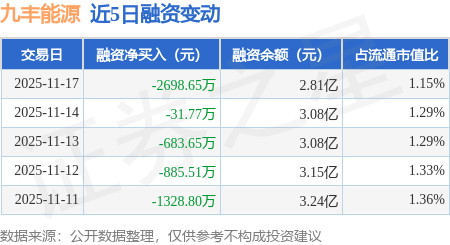
Core Viewpoint - On November 17, Jiufeng Energy (605090) experienced a net financing sell-off of 26.99 million yuan, with a financing balance of 281 million yuan, indicating a decrease in investor confidence [1]. Financing Summary - On November 17, the net financing buy-in was 66.84 million yuan, while the financing repayment amounted to 93.83 million yuan, resulting in a net sell-off of 26.99 million yuan and a financing balance of 281 million yuan [1]. - The financing balance on November 17 represented 1.15% of the circulating market value [2]. - The financing balance has decreased from 308 million yuan on November 14 to 281 million yuan on November 17, reflecting a downward trend [4]. Margin Trading Summary - On November 17, there were 1,800 shares sold short, with 1,000 shares repaid, resulting in a net short sell of 800 shares and a remaining short position of 49,900 shares [2]. - Over the past three trading days, there has been a cumulative net short sell of 7,600 shares, with 12 out of the last 20 trading days showing net short selling activity [2]. Overall Margin Trading Balance - The total margin trading balance was reported at 283 million yuan on November 17, down by 26.91 million yuan, which is an 8.69% decrease from the previous day [4].


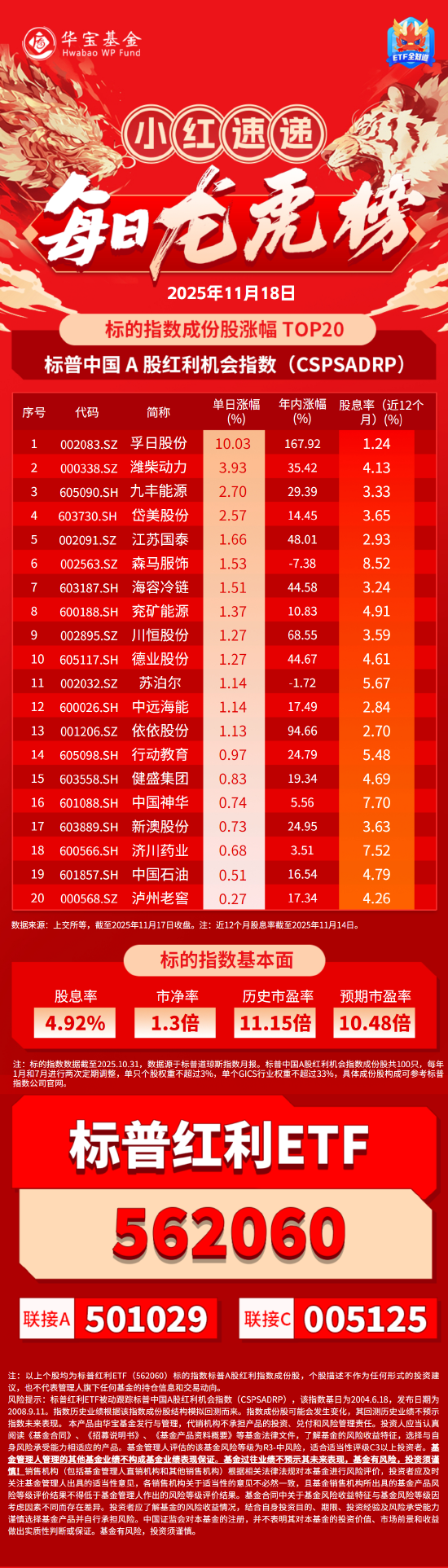
小红日报|孚日股份涨停!标普红利ETF(562060)标的指数收0.49%
Xin Lang Ji Jin· 2025-11-18 01:00
Group 1 - The article highlights the top 20 stocks in the S&P China A-Share Dividend Opportunity Index, showcasing significant daily and year-to-date gains along with their dividend yields [1] - The stock with the highest daily increase is Xue Ri Co., Ltd. (002083.SZ) with a daily gain of 10.03% and a year-to-date increase of 167.92% [1] - Weichai Power (000338.SZ) and Jiufeng Energy (605090.SH) also show strong performance with year-to-date gains of 35.42% and 29.39% respectively [1] Group 2 - The dividend yields of the top stocks range from 1.24% to 8.52%, indicating a mix of growth and income potential for investors [1] - Companies like Senma Clothing (002563.SZ) and China Shenhua (601088.SH) have notable dividend yields of 8.52% and 7.70% respectively, despite varying year-to-date performance [1] - The overall performance of these stocks suggests a positive trend in the market, with MACD golden cross signals indicating potential upward momentum [3]



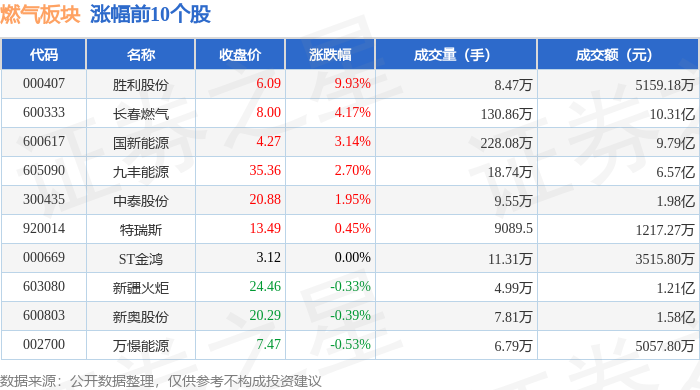
燃气板块11月17日跌0.61%,首华燃气领跌,主力资金净流出3.79亿元
Zheng Xing Xing Ye Ri Bao· 2025-11-17 08:49
Market Overview - The gas sector experienced a decline of 0.61% on November 17, with Shouhua Gas leading the drop [1] - The Shanghai Composite Index closed at 3972.03, down 0.46%, while the Shenzhen Component Index closed at 13202.0, down 0.11% [1] Stock Performance - Notable gainers included: - Shengli Co., Ltd. (Code: 000407) with a closing price of 6.09, up 9.93% and a trading volume of 84,700 shares [1] - Changchun Gas (Code: 600333) closed at 8.00, up 4.17% with a trading volume of 1.3086 million shares [1] - Guo New Energy (Code: 600617) closed at 4.27, up 3.14% with a trading volume of 2.2808 million shares [1] - Notable decliners included: - Caohua Gas (Code: 300483) closed at 17.30, down 8.76% with a trading volume of 612,200 shares [2] - Kaiteng Gas (Code: 920010) closed at 14.35, down 6.70% with a trading volume of 169,600 shares [2] - Baichuan Energy (Code: 600681) closed at 5.11, down 5.89% with a trading volume of 1.6210 million shares [2] Capital Flow - The gas sector saw a net outflow of 379 million yuan from institutional investors, while retail investors contributed a net inflow of 267 million yuan [2] - The main capital flow data indicates: - Jiufeng Energy (Code: 605090) had a net inflow of 48.9985 million yuan from institutional investors [3] - Shengli Co., Ltd. (Code: 000407) had a net inflow of 16.6492 million yuan from institutional investors [3] - Zhongtai Co., Ltd. (Code: 300435) had a net inflow of 15.8782 million yuan from institutional investors [3]


公用事业与环保行业2026年投资策略:能源变革持续推进,清洁能源&环保兼具成长与公用事业属性
Guoxin Securities· 2025-11-17 07:56
Group 1: Power Industry - The unified electricity market is accelerating construction, promoting high-quality development of renewable energy. The basic rules of the unified electricity market have been established, with a comprehensive coverage of the spot market and a market-driven pricing mechanism for renewable energy [1][24][29] - In the first three quarters of 2025, the national industrial power generation reached 72,557 billion kWh, a year-on-year increase of 1.6%, while the total social electricity consumption was 77,675 billion kWh, up 4.6% [20][22] - The electricity supply-demand situation is overall loose, but the peak load is tight, with the maximum electricity load reaching 1.506 billion kW on July 16, 2025, an increase of 0.55 million kW compared to the previous year [20][22] Group 2: Renewable Energy - The green electricity price has reached a bottoming point, with the core uncertainty regarding electricity prices gradually clarified, indicating that the industry's darkest hour is coming to an end [2][30] - The wind and solar installed capacity exceeded 1.7 billion kW in the first three quarters of 2025, accounting for nearly one-quarter of total social electricity consumption [36][40] - The challenges of renewable energy consumption remain, with increasing abandonment rates for wind and solar energy, indicating a mismatch between renewable energy development and consumption capacity [41][43] Group 3: Thermal Power - The transition of thermal power to a regulating power source is accelerating, with coal prices expected to support long-term contract prices, stabilizing thermal power profitability [2][10] - The capacity price for coal power is expected to increase further in 2026, promoting stable profitability for coal power [2][10] Group 4: Hydropower - Hydropower is experiencing a widening interest margin, with ample cash flow and stable performance supporting high dividends [3][10] - The core growth points for hydropower performance include increased installed capacity, rising electricity prices, and reduced financial costs and depreciation [3][10] Group 5: Nuclear Power - The nuclear power market is facing downward pressure on market prices, but there is a rebound in Guangdong's nuclear power pricing, indicating a strong momentum for new nuclear power development [3][10] - The approval of new nuclear units is regularized, with 10 units approved within the year, indicating a steady growth trajectory for the nuclear power sector [3][10] Group 6: Natural Gas - Domestic natural gas supply and demand are relatively loose, with a decline in apparent consumption by 0.2% year-on-year in the first nine months of 2025 [4][10] - The global natural gas market is entering a supply expansion phase, with overseas gas prices expected to decline [4][10] Group 7: Green Methanol - The promotion of green electricity consumption and the replacement of shipping fuels are expected to open up growth space for green methanol [4][9] - As of August 2025, there are 173 signed/registered green methanol projects in China, with a capacity of 53.46 million tons per year, indicating rapid growth in project numbers and capacity [9][10] Group 8: Environmental Protection - The water and waste incineration industries are entering a mature phase, with significant improvements in free cash flow [9][10] - The domestic waste oil resource utilization industry is expected to benefit from the EU's SAF mandatory blending policy, increasing demand for raw materials [9][10]






公用事业与环保行业2026 年投资策略:能源变革持续推进,清洁能源&环保兼具成长与公用事业属性
Guoxin Securities· 2025-11-17 07:55
Group 1: Power Sector - The unified electricity market is accelerating construction, promoting high-quality development of renewable energy. The basic rules of the unified electricity market have been established, with a comprehensive coverage of the spot market and a market-driven pricing mechanism for renewable energy [1][24][29] - In the thermal power sector, the transition to a regulatory power source is accelerating, with rising coal prices expected to support long-term contract prices. The profitability of thermal power is anticipated to stabilize due to increased capacity prices and auxiliary service revenues [2][10] - The hydropower sector is experiencing widening interest margins, with strong cash flow and stable performance supporting high dividends. The integration of wind, solar, and storage development is a core growth point for hydropower performance [3][10] Group 2: Renewable Energy - The green electricity sector is showing signs of recovery as the negative impact of electricity prices diminishes. The dual-track pricing mechanism provides a basic income guarantee for renewable energy projects, indicating a shift from policy-driven to market-driven growth [2][10] - The wind and solar power installed capacity is expected to increase significantly, with an average annual increase of 20 million kilowatts over the next decade. By 2035, the total installed capacity of wind and solar power is projected to reach six times that of 2020 [36][40] Group 3: Natural Gas and Green Methanol - The domestic natural gas supply is expected to remain relatively loose, with a decline in apparent consumption in early 2025. The global natural gas market is entering a supply expansion phase, which may lead to a downward trend in overseas gas prices [4][10] - Green methanol is anticipated to grow due to the promotion of green electricity consumption and its potential as a shipping fuel alternative. The domestic green methanol projects have rapidly increased, with a total capacity of 53.46 million tons per year [9][10] Group 4: Environmental Sector - The water and waste incineration industries are entering a mature phase, with significant improvements in free cash flow. The decline in risk-free returns is leading to a shift in investor expectations and risk preferences, highlighting investment opportunities in the environmental sector [9][10] - The Chinese scientific instrument market is projected to exceed $9 billion, with substantial room for domestic substitution. Companies in the environmental monitoring instrument sector are expected to benefit from this trend [9][10]
降温预期消化,美国气价回落、欧洲、中国气价微降
Soochow Securities· 2025-11-17 06:36
证券研究报告·行业跟踪周报·燃气Ⅱ [Table_Tag] [投资要点 Table_Summary] 2025 年 11 月 17 日 证券分析师 袁理 执业证书:S0600511080001 021-60199782 yuanl@dwzq.com.cn 证券分析师 谷玥 执业证书:S0600524090002 guy@dwzq.com.cn 燃气Ⅱ行业跟踪周报 降温预期消化,美国气价回落、欧洲&中国气 价微降 增持(维持) 行业走势 -12% -9% -6% -3% 0% 3% 6% 9% 12% 15% 18% 21% 2024/11/18 2025/3/18 2025/7/16 2025/11/13 燃气Ⅱ 沪深300 相关研究 《天气转冷美国&欧洲气价上涨,中 国供应充足气价微降》 2025-11-10 《天气转冷美国&中国气价上涨,欧 洲燃气发电出力下降气价回落》 2025-11-03 东吴证券研究所 1 / 14 请务必阅读正文之后的免责声明部分 ◼ 价格跟踪:降温预期消化,美国气价回落、欧洲&中国气价微降。截至 2025/11/14,美国 HH/欧洲 TTF/东亚 JKM/中国 LNG 出厂/中 ...
公用事业与环保行业2026年投资策略:能源变革持续推进,清洁能源、环保兼具成长与公用事业属性
Guoxin Securities· 2025-11-17 05:27
Group 1: Power Industry - The unified electricity market is accelerating construction, promoting high-quality development of renewable energy. The basic rules of the unified electricity market have been established, with a focus on market-driven pricing for renewable energy [1][24][29] - In the first three quarters of 2025, the wind power sector's revenue decreased by 2.80% year-on-year, while the solar power sector's revenue dropped by 14.01%, indicating pressure on the performance of the renewable energy sector due to consumption and pricing issues [30][31] - The total installed capacity of wind and solar power reached 582 GW and 1127 GW respectively by September 2025, accounting for 46% of the total installed capacity, with a significant contribution to non-fossil energy consumption [36][40] Group 2: Thermal Power - The transition of thermal power to a regulatory power source is accelerating, with coal prices expected to support long-term contract prices, stabilizing profitability for coal-fired power plants [2] - The capacity price for coal-fired power is anticipated to increase further in 2026, promoting stable profitability for coal power [2][10] Group 3: Hydropower - Hydropower is experiencing improved cost-effectiveness due to abundant cash flow and stable performance, with high dividends becoming more attractive in a declining interest rate environment [3] - The core growth points for hydropower include increased installed capacity, rising electricity prices, and reduced financial costs and depreciation [3] Group 4: Nuclear Power - The nuclear power sector is facing pressure from declining market prices, but there is a rebound in electricity prices in Guangdong, and new nuclear power developments are gaining momentum [3][10] - The approval of new nuclear units is becoming more regular, with 10 units approved in 2025, indicating a positive outlook for the sector [3] Group 5: Natural Gas - Domestic natural gas supply is expected to remain relatively loose, with a decline in apparent consumption by 0.2% year-on-year in the first nine months of 2025 [4] - The global natural gas market is entering a supply expansion phase, which may lead to a downward trend in overseas gas prices [4] Group 6: Green Methanol - The promotion of green electricity consumption and the replacement of shipping fuels are expected to open up growth opportunities for green methanol [9] - As of August 2025, there are 173 signed/registered green methanol projects in China, with a total capacity of 53.46 million tons per year, indicating rapid growth in the sector [9][10] Group 7: Environmental Protection - The water and waste incineration sectors are entering a mature phase, with significant improvements in free cash flow, suggesting investment opportunities in the environmental protection sector [10] - The domestic market for scientific instruments exceeds $9 billion, with substantial potential for domestic substitution, particularly benefiting companies in environmental monitoring instruments [10]
从三季报看化工行业的投资机会
2025-11-16 15:36
Summary of Key Points from Conference Call Industry Overview - The chemical industry is currently in a phase of profit recovery after a decline from the peak in 2021, similar to the cycle observed from 2012 to 2015 [1][3] - Raw material prices are stable, with gross margins and price spreads at historical lows, but the pressure from oversupply is easing, and demand from mid and downstream sectors is steadily growing [1][3] - Capital expenditure in the chemical industry is expected to expand rapidly from 2022 to 2024, but a significant decline is anticipated in 2025, indicating a peak in capacity growth [1][3] Market Dynamics - The refrigerant market is entering a long-term upward cycle starting from the end of 2023, with prices for major varieties expected to continue rising, such as the price of 2,332 reaching 63,000 yuan, three times higher than the same period last year [1][5] - Major refrigerant companies have reported significant profit increases, with Yonghe's profit growth reaching 450% in the first three quarters [1][5] - The refrigerant quota policy is expected to remain stable, transitioning from annual to quarterly pricing, which will facilitate more frequent performance realization [1][5] Cooling Liquid Market - The cooling liquid market is categorized into three types: water-based, oil-based, and fluorinated liquids, with fluorinated liquids showing promising applications in immersion cooling [1][6] - Companies like Juhua and Yonghe have already established a good layout in fluorinated liquids, positioning them for better growth as demand for liquid cooling increases [1][6] Price Trends and Expectations - Refrigerant prices are likely to see a slight increase starting in November due to year-end rigid demand and the exhaustion of annual quotas [1][7] - The natural gas market is under pressure due to the predicted La Niña phenomenon and ongoing geopolitical tensions, with a projected increase in consumption as winter approaches [2][8] Investment Opportunities - The chemical industry is currently at a low valuation, with a price-to-book (PB) ratio of approximately 2.2, indicating potential for upward movement [3][9] - Investment opportunities are identified in the refrigerant, natural gas, and phosphate industry chains, particularly influenced by the demand for electric vehicle batteries [3][9]
专题报告:中国天然气进出口格局
Guang Fa Qi Huo· 2025-11-13 07:45
Report Industry Investment Rating No relevant content provided. Core Viewpoints of the Report - China has a large natural gas supply gap, making it a major importer with an import dependency of 40% - 44% in recent years. The import volume far exceeds the export volume, but both show an overall increasing trend. The import forms are pipeline gas and liquefied natural gas (LNG), with the LNG import volume growing faster and exceeding the pipeline gas volume since 2017 [1][6]. - The export volume of natural gas in China is much lower than the import volume, but it shows an overall increasing trend. Pipeline gas is the main form of export, and the export destinations are Hong Kong and Macau. The export of LNG started in 2018, driven by domestic supply - demand conditions and international market premiums [7]. - The import volume of China's pipeline gas has increased steadily, and the import price may be highly correlated with international oil prices. The import sources are mainly from Russia and Turkmenistan. The LNG import volume has grown rapidly, with diversified sources and long - term contracts accounting for a large proportion [2][17]. Summary by Relevant Catalogs 1. China's Basic Situation of Natural Gas Import and Export - Supply gap: In 2015, the domestic natural gas supply gap was 663 billion cubic meters, and it expanded to 1768 billion cubic meters in 2024, driving up the import demand [6]. - Import volume: From 2015 to 2024, the import volume increased from 611 billion cubic meters to 1817 billion cubic meters, with a compound growth rate of 11.5%. In 2024, the main import sources were Russia, Australia, Turkmenistan, Qatar, and Malaysia, accounting for 81% of the total import volume [6]. - Import dependency: Since 2018, the import dependency has been in the range of 40% - 44% [6]. - Export volume: From 2015 to 2024, the export volume increased from 33 billion cubic meters to 60 billion cubic meters, with a compound growth rate of 6.2%. The export is mainly pipeline gas, and the export destinations are Hong Kong and Macau. The export of LNG started in 2018, and it is expected to grow in the long - term [7]. 2. The Full Operation of Three Existing On - shore Import Channels and the Steady Growth of China's Pipeline Gas Import Volume - Import volume growth: From 2015 to 2024, the import volume increased from 2468 thousand tons to 5369 thousand tons, with a compound growth rate of 8.1% [2][11]. - Import sources: The import countries are Turkmenistan, Uzbekistan, Kazakhstan, Myanmar, and Russia. In 2024, the import amounts from Turkmenistan and Russia were 9.57 billion and 8.04 billion US dollars respectively, accounting for 83.5% of the total import amount [11]. - Import pipelines: There are three import pipelines: the Central Asian Gas Pipeline, the China - Myanmar Gas Pipeline, and the Eastern Route of the China - Russia Gas Pipeline. The Central Asian Gas Pipeline has four lines (ABC are in operation, D is under construction), the China - Myanmar Gas Pipeline enhances the energy security of south - western China, and the Eastern Route of the China - Russia Gas Pipeline improves the gas supply in the northeast and east of China and optimizes the import structure [12][13][16]. - Price: The import price of pipeline gas may be highly correlated with international oil prices, with a lag of about 6 months and a correlation coefficient of 0.93 [17]. 3. Diverse Sources and Long - term Contracts Dominating: China Becomes the World's Largest LNG Importer - Import volume growth: From 2006 to 2024, the import volume increased from 68,800 tons to 7,664,900 tons, with a compound growth rate of 29.9%. It can be divided into two stages: high - speed growth from 2006 - 2021 and a significant slowdown from 2022 - 2025 [21]. - Import sources: The sources are diverse, with more than 15 countries. The main sources are Australia, Qatar, Russia, Malaysia, the United States, and Indonesia, accounting for 89% of the total import volume in 2024. The import volume from different countries shows different trends [22]. - Import structure: Long - term contracts dominate, accounting for 87.4% of the total LNG import volume in 2024. More domestic procurement units are participating in international LNG procurement, and state - owned enterprises have signed a large number of long - term contracts after the Russia - Ukraine conflict [23].
《生态环境监测条例》公布,25Q3公用环保基金持股情况梳理 | 投研报告
Zhong Guo Neng Yuan Wang· 2025-11-12 02:46
Core Viewpoint - The market showed positive performance this week, with the CSI 300 index rising by 0.82%, the utilities index increasing by 2.42%, and the environmental index up by 2.71% [2] Market Review - The utilities and environmental sectors ranked 9th and 7th respectively among the 31 primary industry classifications by Shenwan [2] - Within the electricity sector, thermal power rose by 2.09%, hydropower increased by 2.00%, and new energy generation grew by 3.08% [2] - The water sector saw a rise of 1.05%, while the gas sector increased by 1.23% [2] Important Events - The State Council, led by Premier Li Qiang, announced the "Ecological Environment Monitoring Regulations," effective from January 1, 2026, aimed at enhancing the ecological environment monitoring system [2] Fund Holdings Analysis - As of Q3 2025, the utilities and environmental sectors experienced a reduction in fund holdings, with 122 stocks held, down by 4 from Q2 [3] - The total market value of holdings in these sectors was 49.695 billion, a decrease of 29.64% from the previous quarter [3] - The proportion of holdings in these sectors relative to total fund equity investments fell by 0.43 percentage points to 0.55% [3] Investment Strategy - In the utilities sector, recommendations include major thermal power companies like Huadian International and Shanghai Electric due to stable profitability [4] - Continued government support for new energy development suggests a gradual stabilization in profitability for leading new energy firms such as Longyuan Power and Three Gorges Energy [4] - Nuclear power companies like China National Nuclear Power and China General Nuclear Power are expected to maintain stable earnings [4] - High-dividend hydropower stocks are highlighted for their defensive attributes, with recommendations for leading firms like Yangtze Power [4] - In the environmental sector, opportunities in water and waste incineration industries are noted, with recommendations for firms like China Everbright Environment [5] - The domestic waste oil recycling industry is expected to benefit from the EU's SAF blending policy, with recommendations for firms like Shanggou Environmental Energy [5]