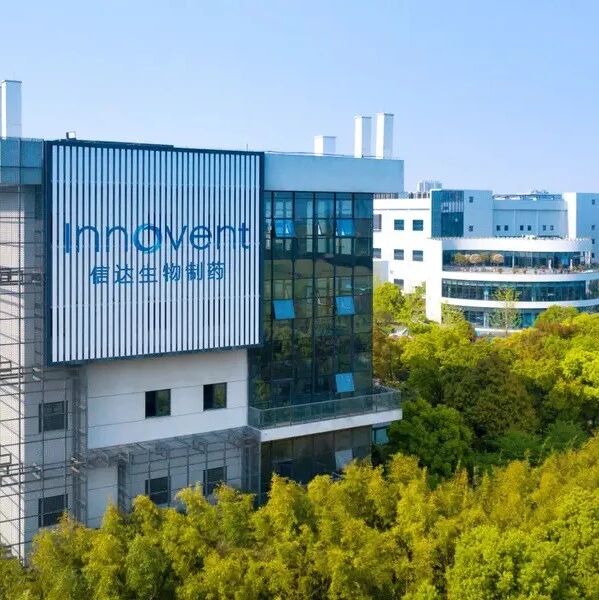
信达生物

Search documents
告别普涨,哪些创新药企“真金不怕火炼”
3 6 Ke· 2026-01-21 12:12
Core Viewpoint - The innovative drug sector is expected to experience a resurgence in 2025, transitioning from a broad market rally to a focus on select stocks driven by global clinical data, overseas commercialization, and domestic profitability turning points [1] Group 1: Market Performance - In 2025, the A-share innovative drug index saw an annual increase of nearly 20%, while the H-share index rose by 66.52%. The first half of the year recorded increases of approximately 17% for A-shares and 58% for H-shares, with the second half showing more modest gains of about 3% and 9% respectively [1] - The A-share billion-dollar club includes companies like BeiGene (市值4190.64亿元), Hengrui Medicine (市值3994.27亿元), and Baillie Gifford (市值1332.18亿元), while the H-share club includes Hengrui Medicine (市值4729.34亿元), BeiGene (市值3191亿元), and others [2] Group 2: Company Dynamics - Companies in the billion-dollar club are valued based on "pipeline value + BD monetization + global sales peak." Capital markets are comparing these firms to global leaders, elevating them from "First-in-class" to "Best-in-class" [3] - In 2025, domestic innovative drug license-out transactions totaled 83, amounting to $84.5 billion, surpassing the total of over $60 billion for 2024. Hengrui Medicine's international deals included partners like GSK and Merck, with upfront payments totaling $765 million [3] Group 3: Market Challenges - Some companies that previously entered the billion-dollar club, such as Kintor Pharmaceutical and China National Pharmaceutical Group, have fallen below the threshold due to systemic valuation corrections and stricter FDA approval standards [4] - The market has become desensitized to BD transactions, as evidenced by the stock price drop of Innovent Biologics following a $11.4 billion collaboration announcement, indicating a tightening of valuation expectations [4] Group 4: Capital Operations - As the innovative drug market heats up in 2025, companies are initiating new capital operations, including acquisitions and cross-border listings. For instance, China National Pharmaceutical Group acquired Lixian Pharmaceuticals for approximately $500 million [5] - Baillie Gifford raised 3.764 billion yuan through a private placement in the A-share market, while also applying for an IPO in Hong Kong [5] Group 5: Small-cap Stocks - The top three performing innovative drug stocks in A-shares for 2025 were Shuyou Pharmaceutical (涨幅488%), Yipinhong (涨幅370%), and Yifang Biotechnology (涨幅235%). In H-shares, the top performers were Beihai Kangcheng (涨幅1824%), Heber Pharmaceuticals (涨幅553%), and Sanofi (涨幅311.18%) [7] - These stocks have core products that received high recognition, with clinical pipelines achieving significant breakthroughs, such as Shuyou's STSP-0601 and Beihai Kangcheng's Selinexor [7] Group 6: Future Outlook - The innovative drug sector is expected to enter a "hardcore alpha" phase in 2026, focusing on companies that can deliver genuine clinical data, achieve overseas commercialization, and demonstrate domestic profitability [10] - The emphasis will shift from broad market rallies to specific companies that can prove their clinical trial results and secure sales milestones, with a focus on high-demand areas like dual antibodies and ADCs [11][12]
短期港股因“存款搬家”搅动 2026年生物医药板块值得期待
Xin Lang Cai Jing· 2026-01-21 10:25
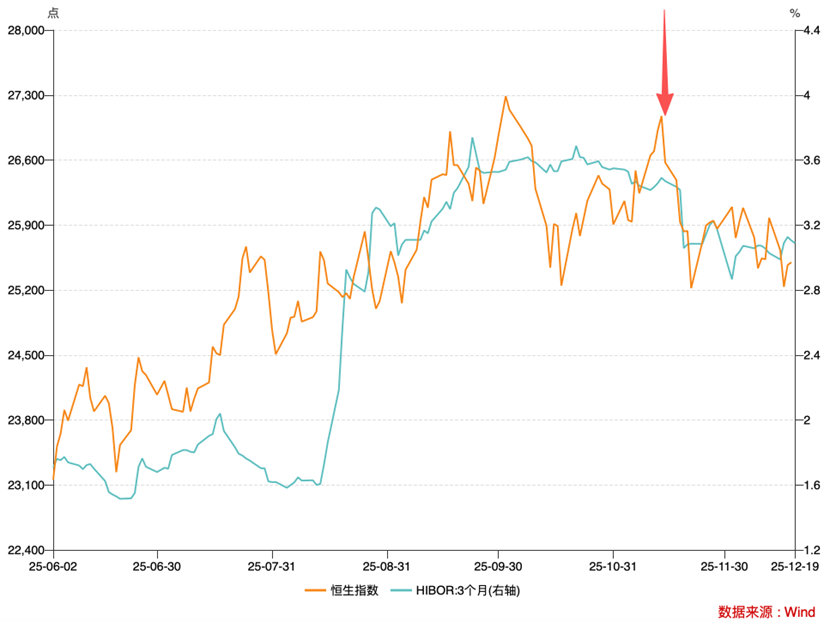
Core Insights - Recent fluctuations in the Hong Kong stock market are primarily driven by liquidity contraction due to deposit migration, which is not expected to alter the positive mid-to-long-term trend [2][27] - The risks associated with this liquidity contraction are anticipated to ease with the new Federal Reserve chair's influence [2][27] - The biopharmaceutical sector in Hong Kong is expected to have significant highlights in 2026 [2][27] Short-term Market Fluctuations - The root cause of recent volatility in the Hong Kong stock market is identified as "deposit migration" leading to liquidity shrinkage [3][28] - The offshore RMB was previously viewed as a liquidity anchor for the Hong Kong market, creating a chain reaction that benefits the capital market [5][28] - The decline in HIBOR (Hong Kong Interbank Offered Rate) has not translated into improved liquidity for the stock market, as it is primarily driven by capital outflow rather than liquidity enhancement [11][35] Impact of Southbound Capital - The inflow of southbound capital has contracted, causing significant disturbances to the Hong Kong market [9][32] - Concerns over potential fund outflows arise from the over-allocation of mainland active equity funds to Hong Kong stocks, which could lead to rebalancing [8][32] Biopharmaceutical Sector Outlook - The biopharmaceutical sector is highlighted as a key area of focus for 2026, with expectations of no "black swan" events in the short term [16][39] - The new procurement rules for medical insurance in China are expected to favor small and medium-sized enterprises, leading to improved financial performance in 2026 [41][45] - Specific companies recommended for investment include: - **Innovent Biologics (09696.HK)**: Anticipated to reach significant milestones in 2026 with ongoing collaborations [46] - **Lee's Pharmaceutical (00950.HK)**: Currently has a low P/E ratio and is actively expanding its business [47] - **China Biologic Products (01177.HK)**: Focused on various therapeutic areas and has recently received approval for a new drug [47]


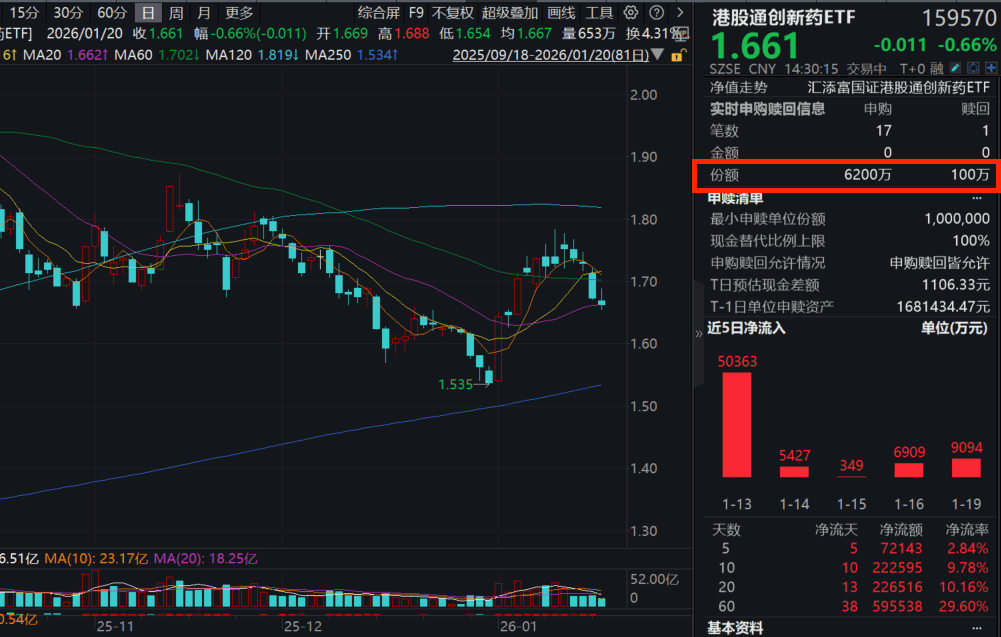
JPM收官,中国创新药加速全球化!港股通创新药ETF(159570)探底回升翻红,近5日净流入超3亿元,在全市场创新药ETF中规模领跑!
Xin Lang Cai Jing· 2026-01-21 02:41
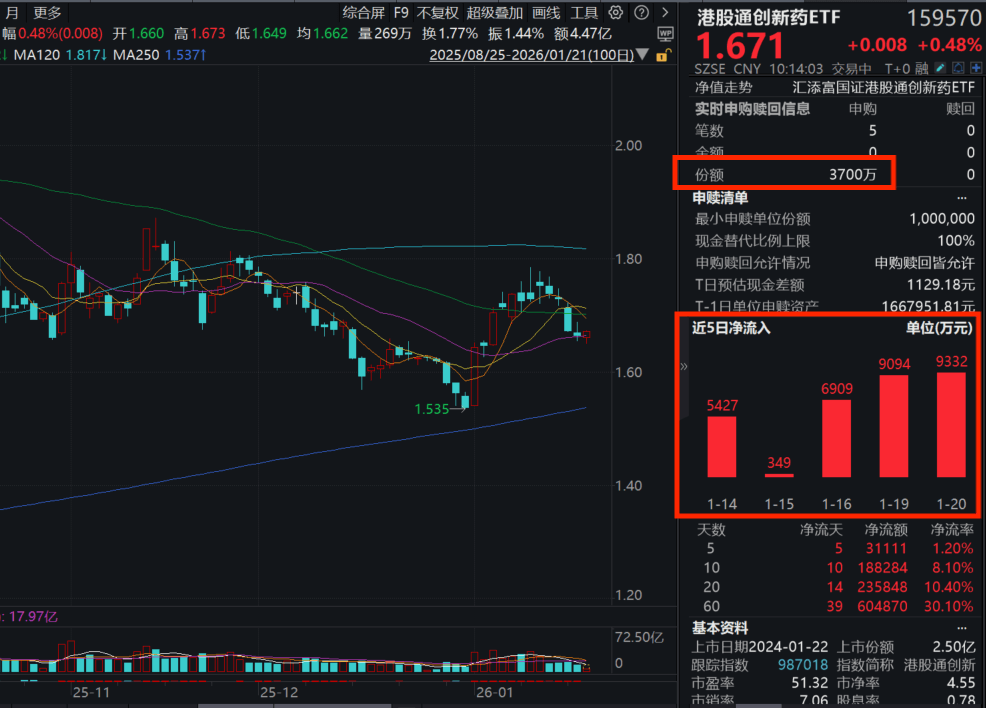
Group 1 - The Hong Kong Innovation Drug ETF (159570) has seen a significant inflow of funds, with a recent trading volume exceeding 5 billion yuan and a net inflow of over 300 million yuan in the past five days [1] - As of January 20, the total size of the Hong Kong Innovation Drug ETF reached over 25.3 billion yuan, leading the market in terms of scale among innovation drug ETFs [1] - The index components of the ETF showed mixed performance, with notable gains from companies like Kingsoft Biotech and China Biologic Products, while companies like CanSino Biologics experienced declines [3][4] Group 2 - At the J.P. Morgan Healthcare Conference, several Chinese pharmaceutical companies showcased their advancements, including BeiGene's new drug approval in China and plans for accelerated approval in the U.S. [5] - Innovent Biologics and Pfizer are set to conduct five global Phase III trials for their drug SSGJ-707 by 2026, targeting various cancers [6] - The collaboration between NVIDIA and Eli Lilly aims to establish an AI innovation lab with a projected investment of up to 1 billion USD over five years, potentially transforming drug development processes [8] Group 3 - Tempus AI reported a revenue of approximately 1.27 billion USD for 2025, marking an 83% year-on-year increase, driven by significant growth in its diagnostic business [9] - The top ten components of the Hong Kong Innovation Drug ETF account for over 73% of its weight, highlighting the concentration of leading innovative drug companies within the ETF [10]
恒生医疗大跳水,互联网/大消费/科技等紧随其后
Ge Long Hui· 2026-01-20 13:16
Group 1 - The Hang Seng Index opened with a sharp decline and maintained a weak consolidation throughout the day, closing down by 1.05% [1] - The healthcare sector led the decline, with the Hang Seng Healthcare Index dropping by 2.68%, including significant losses from China Biologic (down 6.19%) and 3SBio (down 5.51%) [3] - The technology sector also faced weakness, with the Hang Seng Technology Index falling by 1.55%, highlighted by Bilibili's drop of 6.85% and Alibaba's decline of 3.49% [3] Group 2 - The banking sector showed relative resilience, with the Hang Seng Bank Index closing down by only 0.67%, despite some individual banks like Chongqing Bank and Standard Chartered experiencing slight declines [3] - Overall, more than 10 stocks in the healthcare sector saw declines exceeding 4%, indicating a broad sell-off in this industry [3] - The performance of major banks such as China Minsheng Bank, Bank of China, and Industrial and Commercial Bank of China also reflected minor losses, contributing to the overall stability of the banking sector [3]
2025年药品BD出海总结
Southwest Securities· 2026-01-20 11:37
Investment Rating - The report indicates a significant acceleration in BD (Business Development) overseas for Chinese innovative drugs, suggesting a positive investment outlook for the industry [3]. Core Insights - The number of BD projects, upfront payments, and total amounts for Chinese pharmaceutical companies significantly increased in 2025, with 165 projects, over $7.03 billion in upfront payments (up 226.8% year-on-year), and a total amount of $136.68 billion (up 192.2% year-on-year) [2][7]. - The report highlights a focus on dual antibodies (双抗), antibody-drug conjugates (ADC), GLP-1 receptor agonists (GLP1RA), and small nucleic acids as key areas for BD overseas [2][3]. Summary by Sections BD Project Growth - In 2025, the quarterly breakdown of BD projects shows 41, 43, 30, and 51 projects in Q1, Q2, Q3, and Q4 respectively, with significant year-on-year increases [2][7]. - Upfront payments for each quarter were $0.9 billion, $2.0 billion, $1.86 billion, and $2.27 billion, reflecting substantial growth rates [2][7]. Outbound BD Models - The predominant model for BD remains license in/out, while the NewCo/Co-CoJV model is gaining attention, with limited successful cases of independent commercialization [2][12][13]. - In 2025, MNCs (Multinational Corporations) accounted for $4.71 billion in upfront payments, representing 67% of total BD upfront payments [12]. Key Drug Categories - Dual antibodies saw a remarkable increase, with $3.5 billion in upfront payments (up 414.7%) and a total amount of $21.85 billion (up 361.5%) in 2025 [2][18]. - ADCs emerged as a significant focus, with $1.63 billion in upfront payments (up 676.2%) and a total amount of $21.13 billion (up 390.6%) [2][26]. - GLP-1RA projects achieved $470 million in upfront payments, marking a 109.8% increase, with a total amount of $9.6 billion [2]. NewCo Model - The NewCo model has facilitated overseas BD, with a total of $350 million in upfront payments and $13.74 billion in potential total amounts from 2023 to 2025 [17]. - In 2025, NewCo projects secured $110 million in upfront payments and $4.76 billion in potential total amounts [17]. Clinical Development Stages - Approximately 62% of molecules were in early clinical stages (pre-clinical to before Phase II) at the time of BD, indicating a trend towards early-stage licensing [8][9].


速递|信达生物玛仕度肽新适应症临床获批,押注减重+降压协同价值
GLP1减重宝典· 2026-01-20 09:12
Core Viewpoint - The article discusses the approval of a new clinical study for the drug Mashtudipeptide by Innovent Biologics, targeting blood pressure control in overweight or obese patients with hypertension, indicating a strategic upgrade in disease combination management within the crowded GLP-1 market [4][5]. Group 1: Clinical Development - Innovent Biologics has received approval for Mashtudipeptide injection to conduct a clinical study focused on hypertension combined with overweight or obesity [4]. - This clinical design signals a shift from viewing GLP-1 drugs solely as weight loss tools to recognizing them as platforms for managing metabolic diseases [5]. Group 2: Market Dynamics - The competition in the GLP-1 sector has evolved from focusing on weight loss efficacy to emphasizing safety and tolerability, and now to demonstrating clinical value in managing multiple comorbidities [6]. - Conditions such as hypertension, cardiovascular risks, fatty liver, and sleep apnea are emerging as new battlegrounds for GLP-1 drugs [6]. Group 3: Future Implications - As more indications are pursued, the competition will shift from merely comparing weight loss outcomes to a comprehensive evaluation of real-world disease burden and long-term outcomes [8]. - Innovent's focus on hypertension in obese populations exemplifies this trend towards a more integrated approach in the GLP-1 competitive landscape [8].
“AI药物研发领域,美企依赖中国数据,中企需要美国市场”
Guan Cha Zhe Wang· 2026-01-20 07:08
Core Insights - Artificial intelligence (AI) is accelerating drug development globally, highlighting the increasing interdependence between China and the U.S. in this field [1] - The competitive advantage in AI-driven drug development relies not only on computational power but also on the ability to efficiently extract data from genomics and clinical trials, with China emerging as a significant data source for the U.S. [1][3] Group 1: AI in Drug Development - The first step in building effective AI models for drug development is data collection, which involves integrating dispersed data from various countries [3] - U.S. pharmaceutical companies heavily rely on Chinese clinical data to support their AI model training and drug development processes [3] - China's clinical trial ecosystem is considered one of the best globally, characterized by a large patient base and rapid recruitment speeds [3] Group 2: Market Dynamics and Collaborations - In 2025, Chinese pharmaceutical companies completed 157 early drug licensing agreements totaling $135.7 billion, primarily with large Western pharmaceutical firms [4] - Notable collaborations include a $5.6 billion exclusive licensing agreement between Rongchang Biologics and AbbVie for a new PD-1/VEGF dual-target antibody drug [4] - Chinese biotech firms are leveraging partnerships with multinational companies to access international markets, as seen in the collaboration between Takeda Pharmaceutical and Innovent Biologics, valued at $11.4 billion [4] Group 3: Challenges and Future Outlook - Despite advancements, U.S. remains a leader in AI-driven drug development due to superior AI technology and a mature venture capital ecosystem [5] - The U.S. is tightening control over biological data, with recent legislation seen as a strategic move to limit collaboration with Chinese biotech firms [5] - The global pharmaceutical industry is transitioning from traditional drug discovery methods to AI-supported automated laboratories capable of conducting thousands of experiments daily [5] Group 4: Growth Projections for AI in Pharmaceuticals - The global AI pharmaceutical market is projected to reach $5.62 billion by 2028, with long-term estimates ranging from $28 billion to $53 billion [6] - In China, the AI pharmaceutical sector is expected to experience rapid growth, with market size anticipated to exceed 500 billion RMB by 2025-2030, maintaining a compound annual growth rate of over 15% [6]
创新药迎JPM+BD+业绩预增多重催化!港股通创新药ETF(159570)跌近1%连续第四日回调,超1亿元资金逢跌布局!
Xin Lang Cai Jing· 2026-01-20 07:05
Group 1 - The Hong Kong Innovation Drug ETF (159570) has experienced a decline for four consecutive days, with a nearly 1% drop and a trading volume exceeding 1.15 billion HKD, indicating rapid capital inflow [1] - As of January 19, the latest scale of the Hong Kong Innovation Drug ETF (159570) has surpassed 25.4 billion HKD, leading its peers in the same category [1] - The weighted stocks of the ETF have mostly shown negative performance, with notable declines including Innovent Biologics down over 3% and Hengrui Medicine down over 2% [3][4] Group 2 - At the JPMorgan Conference, over 20 Chinese pharmaceutical companies showcased their innovations, with Hengrui expected to see a 25%+ growth in innovative drug revenue by 2026 [5] - The domestic biotech sector is experiencing a surge in business development (BD) activities, with significant deals such as the 5.6 billion USD global exclusive license agreement between Rongchang Biopharma and AbbVie [5][6] - A domestic innovative drug company has projected a revenue of approximately 45.46 billion RMB for 2025, reflecting a year-on-year growth of 15.84%, with a substantial increase in net profit [7]
“中国在又一领域发起挑战,但中美谁也离不开谁”
Guan Cha Zhe Wang· 2026-01-20 06:56
Core Insights - Artificial Intelligence (AI) is accelerating drug development globally, highlighting the increasing interdependence between China and the United States [1][3] - The competitive advantage in AI-driven drug development relies not only on computational power but also on the ability to efficiently extract data from genomics and clinical trials, with China emerging as a significant data source for the U.S. [1][3] Group 1: AI in Drug Development - The first step in building effective AI models for drug development is data collection, which involves integrating dispersed data from various countries [3] - U.S. pharmaceutical companies heavily rely on Chinese clinical data to support AI model training and drug development [3] - China's clinical trial ecosystem is considered one of the best globally, characterized by a large patient base and rapid recruitment speeds [3] Group 2: Market Dynamics and Collaborations - In 2025, Chinese pharmaceutical companies completed 157 early drug licensing agreements totaling $135.7 billion, primarily with large Western pharmaceutical firms [4] - Notable collaborations include a $5.6 billion exclusive licensing agreement between Rongchang Biotech and AbbVie for a new PD-1/VEGF dual-target antibody drug [4] - Chinese biotech firms are leveraging partnerships with multinational companies to access international markets, as seen in the collaboration between Takeda Pharmaceutical and Innovent Biologics, valued at $11.4 billion [4] Group 3: Challenges and Future Outlook - Despite advancements, U.S. remains a leader in AI-driven drug development due to superior AI technology and a mature venture capital ecosystem [5] - The U.S. is tightening control over biological data, with recent legislation seen as a strategic move to limit collaboration with Chinese biotech firms [5] - The global pharmaceutical industry is transitioning from serendipitous drug discovery to hypothesis-driven models supported by AI, with automated laboratories capable of conducting thousands of experiments daily [5] Group 4: Growth Projections for AI in Pharmaceuticals - The global AI pharmaceutical market is projected to reach $5.62 billion by 2028, with long-term estimates ranging from $28 billion to $53 billion [6] - In China, the AI pharmaceutical sector is expected to experience rapid growth, with market size anticipated to exceed 500 billion RMB by 2030, maintaining a compound annual growth rate of over 15% [6]
中国创新药2025年出海交易超1300亿美元,港股医药ETF(159718)备受关注
Xin Lang Cai Jing· 2026-01-20 02:24
Core Viewpoint - The Chinese innovative drug business development (BD) for overseas licensing reached a record high of $135.655 billion in total transaction value for 2025, with a significant increase in upfront payments and transaction numbers compared to previous years [1][2]. Group 1: Market Performance - The China Securities Hong Kong Stock Connect Pharmaceutical and Health Comprehensive Index (930965) showed mixed performance among its constituent stocks, with Times Angel leading at a 4.83% increase [1]. - The Hong Kong pharmaceutical ETF (159718) was quoted at 0.96 yuan [1]. Group 2: Industry Developments - The innovative drug BD overseas licensing transactions in China for 2025 totaled $135.655 billion, with upfront payments of $7 billion and 157 transactions, all marking historical highs [2]. - Notable collaborations include Rongchang Biopharma's PD-1/VEGF dual antibody RC148 receiving a $650 million upfront payment from AbbVie, and Yilian Biopharma's partnership with Roche on B7H3-targeted ADC [2]. - GSK's Bepirovirsen for chronic hepatitis B showed positive results in Phase III trials, and Arrowhead announced advancements in RNAi therapies for weight loss, validating the clinical value of small nucleic acid drugs [2]. Group 3: Investment Outlook - The 44th Annual J.P. Morgan Healthcare Conference revealed positive updates from leading global pharmaceutical companies, with significant BD transactions and improved forecasts from CXO companies like WuXi AppTec [2]. - The global pharmaceutical industry remains robust, with innovation in drugs and medical devices continuing to be the main investment theme [2].