巨化股份

Search documents
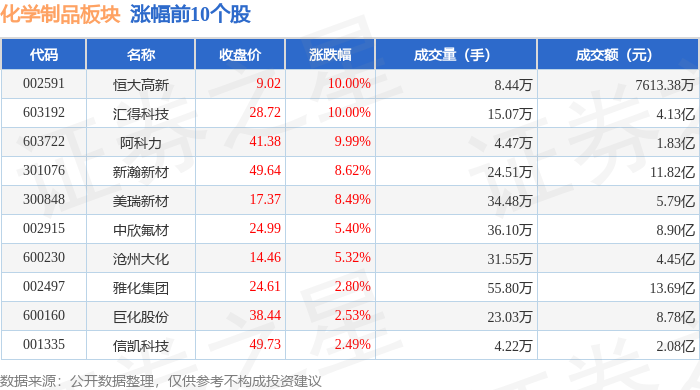
化学制品板块12月30日涨0.27%,恒大高新领涨,主力资金净流出7.72亿元
Zheng Xing Xing Ye Ri Bao· 2025-12-30 08:56
Core Viewpoint - The chemical products sector experienced a slight increase of 0.27% on December 30, with Evergrande High-tech leading the gains, while the Shanghai Composite Index closed at 3965.12, showing no change, and the Shenzhen Component Index rose by 0.49% [1]. Group 1: Stock Performance - Evergrande High-tech (002591) closed at 9.02, up 10.00% with a trading volume of 84,400 shares and a transaction value of 76.13 million yuan [1]. - Huide Technology (603192) also rose by 10.00% to close at 28.72, with a trading volume of 150,700 shares and a transaction value of 413 million yuan [1]. - Akali (603722) increased by 9.99% to 41.38, with a trading volume of 44,700 shares and a transaction value of 183 million yuan [1]. - New Trend New Materials (301076) saw an 8.62% increase, closing at 49.64 with a trading volume of 245,100 shares and a transaction value of 1.182 billion yuan [1]. - Meirui New Materials (300848) rose by 8.49% to 17.37, with a trading volume of 344,800 shares and a transaction value of 579 million yuan [1]. Group 2: Fund Flow Analysis - The chemical products sector experienced a net outflow of 772 million yuan from institutional investors, while retail investors saw a net inflow of 710 million yuan [2]. - The main net inflow for New Trend New Materials (301076) was 102 million yuan, accounting for 8.59% of its trading volume [3]. - Meirui New Materials (300848) had a main net inflow of 97.12 million yuan, representing 16.78% of its trading volume [3]. - Institutional investors showed a net outflow from Huide Technology (603192) of 28.44 million yuan, which is a 6.89% decrease in their trading volume [3].


华金证券:AI发展加速液冷渗透率 液冷工质打开成长空间
Zhi Tong Cai Jing· 2025-12-30 08:53
Group 1 - The core viewpoint of the report is that the increasing demand for computing power is leading to significant power consumption issues in data centers, making liquid cooling a necessary solution for temperature control in high-density environments [1][2]. - The Chinese liquid cooling server market is projected to reach $2.37 billion in 2024, representing a year-on-year growth of 67.0%, and is expected to grow to $3.39 billion by 2025, with a compound annual growth rate (CAGR) of 46.8% from 2024 to 2029, ultimately reaching $16.2 billion by 2029 [2]. - Liquid cooling solutions are becoming essential in various sectors, including AI computing, internet, finance, energy, transportation, and industrial manufacturing, as traditional air cooling cannot meet the energy and heat dissipation requirements [1][2]. Group 2 - Liquid cooling working fluids are diverse, with glycol, propylene glycol, and water being predominant in plate cooling, while immersion cooling utilizes oils, silicates, and fluorinated liquids, which are critical components for cooling performance [3]. - Fluorinated liquids are gaining traction due to their surface tension, insulation properties, and material compatibility, making them indispensable in high-power density AI server applications [3]. - The exit of 3M from the market presents growth opportunities for domestic companies in the high-performance fluorinated liquid sector, while oils and silicates are also potential supplementary choices for cooling fluids [3]. Group 3 - Investment recommendations include companies involved in liquid cooling fluids such as Dongyangguang, Xinzoubang, Runhe Materials, Juhua Co., Yonghe Co., Wuhua Technology, Jinshi Resources, Dongyue Group, Yongtai Technology, Huayi Group, Sanmei Co., Unity Co., Bayi Space, Changlan Technology, Xin'an Co., and Jitai Co. [4].
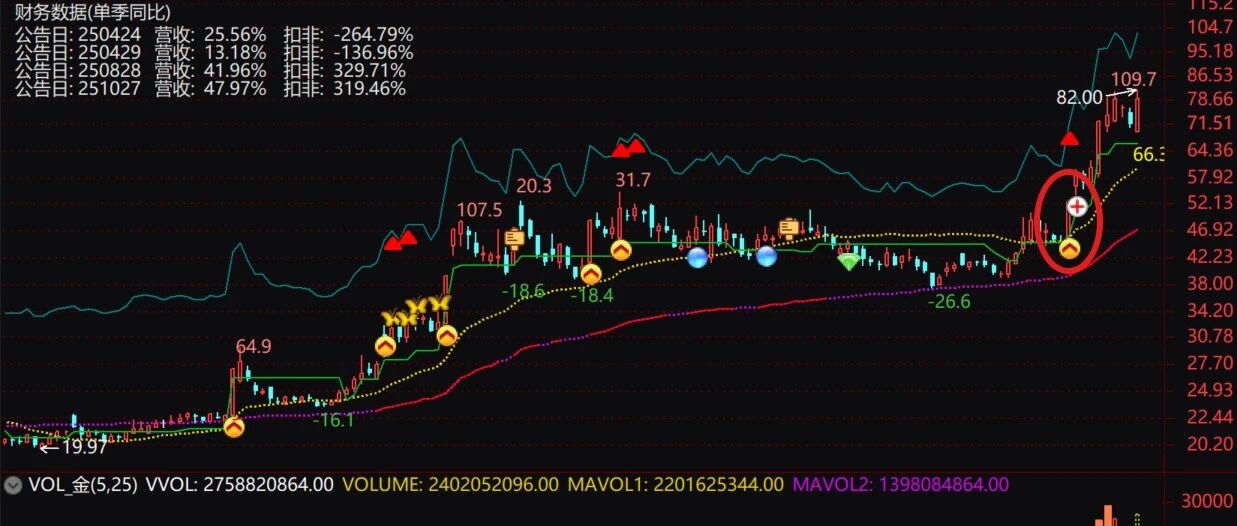
液冷有关的几只业绩和走势俱佳的票
猛兽派选股· 2025-12-30 07:04
Core Viewpoint - The liquid cooling industry, while part of the computing ecosystem alongside optical modules and PCBs, has a less robust business model and profitability. However, it has significant potential for penetration, particularly in high-density AI clusters, where current overall penetration is low, projected to reach about 20%-25% by 2025 [1]. Group 1: Industry Overview - Optical modules and PCBs are essential components of server and switch infrastructure, with nearly 100% penetration rates, while liquid cooling is only a necessity in high-density AI clusters [1]. - The revenue recognition for optical modules and PCBs is quick and has a short cycle, whereas liquid cooling projects typically have a lag of over six months due to the need for infrastructure setup [1]. - The standardization and mass production of optical modules and PCBs lead to stable and high gross margins, while liquid cooling faces challenges due to customization and project-based sales, resulting in lower gross margins [2]. Group 2: Key Companies - **Inspur**: A leading domestic liquid cooling company with a comprehensive solution covering cold plates, CDU, and system integration, benefiting from partnerships with major players like NVIDIA and Intel. It is positioned to gain from the AI high-density computing cooling market, although its valuation may be stretched with a PB exceeding 30x [2]. - **Tongfei Co., Ltd.**: A specialized enterprise transitioning to data center liquid cooling, with a dual-path approach in cold plate and immersion cooling, aiming for significant growth in AI computing infrastructure and energy storage [3]. - **Yidong Electronics**: Entering the AI server liquid cooling market in 2024, it aims to integrate connectors and liquid cooling solutions, achieving significant revenue milestones in 2025 [4]. - **Dingtong Technology**: Focused on integrated connector and liquid cooling modules, it is set to ramp up production and gross margin potential in the coming years [5]. - **Siquan New Materials**: Specializing in high thermal conductivity materials for AI server cooling, it is expected to enter a critical phase of mass delivery and certification by 2025 [6]. - **Zhongshi Technology**: Engaged in thermal management materials and AI server cooling solutions, it is expanding its production capacity and is expected to see significant order and margin growth [7]. - **Feirongda**: With a focus on electromagnetic shielding and thermal management, it is positioned for significant delivery and expansion in the AI server cooling market [8]. - **Dongyangguang**: Following a comprehensive approach in liquid cooling, it is set to enter a critical phase of delivery and overseas expansion [9]. - **Juhua Co., Ltd.**: Leveraging its fluorochemical expertise, it is positioned as a key player in the liquid cooling market, focusing on domestic replacement and overseas expansion [10]. - **Qiangrui Technology**: Engaged in integrated solutions for testing equipment, it is expected to achieve significant breakthroughs in delivery and ecosystem integration by 2025 [11].
化工ETF嘉实(159129)涨2.56%,化工行业或迎周期拐点向上
Jin Rong Jie· 2025-12-30 07:02
Group 1 - The Shenzhen Component Index rose by 0.67%, and the ChiNext Index increased by 0.54%, with the chemical sub-index up by 2.37% [1] - Individual stocks such as Hengli Petrochemical surged over 6%, and Juhua Co. rose more than 3%, with Wanhu Chemical and Salt Lake Potash also seeing gains [1] - The chemical ETF by Jiashi (159129) increased by 2.56%, with a trading volume of 20.62 million yuan and a turnover rate of 2.86% [1] Group 2 - China Galaxy Securities forecasts a negative growth in capital expenditure for the chemical industry starting in 2024, with supply expected to contract due to the "anti-involution" trend and accelerated exit of outdated overseas capacity [1] - The "14th Five-Year Plan" emphasizes expanding domestic demand, which, combined with the onset of a U.S. interest rate cut cycle, is expected to open up demand for chemical products [1] - The chemical industry has been in a down cycle for approximately 3.5 years, but with continued decline in capital expenditure and faster exit of outdated capacity, the industry is expected to enter a low growth phase [1] - The industry is anticipated to reach a cyclical turning point by 2026, transitioning from valuation recovery to earnings growth, referred to as the "Davis Double-Click" [1] Group 3 - The Jiashi Chemical ETF tracks the CSI Sub-Segmented Chemical Industry Theme Index, which selects 50 large-scale, liquid chemical listed companies from the Shanghai and Shenzhen markets [2] - The top ten weighted stocks in the index include Wanhu Chemical, Salt Lake Potash, Tianci Materials, Cangge Mining, Juhua Co., Hualu Hengsheng, Duofu Du, Hengli Petrochemical, Baofeng Energy, and Yuntianhua, collectively accounting for over 45.41% of the index [2]
化工ETF(159870)涨超2.2%,机构继续看好2026年板块景气度反转
Xin Lang Cai Jing· 2025-12-30 05:33
Group 1 - The core viewpoint is that the chemical sector is expected to reverse next year after four years of bottoming out, driven by anticipated demand recovery following the Federal Reserve's preemptive interest rate cuts [1] - The most significant impact of the anti-involution trend is on PTA and long silk, with a positive outlook for PTA due to major refining companies leading the charge, despite some opposition [1] - Future capacity additions in the PX chain are limited, with recent price increases attributed to maintenance by some companies and production cuts in Indian refineries, ultimately depending on next year's demand recovery [1] Group 2 - Currently, there is a liquidity bull market, with the market seeking outlets for investment, and the chemical sector is one of the areas being positioned for potential opportunities at the bottom [1] - As of December 30, 2025, the CSI Sub-Industry Chemical Theme Index (000813) rose by 2.09%, with significant gains in constituent stocks such as Xin Feng Ming (603225) up 8.56% and Hengli Petrochemical (600346) up 8.52% [1] - The Chemical ETF (159870) increased by 2.22%, with the latest price reported at 0.83 yuan [1] Group 3 - The Chemical ETF closely tracks the CSI Sub-Industry Chemical Theme Index, which consists of seven sub-indices reflecting the overall performance of listed companies in related sectors [2] - As of November 28, 2025, the top ten weighted stocks in the CSI Sub-Industry Chemical Theme Index accounted for 45.41% of the index, including companies like Wanhua Chemical (600309) and Yanhua Co. (000792) [2]
ETF盘中资讯|化工板块强势回归!石化、化肥股领涨,化工ETF(516020)上探1.63%!
Jin Rong Jie· 2025-12-30 03:56
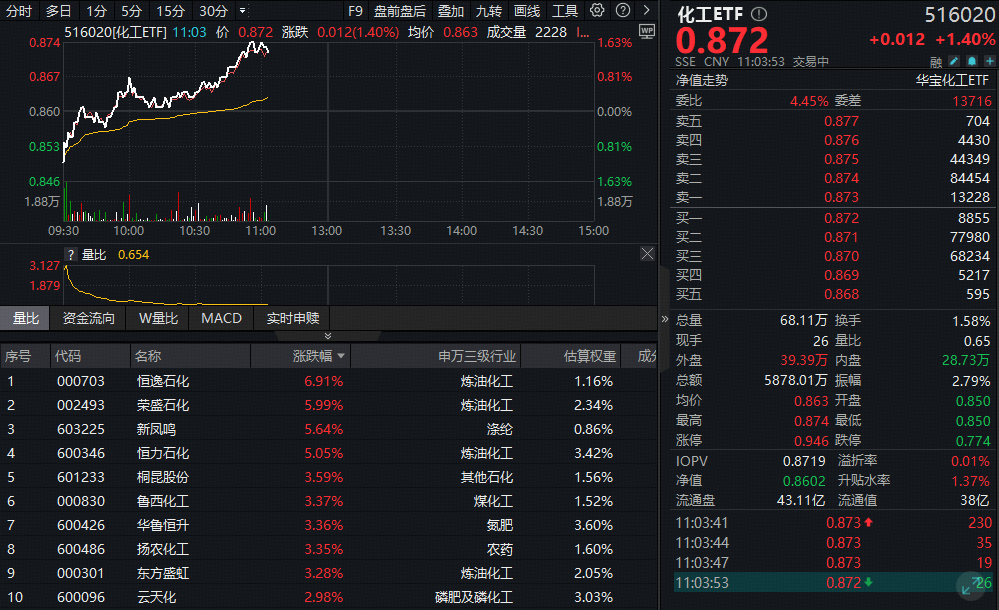
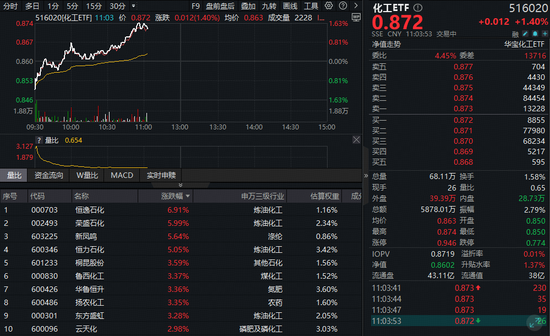
Group 1 - The chemical sector has regained momentum, with the chemical ETF (516020) experiencing a price increase of 1.4% after a low opening, reaching a maximum intraday gain of 1.63% [1] - Key stocks in the sector, including Hengyi Petrochemical, Rongsheng Petrochemical, and Xin Fengming, saw significant gains, with Hengyi Petrochemical rising over 6% and others increasing by more than 5% [1][2] - A recent conference on the high-quality development of the fertilizer industry highlighted the industry's transition towards quality and efficiency, aligning with the "14th Five-Year Plan" and the upcoming "15th Five-Year Plan" [1] Group 2 - According to Huaxin Securities, the chemical industry remains in a weak position overall, with mixed performance across sub-sectors due to past capacity expansions and weak demand, although some sectors like lubricants have exceeded expectations [3] - The chemical ETF (516020) is currently at a price-to-book ratio of 2.57, which is considered relatively reasonable based on historical data, suggesting potential for medium to long-term investment [3] - According to Everbright Securities, the basic chemical industry is expected to see strong demand from new materials, particularly in emerging applications like AI and OLED, which will drive growth in core materials such as photoresists [5] Group 3 - The chemical ETF (516020) tracks the CSI Sub-Industry Chemical Theme Index, covering various sub-sectors and concentrating nearly 50% of its holdings in large-cap leading stocks, which provides an opportunity to capitalize on strong market leaders [5] - The ETF also includes significant positions in sectors like phosphate and nitrogen fertilizers, as well as fluorine chemicals, allowing for a comprehensive approach to investment opportunities in the chemical sector [5]


化工板块强势回归!石化、化肥股领涨,化工ETF(516020)上探1.63%!
Xin Lang Cai Jing· 2025-12-30 03:20
Group 1 - The chemical sector has regained momentum, with the chemical ETF (516020) experiencing a maximum intraday increase of 1.63% and closing up 1.4% [1][8] - Key stocks in the sector include Hengyi Petrochemical, which surged over 6%, and other companies like Rongsheng Petrochemical and New Fengming, which rose over 5% [1][8] - The recent high-quality development conference for the fertilizer industry highlighted the transition towards quality and efficiency in the sector, alongside new quota policies for refrigerants that are expected to optimize supply-demand dynamics [10][10] Group 2 - According to Huaxin Securities, the chemical industry remains weak overall, with mixed performance across sub-sectors due to past capacity expansions and weak demand, although some sectors like lubricants have exceeded expectations [3][10] - The chemical ETF (516020) has a price-to-book ratio of 2.57, indicating a relatively reasonable valuation position within the last decade [3][10] - According to Everbright Securities, the basic chemical industry is expected to see significant growth by 2025, driven by strong demand in new materials and emerging applications such as AI and OLED [4][11] Group 3 - The chemical ETF (516020) tracks the CSI sub-sector chemical industry theme index, covering various segments, with nearly 50% of its holdings in large-cap stocks like Wanhua Chemical and Salt Lake Potash [4][11] - Investors can also access the chemical sector through linked funds of the chemical ETF, providing a diversified investment approach [5][11]
化工ETF(159870)红盘向上,PX盈利情况率先好转,PTA反内卷可期,聚酯产业链景气度持续上行
Xin Lang Cai Jing· 2025-12-30 02:40
Group 1: Polyester Industry Chain Price Trends - The prices of polyester industry chain products have increased as of December 25, with PX at 7318, PTA at 5040, polyester filament at 6450, polyester bottle chips at 5990, and BOPET at 7475 yuan/ton, reflecting increases of +7.88%, +8.39%, +2.79%, +5.27%, and +1.15% respectively compared to the previous week [1] Group 2: Production Capacity Insights - PX production is currently at 89% capacity, with no new capacity expected before Q4 2024. PTA has a 74% operating rate with significant pressure from 2025, and no new capacity is anticipated for 2026. Polyester filament is stable with a 90% operating rate and an annual expansion of 3-4% [1] Group 3: Demand and Consumption Forecast - From January to November this year, the apparent demand for polyester filament has only increased by 3.5%. Following a proactive inventory accumulation cycle in 2024, a destocking cycle is expected to begin in early 2025. By 2026, a return to an inventory accumulation cycle is anticipated, with consumption growth expected to return to the 5-10% range [1] Group 4: Profitability Analysis - Recent profitability trends show PX recovering from zero to 700 yuan/ton, PTA moving from cash flow losses to break-even, and polyester entering a state of slight losses. By 2026, PX profits are expected to expand further, while PTA is likely to maintain break-even, and polyester is projected to recover to a profit range of 100-200 yuan [1] Group 5: Lithium Battery Materials Sector - The lithium battery materials sector has seen a decline due to rumors of a 15% production cut by CATL in Q1 and speculation about 6F prices dropping below 110,000 yuan. However, ongoing negotiations indicate that pricing discussions are progressing as planned, and CATL's suppliers have stated that a 15% reduction is not feasible without losing market share [2] Group 6: Chemical ETF Performance - As of December 30, 2025, the CSI Sub-Industry Chemical Theme Index (000813) rose by 0.37%, with notable increases in constituent stocks such as Hengyi Petrochemical (000703) up by 5.21% and Hengli Petrochemical (600346) up by 2.95% [2]
光伏硅片价格回升,出光兴产、三井化学整合千叶乙烯业务 | 投研报告
Zhong Guo Neng Yuan Wang· 2025-12-30 02:02
Industry Overview - The chemical sector's overall performance ranked 7th this week (2025/12/22-2025/12/26) with a fluctuation of 4.23%, outperforming the Shanghai Composite Index by 2.35 percentage points and the ChiNext Index by 0.34 percentage points [1] - The chemical industry is expected to continue its differentiated trend in 2025, with a focus on synthetic biology, pesticides, chromatography media, sweeteners, vitamins, light hydrocarbon chemicals, COC polymers, and MDI [1] Synthetic Biology - The arrival of a pivotal moment in synthetic biology is anticipated, driven by the adjustment of energy structures, which may disrupt fossil-based materials and favor low-energy products [1] - Traditional chemical companies are expected to compete based on energy consumption and carbon tax costs, with successful firms leveraging green energy alternatives and integrated advantages to reduce costs [1] - The demand for bio-based materials is projected to surge, leading to potential profitability and valuation increases for leading companies in the synthetic biology sector, such as Kasei Bio and Huaheng Bio [1] Refrigerants - The implementation of quota policies is expected to usher in a high-growth cycle for third-generation refrigerants, with supply entering a "quota + continuous reduction" phase starting in 2024 [2] - The demand for refrigerants is anticipated to grow steadily due to the development of heat pumps, cold chain markets, and the expansion of the air conditioning market in Southeast Asia [2] - Companies with a high quota share, such as Juhua Co., Sanmei Co., Haohua Technology, and Yonghe Co., are expected to benefit significantly from this trend [2] Electronic Specialty Gases - Electronic specialty gases are critical to the electronics industry and represent a core component of domestic industrial chain localization [2] - The domestic market faces a contradiction between rapid upgrades in wafer manufacturing and insufficient high-end electronic specialty gas capacity, presenting significant domestic substitution opportunities [2] - Key players like Jinhong Gas, Huate Gas, and China Shipbuilding Gas are positioned to capitalize on the growing demand driven by integrated circuits, panels, and photovoltaics [2] Light Hydrocarbon Chemicals - The trend towards light raw materials in the global olefin industry is becoming increasingly significant, with a shift from heavy naphtha to lighter low-carbon alkanes like ethane and propane [3] - Light hydrocarbon chemicals are characterized by low carbon emissions, low energy consumption, and low water usage, aligning with global carbon neutrality goals [3] - Companies in the light hydrocarbon sector, such as Satellite Chemical, are expected to see a revaluation of their value as this trend continues [3] COC Polymers - The industrialization process of COC/COP (cyclic olefin copolymer) is accelerating in China, driven by domestic companies achieving breakthroughs and the shift of downstream industries to domestic sources [4] - COC/COP materials are increasingly used in various applications, including mobile camera lenses and medical packaging, with a focus on high-end applications [4] - Companies like Acolyte are recommended for their potential in the COC polymer production segment [4] Potash Fertilizers - Potash fertilizer prices are expected to rebound as the industry enters a destocking cycle, with supply constraints due to Canpotex withdrawing new quotes and Nutrien announcing production cuts [5] - The demand for potash fertilizers is likely to increase as farmers respond to rising grain prices, leading to a potential reversal in potash prices [5] - Leading companies in the potash sector, such as Yara International, Salt Lake Potash, and Zangge Mining, are recommended for investment [5] MDI Market - The MDI market is characterized by oligopoly, with demand steadily improving due to the expansion of polyurethane applications [6] - The global MDI production capacity is concentrated among five major chemical giants, which control approximately 90.85% of the market [6] - Companies like Wanhua Chemical are expected to benefit from the favorable supply dynamics and demand recovery in the MDI sector [6] Chemical Price Tracking - The top five price increases this week included NYMEX natural gas (9.59%), PTA (8.95%), and butadiene (6.83%) [6] - The top five price decreases included pure MDI (-4.23%) and acrylic fiber (-3.45%) [6] - A total of 170 chemical companies reported production capacity impacts this week, with 6 new repairs and 10 restarts [6]


AI发展加速液冷渗透率,液冷工质打开成长空间 | 投研报告
Zhong Guo Neng Yuan Wang· 2025-12-30 02:02
Core Insights - The development of AI has led to significant power consumption issues, making liquid cooling solutions increasingly essential for data centers and high-density computing environments [1] - The Chinese liquid cooling server market is projected to reach $2.37 billion in 2024, representing a year-on-year growth of 67.0%, and is expected to grow to $3.39 billion in 2025, with a compound annual growth rate (CAGR) of 46.8% from 2024 to 2029, ultimately reaching $16.2 billion by 2029 [1] - The demand for liquid cooling fluids is also expected to surge alongside the growth of the liquid cooling market [1] Liquid Cooling Fluids - Various options for liquid cooling fluids are available, with glycol, propylene glycol, and water being predominant in cold plate cooling, while oil, silicone, and fluorinated liquids are used in immersion cooling [2] - Fluorinated liquids are becoming a critical component in both immersion and cold plate cooling systems due to their surface tension, insulation properties, and material compatibility, especially in high-power density AI server applications [2] - The exit of 3M from the market presents growth opportunities for domestic companies in the high-performance fluorinated liquid segment [2] Investment Recommendations - The rise of AI has created significant power and cooling challenges, positioning liquid cooling as a vital solution, with liquid cooling fluids expected to grow rapidly [2] - Companies that are early entrants into the liquid cooling supply chain are likely to benefit, with specific recommendations to focus on firms such as Dongyangguang, Xinzhoubang, Runhe Materials, Juhua Co., Yonghe Co., Haohua Technology, Jinshi Resources, Dongyue Group, Yongtai Technology, Huayi Group, Sanmei Co., Unity Co., Bayi Shikong, Changlan Technology, Xin'an Co., and Jitai Co. [2]