良品铺子

Search documents
两个百亿国资,为了江陵首富“打”起来了
Sou Hu Cai Jing· 2025-09-14 03:38
Core Insights - The acquisition of Liangpinpuzi by state-owned enterprises has become a hot topic, with Wuhan Yangtze International Trade Group (Changjiang Guomao) entering the picture after a previous agreement with Guangzhou Light Industry [3][4][7] - The deal involves the transfer of 29.99% of Liangpinpuzi's shares, with Changjiang Guomao set to gain control of the company [8][4] - Liangpinpuzi's founder, Yang Hongchun, has faced challenges as the company transitions from a high-end snack positioning to a focus on "natural and healthy new snacks" amid increasing competition [11][12][15] Acquisition Details - Changjiang Guomao will acquire 21% of Liangpinpuzi's shares for 10.46 billion yuan and an additional 8.99% for 4.45 billion yuan, maintaining the price of 12.42 yuan per share [4][8] - The acquisition process has been complicated by a lawsuit from Guangzhou Light Industry, which had previously signed an agreement to acquire shares from Liangpinpuzi's controlling shareholder [3][9] Company Background - Liangpinpuzi, once a leading player in the snack industry, has seen its market position challenged by the rise of low-cost competitors and changing consumer preferences [11][12] - The company previously thrived on the dual trends of consumption upgrade and e-commerce boom, achieving a peak market value of over 30 billion yuan [11][12] Strategic Shifts - Liangpinpuzi is undergoing a strategic transformation to address market challenges, focusing on reducing sugar, salt, fat, and additives in its products while promoting a "clean label" approach [13][14] - The company aims to lower prices by 10%-40% on key products to compete with low-cost snack retailers, while also enhancing its supply chain efficiency [14][15] Industry Trends - The Chinese snack industry is expected to face significant challenges in the next five years, including consumption segmentation, health awareness, and supply chain excess [15][18] - Brands must adapt by upgrading their products, supply chains, channels, and emotional branding to survive and thrive in a competitive landscape [15][18]



休闲零食两极分化加剧:量贩冲击传统巨头,即时零售入局增加变量
Sou Hu Cai Jing· 2025-09-13 13:45
Core Insights - The rise of discount snack stores is reshaping the snack retail landscape in China, with significant growth in the volume and profitability of leading companies in this sector [4][5][6]. Industry Overview - Traditional snack giants are facing pressure, while discount snack leaders like Wancheng Group and Mingming Hen Mang are experiencing explosive growth, with Wancheng's net profit increasing over 500 times year-on-year [3][5]. - The market share of discount stores is projected to exceed 40% in 2024, surpassing supermarkets and e-commerce channels [5]. Company Performance - Wancheng Group reported a revenue of 323.3 billion yuan in 2024, a year-on-year increase of 247%, with a net profit of 2.93 billion yuan, up 453% [6]. - Mingming Hen Mang has also shown rapid growth, with over 20,000 stores nationwide and a significant increase in revenue from 42.86 billion yuan in 2022 to 393.43 billion yuan in 2024 [6][7]. Business Model - Discount snack stores operate on a low-margin model, with average gross margins around 10%, allowing them to offer lower prices compared to traditional retail channels [9][10]. - The focus on private label products and high turnover rates supports their business model, enabling them to attract price-sensitive consumers [11][12]. Market Dynamics - The integration of instant retail platforms is enhancing the growth of discount snack stores, with significant order increases reported through partnerships with platforms like Meituan [13][14]. - The overall snack market in China is expected to reach 1.2378 trillion yuan by 2027, indicating a shift from rapid growth to a more stable market [15]. Competitive Landscape - The competition among discount snack retailers is intensifying, with many companies collaborating with discount platforms to boost sales [7][13]. - The future of the market will depend on balancing brand value with cost efficiency, as well as innovation in supply chain management and customer loyalty [15][16].
零食巨头们,正纷纷押注“人类猫条”
2 1 Shi Ji Jing Ji Bao Dao· 2025-09-13 11:38
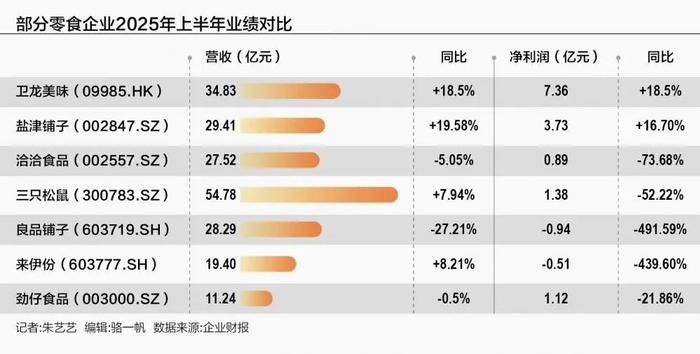
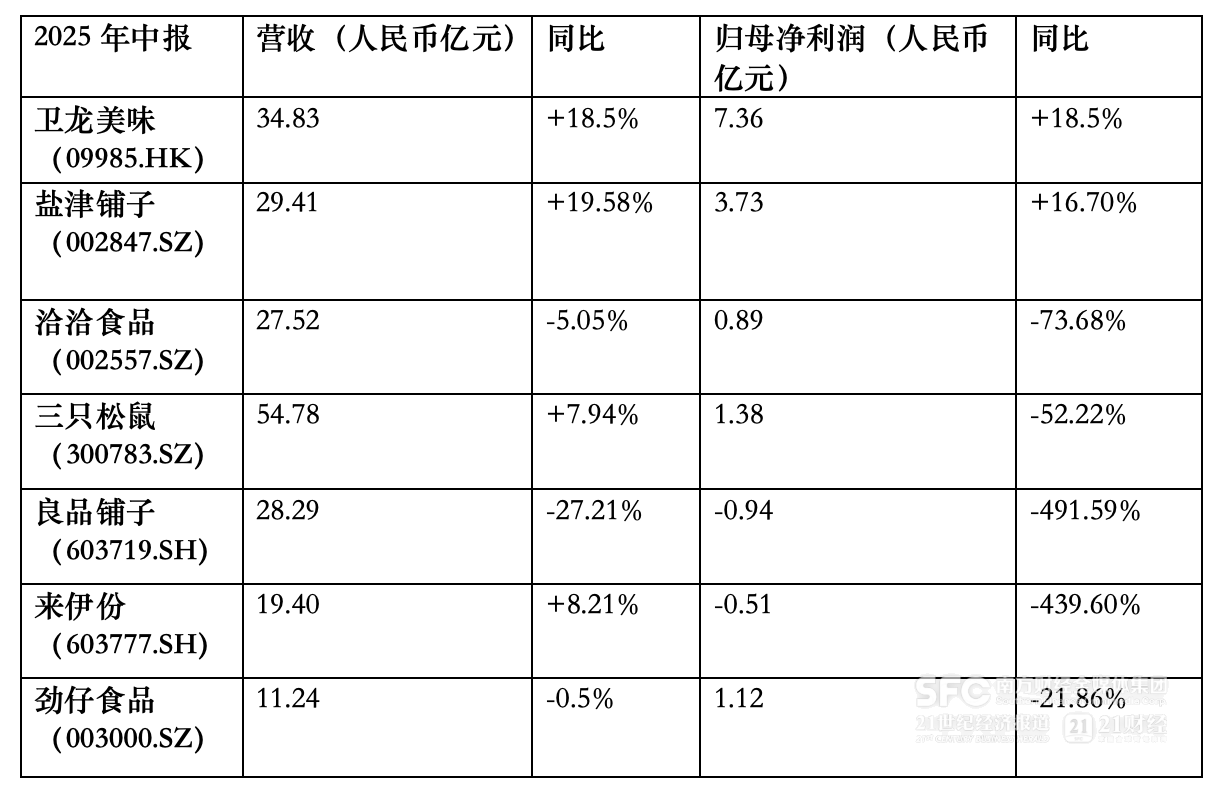
Group 1: Industry Overview - Konjac, known as "human cat strips," is becoming a phenomenon in the snack food market, attracting significant attention from various companies [1][5] - The konjac food industry has experienced a compound annual growth rate of 20% over the past decade, with the market size expected to reach 26.9 billion yuan in 2024 [5] - Major snack companies are increasingly entering the konjac segment, including Salted Fish Pouch, Wei Long, and Qiaqia Food, among others [1][6][7] Group 2: Company Performance - Salted Fish Pouch reported a revenue of 29.41 billion yuan in the first half of 2025, a year-on-year increase of 19.58%, with konjac snacks contributing 7.91 billion yuan, up 155.10% [6][7] - Wei Long's revenue reached 34.83 billion yuan in the first half of 2025, growing 18.5%, with konjac products driving a 44.3% increase in the vegetable product segment [5][6] - Qiaqia Food's revenue declined by 5.05% to 27.52 billion yuan in the first half of 2025, despite launching new konjac products [8] Group 3: Market Competition - The competition among snack companies is intensifying, with the number of stores for the "Ming Ming Very Busy" group surpassing 20,000 nationwide [3][10] - Companies are focusing on expanding their presence in snack retail channels, with Salted Fish Pouch emphasizing a strategy shift towards channel dominance [11][12] - Three Squirrels is also exploring opportunities in the konjac segment while investing in community snack stores to enhance competition [8][12][13]


零食巨头们,正纷纷押注“人类猫条”
21世纪经济报道· 2025-09-13 11:29
Core Viewpoint - The emergence of konjac as a phenomenon-level snack product is driving significant revenue growth for various snack companies, with notable contributions from brands like Salted Fish Pouch and Wei Long [1][4][5]. Group 1: Company Performance - Salted Fish Pouch's konjac snack brand "Da Mo Wang" generated revenue of 791 million yuan in the first half of 2025, a year-on-year increase of 155.10%, accounting for 26.90% of total revenue [1][6]. - Wei Long's konjac products "Mo Yu Shuang" and "Xiao Mo Nu" significantly boosted its vegetable product segment revenue by 44.3% to 2.109 billion yuan, representing 60.5% of total revenue in the first half of 2025 [5][6]. - The overall revenue for Wei Long reached 3.483 billion yuan, with a net profit of 736 million yuan, both reflecting an 18.5% year-on-year growth [2][5]. Group 2: Market Trends - The konjac food industry has experienced a compound annual growth rate of 20% over the past decade, with a projected market size of 26.9 billion yuan by 2024 [4]. - More than 30 companies, including Qiaqia Food, Three Squirrels, and Liangpinpuzi, are entering the konjac snack market, indicating a competitive landscape [6][8]. Group 3: Channel Expansion - The snack industry is witnessing intense competition in the retail channel, with the Mingming Hen Mang Group surpassing 20,000 stores nationwide, prompting companies to focus on snack retail channels [10][12]. - Salted Fish Pouch has shifted its strategy to prioritize channel development, with over 70% of its revenue coming from distribution channels, including snack retail and community group buying [10][12]. - Qiaqia Food reported a significant increase in revenue from snack retail channels, growing from approximately 5 million yuan in January 2023 to around 45 million yuan in April 2024 [11][12].
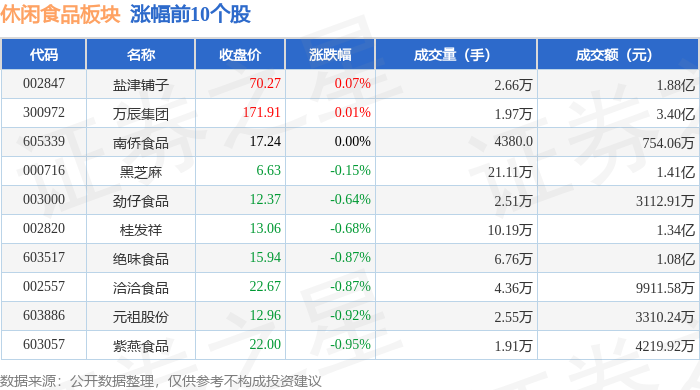
休闲食品板块9月12日跌1.33%,煌上煌领跌,主力资金净流出2.49亿元
Zheng Xing Xing Ye Ri Bao· 2025-09-12 08:31
证券之星消息,9月12日休闲食品板块较上一交易日下跌1.33%,煌上煌领跌。当日上证指数报收于 3883.69,上涨0.22%。深证成指报收于12996.38,上涨0.13%。休闲食品板块个股涨跌见下表: 从资金流向上来看,当日休闲食品板块主力资金净流出2.49亿元,游资资金净流入1.05亿元,散户资金净 流入1.44亿元。休闲食品板块个股资金流向见下表: | 代码 名称 | | 主力净流入 (元) | 主力净占比 游资净流入 (元) | | 游资净占比 散户净流入 (元) | | 散户净占比 | | --- | --- | --- | --- | --- | --- | --- | --- | | 300972 万辰集团 | | 1875.02万 | 4.01% | 2583.32万 | 5.52% | -4458.34万 | -9.53% | | 002847 | 盐津铺子 | 566.85万 | 2.24% | 635.39万 | 2.51% | -1202.24万 | -4.75% | | 002991 | 甘源食品 | 359.33万 | 4.59% | -17.98万 | -0.23% | -34 ...

押注魔芋大单品,扩张零食量贩店,“盐津铺子们”继续跑马圈地
2 1 Shi Ji Jing Ji Bao Dao· 2025-09-12 07:08
Core Viewpoint - Konjac, known as "human cat strips," is becoming a phenomenon in the snack food industry, with companies like Salted Fish Pouch and Wei Long capitalizing on this trend through their konjac product lines [1][4]. Company Performance - Salted Fish Pouch's konjac snack brand "Big Demon King" generated revenue of 791 million yuan in the first half of 2025, a year-on-year increase of 155.10%, contributing significantly to the company's total revenue of 2.941 billion yuan [1][12]. - Wei Long's konjac products "Konjac Shuang" and "Little Witch" drove a 44.3% increase in the vegetable products segment to 2.109 billion yuan, accounting for 60.5% of total revenue in the first half of 2025 [7][8]. - In the first half of 2025, Salted Fish Pouch reported total revenue of 2.941 billion yuan, up 19.58% year-on-year, with a net profit of 373 million yuan, an increase of 16.70% [12][18]. Market Trends - The konjac food industry has seen a compound annual growth rate of 20% over the past decade, with the market size expected to reach 26.9 billion yuan by 2024 [5]. - More than 30 companies, including Qiaqia Food and Three Squirrels, are entering the konjac snack market, indicating a competitive landscape [14]. Channel Development - The competition among snack companies is intensifying in the offline market, with the Mingming Busy Group surpassing 20,000 stores nationwide [3][19]. - Salted Fish Pouch has shifted its strategy to prioritize channel development, emphasizing the importance of distribution channels in its growth [19]. - Qiaqia Food has also increased its investment in emerging channels like snack wholesale stores and membership stores, reflecting a broader trend in the industry [20].
万辰利润暴涨背后:好想来的激进与加盟商的无奈
Xin Lang Cai Jing· 2025-09-12 04:15
Core Viewpoint - The rapid growth of Wancheng Group in the snack industry contrasts sharply with the declining performance of established brands, raising questions about sustainability and potential risks in its business model [1][26]. Financial Performance - In the first half of 2025, Wancheng Group reported revenue of 22.583 billion yuan, a year-on-year increase of 106.89%, and a net profit of 472 million yuan, a staggering increase of 50,358.80% [1][3]. - The significant profit surge is primarily attributed to the strong growth in the bulk snack business, which contributed 22.345 billion yuan in revenue, accounting for 98.95% of total revenue, with a year-on-year growth of 109.33% [3][6]. Business Model and Revenue Sources - The bulk snack business generates revenue mainly through three channels: wholesale supply to franchisees, store sales, and others. The majority of income comes from supplying products to franchisees, with 21.810 billion yuan in revenue from this channel, a year-on-year increase of 112.56% [6][8]. - As of June 2025, Wancheng Group had 15,400 stores, a net increase of 8,727 stores compared to the same period in 2024, representing a growth of 131.47% [8]. Franchisee Dynamics - Despite the growth in franchisee numbers, individual store revenue has declined, with average monthly revenue dropping from 32.20 million yuan in the first half of 2024 to 29.57 million yuan in the first half of 2025, a decrease of 8.16% [13]. - Franchisees face increasing pressure due to rising costs and declining revenues, with the initial investment for a store estimated at around 500,000 yuan, leading to a payback period of approximately 17 months under ideal conditions [16]. Market Competition - The snack market is becoming increasingly competitive, transitioning from a "blue ocean" to a "red ocean" environment, with intensified competition among existing players and new entrants [17][19]. - Wancheng's store expansion strategy has led to high regional concentration, particularly in East China, where over 56.80% of its stores are located, resulting in internal competition and diluted customer traffic [17]. Risks and Challenges - Wancheng Group faces significant risks, including food safety issues, high debt levels, and the potential for franchisee closures due to profitability challenges [22][24]. - The company's asset-liability ratio is projected to rise to 90.97% following a planned acquisition, indicating a precarious financial position that could exacerbate cash flow issues if revenues decline [24][26]. Conclusion - While Wancheng Group has achieved remarkable growth through its franchise model, the sustainability of this growth is under scrutiny due to market saturation, franchisee profitability challenges, and associated risks [26][27].

2025年1-4月全国农副食品加工业出口货值为705.1亿元,累计下滑3%
Chan Ye Xin Xi Wang· 2025-09-12 01:10
上市公司:黑芝麻(000716),双汇发展(000895),千味央厨(001215),青岛食品(001219),三 全食品(002216),得利斯(002330),金字火腿(002515),洽洽食品(002557),五芳斋 (603237),安井食品(603345),绝味食品(603517),惠发食品(603536),有友食品 (603697),良品铺子(603719),来伊份(603777),桃李面包(603866) 相关报告:智研咨询发布的《2025-2031年中国农副食品加工专用设备制造行业市场动态分析及发展前 景研判报告》 2019年-2025年1-4月全国农副食品加工业出口货值统计图 数据来源:国家统计局,智研咨询整理 知前沿,问智研。智研咨询是中国一流产业咨询机构,十数年持续深耕产业研究领域,提供深度产业研 究报告、商业计划书、可行性研究报告及定制服务等一站式产业咨询服务。专业的角度、品质化的服 务、敏锐的市场洞察力,专注于提供完善的产业解决方案,为您的投资决策赋能。 根据国家统计局数据可知:2025年4月全国农副食品加工业出口货值为179.2亿元,同比下降6%;2025 年1-4月全国农副食品加 ...

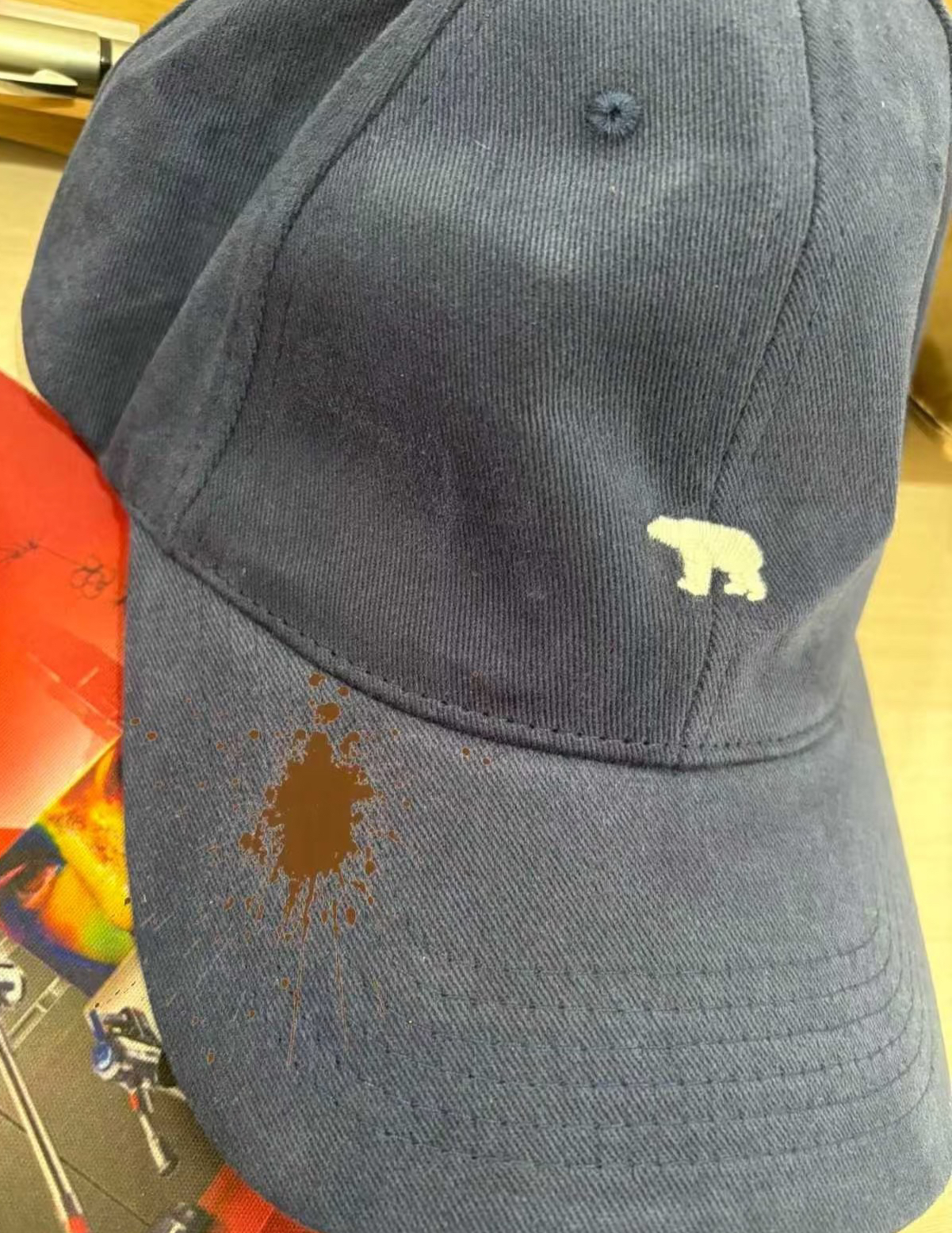
帽子被污损、水果变发霉……AI伪造图竟成骗取退款“神器”?
Qi Lu Wan Bao· 2025-09-11 14:27
Core Viewpoint - The rise of AI-generated fake images for refund claims has sparked significant discussion, highlighting the need for stricter regulations in the e-commerce sector to combat misuse of technology [1][10][12]. Group 1: AI Misuse in Refund Claims - Consumers are using AI tools to create fake images of product defects to claim refunds, leading to a phenomenon referred to as "refund神器" [1][10]. - Examples include AI-generated images of products with fabricated defects, such as a hat with a fake stain that appears too perfect [1][3]. - Some consumers have successfully used AI to generate images that lack clear watermarks, making it difficult for merchants to identify the fakes [9][11]. Group 2: Impact on Small Merchants - The majority of affected merchants are small businesses dealing with low-value items, making them more vulnerable to such fraudulent claims [10][11]. - The shift in e-commerce platforms' refund policies has led to an increase in refund requests without the need for returns, further complicating the situation for small merchants [10][12]. Group 3: Legal and Regulatory Developments - The introduction of the "Artificial Intelligence Generated Content Identification Measures" aims to address the misuse of AI in e-commerce by mandating clear labeling of AI-generated content [15]. - The new regulations focus on identifying what content is generated, who generated it, and how it was created, which is crucial for both merchants and consumers [15]. - Non-compliance with these regulations could result in severe penalties for service providers and platforms, including fines and license revocation [15].
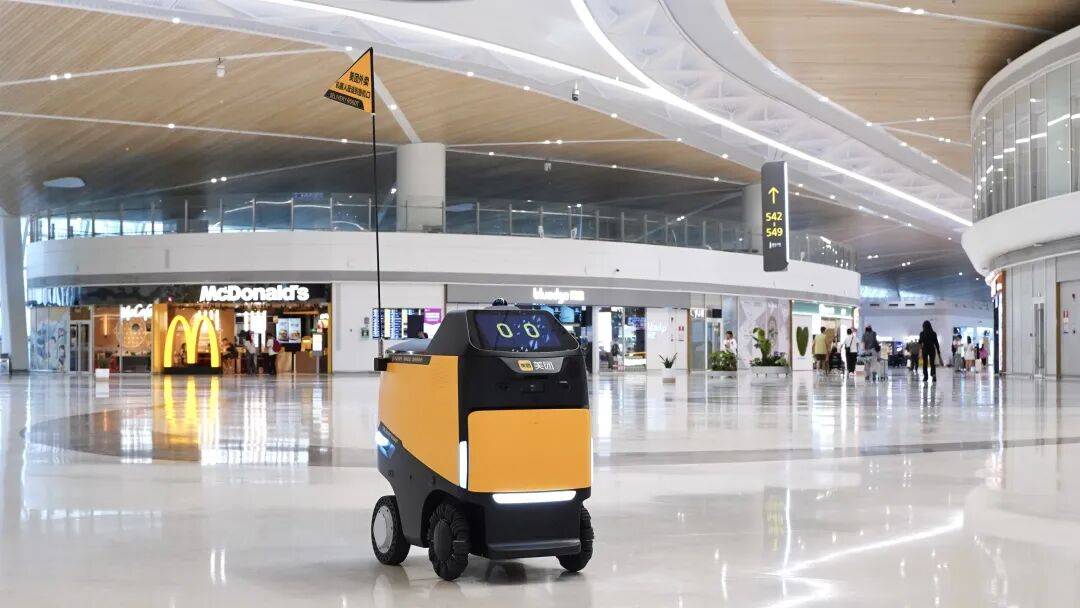
机器人送餐!在深圳机场点外卖太酷!
Sou Hu Cai Jing· 2025-09-11 12:12
Core Viewpoint - Shenzhen Airport has launched an intelligent food delivery service in collaboration with Meituan, utilizing the "Little Bumblebee" delivery robot to enhance convenience for travelers [1][3]. Group 1: Service Launch and Features - This marks Meituan's first integration of airport scenarios into its delivery service, as well as the debut of the "Little Bumblebee" robot in large transportation hubs [3]. - The service upgrade includes a more convenient ordering process via the Meituan app, allowing travelers to select restaurants and items for delivery to any boarding gate in the satellite hall [3]. - A total of 11 restaurants in the satellite hall are currently available for delivery through the Meituan app, including major brands like Starbucks, KFC, and Heineken, with plans to introduce more brands in the future [3]. Group 2: Customer Experience - Travelers can now order food from the comfort of their boarding gate, eliminating the need to rush to restaurants and potentially miss flights [6]. - The delivery robot is designed to navigate efficiently, being capable of familiar routes, using elevators, and passing through gates, ensuring timely delivery of food [3].